Q.a. i) What are conformers? Draw the Newman projection of ethane molecule.
You're viewing a preview — the full solution, concept, methods & PYQ mapping are locked.
Start your 14-day free trial to unlock the full solution →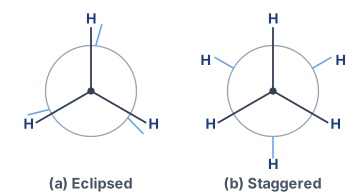
Conformers = rotamers about a C–C single bond (ethane: staggered most stable, eclipsed least). Markovnikov: X→carbon with fewer H; anti-Markovnikov (peroxide, HBr only): Br→carbon with more H.
i) Conformers: different spatial (three-dimensional) arrangements of the atoms of a molecule that arise purely from rotation about a C–C single bond, and which are freely interconvertible into one another without breaking any bonds.
Newman projection of ethane (described): viewed along the C1–C2 axis, the front carbon is represented by a dot with three bonds (to its three H atoms) radiating out at 120° to each other; the back carbon is represented by a circle, with its three C–H bonds shown as short lines emerging from behind the circle's edge.
- Staggered conformation (most stable, lowest energy): the three back C–H bonds are positioned exactly between the three front C–H bonds (offset by 60°), minimizing electron-pair (torsional) repulsion.
- Eclipsed conformation (least stable, highest energy): the three back C–H bonds lie directly behind the three front C–H bonds (0° offset, drawn slightly rotated for visual clarity), maximizing torsional strain.
ii) Markovnikov's rule: when a protic acid adds to an unsymmetrical alkene, the negative part () of the reagent attaches to the carbon atom bearing the fewer hydrogen atoms (equivalently, H adds to the carbon already richer in hydrogens), because this pathway proceeds via the more stable carbocation intermediate.
…
Unlock everything free for 14 days
- Full step-by-step solutions
- Concept-first explanations
- Methods, shortcuts & mistakes
- PYQ mapping + timed mock tests
Full access for 14 days. No credit card required.