Q.(a) Discuss the oxidation states of first row transition elements. [3]
You're viewing a preview — the full solution, concept, methods & PYQ mapping are locked.
Start your 14-day free trial to unlock the full solution →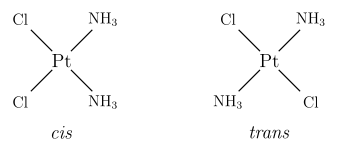
Transition metals show many oxidation states because both their outer s- and inner d-electrons are close in energy and can be lost/shared in bonding; lanthanide contraction is the gradual shrinkage of 4f-element radii across the series, which makes second- and third-row transition congeners nearly identical in size. [OR: [Co(NH3)6]3+ uses d2sp3 (inner-orbital) hybridisation per VBT, and square-planar [Pt(NH3)2Cl2] exists as cis (adjacent Cl's) and trans (opposite Cl's) geometrical isomers.]
(a) Oxidation states of first-row transition elements:
Unlike the main-group elements, transition elements show a wide range of oxidation states because the energies of the (n-1)d and ns orbitals are very close, so electrons from both subshells can participate in bond formation, not just the outermost s-electrons.
- Nearly all first-row transition elements show a +2 oxidation state (from loss of the two 4s electrons), and most also show +3.
- The number of oxidation states shown by an element tends to increase on going from Sc to Mn (as more d-electrons become available to also be involved) and then decreases from Fe to Zn (as the d-orbitals fill up and the electrons become more tightly bound/less available).
- The maximum oxidation state shown by any first-row transition element is +7, exhibited by manganese (Mn), corresponding to the loss of all 2(4s) + 5(3d) = 7 valence electrons (as seen in MnO4-, the permanganate ion).
- Compounds in the higher oxidation states tend to be more covalent and oxidising (e.g., MnO4- is a strong oxidising agent), while lower oxidation states (+2) tend to be more ionic.
(b) Lanthanide contraction:
As we move across the lanthanide series (Ce to Lu, filling the 4f subshell), there is a steady and regular decrease in the atomic and ionic (M3+) radii of the elements. This is called lanthanide contraction.
Cause: the 4f electrons being added have very poor shielding ability (poor screening of the nuclear charge) compared to electrons in s, p, or d orbitals, because the diffuse, complex shape of f-orbitals gives them a low shielding effect on outer electrons. So, as the nuclear charge (Z) increases by 1 unit across the series, the poorly-shielded increase in effective nuclear charge pulls the outer electron shells inward more than expected, causing a small but cumulative contraction in size at each step.
Two consequences of lanthanide contraction:
- It causes the second-row (4d) and third-row (5d) transition elements of the same group to have almost identical atomic/ionic radii (e.g., Zr and Hf; Nb and Ta; Mo and W) — because the expected size increase on going down a group from the 4d to 5d series is almost exactly cancelled out by the intervening lanthanide contraction. This makes these pairs of elements very difficult to separate chemically, since their chemical properties are also nearly identical as a result.
- It causes a steady decrease in the basic character of the lanthanide hydroxides, M(OH)3, from La(OH)3 (most basic) to Lu(OH)3 (least basic), as the decreasing ionic radius across the series increases the covalent character (and hence decreases the ionic/basic character) of the M-OH bond.
--- OR ---
(a) Structure of [Co(NH3)6]3+ (Valence Bond Theory): …
Unlock everything free for 14 days
- Full step-by-step solutions
- Concept-first explanations
- Methods, shortcuts & mistakes
- PYQ mapping + timed mock tests
Full access for 14 days. No credit card required.