Skip to content
← Physics

Physics · Class 12 Science

Odisha Chse Class 12 Physics — Real Previous-Year Papers

with complete answers

Real previous-year board papers, year by year — the official exam pattern, the full question paper, and every question solved the concept-first way. Distinct from the chapter-wise textbook bank.

2018–2026
Years of papers
7
Total Papers
7
Real Board Papers
0
Sample papers
295
Real-paper Q & A
0
Sample-paper Q & A

Real board-paper questions available, by year

50 Q2026complete
—2025Paper not available
39 Q2024complete
39 Q2023complete
—2022Paper not available
—2021Exam cancelled (COVID-19)
39 Q2020complete
—2019Paper not available
39 Q2018complete

2025 — Paper not available: We publish a CHSE Odisha +2 Science board question paper only after verifying it against a genuine printed original. No such verified paper is available for this year from the sources we check, so we show none rather than an unconfirmed copy.

2022 — Paper not available: We publish a CHSE Odisha +2 Science board question paper only after verifying it against a genuine printed original. No such verified paper is available for this year from the sources we check, so we show none rather than an unconfirmed copy.

2021 — Exam cancelled (COVID-19): The Council of Higher Secondary Education, Odisha (CHSE) cancelled the +2 Science Class-12 board exam for this year statewide due to COVID-19; no annual question paper was ever conducted or printed, so none exists to publish.

2019 — Paper not available: We publish a CHSE Odisha +2 Science board question paper only after verifying it against a genuine printed original. No such verified paper is available for this year from the sources we check, so we show none rather than an unconfirmed copy.

Odisha CHSE +2 Science Board Exam 2026 · Set ANNUAL

Real board examination

About this paper

The real Class-12 board examination held in 2026. Every question below is solved the concept-first way. Sample papers are labelled honestly — never shown as a past exam.

Total marks
70
Questions
37
Duration
180 min
Sections
4

The marks / questions / duration above are the official exam pattern. We currently have 50 of this paper’s questions (135% of the full paper), with 50 fully solved. Questions we couldn’t yet extract or verify are held — never shown as complete.

Sections & marks

SectionTypeQuestionsMarks eachTotal
ASection AObjective (MCQ) -- all compulsory, 1 mark each20120
BSection BShort answer -- answer any 7 of 12 printed, 2 marks each7214
CSection CShort answer -- answer any 7 of 12 printed, 3 marks each7321
DSection DLong answer -- answer any 3 of 6 printed, 5 marks each3515
Total3770

The question paper

The questions we hold for this paper, laid out by section. Solutions are on the Answers tab.

Board Examination

Physics

Odisha CHSE +2 Science Board Exam 2026 · Set ANNUAL

Series/Set: ANNUALRoll No. ________
Time Allowed: 3 hoursMaximum Marks: 70

General Instructions

  1. This question paper contains 37 questions divided into 4 sections — A, B, C, D.
  2. Section A comprises 20 questions of 1 mark each (Objective (MCQ) -- all compulsory, 1 mark each).
  3. Section B comprises 7 questions of 2 marks each (Short answer -- answer any 7 of 12 printed, 2 marks each).
  4. Section C comprises 7 questions of 3 marks each (Short answer -- answer any 7 of 12 printed, 3 marks each).
  5. Section D comprises 3 questions of 5 marks each (Long answer -- answer any 3 of 6 printed, 5 marks each).

Above is the official exam pattern. The questions printed below are those we currently hold for this paper.

Section A

Objective (MCQ) -- all compulsory, 1 mark each · 1 mark each · 20 of 20 shown

Q1.
Two spheres carrying charges +6 μC and +9 μC, separated by a distance d, experience a force of repulsion F. When a charge of −3 μC is added to each sphere and distance d is kept the same, the new force of repulsion will be
  • (a) 3F
  • (b) F/9
  • (c) F
  • (d) F/3
[1]
Q2.
Electric flux is a
  • (a) scalar quantity
  • (b) vector quantity
  • (c) scalar or vector quantity
  • (d) constant quantity
[1]
Q3.
Equal charges are given to two spheres of different radii. Then the electric potential will
  • (a) be more on the bigger sphere
  • (b) be more on the smaller sphere
  • (c) be equal on both the spheres
  • (d) depend on the nature of the materials of the spheres
[1]
Q4.
Two wires that are made up of two different materials have specific resistances in the ratio 2:3, lengths 3:4 and areas 4:5. The ratio of their resistances is
  • (a) 6:5
  • (b) 6:8
  • (c) 5:8
  • (d) 1:2
[1]
Q5.
There are n resistors each of resistance R. When they are connected in parallel, the equivalent resistance is x. If they are connected in series, the equivalent resistance will be
  • (a) x/n^2
  • (b) n^2 x
  • (c) x/n
  • (d) nx
[1]
Q6.
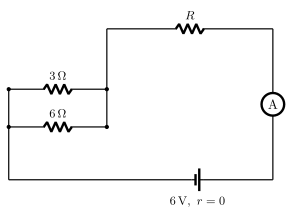
If the ammeter in the given circuit reads 2 amperes, the resistance R is
  • (a) 1 ohm
  • (b) 2 ohms
  • (c) 3 ohms
  • (d) 4 ohms A circuit with a 3 ohm and 6 ohm resistor in parallel, in series with a resistor R, an ammeter, and a 6 V cell — Odisha Class 12 Physics ammeter-reading question
[1]
Page 1 of 8
Q7.
Five cells, each of e.m.f. 0.2 volt and internal resistance 1 Ω, are connected in series to an external resistance of 10 Ω. The current through the 10 Ω resistor is (a) 1/2.5 A (b) 1/10 A (c) 1/15 A (d) 1/2 A
[1]
Q8.
An arc of a circle of radius R subtends an angle π/2 at the centre. It carries a current i. The magnetic induction at the centre will be (a) μ0 i / 2R (b) μ0 i / 8R (c) μ0 i / 4R (d) 2μ0 i / 5R
[1]
Q9.
If vector m be the magnetic moment of a magnetic dipole placed in a magnetic field of induction vector B, the torque experienced by the dipole will be (a) m . B (b) |m| / |B| (c) m x B (d) |m| |B|
[1]
Q10.
Two coils A (primary) and B (secondary) have mutual inductance 2 x 10^-2 henry. If the current in the primary is i = 5 sin(10πt), then the maximum value of e.m.f. induced in coil B is (a) π volt (b) π/2 volt (c) π/3 volt (d) π/4 volt
[1]
Q11.
When the current changes from +2 A to −2 A in 0.05 second in a coil, an e.m.f. of 8 V is induced in it. The coefficient of self-induction of the coil is (a) 0.1 henry (b) 0.2 henry (c) 0.4 henry (d) 0.8 henry
[1]
Q12.
An ideal transformer has 500 turns in the primary and 5000 turns in the secondary. If the primary be connected to a 6 V battery, then the secondary voltage is (a) 0 (b) 0.6 V (c) 60 V (d) 6 V
[1]
Q13.
A diminished virtual image can be formed only in (a) a plane mirror (b) a concave mirror (c) a convex mirror (d) a concave-parabolic mirror
[1]
Q14.
The refractive indices of glass and water with respect to air are 3/2 and 4/3, respectively. The refractive index of glass w.r.t. water will be (a) 8/9 (b) 9/8 (c) 7/6 (d) 6/7
[1]
Q15.
An astronomical telescope focussed to infinity has objective lens and eyepiece lens of powers 0.5 diopter and 20 diopter, respectively. Its magnifying power will be (a) 8 (b) 20 (c) 30 (d) 40
[1]
Page 2 of 8
Q16.
If alpha particle, proton and electron move with the same momentum, then their respective de Broglie wavelengths λα, λp, λe are related as (a) λα > λp > λe (b) λα < λp < λe (c) λα = λp = λe (d) None of the above
[1]
Q17.
When light falls on a metal surface, the maximum kinetic energy of the emitted electrons depends upon (a) the time for which light falls on the metal (b) the frequency of the incident light (c) the intensity of the incident light (d) the velocity of the incident light
[1]
Q18.
If the first Bohr radius of hydrogen atom be R, then the radius of the third orbit is (a) 9R (b) R/3 (c) 3R (d) R/9
[1]
Q19.
As compared to 12C atom, 14C atom has (a) two extra protons and two extra electrons (b) two extra protons but no extra electrons (c) two extra neutrons and no extra electrons (d) two extra neutrons and two extra electrons
[1]
Q20.
When a semiconductor is heated, its resistance (a) decreases (b) increases (c) remains unchanged (d) is uncertain
[1]
Section B

Short answer -- answer any 7 of 12 printed, 2 marks each · 2 marks each · 12 of 7 shown

Q1.
State Coulomb's law between two point charges.
[2]
Q2.
Find the equivalent capacitance of four capacitors, each having a capacitance of 1 μF, that are placed in series.
[2]
Q3.
Write the relation among e.m.f., internal resistance and terminal potential difference of a cell.
[2]
Page 3 of 8
Q4.
Write the expression for the force on a moving charge in uniform magnetic and electric fields.
[2]
Q5.
If the peak value of an alternating e.m.f. is E0 volt, what is its r.m.s. value?
[2]
Q6.
What is the phenomenon by which light is transmitted through optical fibres? Draw the figure.
[2]
Q7.
Two thin convex lenses have focal lengths 20 cm each. If they are kept in contact, calculate the equivalent focal length and power of the combination.
[2]
Q8.
Write Einstein's photoelectric equation and explain the symbols in it.
[2]
Q9.
From Rutherford's alpha particle scattering by thin gold foil experiment, what conclusion regarding atom was made?
[2]
Q10.
Draw the circuit diagram to show the use of junction diode as a half-wave rectifier. (No description is required)
[2]
Q11.
Calculate fringe width when the separation between the two slits is 0.2 mm, wavelength is 6000 Å, distance between the slits and screen is 1 metre.
[2]
Q12.
How is n-type semiconductor prepared out of pure germanium?
[2]
Page 4 of 8
Section C

Short answer -- answer any 7 of 12 printed, 3 marks each · 3 marks each · 12 of 7 shown

Q1.
Three charges +q each are placed at the corners A, B, C of a square ABCD of side length a. Find the electric potential at D.
[3]
Q2.
Apply Gauss theorem to find an expression for electric field intensity near an infinitely large plane sheet uniformly charged on one side only.
[3]
Q3.
Two resistors when connected in series have an equivalent resistance of 18 Ω. When they are connected in parallel, the equivalent resistance becomes 4 Ω. Find the resistances.
[3]
Q4.
Write Biot-Savart law in vector form. Apply it to find magnetic induction at the centre of a circular coil having N turns, each of radius a, carrying a current I in it.
[3]
Q5.
Explain the meaning of wattless current. Give two examples of circuits where it is possible approximately.
[3]
Q6.
Arrange the following waves in increasing order of wavelengths: Visible light, X-rays, ultraviolet, gamma rays, infrared, radio waves, microwaves.
[3]
Page 5 of 8
Q7.
Establish the relation between radius of curvature and focal length of a concave mirror.
[3]
Q8.
Calculate the focal length of a double-convex thin lens made of glass of refractive index 1.5, when the radii of curvature are 20 cm each.
[3]
Q9.
Define mass defect and binding energy of a nucleus. How are they related?
[3]
Q10.
Define 'energy gap'. What are its values for good conductors, semiconductors and insulators?
[3]
Q11.
Explain the meaning of 'nuclear fission' and give an example.
[3]
Q12.
Write two differences between diamagnetic and paramagnetic substances.
[3]
Page 6 of 8
Section D

Long answer -- answer any 3 of 6 printed, 5 marks each · 5 marks each · 6 of 3 shown

Q1.
Define electric dipole moment. Derive an expression for electric field intensity at a point on the perpendicular bisector of the line joining the two charges of the electric dipole. (1+4)
[5]
Q2.
State two Kirchhoff's rules. Apply them to find the condition of balance of a Wheatstone's bridge. (1/2+1/2+4)
[5]
Q3.
If an alternating e.m.f. E = E0 sin ωt be used in series with a circuit having inductor, capacitor and resistor in series, derive the expressions for the magnitude and phase of the current.
[5]
Q4.
With the help of a ray diagram, derive an expression for the magnifying power of a compound microscope. (2+3)
[5]
Page 7 of 8
Q5.
Using Bohr model of hydrogen atom, derive the expressions for — (a) radius of the nth orbit of the electron; (b) energy of the electron in the nth orbit. (2½+2½)
[5]
Q6.
When three capacitors are connected in (a) series and (b) parallel, derive the expressions for the equivalent capacitances. (2½+2½)
[5]
Page 8 of 8