Q.What is an inducible operon? Name the genes that constitute an operon. Explain the lac operon of E.Coli with help of schematic representation. OR
You're viewing a preview — the full solution, concept, methods & PYQ mapping are locked.
Start your 14-day free trial to unlock the full solution →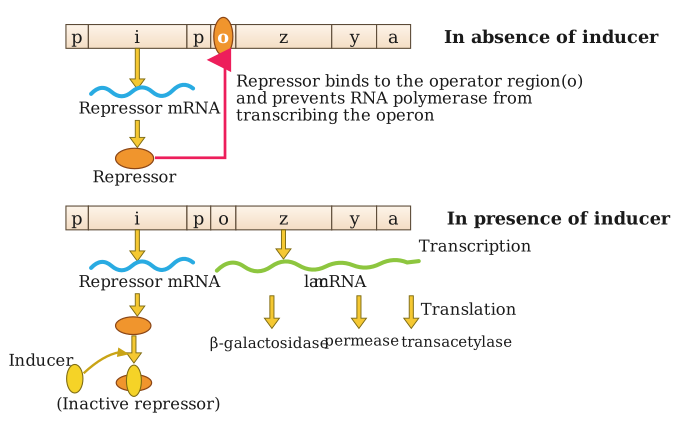
An inducible operon turns its genes on only when the substrate (inducer) is present; the lac operon of E. coli is the textbook example, switched on by lactose.
Inducible operon: In an inducible operon system, the structural genes remain OFF (not transcribed) by default because a repressor protein binds the operator and blocks RNA polymerase. Transcription is switched ON only when a specific small molecule, the inducer, is present -- the inducer binds and inactivates the repressor, allowing transcription to proceed. (This is the opposite of a repressible operon, which is normally ON and is switched off by a co-repressor.)
Genes/elements that constitute an operon:
- Regulatory gene (i): codes for the repressor protein.
- Promoter (p): the RNA-polymerase binding site.
- Operator (o): the region the repressor binds to, controlling transcription of the structural genes.
- Structural gene(s): the gene(s) actually coding for the functional enzymes/proteins.
The lac operon of E. coli:
The lac (lactose) operon has three structural genes -- z (codes for beta-galactosidase, which hydrolyses lactose into glucose and galactose), y (codes for permease, which increases cell permeability to allow lactose entry), and a (codes for transacetylase) -- along with the regulatory gene i, promoter p, and operator o.
- In the absence of lactose: the i gene continuously produces an active repressor protein, which binds tightly to the operator (o), physically blocking RNA polymerase from transcribing the structural genes z, y, a. The operon is OFF. …
Unlock everything free for 14 days
- Full step-by-step solutions
- Concept-first explanations
- Methods, shortcuts & mistakes
- PYQ mapping + timed mock tests
Full access for 14 days. No credit card required.