Q.(a) What is the least distance of distinct vision for normal eye ?
You're viewing a preview — the full solution, concept, methods & PYQ mapping are locked.
Start your 14-day free trial to unlock the full solution →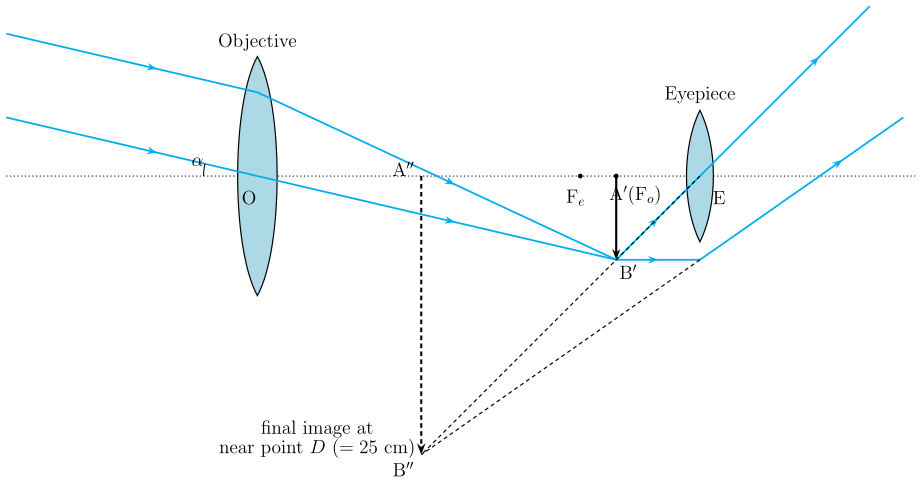
(a) The standard near point of a normal human eye is 25 cm. (b) For a telescope focused so the final image forms at this near point, the magnifying power picks up an extra factor beyond the normal-adjustment value .
(a) Least distance of distinct vision:
For a normal (unaided) human eye, the closest point at which an object can be seen clearly and distinctly, without eye strain, is conventionally taken as .
(b) Astronomical telescope — image at least distance of distinct vision:
An astronomical (refracting) telescope has an objective lens of large focal length and large aperture, and an eyepiece of small focal length .
Ray diagram / image formation: parallel rays from a distant astronomical object are focused by the objective lens at its focal plane, forming a real, inverted, diminished image. This image acts as the object for the eyepiece. When the eyepiece is adjusted so that this intermediate image lies between the eyepiece and its focus, the eyepiece forms a further virtual, magnified image at the desired distance — here, at the least distance of distinct vision, , from the eyepiece, so that it can be viewed comfortably by the eye without strain.
…
Unlock everything free for 14 days
- Full step-by-step solutions
- Concept-first explanations
- Methods, shortcuts & mistakes
- PYQ mapping + timed mock tests
Full access for 14 days. No credit card required.