Q.Draw the molecular orbital diagram of the O2 molecule and, on this basis, explain its bond order and magnetic nature. OR What is meant by a hydrogen bond and how many types are there? Explain with examples.
You're viewing a preview — the full solution, concept, methods & PYQ mapping are locked.
Start your 14-day free trial to unlock the full solution →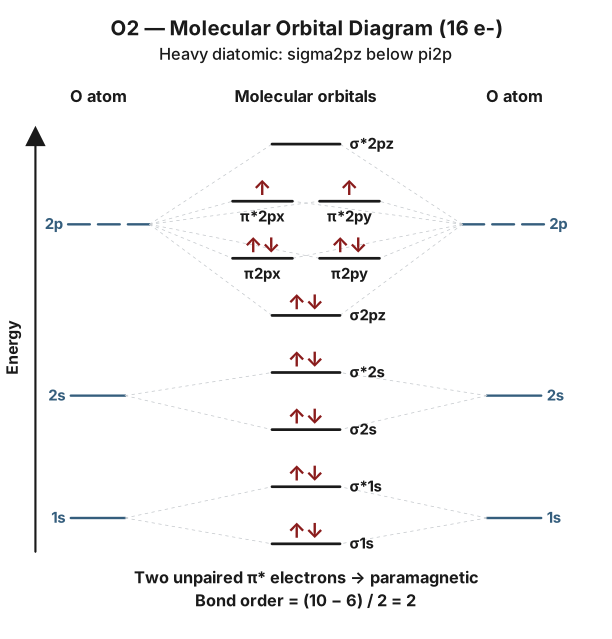
The molecular orbital diagram of O2 correctly predicts both its bond order (2) and its paramagnetism (2 unpaired electrons) — something the simple Lewis/VBT picture of O2 fails to explain.
O2 has 16 electrons total (8 from each O atom). Filling the molecular orbitals in their standard energy order for O2 (which, unlike B2, C2, N2, does not need the σ2p/π2p reordering) gives the configuration:
σ1s2 σ1s2 σ2s2 σ2s2 σ2pz2 π2px2 = π2py2 π2px1 = π2py1
The two innermost 1s-derived MOs (σ1s, σ*1s) come from core electrons and contribute equally to bonding and antibonding character, effectively cancelling out, so they are typically excluded from the valence bond-order calculation.
Counting only the valence (n=2) MOs:
- Bonding electrons: σ2s(2) + σ2pz(2) + π2px(2) + π2py(2) = 8
- Antibonding electrons: σ2s(2) + π2px(1) + π*2py(1) = 4
Bond order = (Nbonding − Nantibonding)/2 = (8 − 4)/2 = 2, consistent with the O=O double bond.
…
Unlock everything free for 14 days
- Full step-by-step solutions
- Concept-first explanations
- Methods, shortcuts & mistakes
- PYQ mapping + timed mock tests
Full access for 14 days. No credit card required.