Q.Write down Stokes' law. Using this law find the expression for the terminal velocity of a body falling freely in an infinitely extended homogeneous liquid. Also draw the variation graph of terminal velocity with time. OR Define angle of contact and capillary action. Find the relation between surface tension and the angle of contact for a liquid rising in a column. Also give any two examples of capillarity in daily life.
You're viewing a preview — the full solution, concept, methods & PYQ mapping are locked.
Start your 14-day free trial to unlock the full solution →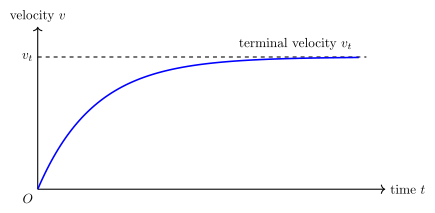
Balancing weight against buoyancy and Stokes' viscous drag gives the terminal velocity .
(This question offered an OR alternative on capillarity; answering the primary part on Stokes' law and terminal velocity below.)
Stokes' Law: when a small sphere of radius moves with speed through a viscous fluid of coefficient of viscosity , at low speed (streamline/laminar flow), the fluid exerts a retarding (viscous drag) force on it given by
Deriving terminal velocity: consider a small sphere of density and radius released from rest in a fluid (density , viscosity ) that extends indefinitely in all directions. Three forces act on it as it falls:
- Weight (downward):
- Buoyant force (upward, by Archimedes' principle):
- Viscous drag (upward, opposing motion, by Stokes' law):
Initially the sphere accelerates downward (weight exceeds buoyancy + drag), but as its speed increases, the drag force grows. Eventually the net force becomes zero, and the sphere moves with a constant maximum speed called the terminal velocity . At this point:
…
Unlock everything free for 14 days
- Full step-by-step solutions
- Concept-first explanations
- Methods, shortcuts & mistakes
- PYQ mapping + timed mock tests
Full access for 14 days. No credit card required.