Q.Write the statement of the theorem of parallel axes and prove it. Draw the necessary diagram. OR Derive the expression for the position coordinates of the centre of mass of a system of two particles.
You're viewing a preview — the full solution, concept, methods & PYQ mapping are locked.
Start your 14-day free trial to unlock the full solution →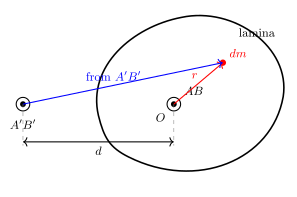
Parallel axis theorem: I = I_cm + Md^2 - the moment of inertia about any axis equals the moment of inertia about a parallel axis through the centre of mass, plus Md^2.
Statement: The moment of inertia of a rigid body about any axis is equal to its moment of inertia about a parallel axis passing through its centre of mass, plus the product of the mass of the body and the square of the perpendicular distance between the two axes:
I = I_cm + M*d^2
[Diagram description: a flat rigid lamina lying in the xy-plane, with the z-axis (AB) passing through its centre of mass O perpendicular to the plane, and a second, parallel axis (A'B') also perpendicular to the plane but passing through a point at distance d from O. A mass element dm is shown at position (x, y) with its perpendicular distance r from AB and its distance from A'B' marked. No source figure was supplied for this item, so the construction is described here in words.]
Proof: Take the axis through the centre of mass (CM) as the z-axis, so any mass element dm at position (x, y) in the body has coordinates measured from the CM, meaning the integral of xdm over the body is 0 and the integral of ydm is 0 (definition of centre of mass). Its distance from this CM axis is r = sqrt(x^2+y^2), so:
I_cm = integral of r^2*dm = integral of (x^2+y^2)*dm
…
Unlock everything free for 14 days
- Full step-by-step solutions
- Concept-first explanations
- Methods, shortcuts & mistakes
- PYQ mapping + timed mock tests
Full access for 14 days. No credit card required.