Question of 115
Q.(a) Define electrode potential.
(b) Draw a labelled diagram of fuel cell.
(c) Solution of CuSO4 was electrolysed with a current of one ampere for 15 minutes. Calculate the mass of copper deposited at the cathode. (Given: 1F = 96500 C mol^-1) [1+1+2=4]
OR
(a) Define cell potential.
(b) Draw a labelled diagram of standard hydrogen electrode.
(c) The conductivity of 0.100 M KCl solution at 298 K is 0.0129 S cm^-1. Calculate the molar conductivity of 0.100 M KCl solution.
Rajasthan RbseRajasthan Board Senior Secondary Examination 2026Subjective· 4mImportance★★★★★
0% · 0/115 Questions
You're viewing a preview — the full solution, concept, methods & PYQ mapping are locked.
Start your 14-day free trial to unlock the full solution →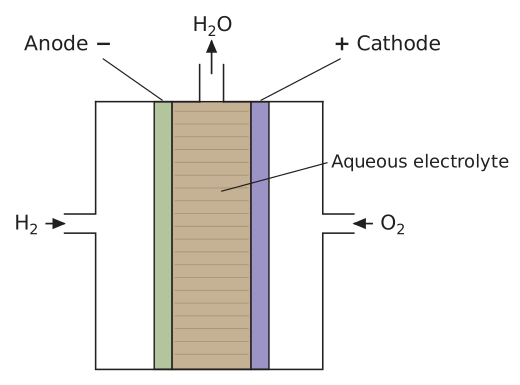
Electrode potential is the tendency of an electrode (metal/ion) to gain or lose electrons relative to the solution it is in contact with; a hydrogen-oxygen fuel cell continuously converts the chemical energy of H2 and O2 into electricity; and the mass of copper deposited during electrolysis is found from Faraday's laws (Q = It, then n = Q/F, then moles Cu = n/2).
- Electrode potential is the potential difference set up between a metal electrode and the electrolyte solution in which it is dipped, arising from the tendency of the metal to lose electrons (oxidation) or the ions in solution to gain electrons (reduction) at that electrode.
- Labelled diagram of a H2-O2 fuel cell (described, since it is a drawing task):
- Two porous carbon (graphite) electrodes coated with catalyst (finely divided Pt/Pd), immersed in concentrated aqueous KOH (or NaOH) electrolyte, separated by a porous barrier/membrane.
- H2 gas is continuously bubbled/fed into one electrode (the anode, negative terminal): H2 + 2OH− -> 2H2O + 2e−
- O2 gas is continuously bubbled/fed into the other electrode (the cathode, positive terminal): O2 + 2H2O + 4e− -> 4OH−
- The two electrodes are connected via an external circuit (through a load/voltmeter) that carries the electron flow, and the product formed is water, which is drained/removed. …
Unlock everything free for 14 days
- Full step-by-step solutions
- Concept-first explanations
- Methods, shortcuts & mistakes
- PYQ mapping + timed mock tests
Full access for 14 days. No credit card required.