Q.A) Write chemical equation of Finkelstein reaction.
B) Why aryl halides are less reactive towards nucleophilic substitution reactions? Explain.
C) Arrange the following alkyl halides in increasing order of their reactivity towards SN2 reaction.
CH3-CH2-Cl, (CH3)2CH-Cl, (CH3)3C-Cl
D) Draw the orbital diagram of CH3Cl.
OR
A) Write chemical equation of Wurtz-Fittig reaction.
B) The reaction of alkyl chloride with aqueous KOH leads to the formation of alcohols but in presence of alcoholic KOH, alkenes are major products. Explain.
C) Arrange the following halogen derivatives in increasing order of their reactivity towards nucleophilic substitution reactions.
R-Cl, C6H5-Cl, C6H5-CH2-Cl
D) Draw a labelled diagram of laboratory method of preparation of chloroform.
You're viewing a preview — the full solution, concept, methods & PYQ mapping are locked.
Start your 14-day free trial to unlock the full solution →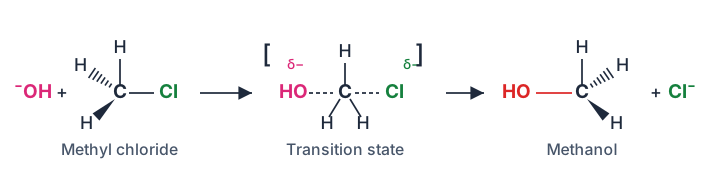
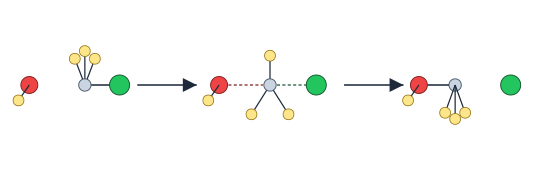
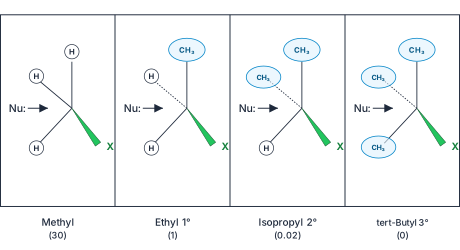
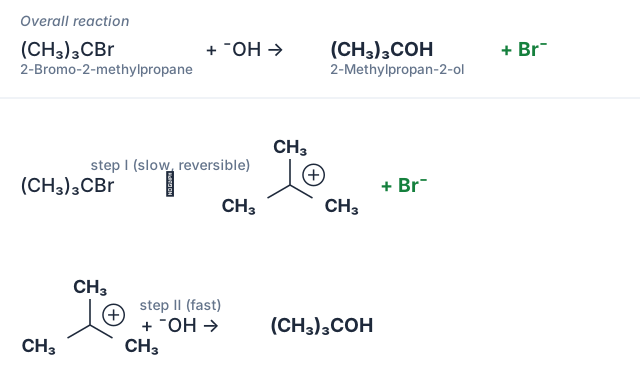
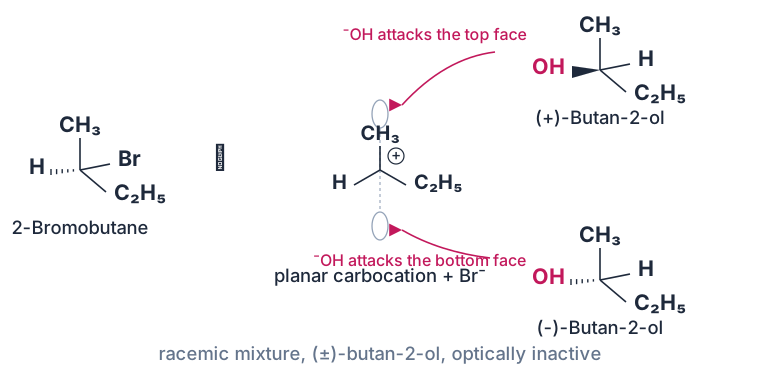
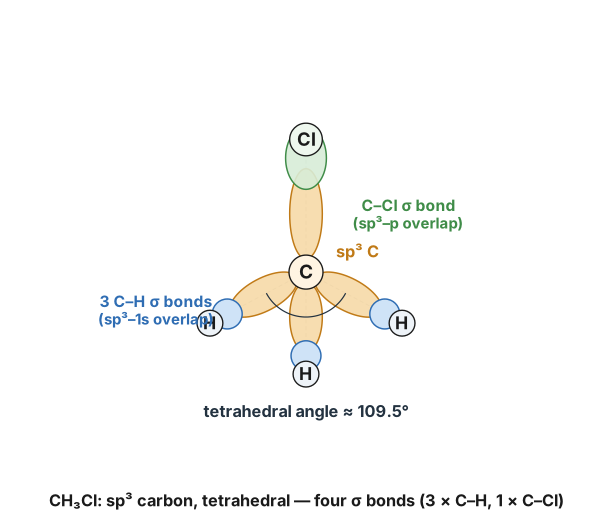
The Finkelstein reaction converts alkyl chlorides/bromides into alkyl iodides using NaI in dry acetone; aryl halides resist SN reactions because of C-X resonance strengthening; SN2 rate falls as the carbon becomes more substituted (more sterically hindered); and methyl chloride has a simple sp3 tetrahedral carbon skeleton.
A) Finkelstein reaction:
Alkyl chlorides or bromides are converted to alkyl iodides by treating them with sodium iodide dissolved in dry acetone:
R-Cl (or R-Br) + NaI --dry acetone--> R-I + NaCl (or NaBr) (down, precipitates)
NaI is soluble in dry acetone while NaCl/NaBr is not, so the precipitation of NaCl/NaBr drives the equilibrium forward (Le Chatelier), giving a good yield of the alkyl iodide.
B) Why aryl halides are less reactive towards nucleophilic substitution:
- Resonance: The lone pair on the halogen conjugates with the aromatic ring's pi-electron system, giving the C-X bond partial double-bond character. This makes the C-X bond shorter and stronger than a normal C-X single bond, so it resists being broken by an incoming nucleophile.
- Hybridisation of carbon: The carbon bonded to the halogen in an aryl halide is sp2 hybridised (versus sp3 in an alkyl halide); sp2 carbon is more electronegative and holds the shared (bonding) electrons - and hence the halogen - more tightly, strengthening the C-X bond further.
- Instability of the possible carbocation and steric/electronic blocking of backside attack (the electron-rich, planar ring repels an approaching nucleophile) also disfavour both SN1 and SN2 pathways at an aromatic carbon.
C) Reactivity order towards SN2 reaction:
The SN2 mechanism proceeds through a single transition state where the nucleophile attacks from the side opposite (backside of) the leaving group; increasing alkyl substitution around the carbon bearing the halogen increases steric hindrance to this backside attack, slowing the reaction. So SN2 reactivity decreases as we go from primary to tertiary halides:
Given: CH3-CH2-Cl (1 degree), (CH3)2CH-Cl (2 degree), (CH3)3C-Cl (3 degree)
Increasing order of SN2 reactivity: (CH3)3C-Cl < (CH3)2CH-Cl < CH3-CH2-Cl
D) Orbital (structure) diagram of CH3Cl: …
Unlock everything free for 14 days
- Full step-by-step solutions
- Concept-first explanations
- Methods, shortcuts & mistakes
- PYQ mapping + timed mock tests
Full access for 14 days. No credit card required.