A circle of radius r has area πr2. An ellipse is a circle that has been stretched by different amounts along two perpendicular directions, so it is natural to expect its area to be a stretched version of πr2. The standard ellipse centred at the origin is
a2x2+b2y2=1,
where a is the semi-major (or semi-minor) axis along x and b is the semi-axis along y. The result we want is beautifully simple:
Area of ellipse=πab
Notice that when a=b=r the ellipse becomes a circle and πab collapses to πr2 — a good sanity check.
Finding it by integration
Because the ellipse is symmetric about both axes, we compute the area of the piece in the first quadrant and multiply by 4. Solving the equation for the upper half gives
y=b1−a2x2=aba2−x2.
As x runs from 0 to a this traces the first-quadrant arc, so
Area=4∫0aaba2−x2dx.
The integral ∫0aa2−x2dx is the area of a quarter-circle of radius a, which equals 4πa2. (You may also get it from the standard result ∫a2−x2dx=2xa2−x2+2a2sin−1ax+C.) Therefore
Area=a4b⋅4πa2=πab.
The intuition
The factor ab in front is exactly the vertical stretch that turns a circle of radius a into this ellipse: it scales every height by b/a, and scaling all heights scales the area by the same ratio. Multiplying the circle's area πa2 by b/a gives πab. …
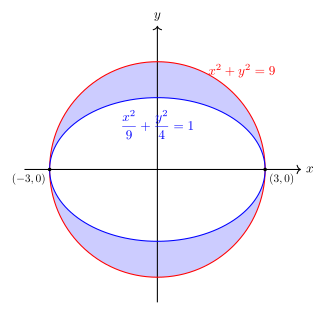
Figure — Circle x^2+y^2=9 (radius 3 centred at origin) with the ellipse x^2/9+y^2/4=1 drawn inside it, the tw
The ellipse 9x2+4y2=1 lies entirely inside the circle x2+y2=9 (touching only at (±3,0)), so the required area is (circle area) − (ellipse area) =9π−6π=3π.
First confirm the ellipse lies inside the circle: on the ellipse, y2=4(1−9x2), so x2+y2=x2+4−94x2=4+95x2, which for ∣x∣≤3 ranges from 4 (at x=0) to 9 (at x=±3) — always ≤9. So the entire ellipse lies within (or on) the circle of radius 3.