Q.If a metal rod of length l is placed normal to a uniform magnetic field (B) and moved with a velocity
You're viewing a preview — the full solution, concept, methods & PYQ mapping are locked.
Start your 14-day free trial to unlock the full solution →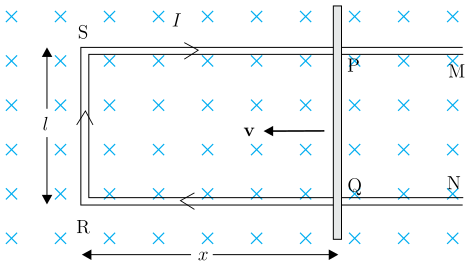
The free charge carriers inside a moving conducting rod experience a magnetic (Lorentz) force that pushes them to one end, building up a potential difference between the ends — this is the motional emf, equal to Blv.
Setup: A metal rod of length lies perpendicular to a uniform magnetic field (field into the page, say), and the rod is moved with velocity , also perpendicular to (and perpendicular to the rod), sliding along fixed rails.
(Diagram: a horizontal rod of length l lying across two parallel rails, magnetic field B directed into the plane of the page, rod moving with velocity v to the right, perpendicular to both B and its own length.)
Derivation: Consider a free electron (charge ) inside the rod, moving with the rod's velocity . It experiences a magnetic (Lorentz) force:
For , this force has magnitude and pushes the free charges along the length of the rod, accumulating positive charge at one end and negative at the other, until the resulting electrostatic field inside the rod balances the magnetic force.
…
Unlock everything free for 14 days
- Full step-by-step solutions
- Concept-first explanations
- Methods, shortcuts & mistakes
- PYQ mapping + timed mock tests
Full access for 14 days. No credit card required.