Q.Define power of a lens. Prove that the focal length of a spherical mirror is half of its radius of curvature. Draw necessary ray diagram. OR Define magnifying power. Obtain the formula for the magnifying power of a simple microscope, if the image is formed at the least distance of distinct vision (D). Draw necessary ray diagram.
🔒You're viewing a preview — the full solution, concept, methods & PYQ mapping are locked.
🔒 Start your 14-day free trial to unlock the full solution →Concept understanding — Spherical Mirror Equation
The Spherical Mirror Equation: From Intuition to Formula
Imagine you're standing in front of a concave mirror — the kind that makes your face look bigger when you're close, but flips everything upside down when you step far back. That change isn't magic; it's geometry. The spherical mirror equation is the single relationship that predicts exactly where an image will form, and whether it's real or virtual, for any spherical mirror.
The Core Idea
Every point on an object sends out light rays in all directions. A mirror redirects those rays. The mirror equation tells you: given the mirror's curvature and the object's distance, where will those rays meet again (or appear to meet)?
There are only three quantities you need:
- u — object distance (from the mirror's pole)
- v — image distance (from the mirror's pole)
- f — focal length (a property of the mirror's curvature)
The equation is:
v1+u1=f1
The power is in the sign convention, because every distance can point in one of two directions.
The Sign Convention (New Cartesian Sign Convention)
This is where most students slip. The equation works for all spherical mirrors — concave and convex — only if you follow the convention used throughout NCERT and CBSE:
- All distances are measured from the mirror's pole.
- The incident light is taken to travel left to right, so distances measured in that same direction (to the right) are positive, and distances measured against it (to the left) are negative.
- Heights above the principal axis are positive; heights below are negative.
Because a real object is always placed in front of the mirror (to the left, where the incident light originates), its distance u is always negative.
Under this convention, the focal length of a concave mirror is negative (its focus F sits in front of the mirror, on the same side as the object), and the focal length of a convex mirror is positive (its focus lies behind the mirror). This is one of the most frequently tested facts in CBSE board exams.
A very common mistake is writing f as positive for a concave mirror because "it converges light." Convergence tells you the type of mirror, not the sign — the sign comes purely from where the focus physically sits relative to the pole, under the convention above.
Where Does the Formula Come From?
For a concave mirror, parallel rays from a distant object converge at the focus, a point at (signed) distance f from the mirror. The derivation uses similar triangles from a ray diagram.
›Proof
Consider an object of height ho in front of a concave mirror. Draw the ray parallel to the axis: it reflects through the focus F. Draw the ray through the centre of curvature C: it strikes the mirror normally and reflects straight back on itself. These two reflected rays cross to form the image, of height hi.
From similar triangles formed by the ray through C:
hiho=R−vu−R
where R=2f is the radius of curvature (with the same sign convention as f).
From similar triangles formed by the ray through F:
hiho=fu−f
Equating the two ratios and simplifying (using R=2f) gives:
v1+u1=f1
What the Equation Tells You
Rearranging for v:
v=u−fuf
Because u is negative for a real object, and v takes the sign the geometry dictates:
- v negative → the image forms in front of the mirror → real image (can be projected on a screen).
- v positive → the image forms behind the mirror → virtual image.
For a concave mirror (f negative), using the magnitude of the object distance ∣u∣ measured from the pole:
- ∣u∣>2∣f∣ → real, inverted, diminished image between f and 2f
- ∣u∣=2∣f∣ → real, inverted, same-size image at 2f
- ∣f∣<∣u∣<2∣f∣ → real, inverted, magnified image beyond 2f
- ∣u∣=∣f∣ → image at infinity …
Why this formula?
Spherical Mirror Equation: Why the Formula Holds
The spherical mirror equation — also called the mirror formula — relates the object distance (u), image distance (v), and focal length (f) of a spherical mirror. Let's build the reasoning step by step.
1. The Key Formula
For a spherical mirror (concave or convex):
f1=u1+v1
Where:
- f = focal length (positive for concave, negative for convex)
- u = object distance from pole (always negative by sign convention)
- v = image distance from pole (sign depends on image location)
2. Why This Formula Holds — The Derivation
Step 1: Start with a ray diagram
Consider a concave mirror with:
- Pole P
- Centre of curvature C (radius R)
- Focus F (midpoint of PC, so f=R/2)
Take an object placed beyond C. Draw two rays from the object's tip:
- A ray parallel to the principal axis → reflects through F
- A ray through C → reflects back along itself
These rays meet at the image point.
Step 2: Use similar triangles
Let the object height be ho and image height be hi.
From the geometry of the ray through C:
- Triangle formed by object, C, and axis is similar to triangle formed by image, C, and axis.
This gives:
hiho=R−vu−R
(Here u and v are distances from P, with sign conventions applied later.)
Step 3: Use the parallel ray
From the ray parallel to the axis:
- Triangle formed by object, F, and axis is similar to triangle formed by image, F, and axis.
This gives:
hiho=fu−f
Step 4: Equate the two ratios
Since both ratios equal ho/hi:
R−vu−R=fu−f
Step 5: Substitute R=2f
For a spherical mirror, the focal length is half the radius of curvature:
R=2f
Substitute:
2f−vu−2f=fu−f
Step 6: Cross-multiply and simplify
Cross-multiply:
f(u−2f)=(u−f)(2f−v)
Expand:
fu−2f2=2fu−uv−2f2+fv
Cancel −2f2 on both sides:
fu=2fu−uv+fv
Bring all terms to one side:
0=fu−uv+fv
Rearrange:
uv=fu+fv
Step 7: Divide by uvf
Divide both sides by uvf:
f1=v1+u1
This is the mirror formula.
3. Why the Sign Convention Matters
The derivation above used distances as positive magnitudes. In actual problem-solving, we use the Cartesian sign convention:
- Distances measured against incident light are negative
- Distances measured along incident light are positive
For a concave mirror:
- u is negative (object in front)
- f is negative (focus in front)
- v is negative for real images (in front) …
Power of a lens is defined as the reciprocal of its focal length in metres; the focal length of a spherical mirror equals half its radius of curvature, which follows from simple geometry of a paraxial ray's reflection. …
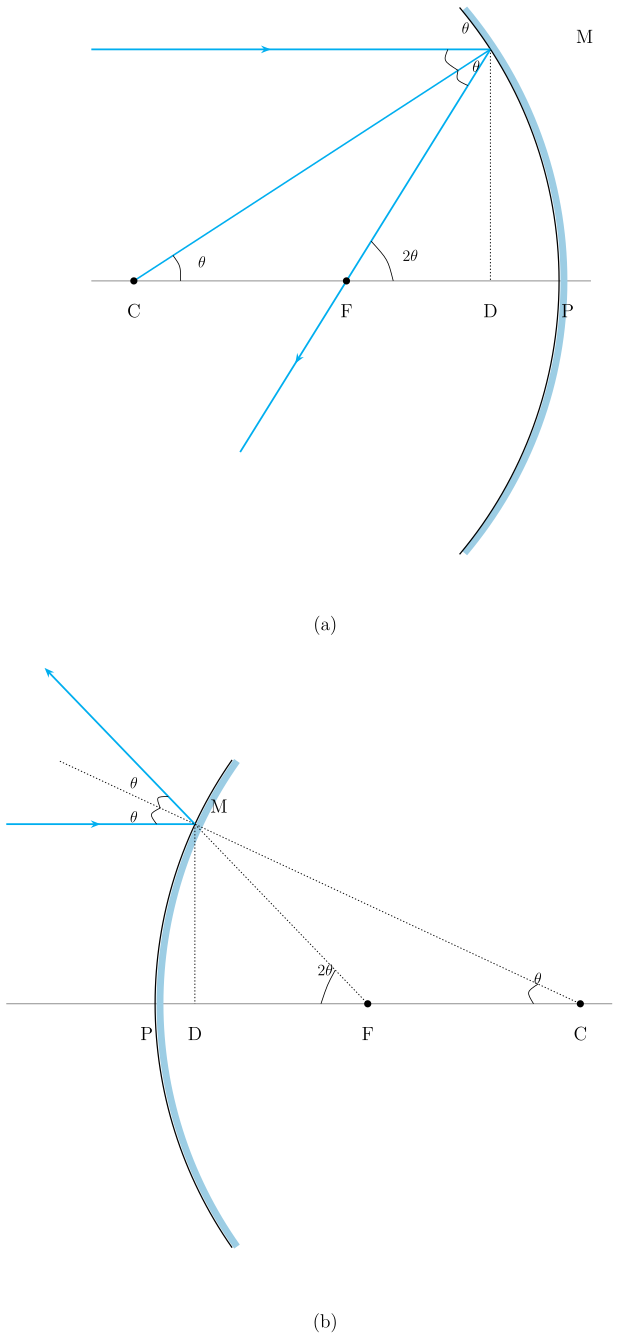
Power of a lens is defined as the reciprocal of its focal length in metres; the focal length of a spherical mirror equals half its radius of curvature, which follows from simple geometry of a paraxial ray's reflection.
Power of a lens: The power P of a lens is defined as the reciprocal of its focal length f, measured in metres:
P = 1/f
Its SI unit is the dioptre (D), where 1 D = 1 m^-1. Power indicates how strongly a lens converges (positive P, convex lens) or diverges (negative P, concave lens) a beam of light; a lens of shorter focal length has greater power.
Proof that f = R/2 for a spherical (concave) mirror:
Consider a concave mirror with pole P, centre of curvature C, and radius of curvature R = PC. Consider a ray parallel to the principal axis, striking the mirror at a point M close to the pole (paraxial ray), and reflecting to pass through the focus F on the principal axis.
Since CM is the normal to the mirror at M (radius is always normal to a spherical surface), the law of reflection means the angle of incidence equals the angle of reflection at M, both measured from the normal CM. Let this common angle be theta.
Since the incident ray is parallel to the principal axis and CM is a transversal, the angle between the incident ray and CM (angle of incidence, theta) equals the angle MCF (alternate angles, since MC is like a transversal cutting the parallel lines - the incident ray and the axis).
Also, by the law of reflection, the angle of reflection (angle between reflected ray MF and normal MC) is also theta, which is the angle CMF.
So in triangle CMF: angle MCF = theta and angle CMF = theta, i.e. triangle CMF is isosceles with the two base angles equal, so the two sides opposite these equal angles are also equal:
MF = CF
…
- CBSE 2026Set ANNUAL1 markMCQQ.A 4.5 cm needle is placed 12 cm away from a convex mirror of focal length 15 cm. The location of the image is(a) formed at 6.67 cm behind the mirror.(b) formed at 67 cm behind the mirror.(c) formed at 70 cm same side of the mirror.(d) formed at 5.57 cm same side of the mirror.
›Reveal solutionSolution
Using the mirror formula with the correct sign convention, the convex mirror forms a virtual image 6.67 cm behind the mirror.
Given: Needle height h=4.5 cm, object distance u=−12 cm (object in front, so negative by convention), convex mirror so focal length f=+15 cm (behind the mirror, positive).
Mirror formula:
v1+u1=f1
v1=f1−u1=151−−121=151+121
Taking LCM (60): v1=604+605=609=203
v=320=6.67 cm …
- CBSE 2025Set 55/4/11 markMCQQ.The magnification produced by a spherical mirror is −2.0. The mirror used and the nature of the image formed will be: (A) Convex and virtual (B) Concave and real (C) Concave and virtual (D) Convex and real
›Reveal solutionSolution
A magnification of −2.0 means the image is inverted (negative sign) and magnified (magnitude > 1). Only a concave mirror can produce an inverted, magnified image, and such an image is always real. So the mirror is concave and the image is real — option (B).
Concept and Intuition
The magnification m of a spherical mirror tells you two things at once: the sign tells you orientation, and the magnitude tells you size.
- If m is positive, the image is virtual and erect (upright).
- If m is negative, the image is real and inverted (upside down).
The magnitude ∣m∣ tells you relative size:
- ∣m∣>1 → image is magnified (larger than object)
- ∣m∣<1 → image is diminished (smaller)
- ∣m∣=1 → same size
Here m=−2.0 means the image is inverted (negative) and twice as large as the object (∣m∣=2).
Now, which mirror can produce an inverted, magnified image? A convex mirror always gives a virtual, erect, and diminished image — so it can never produce a negative magnification. A concave mirror, however, can produce both real (inverted) and virtual (erect) images depending on where the object is placed. The real image from a concave mirror is always inverted, and when the object is between the centre of curvature and the focus, that real image is also magnified.
So the only mirror that fits m=−2.0 is a concave mirror, and the image must be real.
Step-by-step reasoning
-
Interpret the sign of m
m=−2.0 is negative. For spherical mirrors, a negative magnification always means the image is inverted relative to the object. An inverted image formed by a single mirror is always real (it can be projected on a screen). So the image is real.
-
Interpret the magnitude of m
∣m∣=2.0>1, so the image is magnified — larger than the object.
-
Eliminate convex mirror
A convex mirror always produces a virtual, erect, and diminished image for any real object. That means m is always positive and ∣m∣<1. Since our m is negative and ∣m∣>1, a convex mirror is impossible. This eliminates options (A) and (D).
-
Check concave mirror possibilities
A concave mirror can produce:
- A real, inverted, magnified image when the object is placed between F and C (focus and centre of curvature).
- A virtual, erect, magnified image when the object is placed between P and F (pole and focus). In that case m is positive.
Since our m is negative, the image cannot be virtual. So the only possibility is the real, inverted, magnified case — which is exactly what a concave mirror gives for an object between F and C. …
- CBSE 2025Set IMPROVEMENT1 markMCQQ.Assertion (A): The radius of curvature of a concave mirror is 20 cm. If an object is placed in front of the mirror at a distance of 10 cm from its pole, its image is formed at infinity. Reason (R): The image of an object placed at the focus of a spherical mirror is formed at infinity. Select the correct option.(a) Both A and R are correct and R is the correct explanation of A.(b) Both A and R are correct but R is not the correct explanation of A.(c) A is correct but R is incorrect.(d) Both A and R are incorrect.
›Reveal solutionSolution
Both statements are true, and the reason correctly explains why the assertion is true.
For a concave mirror of radius of curvature R=20cm, the focal length is f=R/2=10cm. In Assertion (A), the object is placed at a distance of 10 cm from the pole — exactly at the focus. Using the mirror formula v1+u1=f1, when u=f, we get v1=f1−f1=0, so v→∞ — the image is indeed formed at infinity. This is exactly the general principle stated in Reason (R): rays from an object placed at the f …
- CBSE 2024Set ANNUAL1 markMCQQ.Focal length of a concave mirror in air is 25 cm. Its focal length in water will be -(a) 50 cm(b) 12.5 cm(c) ∞(d) 25 cm
›Reveal solutionSolution
A mirror's focal length depends only on its radius of curvature, not on the surrounding medium.
For a spherical mirror, f=R/2, where R is the radius of curvature -- a purely geometrical quantity. Since reflection (unlike refraction) does not depend on the refractive index of the surrounding medium, the focal length …
- CBSE 2024Set A1 markMCQQ.The correct relationship between the radius of curvature (R) and focal length(f) of a spherical mirror is ______.(a) R = 2f(b) f = 2R(c) R = f/2(d) R = 1/f
›Reveal solutionSolution
For a spherical mirror, R = 2f because the focal point lies midway between the pole and the centre of curvature.
For a spherical mirror (concave or convex), a ray parallel to the principal axis, after reflection, passes through (or appears to diverge from) the focus F. Using the mirror geometry, for paraxial rays, the focal length f is related to the radius of curvature R by: …
- CBSE 2024Set ANNUAL1 markQ.The radius of curvature of a concave mirror is 24 cm. The value of its focal length will be __________ cm.
›Reveal solutionSolution
For a spherical mirror, f = R/2, a direct geometric consequence of paraxial ray reflection.
For any spherical mirror (concave or convex), the focal length is related to the radius of curvature by:
…
- CBSE 2023Set 55/1/11 markMCQQ.For a concave mirror of focal length f, the minimum distance between an object and its real image is :(a) zero(b) f(c) 2f(d) 4f
›Reveal solutionSolution
For a concave mirror, the object and its real image can be brought arbitrarily close together, but the minimum possible distance between them is zero — achieved when the object is at the centre of curvature and the image coincides with it.
The question asks for the minimum distance between an object and its real image formed by a concave mirror. This is a classic problem that tests your understanding of the mirror formula and the concept of real images.
The core idea
A real image is formed when rays actually converge after reflection. For a concave mirror, a real image is formed only when the object is placed beyond the focus (i.e., u>f). The image distance v is then positive (real) and given by the mirror formula:
u1+v1=f1
The distance between the object and its image is ∣u−v∣. We want to find the smallest possible value of this distance for real images.
Step-by-step reasoning
- Set up the mirror formula For a concave mirror, f is positive. Let u be the object distance (positive, measured from the mirror). For a real image, v is also positive. The mirror formula gives:
v1=f1−u1=ufu−f
So:
v=u−fuf
- Write the distance between object and image Let D=∣u−v∣. Since both u and v are positive and measured from the mirror, the object and image lie on the same side of the mirror. The distance between them is:
D=∣u−v∣=u−u−fuf
- Simplify the expression Factor u:
D=u1−u−ff=uu−fu−f−f=uu−fu−2f
Since for real images u>f, the denominator u−f>0. The sign of u−2f depends on u. So:
D=u⋅u−f∣u−2f∣
-
Analyse the behaviour
- If u>2f, then u−2f>0, so D=u⋅u−fu−2f.
- If f<u<2f, then u−2f<0, so D=u⋅u−f2f−u.
In both cases, D is positive. The question is: can D become zero?
-
When does D=0?
D=0 when ∣u−2f∣=0, i.e., when u=2f. …
- CBSE 2023Set F1 markMCQQ.A spherical mirror is immersed in water. Its focal length will (A) decrease (B) increase (C) remain same (D) none of these
›Reveal solutionSolution
A mirror's focal length depends only on its radius, so immersing it in water does not change f.
Unlike a lens (whose focal length depends on the refractive index of the medium through the lens-maker's formula), a spherical mirror forms images purely by reflection. Its focal length is
f=2R, …
- CBSE 2023Set ANNUAL1 markQ.The radius of curvature of a concave mirror is 28 cm, its focal length will be?
›Reveal solutionSolution
For a spherical mirror, the focal length is half the radius of curvature: f = R/2.
For a concave mirror, the focus lies midway between the pole and the centre of curvature, so f=2R.
…
- CBSE 2023Set TERM21 markMCQQ.Focal length of Plane mirror is :(a) Infinite(b) Zero(c) 10 cm(d) 20 cm
›Reveal solutionSolution
A plane mirror can be thought of as a spherical mirror whose radius of curvature is infinite, so its focal length is also infinite.
For a spherical mirror, f=R/2, where R is the radius of curvature. A plane mirror is the limiting case of a spherical mirror with R→∞ (an infinitely large sphere looks flat locally). Hence its focal length is also infinite — parallel rays …
- CBSE 2019Set ANNUAL1 markQ.A convex mirror is placed inside water. Will its focal length change? (Write 'Yes' or 'No')
›Reveal solutionSolution
A mirror's focal length depends only on its radius of curvature (f = R/2), not on the medium, so it does not change in water.
Reflection at a mirror obeys the law of reflection regardless of the medium in which it is placed. The focal length of a spherical mirror is fixed purely by its geometry:
f = R/2,
…
🎓Unlock everything free for 14 days
- ✓Full step-by-step solutions
- ✓Concept-first explanations
- ✓Methods, shortcuts & mistakes
- ✓PYQ mapping + timed mock tests
Full access for 14 days. No credit card required.