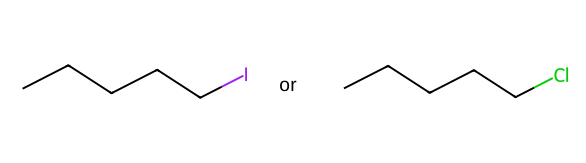
Q.(a) Carry out the following conversions:
🔒You're viewing a preview — the full solution, concept, methods & PYQ mapping are locked.
🔒 Start your 14-day free trial to unlock the full solution →Concept understanding — SN1 and SN2 Mechanism
The Core Idea: Two Ways to Swap a Group
Imagine you have a molecule with a leaving group (like a halogen) attached to a carbon. You want to replace that leaving group with a nucleophile (something that loves positive charge). There are two fundamentally different ways this can happen — like two different ways to replace a lightbulb.
SN2 is like unscrewing the old bulb and screwing in the new one in one smooth motion. SN1 is like first pulling the old bulb out completely, leaving an empty socket, and then putting the new bulb in.
That empty socket — the carbocation — is the key difference.
SN2: One Step, Backside Attack
The name says it all: Substitution, Nucleophilic, Bimolecular. "Bimolecular" means two molecules (the nucleophile and the substrate) are involved in the rate-determining step.
The Mechanism
The nucleophile attacks the carbon from the backside — directly opposite the leaving group. As the nucleophile approaches, the leaving group starts to leave. At the transition state, the nucleophile is partially bonded and the leaving group is partially detached. Then the leaving group departs completely, and the nucleophile is fully bonded.
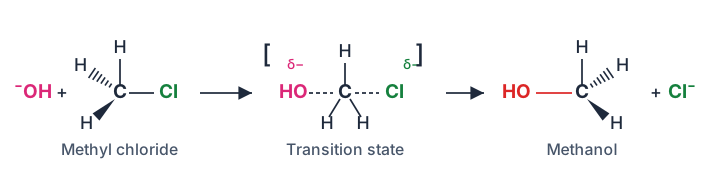
All of this happens in one step — no intermediate.
The Stereochemistry: Inversion
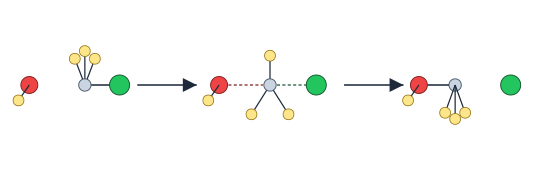
Because the nucleophile attacks from the back, the configuration at the carbon inverts — like an umbrella turning inside out in a strong wind. If you start with an R configuration, you get S (and vice versa). This is called Walden inversion.
What Favours SN2?
- Primary carbon (least steric hindrance — the backside is wide open)
- Strong nucleophile (needs to push its way in)
- Good leaving group (but not too good — it needs to wait for the nucleophile)
- Polar aprotic solvent (doesn't solvate the nucleophile too tightly)
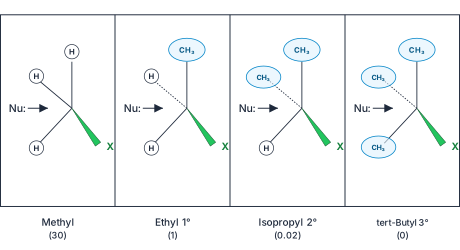
SN2 is impossible on tertiary carbons — the three bulky groups block the backside completely. The nucleophile simply cannot get close enough.
SN1: Two Steps, Carbocation Intermediate
Substitution, Nucleophilic, Unimolecular. "Unimolecular" means only one molecule (the substrate) is involved in the rate-determining step.
The Mechanism
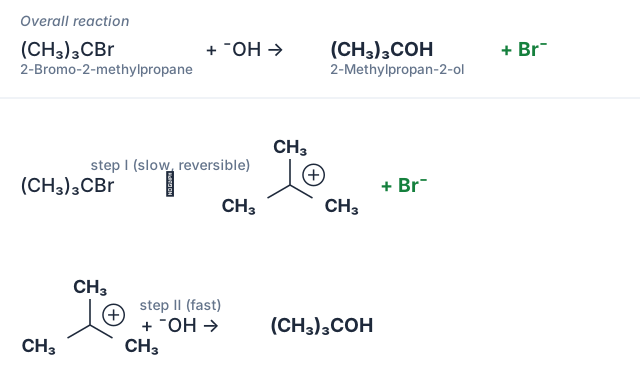
Step 1 (slow, rate-determining): The leaving group leaves on its own, forming a carbocation (a carbon with only six electrons — positively charged and very unstable).
Step 2 (fast): The nucleophile attacks the carbocation. Since the carbocation is flat (trigonal planar), the nucleophile can attack from either side with equal probability.
The Stereochemistry: Racemisation
Because the nucleophile can attack from either face of the flat carbocation, you get a racemic mixture — equal amounts of R and S. If the starting material is optically pure, the product will be optically inactive.
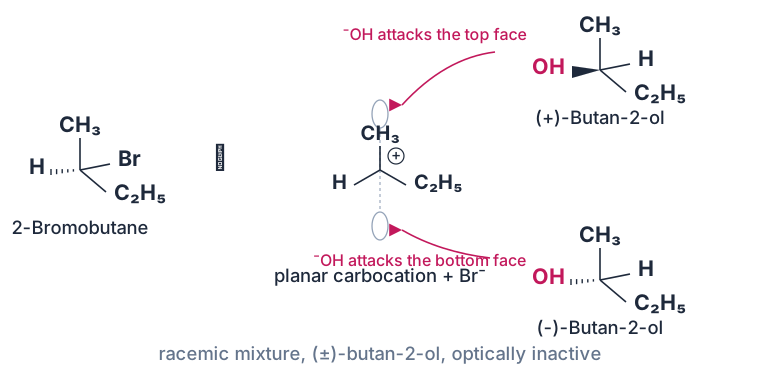
In practice, you often get slightly more inversion than retention (about 60:40) because the leaving group can partially block one face as it departs. But the key idea is loss of stereochemistry.
What Favours SN1?
- Tertiary carbon (the carbocation is stabilised by three alkyl groups — hyperconjugation and inductive effect)
- Weak nucleophile (doesn't need to force its way in — the carbocation is desperate for electrons)
- Excellent leaving group (must be able to leave on its own)
- Polar protic solvent (stabilises the carbocation and the leaving group)
SN1 is impossible on primary carbons — a primary carbocation is so unstable it effectively doesn't exist. The leaving group would never leave on its own.
The Big Comparison Table …
Each conversion follows a familiar mechanism, from Markovnikov re-addition of the halogen and the Sandmeyer replacement of a diazonium group to the leaving-group dependence of SN2 and the Williamson ether synthesis. …
(a) Both conversions use a two-step sequence (elimination then Markovnikov addition; diazotization then Sandmeyer). (b) A better (more polarizable, weaker C-X bond) leaving group makes SN2 faster - iodide beats chloride. (c) Sodium phenoxide + ethyl chloride is a textbook Williamson ether synthesis, giving phenetole.
(a)(i) 1-Bromopropane -> 2-Bromopropane:
Step 1 (elimination): 1-Bromopropane is treated with alcoholic KOH, which favours elimination (dehydrohalogenation) over substitution, forming propene:
CH3CH2CH2Br --(alc. KOH, heat)--> CH3CH=CH2 (propene) + KBr + H2O
Step 2 (Markovnikov addition): propene is treated with HBr; by Markovnikov's rule, H adds to the carbon with more hydrogens (C1) and Br adds to the more substituted carbon (C2), forming the secondary bromide:
CH3CH=CH2 + HBr --> CH3CHBrCH3 (2-Bromopropane)
(a)(ii) Aniline -> Chlorobenzene:
Step 1 (diazotization): aniline is treated with NaNO2 and HCl at 0-5 degree C to form benzenediazonium chloride:
C6H5NH2 + NaNO2 + 2HCl --(0-5 degree C)--> C6H5N2+Cl- + NaCl + 2H2O
Step 2 (Sandmeyer reaction): the diazonium salt is treated with cuprous chloride and HCl, replacing the diazonium group with chlorine:
C6H5N2+Cl- --(CuCl/HCl)--> C6H5Cl (chlorobenzene) + N2
…
Showing the 12 most recent of 19 on this concept.
- CBSE 2026Set ANNUAL1 markMCQQ.[Case study] Depending on the molecule involved in controlling the rate of reaction, nucleophilic substitution reaction can be divided in two categories: nucleophilic unimolecular (SN1) and nucleophilic bimolecular (SN2). Alkyl halide reactivity towards SN1 and SN2 reactions depends on a number of variables, including steric hindrance, stability of the intermediate or transition state and solvent polarity. Primary alkyl halides, followed by secondary and tertiary alkyl halide are most favourable to the SN2 reaction mechanism. In the case of SN1 reactions, this order is reversible.(i) Which of the following is most reactive towards nucleophilic substitution reaction ?(a) CHCl3(b) CH2=CHCl(c) ClCH2CH=CH2(d) CH2CH=CHCl
›Reveal solutionSolution
Allyl chloride is most reactive because ionisation of the C–Cl bond gives an allylic carbocation stabilised by resonance with the adjacent C=C double bond, favouring rapid SN1 substitution.
Comparing the four halides:
- CHCl₃ (chloroform): a trihalomethane; it is not a typical alkyl/allyl/vinyl halide substrate for facile nucleophilic substitution under these conditions — its C–H (not a good leaving-group carbon) and its multiple Cl on the same very electron-poor carbon make it comparatively unreactive here.
- CH₂=CHCl (vinyl chloride): the C–Cl bond is attached directly to an sp² carbon of the double bond. This bond has partial double-bond character (due to conjugation of a chlorine lone pair with the π system) and is both shorter and stronger than a normal C–Cl bond; also, any positive charge generated at that carbon cannot be stabilised by the adjacent π system (it would need an empty orbital where the π bond already sits). Vinylic and aryl halides are therefore very unreactive towards nucleophilic substitution. …
- CBSE 2026Set ANNUAL1 markMCQQ.[Case study, continued](ii) Isopropyl chloride undergoes hydrolysis by(a) SN1 and SN2 mechanism(b) SN1 mechanism(c) SN2 mechanism(d) None of the above
›Reveal solutionSolution
Isopropyl chloride is a secondary alkyl halide; secondary halides sit in the intermediate reactivity zone and can react by either SN1 (via a moderately stable secondary carbocation) or SN2 (moderate steric hindrance still allows backside attack), so both mechanisms operate, often simultaneously depending on conditions.
Reactivity trend for nucleophilic substitution:
- Primary halides are sterically unhindered, favouring SN2 (backside attack is easy) but their carbocation would be unstable, disfavouring SN1.
- Tertiary halides are too sterically hindered for backside attack (SN2 is disfavoured) but readily form a stable tertiary carbocation, strongly favouring SN1. …
- CBSE 2026Set ANNUAL1 markMCQQ.Which of the following on heating with aqueous KOH, produces acetaldehyde?(a) CH3CH2Cl(b) CH2ClCH2Cl(c) CH3CHCl2(d) CH3COCl
›Reveal solutionSolution
Only the geminal dihalide CH3CHCl2 hydrolyses to an unstable gem-diol that collapses to the aldehyde; the other substrates give an alcohol, a diol, or a carboxylate instead.
CH3CHCl2 (c), a gem-dihalide (both Cl on the same carbon):
CH3CHCl2+2KOH(aq)→CH3CH(OH)2+2KCl
The geminal diol CH3CH(OH)2 is unstable (two −OH groups on the same carbon) and spontaneously eliminates water:
CH3CH(OH)2→CH3CHO+H2O
Net: CH3CHCl2+2KOH→CH3CHO+2KCl+H2O — acetaldehyde.
Why the others are wrong:
- (a) CH3CH2Cl + aq. KOH undergoes simple nucleophilic substitution to give ethanol, CH3CH2OH — not an aldehyde. …
- CBSE 2026Set ANNUAL1 markMCQQ.Which one of the following is the correct statement?(a) Alkyl halides are more reactive than aryl halides towards nucleophilic substitution reaction(b) Alkyl halides are less reactive than aryl halides towards nucleophilic substitution reaction(c) Nucleophilic substitution reaction proceeds through carbocation(d) Aryl halides cannot be prepared by electrophilic substitution to arenes
›Reveal solutionSolution
Resonance donation of the halogen's lone pair into the aromatic ring strengthens and shortens the aryl C−X bond and makes the ring electron-rich, so alkyl halides are far more reactive than aryl halides toward nucleophilic substitution.
Why aryl halides resist substitution: the halogen's lone pair delocalises into the benzene ring by resonance, giving the C−X bond partial double-bond character — it becomes shorter and stronger than a normal C−X single bond, and harder to break. The electron-rich ring also repels an incoming nucleophile, and backside (SN2-type) attack on the sp2 carbon is sterically/geometrically hindered by the planar ring; an SN1-type pathway would require a highly unstable phenyl cation, which does not form under normal conditions.
Why the other statements are wrong:
- (b) is the exact reverse of the truth. …
- CBSE 2025Set ANNUAL1 markQ.How can the following conversion be carried out? (Give chemical equation only) — Bromoethane to propane nitrile
›Reveal solutionSolution
Nucleophilic substitution of bromide by cyanide ion (alcoholic KCN) gives the nitrile.
Bromoethane is heated with alcoholic potassium cyanide (KCN); the cyanide ion (a good nucleophile, attacking through carbon) displaces bromide in an SN2 reaction:
C2H5Br+KCNethanolicC2H5CN+KBr
…
- CBSE 2024Set D1 markMCQQ.C2H5Br + NaOH -> C2H5OH + NaBr is an example of which of the following types of reaction?(a) Electrophilic substitution(b) Nucleophilic substitution(c) Both (A) and (B)(d) None of these
›Reveal solutionSolution
The nucleophile OH- attacks the electrophilic carbon of C2H5Br and displaces the leaving group Br-, giving C2H5OH. This is nucleophilic substitution.
In C2H5Br the C-Br bond is polar; carbon carries a partial positive charge. The hydroxide ion (OH-) from NaOH is an electron-rich nucleophile that attacks this carbon and expels bromide as the leaving group:
C2H5Br + OH- -> C2H5OH + Br-
…
- CBSE 2024Set ANNUAL1 markMCQQ.Arylhalides are less reactive towards nucleophilic substitution reaction as compared to alkylhalides due to :(a) The formation of less stable carbonium ion(b) Resonance stabilization(c) Longer carbon-halogen bond(d) Inductive effect
›Reveal solutionSolution
Aryl halides resist nucleophilic substitution because resonance between the halogen's lone pair and the ring strengthens the C-X bond.
In an aryl halide such as chlorobenzene, a lone pair on the halogen conjugates with the pi-electron system of the ring. This delocalisation:
- Gives the carbon-halogen bond partial double-bond character, making it shorter and stronger than a normal C-X single bond, so it resists heterolytic cleavage (needed for both SN1 and SN2 pathways).
- Increases electron density on the ring (especially ortho/para to X), which repels an approaching nucleophile.
- The carbon bearing the halogen is sp2 hybridised, holding the bonding electrons closer to carbon and further strengthening the bond. …
- CBSE 2023Set ANNUAL1 markMCQQ.Which of the following will react faster in SN2 reaction?(a) 1-bromopentane(b) 2-bromopentane(c) 3-bromopentane(d) 2-bromo-2-methyl butane
›Reveal solutionSolution
SN2 rate depends inversely on steric hindrance around the carbon bearing the leaving group; the primary halide has the least hindrance and reacts fastest.
In an SN2 reaction, the nucleophile attacks the carbon from the side opposite the leaving group in a single concerted step, so the rate is very sensitive to steric crowding at that carbon: primary (1 degree) > secondary (2 degree) > tertiary (3 degree), and tertiary halides essentially do not undergo SN2. Among the choices, 1-bromopentane has its Br on a pr …
- CBSE 2023Set ANNUAL1 markMCQQ.SN2 mechanism proceeds through the intervention of(a) carbonium ion(b) transition state(c) free radical(d) carbanion
›Reveal solutionSolution
SN2 substitution is concerted (bond-breaking and bond-making happen simultaneously in one step) via a single pentacoordinate transition state, unlike SN1 (carbocation intermediate) or radical-chain reactions.
Mechanism of SN2: The nucleophile (Nu−) attacks the electrophilic carbon from the side directly opposite (backside of) the leaving group (X). As the new Nu−C bond starts to form, the C−X bond simultaneously starts to break — both events occur in a single, concerted step:
Nu−+R3C-X→[Nu⋯CR3⋯X]‡→Nu-CR3+X−
The bracketed species is the transition state: a fleeting, high-energy, pentacoordinate arrangement (5 groups around carbon — the incoming nucleophile, the three original substituents, and the departing leaving group) that is never actually isolable, unlike a true intermediate. Because there is only one transition state and no intermediate, the reaction is second order overall (rate depends on both [Nu−] and [R3CX]) and proceeds with inversion of configuration at carbon (Walden inversion), since the nucleophile ends up on the opposite face from where the leaving group departed.
…
- CBSE 2022Set ANNUAL1 markMCQQ.A primary alkyl halide would prefer to undergo:(a) SN2(b) SN1(c) Elimination(d) None of these
›Reveal solutionSolution
Primary alkyl halides favour SN2 because the carbon is sterically open to backside attack and a primary carbocation (needed for SN1) is too unstable. Option (A).
The two nucleophilic substitution pathways:
- SN1 — proceeds through a carbocation; favoured by tertiary halides (stable 3° carbocation).
- SN2 — one-step backside attack by the nucleophile; favoured when the carbon is sterically uncrowded, i.e. by primary halides. …
- CBSE 2021Set A1 markMCQQ.SN2 mechanism proceeds via formation of(a) Carbocation(b) Transition state(c) Free radical(d) Carbanion
›Reveal solutionSolution
SN2 goes through one concerted step with a pentacoordinate transition state, not an intermediate carbocation/carbanion.
In the SN2 (Substitution Nucleophilic Bimolecular) mechanism:
- The nucleophile attacks the carbon from the side opposite to the leaving group.
- Bond making (Nu-C) and bond breaking (C-leaving group) occur simultaneously in one step. …
- CBSE 2020Set 56/3/11 markMCQQ.Racemisation occurs in (A) SN2 reaction (B) SN1 reaction (C) Neither SN2 nor SN1 reactions (D) SN2 reaction as well as SN1 reaction
›Reveal solutionSolution
Racemisation occurs when a chiral centre is converted to a planar intermediate that can be attacked from either face with equal probability. This happens exclusively in SN1 reactions through the formation of a planar carbocation. The correct option is (B).
The key to understanding racemisation lies in recognising what happens to the stereochemistry at a chiral carbon during nucleophilic substitution.
The Stereochemical Fate of Chiral Centres
When a nucleophile attacks a chiral carbon bearing a leaving group, the three-dimensional arrangement of groups around that carbon determines whether we retain, invert, or lose stereochemical information entirely.
1. The SN2 Mechanism and Inversion
In an SN2 reaction, the nucleophile attacks from the side directly opposite to the leaving group. This backside attack forces all three other groups attached to the carbon to flip to the opposite side, like an umbrella turning inside-out in the wind.
The result? Complete inversion of configuration at the chiral centre—what we call Walden inversion. If you start with an (R)-enantiomer, you end with an (S)-enantiomer, and vice versa. The product is a single stereoisomer, not a mixture.
Watch outA common mistake is thinking that because SN2 changes configuration, it must produce a racemic mixture. Inversion gives you the opposite enantiomer cleanly, not both enantiomers in equal amounts.
2. The SN1 Mechanism and Carbocation Formation
The SN1 reaction proceeds through a two-step mechanism. First, the leaving group departs, taking both bonding electrons with it. This leaves behind a carbocation at what was formerly the chiral centre.
Here's the crucial point: a carbocation is sp2 hybridised and planar. The three groups attached to it lie in a flat plane, with an empty p-orbital perpendicular to that plane. The molecule has lost its chirality at this intermediate stage.
3. Nucleophilic Attack on the Planar Carbocation
When the nucleophile approaches this planar carbocation in the second step, it can attack from either face of the molecule with equal probability. There's no steric or electronic preference for one side over the other.
- Attack from the top face regenerates one enantiomer
- Attack from the bottom face produces the opposite enantiomer …
🎓Unlock everything free for 14 days
- ✓Full step-by-step solutions
- ✓Concept-first explanations
- ✓Methods, shortcuts & mistakes
- ✓PYQ mapping + timed mock tests
Full access for 14 days. No credit card required.