Skip to content
← Physics

Physics · Class 12 Science

Tripura Tbse Class 12 Physics — Real Previous-Year Papers

with complete answers

Real previous-year board papers, year by year — the official exam pattern, the full question paper, and every question solved the concept-first way. Distinct from the chapter-wise textbook bank.

2023–2026
Years of papers
4
Total Papers
4
Real Board Papers
0
Sample papers
148
Real-paper Q & A
0
Sample-paper Q & A

Real board-paper questions available, by year

37 Q2026complete
37 Q2025complete
37 Q2024complete
37 Q2023complete
—2022Paper not yet available
—2021Exam cancelled (COVID-19)

2022 — Paper not yet available: This year’s exam was held, but no verified question paper for this subject has been published by any source we check — the official TBSE site and the public past-paper archives. We publish only a paper we can verify against a real printed original — this one will appear here once it is.

2021 — Exam cancelled (COVID-19): TBSE cancelled the Class-12 Higher Secondary (+2 Stage) examination in 2021 due to COVID-19; no annual question paper was conducted or printed that year, so none exists to publish. Results were declared using an expert-committee evaluation formula.

Higher Secondary (+2 Stage) Examination 2026 · Set ANNUAL

Real board examination

About this paper

The real Class-12 board examination held in 2026. Every question below is solved the concept-first way. Sample papers are labelled honestly — never shown as a past exam.

Total marks
70
Questions
37
Duration
195 min
Sections
5

The marks / questions / duration above are the official exam pattern. We currently have 37 of this paper’s questions (100% of the full paper), with 37 fully solved. Questions we couldn’t yet extract or verify are held — never shown as complete.

Sections & marks

SectionTypeQuestionsMarks eachTotal
ASection Amcq10110
BSection Bvery_short10110
CSection Cshort7214
DSection Dshort7321
ESection Elong3515
Total3770

The question paper

The questions we hold for this paper, laid out by section. Solutions are on the Answers tab.

Board Examination

Physics

Higher Secondary (+2 Stage) Examination 2026 · Set ANNUAL

Series/Set: ANNUALRoll No. ________
Time Allowed: 3 hr 15 minMaximum Marks: 70

General Instructions

  1. This question paper contains 37 questions divided into 5 sections — A, B, C, D, E.
  2. Section A comprises 10 questions of 1 mark each (mcq).
  3. Section B comprises 10 questions of 1 mark each (very_short).
  4. Section C comprises 7 questions of 2 marks each (short).
  5. Section D comprises 7 questions of 3 marks each (short).
  6. Section E comprises 3 questions of 5 marks each (long).

Above is the official exam pattern. The questions printed below are those we currently hold for this paper.

Section A

mcq · 1 mark each · 10 of 10 shown

Q1.
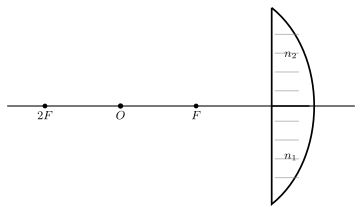
The lens shown in the figure is made of two different materials having refractive indices n1 and n2. If a point-sized object is placed on the axis of the lens, how many images will be formed?
  • (a) 1
  • (b) 2
  • (c) 3
  • (d) 5 a convex lens split along its axis into an upper half of index n2 and lower half of index n1 with a point object on the axis — Class 12 Physics question
[1]
Q2.
In Young's double-slit experiment, for which of the following colours will the fringe width be minimum?
  • (a) Red
  • (b) Green
  • (c) Blue
  • (d) Yellow
[1]
Q3.
If the kinetic energy of a free electron becomes half of its original value, by what factor will its de Broglie wavelength change?
  • (a) 2 times
  • (b) 1/2 times
  • (c) √2 times
  • (d) 1/√2 times
[1]
Q4.
The energy of an electron in the ground state of a hydrogen atom is -13.6 eV. What will be the energy of an electron in the third orbit of the same atom?
  • (a) -1.51 eV
  • (b) -3.40 eV
  • (c) -4.53 eV
  • (d) -6.80 eV
[1]
Q5.
To obtain a p-type silicon semiconductor, silicon should be doped with which of the following?
  • (a) Arsenic
  • (b) Aluminium
  • (c) Antimony
  • (d) Phosphorus
[1]
Q6.
An electric dipole formed by charges +q and -q separated by a distance 'd' is placed inside a hollow sphere of radius 'r' (2r > d). The electric flux through the surface of the sphere is —
  • (a) q/ε0, outward
  • (b) 2q/ε0, inward
  • (c) 2q/ε0, outward
  • (d) zero
[1]
Page 1 of 6
Q7.
E = -dV/dr expresses the relation between the electric field (E) and the electric potential (V). Here the significance of the negative (–) sign is — (a) E is opposite in direction to V (b) E is negative (c) If V decreases, E increases (d) The direction of E is the direction in which the value of V decreases
[1]
Q8.
Which of the following characteristics of electrons determines the magnitude of electric current in a conductor? (a) Only the drift velocity (b) Only the thermal velocity (c) Both the drift velocity and the thermal velocity (d) Neither the drift velocity nor the thermal velocity
[1]
Q9.
Which of the graphs below correctly represents the variation of magnetic susceptibility (χm) with temperature (T) for a diamagnetic substance? (A) Graph A — a constant horizontal line lying above the T-axis (χm stays at a fixed positive value, unchanged as T increases) (B) Graph B — a constant horizontal line lying below the T-axis (χm stays at a fixed negative value, unchanged as T increases) (C) Graph C — a straight line starting below the origin (negative χm) and rising toward the T-axis as T increases (D) Graph D — a straight line starting near the origin and sloping downward into increasingly negative χm values as T increases
[1]
Q10.
The figure shows a region (directed into the plane of the paper) with a uniform, time-independent magnetic field B. A rectangular conducting wire loop of area A is initially placed completely inside this magnetic-field region. The loop is then pulled out of the field with constant velocity V⃗. Assume the loop starts leaving the field at time t = t1 and has completely left the field at time t = t2. Which of the graphs below correctly represents how the EMF induced in the loop varies with time? (a) Graph A — constant value then linearly decreasing to zero at t2 (b) Graph B — zero, then rises and falls back to zero by t2 (asymmetric pulse) (c) Graph C — zero, flat constant plateau between t1 and t2, then zero (d) Graph D — triangular pulse peaking between t1 and t2
[1]
Section B

very_short · 1 mark each · 10 of 10 shown

Q1.
In a single-slit diffraction experiment, if the width of the slit is doubled, what change will occur in the size of the central maximum?
[1]
Q2.
The graph below shows, for a photoelectric-effect experiment, the variation of photoelectric current (I) with collector potential (V) for two different incident waves of frequencies ν1 and ν2. Which of the two frequencies ν1 and ν2 is larger?
[1]
Q3.
A hydrogen atom is in its third excited state. What is the maximum number of spectral lines that can be emitted by this atom?
[1]
Q4.
The binding energy per nucleon of a deuterium nucleus and a helium nucleus are 1.1 MeV and 7.0 MeV respectively. Two deuterium nuclei fuse together in a fusion reaction to form one helium nucleus. Calculate the amount of energy released in this fusion reaction.
[1]
Page 2 of 6
Q5.
What is the direction of the diffusion current in a p-n junction diode?
[1]
Q6.
Write the relationship between the electromotive force (EMF), the potential difference, and the internal resistance of a cell.
[1]
Q7.
A particle carrying charge q, moving with velocity V⃗, enters a magnetic field B⃗ that is directed perpendicular to the direction of V⃗. What will be the nature of the particle's path in the magnetic field?
[1]
Q8.
State Lenz's law of electromagnetic induction.
[1]
Q9.
What is the value of the critical angle for a material of refractive index √2?
[1]
Q10.
The focal lengths of the objective and eyepiece lenses of a telescope are f0 and fe respectively. What will be the length of the telescope tube under normal adjustment?
[1]
Section C

short · 2 marks each · 7 of 7 shown

Q1.
Show that if an object is placed at a distance 'x' in front of a concave mirror of radius of curvature 'r', its image is formed at a distance rx/(2x–r) in front of the mirror. **OR** In Young's double-slit experiment, when light of wavelength 600 nm is used, 12 fringes are formed within a certain portion of the screen. If light of wavelength 400 nm is used instead, how many fringes will be formed within that same portion of the screen?
[2]
Q2.
Using Einstein's photoelectric equation, draw a graph of the maximum kinetic energy of the photoelectrons emitted from a photosensitive metal surface against the frequency of the incident light, and describe how the work function of the metal can be determined from this graph. (1+1) **OR** What is the significance of the total negative energy of an electron revolving in a stationary orbit of an atom?
[2]
Page 3 of 6
Q3.
Explain the nuclear fusion reaction with the help of an example.
[2]
Q4.
Draw the circuit diagram of a half-wave rectifier using a p-n junction diode. Draw the input and output waveforms.
[2]
Q5.
Why does the electric field decrease inside a dielectric placed in an electric field?
[2]
Q6.
A student connected the electrical components — voltmeter (V), ammeter (A), rheostat (Rh), and battery (B) — as shown in the figure, in order to verify Ohm's law. Identify the mistake(s) the student has made, and draw the circuit diagram formed by connecting the components correctly.
[2]
Q7.
When two substances X and Y are placed in a uniform magnetic field, the magnetic field lines change as shown in the figure. (a) Identify the two substances X and Y. (b) Which of the two substances X and Y has the greater magnetic susceptibility?
[2]
Section D

short · 3 marks each · 7 of 7 shown

Q1.
(a) Arrange the following electromagnetic radiations in increasing order of their wavelength — (i) Gamma rays, (ii) Microwaves, (iii) Ultraviolet rays. (b) Why are infrared waves called heat waves? (c) In vacuum, the amplitude of the magnetic field component of an electromagnetic wave is B0 = 510 nT. What is the amplitude of the electric field component of the wave? (1+1+1)
[3]
Q2.
Using Huygens's principle, verify Snell's law of refraction for the case when a plane wavefront travels from a rarer medium to a denser medium.
[3]
Page 4 of 6
Q3.
Establish, on the basis of the wave picture of the electron, the quantum condition proposed by Bohr for the momentum of an electron.
[3]
Q4.
Explain — (i) forward biasing and (ii) reverse biasing of a p-n junction diode. (1½+1½)
[3]
Q5.
Using Kirchhoff's laws for electric circuits, establish the principle of the Wheatstone bridge.
[3]
Q6.
A straight conductor of length L and cross-sectional area A, carrying a current I along the positive Y-axis direction, is placed in a magnetic field B⃗ directed along the positive Z-axis. (a) What magnitude of force will the conductor experience? (b) Determine the direction of this force. (c) Which rule did you use to determine this direction? (1+1+1) **OR** The self-inductance of coil-1, L1, is three times the self-inductance of coil-2, L2. If, at a certain instant, the rate of increase of current and the rate of dissipation of energy are equal in both coils, find, at that instant, the ratio between the two coils of — (a) the induced EMF, (b) the induced current, and (c) the stored energy. (1+1+1)
[3]
Q7.
Read the following passage carefully and answer the questions below it: When maximum current flows in an electric circuit at a certain specific frequency, electrical resonance is said to occur in the circuit. Resonance occurs only in a circuit in which both an inductor (L) and a capacitor (C) are connected, because only in that case do the potential differences across the two ends of L and C cancel each other out (both being in opposite phase), and the current amplitude becomes Im = Vm/R, where Vm equals the potential drop across the two ends of R. (i) Resonance occurs in — (A) an L-circuit (B) an LR-circuit (C) a CR-circuit (D) an LCR-circuit. (ii) The expression for the resonant angular frequency (ω0) is — (A) ω0 = LC (B) ω0 = 1/√(LC) (C) ω0 = 1/(2√(LC)) (D) ω0 = √(LC). (iii) At the resonant frequency, the phase difference between the current and the potential difference is — (A) 0° (B) 45° (C) 90° (D) 180°. (1+1+1)
[3]
Page 5 of 6
Section E

long · 5 marks each · 3 of 3 shown

Q1.
(a) State the Biot-Savart law. Using it, define the electromagnetic unit of electric current. (b) What is a Bohr magneton? (c) How can the magnetic field inside a solenoid be made stronger? ((2+1)+1+1) **OR** (a) State Ampere's circuital law. Applying this law, determine the magnetic field at a distance 'r' from an infinitely long, straight, current-carrying conductor. (b) Mention two ways of increasing the current sensitivity of a galvanometer. (c) What type of resistance would you use to convert a moving-coil galvanometer into a voltmeter? ((1+2)+1+1)
[5]
Q2.
(a) A prism with prism angle 'A' is made of a material of refractive index 'n'. If the minimum deviation of the prism is 'Dm', establish the relation connecting 'n', 'A', and 'Dm' for the prism. (b) A screen is placed 100 cm away from an object. The image of the object is formed on the screen for two different positions of a lens. If the distance between these two positions of the lens is 20 cm, determine the focal length of the lens. (3+2) **OR** (a) Draw the ray diagram for image formation at the least distance of distinct vision by a compound microscope. (b) Why is the focal length of the objective lens kept sufficiently small in a compound microscope? (c) Mention two advantages of a reflecting telescope over a refracting telescope. (2+1+2)
[5]
Q3.
(a) An electric dipole with dipole moment p⃗ is placed at an angle θ with respect to a uniform electric field E⃗. Determine the torque acting on the dipole and write its vector form. (b) Two charges of magnitude +q and +4q are held fixed on the X-axis at a mutual separation of 'd'. Where should a third charge of magnitude +2q be placed so that it experiences no net force? ((2+1)+2) **OR** (a) Two similar large plane plates, each of area 'A', are placed in air at a distance 'd' from each other, with surface charge densities +σ and –σ respectively. (i) Determine the expression for the electric field at a point between the two plates. (ii) Determine the potential difference between the two plates. (iii) Determine the capacitance of the capacitor formed by the two plates. (b) Calculate the effective capacitance of the capacitor combination shown below. ((1+1+1)+2)
[5]
Page 6 of 6