Q.(a) Draw the ray diagram of a (astronomical) telescope when the final image is focused at the least distance of distinct vision.
You're viewing a preview — the full solution, concept, methods & PYQ mapping are locked.
Start your 14-day free trial to unlock the full solution →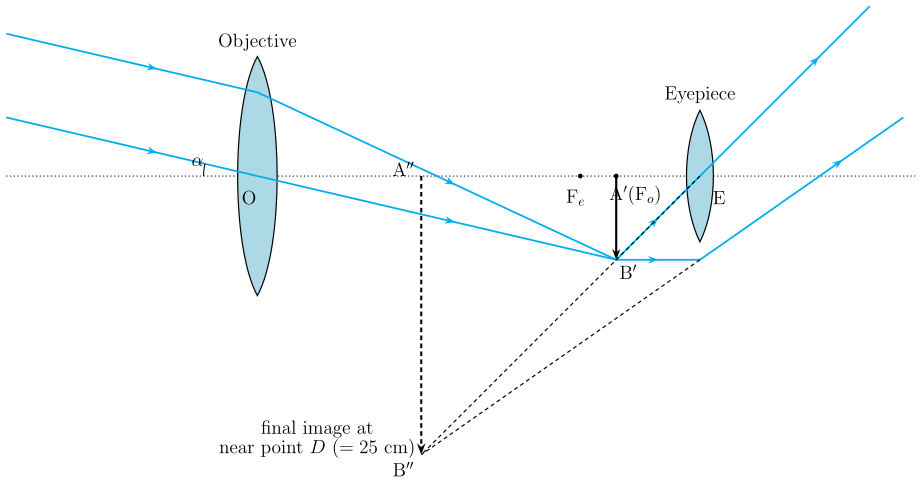
The astronomical telescope's objective always forms a small real image at its focal plane; when the eyepiece is adjusted to view that image from just inside its own focal length, the final virtual image lands at the near point. Separately, light escaping a liquid surface from a submerged point source forms a circle of radius r = d*tan(theta_c) = d/root(mu^2-1), where theta_c is the critical angle.
(a) Ray diagram (final image at near point D): Parallel rays from a distant object are collected by the objective lens (large aperture, long focal length ), which converges them to form a real, inverted, diminished intermediate image at its focal plane. For normal adjustment this image would sit exactly at the eyepiece's focal point too (giving a final image at infinity), but to place the FINAL image at the near point D, the eyepiece is moved slightly CLOSER to the intermediate image (a distance a little less than ) -- the eyepiece then acts as a simple magnifier, taking rays diverging from a point just inside its focus and bending them into a diverging beam that appears to the eye to come from a large, virtual, inverted image at distance D. (The full ray diagram shows: parallel rays -> objective -> converge to a point on its focal plane -> diverge again toward the eyepiece -> emerge as a diverging beam reaching the eye, traced back to a large virtual image at D.)
…
Unlock everything free for 14 days
- Full step-by-step solutions
- Concept-first explanations
- Methods, shortcuts & mistakes
- PYQ mapping + timed mock tests
Full access for 14 days. No credit card required.