Question of 77
Q.Draw the diagram of oogenesis in human and compare it with spermatogenesis.
Uttar Pradesh UpmspUP Board (UPMSP) Intermediate 2019Subjective· 5mImportance★★★★★
0% · 0/77 Questions
You're viewing a preview — the full solution, concept, methods & PYQ mapping are locked.
Start your 14-day free trial to unlock the full solution →Oogenesis (ovary) yields ONE large ovum + polar bodies per oogonium; spermatogenesis (testis) yields FOUR motile sperms per spermatogonium; both use multiplication, growth and maturation phases.
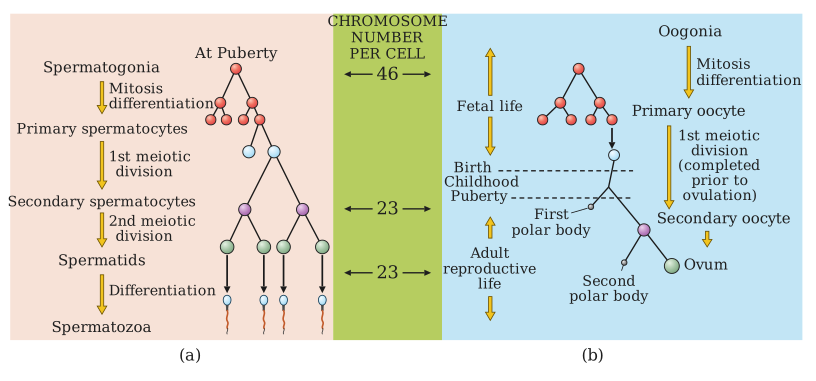
Oogenesis (formation of the egg in the ovary):
- Multiplication phase: the germinal epithelium of the ovary produces oogonia (2n) by mitosis; this occurs in the foetal stage.
- Growth phase: an oogonium grows greatly by storing food (yolk) to become a large primary oocyte (2n).
- Maturation phase: the primary oocyte undergoes meiosis-I to form one large secondary oocyte and a small first polar body (unequal division). The secondary oocyte undergoes meiosis-II to form one large ovum and a second polar body. Thus each oogonium finally forms only ONE functional ovum (haploid) and 2-3 polar bodies that degenerate.
(The described diagram shows: oogonium -> primary oocyte -> [meiosis I] secondary oocyte + 1st polar body -> [meiosis II] ovum + 2nd polar body, with polar bodies degenerating.)
Comparison of oogenesis and spermatogenesis:
- Site: oogenesis occurs in the ovary; spermatogenesis in the testis.
- Product per parent cell: oogenesis forms only ONE functional ovum per oogonium; spermatogenesis forms FOUR functional sperms per spermatogonium.
- Division: in oogenesis the meiotic divisions are unequal (producing tiny polar bodies); in spermatogenesis they are equal (four equal spermatids). …
Unlock everything free for 14 days
- Full step-by-step solutions
- Concept-first explanations
- Methods, shortcuts & mistakes
- PYQ mapping + timed mock tests
Full access for 14 days. No credit card required.