Q.Explain Mendel's Test Cross with the help of diagram.
🔒You're viewing a preview — the full solution, concept, methods & PYQ mapping are locked.
🔒 Start your 14-day free trial to unlock the full solution →Concept understanding — Mendel's Experimental Design
Let’s begin with something you already know from everyday life. Suppose you mix red and white paint — you get pink. Now imagine you cross a tall pea plant with a short one. Common sense might say you’ll get a medium-sized plant. But Mendel found that you don’t. You get all tall plants in the first generation, and then in the next generation, short plants reappear as if they had never been mixed. That is the puzzle Mendel set out to solve, and his experimental design was the tool that cracked it.
The core idea: controlled, large-scale, and trait-by-trait
Mendel’s experimental design was not just “grow some peas and see what happens.” It was a carefully planned method that had three key features:
- He chose a single trait at a time — for example, only seed shape (round vs wrinkled), not seed shape plus flower colour plus plant height all at once. This kept the results clear and interpretable.
- He used pure-breeding lines — plants that, when self-pollinated, always produced offspring identical to themselves for that trait. A pure round-seeded plant always gave round seeds; a pure wrinkled-seeded plant always gave wrinkled seeds. This gave him a known starting point.
- He counted large numbers — not just a handful of plants, but hundreds or thousands. This allowed patterns to emerge that would be invisible in small samples.
Mendel’s genius was not in discovering that traits are inherited — farmers knew that. His breakthrough was in designing an experiment that could reveal the rules of inheritance by controlling variables, using pure lines, and counting systematically. This is why he is called the father of genetics.
The step-by-step plan Mendel followed
Mendel worked with the garden pea (Pisum sativum) for practical reasons: it was easy to grow, had a short generation time, and — crucially — its flowers normally self-pollinate, so he could control exactly which plants were crossed.
His typical experiment went like this:
- Take two pure-breeding parents that differ in one trait — say, a pure tall plant and a pure short plant. These are the P generation (parental generation).
- Cross them artificially — he removed the male parts (anthers) from one flower and dusted pollen from the other parent onto its stigma. This ensured no accidental self-pollination.
- Grow the offspring — these are the F₁ generation (first filial generation). He observed that all F₁ plants were tall. The short trait had vanished.
- Let the F₁ plants self-pollinate — he did not cross them again; he simply let them produce seeds on their own. These seeds grew into the F₂ generation (second filial generation).
- Count and record — in the F₂ generation, both tall and short plants appeared, in a ratio of roughly three tall to one short. The short trait had reappeared.
He repeated this exact procedure for each of the seven traits he studied — seed shape, seed colour, flower colour, pod shape, pod colour, flower position, and stem height. Every time, the pattern was the same: one trait dominated in F₁, and both traits reappeared in a 3:1 ratio in F₂.
Why this design was revolutionary
Before Mendel, people believed in blending inheritance — the idea that parental traits mix like paint. Mendel’s design proved that inheritance is particulate: traits are carried by discrete units (what we now call genes) that remain intact across generations. The short trait did not disappear; it was merely hidden in the F₁ plants and reappeared unchanged in F₂.
The NCERT textbook emphasises that Mendel’s success came from his scientific approach: he chose the right organism, studied one trait at a time, kept accurate records, and used mathematics to analyse his results. This was completely new for biology in the 1860s.
A few key terms you will encounter …
To find whether an individual showing the dominant trait is pure (homozygous) or hybrid (heterozygous), Mendel crossed it with a recessive one — the test cross. …
A test cross = crossing a dominant-phenotype individual with a homozygous recessive to reveal its genotype. Result all dominant ⇒ parent was TT; result 1:1 ⇒ parent was Tt.
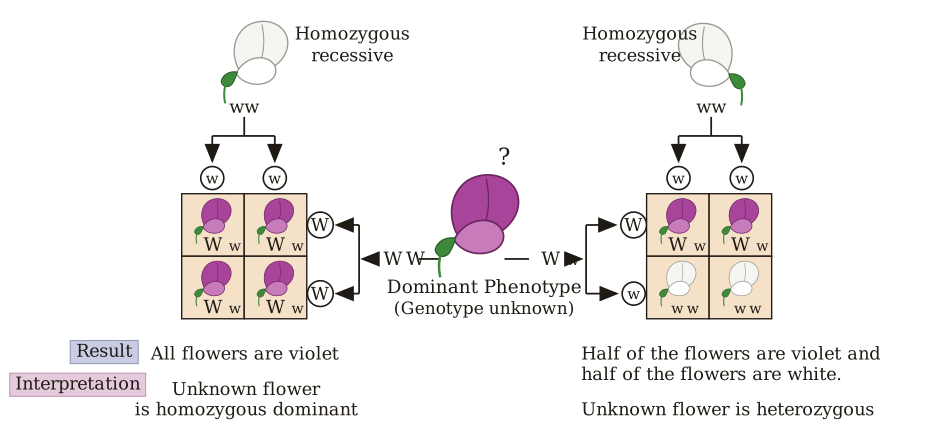
Concept
An individual showing a dominant character (e.g. a tall pea) may be either homozygous (TT) or heterozygous (Tt) — both look identical. To find out which, Mendel devised the test cross: crossing the individual with a homozygous recessive individual (tt), whose gametes carry only the recessive allele and so "reveal" the unknown genotype in the offspring.
The two possible cases (with Punnett squares)
Case 1 — the tall parent is heterozygous (Tt):
Tt×tt
| t | t | |
|---|---|---|
| T | Tt | Tt |
| t | tt | tt |
Offspring = 2 Tt (tall) : 2 tt (dwarf) = 1 tall : 1 dwarf (1:1). So a 1 : 1 ratio ⇒ the parent was heterozygous (Tt).
Case 2 — the tall parent is homozygous (TT):
TT×tt
| t | t | |
|---|---|---|
| T | Tt | Tt |
| T | Tt | Tt |
| … |
- CBSE 2026Set EG1 markMCQQ.How many years did Gregor Mendel conduct experiment on plants of garden pea?(a) Five years(b) Two years(c) Seven years(d) Eleven years
›Reveal solutionSolution
Mendel conducted his hybridisation experiments on garden pea for about seven years — option (c).
Gregor Johann Mendel carried out his classic breeding experiments on the garden pea, Pisum sativum, in the monastery garden at Brno over roughly seven years (1856–1863). He chose pea because it has clear contrasting traits, is normally self-pollinating, has a short life cycle and is easy to hybridise. From these …
- CBSE 2026Set ANNUAL1 markQ.What is the cross called, when a dominant phenotype plant is crossed with the recessive parent plant instead of self-crossing?
›Reveal solutionSolution
The cross of a dominant-phenotype individual with the homozygous recessive parent is a test cross.
Concept: A dominant phenotype can be produced by either a homozygous (TT) or a heterozygous (Tt) genotype, which cannot be told apart by appearance. …
- CBSE 2025Set ANNUAL1 markMCQQ.Which of the following claims would be accurate if garden pea plants from Mendel's Garden were sampled ?(a) Round seeds were more prevalent than wrinkled seeds(b) Wrinkled seeds were more prevalent than round seeds(c) Both round and wrinkled seeds were equally prevalent(d) The response depended on the time of day the sample was taken
›Reveal solutionSolution
In Mendel's monohybrid cross, round (dominant) seeds outnumbered wrinkled (recessive) seeds roughly 3:1 in the F2 generation.
Mendel crossed true-breeding round-seeded pea plants with true-breeding wrinkled-seeded plants. The F1 generation was entirely round-seeded (round being the dominant trait), and when F1 plants were self-pollinated, the F2 generation segregated in an approximate 3:1 ratio of round to wrinkled seeds (Mendel actually recorded 5474 round : 1850 wrinkled, very close to 3:1). So if a sample were drawn from Mendel's garden pea plants (a mixed population across generations, dom …
- CBSE 2024Set BOTANY1 markMCQQ.Fill in the blank selecting the appropriate alternative: Out of seven pairs of contrasting characters of pea plant used by Mendel, ____ had dominant green and recessive yellow.(i) flower colour(ii) pod colour(iii) seed colour(iv) stem colour
›Reveal solutionSolution
Pod colour is the trait among Mendel's seven where green is dominant and yellow is recessive.
Mendel studied seven pairs of contrasting characters in garden pea (Pisum sativum): seed shape (round dominant/wrinkled recessive), seed colour (yellow dominant/green recessive), flower colour (violet dominant/white recessive), pod shape (inflated dominant/constricted recessive), pod colour (green dominant/yellow recessive), flower position (axial dominant/terminal recessive), and stem height (t …
- CBSE 2023Set A1 markQ.Fill in the blank: ______ conducted hybridization experiments on garden peas for seven years.
›Reveal solutionSolution
Mendel, an Austrian monk, performed pea (Pisum sativum) hybridisation experiments at the monastery in Brno and laid the foundation of genetics.
Gregor Johann Mendel chose the garden pea plant for his experiments because it had several contrasting, easily distinguishable traits (like round/wrinkled seeds, tall/dwarf plants), was self-pollinating (allowing pure-line breeding) but could also be cross-pollinated artificially, and had a short generation time. Over seven years of carefully planned cro …
- CBSE 2022Set GO1 markQ.How many pairs of contrasting traits were studied by Mendel in pea plant?
›Reveal solutionSolution
Mendel selected 7 pairs of contrasting characters in pea.
Concept. For his hybridisation experiments Mendel chose the garden pea and worked with seven pairs of contrasting (alternative) traits, each showing a clear dominant and recessive form:
- Seed shape — round / wrinkled
- Seed (cotyledon) colour — yellow / green
- Flower colour — violet / white …
- CBSE 2018Set ANNUAL1 markMCQQ.How many pairs of contrasting characters were studied by Mendel?(a) 5 pairs(b) 6 pairs(c) 7 pairs(d) 8 pairs
›Reveal solutionSolution
Mendel selected seven distinct, easily distinguishable contrasting character-pairs in the garden pea for his hybridisation experiments.
Gregor Mendel conducted his classic breeding experiments on the garden pea (Pisum sativum) because it is self-pollinating, easy to cross-pollinate artificially, and has several traits with clear-cut contrasting (either/or) forms. He specifically chose and studied seven pairs of contrasting characters: (1) seed shape - round/wrinkled, (2) seed colour - yellow/green, (3) pod shape - inflated/constricted, (4) pod colour - green/yellow, (5) flower colour - violet/white, (6) flower position - axial/terminal, and (7) s …
- CBSE 2018Set ANNUAL1 markQ.Why is self pollination procedure essential among the different progeny hybrids for the selection of new recombinants in plant breeding programme?
›Reveal solutionSolution
Repeated self-pollination of hybrid progeny fixes new gene combinations into a stable, true-breeding (homozygous) form, which is essential before a useful recombinant variety can be released.
In a plant breeding programme, after two parent varieties are crossed to produce hybrid progeny showing new combinations of desirable traits (recombinants), these progeny are still heterozygous and will continue to segregate/throw a mixture of different genotypes in subsequent generations if allowed to cross-pollinate freely. To 'fix' the desired new trait combination into a stable, uniform, true-breeding variety, breeders subject the selected progeny to repeated cycles of self-pollination across several successive generations. Self-pollination increases homozygosity generation after generation, so that eventually a line is …
- CBSE 2018Set ANNUAL1 markQ.Write the answer in one word/sentence: Write botanical name of maize.
›Reveal solutionSolution
The botanical name of maize is Zea mays.
Maize, commonly called corn, is a monocot cereal crop belonging to the grass family (Poaceae). Its scientific binomial name, following Linnaeus' system of nomenclature, is Zea mays, where Zea is …
- CBSE 2017Set ANNUAL1 markMCQQ.Which one of the following trait of pea plant studied by Mendel is dominant?(a) Green pod colour(b) Yellow pod colour(c) White flower colour(d) Terminal flower position
›Reveal solutionSolution
Of Mendel's seven pea traits, green pod colour is dominant over yellow.
Mendel studied seven contrasting traits in garden pea (Pisum sativum), each with a dominant and a recessive form:
Trait Dominant Recessive Pod colour Green Yellow Flower colour Violet White Flower position Axial Terminal Stem height Tall Dwarf …
🎓Unlock everything free for 14 days
- ✓Full step-by-step solutions
- ✓Concept-first explanations
- ✓Methods, shortcuts & mistakes
- ✓PYQ mapping + timed mock tests
Full access for 14 days. No credit card required.