Question of 56
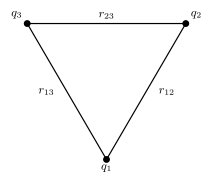
Q.What do you understand by electric potential energy of a system of point charges? Derive the formula for the electric potential energy of the system of three point charges shown in the following figure.
(OR)
What is a capacitor? Deduce the formula for the capacity of a parallel plate capacitor in the following conditions -
(i) When the medium between the plates of the capacitor is vacuum.
(ii) When the medium between the plates of the capacitor is a dielectric of dielectric constant K.
(iii) When the medium between the plates of the capacitor is some metal.
Uttarakhand UbseUttarakhand Board Intermediate (Class 12) 2024Subjective· 4mImportance★★★★★
0% · 0/56 Questions
You're viewing a preview — the full solution, concept, methods & PYQ mapping are locked.
Start your 14-day free trial to unlock the full solution →Concept understanding — Electrostatic Potential Energy of a System of Charges
The potential energy of a system of N point charges is the total work needed to assemble them by bringing each one, in turn, from infinity to its final position, working against the fields of every charge already placed. The general result is a sum over every distinct PAIR of charges: -- for just two charges this reduces to the simple two-charge formula . …
Unlock everything free for 14 days
- Full step-by-step solutions
- Concept-first explanations
- Methods, shortcuts & mistakes
- PYQ mapping + timed mock tests
Full access for 14 days. No credit card required.