Q.Derive an expression for the magnetic field produced at the centre of a current carrying circular coil.
🔒You're viewing a preview — the full solution, concept, methods & PYQ mapping are locked.
🔒 Start your 14-day free trial to unlock the full solution →Concept understanding — Magnetic Field of a Circular Loop
Magnetic Field of a Circular Loop — From Intuition to Formula
Imagine you take a piece of wire and bend it into a perfect circle. Now push a steady current through it. What happens to the space around it? The moving charges in every tiny segment of the wire create their own little magnetic fields. The question is: what do all these tiny fields add up to?
The Intuition: Symmetry and Superposition
At the centre of the loop, something beautiful happens. Every small piece of the wire is at the same distance R from the centre. And each piece sends its magnetic field contribution straight toward (or away from) the centre, depending on the current direction. Because the loop is symmetric, the sideways components from opposite sides cancel out perfectly. Only the component perpendicular to the plane of the loop survives.
So the net field at the centre points straight along the axis of the loop — either out of the page or into it, following the right-hand rule.
Right-hand rule for the loop
Curl the fingers of your right hand in the direction of the current. Your thumb points in the direction of the magnetic field at the centre.
The Precise Statement
For a circular loop of radius R carrying a steady current I, the magnetic field at the centre is:
B=2Rμ0I
where μ0=4π×10−7T⋅m/A is the permeability of free space.
The field is uniform only at the exact centre — move even a little along the axis, and the magnitude changes. But at the centre, the formula is exact.
Bcentre=2Rμ0I
Where Does This Come From?
You can derive it using the Biot–Savart law. Each current element Idℓ produces a field:
dB=4πμ0r2Idℓsinθ
At the centre, every element is perpendicular to the radius vector (θ=90∘, so sinθ=1), and the distance r=R is constant. The direction of each dB is the same (along the axis). So you just integrate dℓ around the full circumference 2πR:
B=∫dB=4πR2μ0I∫02πRdℓ=4πR2μ0I⋅2πR=2Rμ0I
The 4π in the denominator of the Biot–Savart law cancels with the 2π from the circumference, leaving the clean 2R in the denominator.
What If You Have Multiple Turns?
If you wind the wire into N closely spaced turns (a flat coil), each turn contributes the same field at the centre. The fields simply add:
B=2Rμ0NI
This is why a coil of many turns produces a stronger field — each turn is an independent source.
Common mistake …
Applying the Biot-Savart law to the coil is unusually simple at its centre because every current element lies the same distance away and each contributes a field in the same direction, so the contributions add straight up around the loop. …
Applying the Biot–Savart law to every current element of the circular loop and integrating around the loop gives B=μ0I/2R at the centre.
Consider a circular coil of radius R carrying current I. By the Biot–Savart law, a current element Idl produces a magnetic field at a point P at distance r given by:
dB=4πμ0r2Idl×r^
At the centre of the coil, every current element Idl is at the same distance r=R from the centre, and dl is always perpendicular to r (which points radially from the element to the centre), so sinθ=sin90∘=1 for every element. Thus the magnitude of the field due to each element is:
dB=4πμ0R2Idl
…
Showing the 12 most recent of 14 on this concept.
- CBSE 2026Set ANNUAL1 markMCQQ.An arc of a circle of radius R subtends an angle π/2 at the centre. It carries a current i. The magnetic induction at the centre will be(a) μ0 i / 2R(b) μ0 i / 8R(c) μ0 i / 4R(d) 2μ0 i / 5R
›Reveal solutionSolution
The magnetic induction at the centre due to a current-carrying arc subtending angle θ is 4πRμ0iθ; for θ=π/2 this gives μ0i/(8R).
For a full circular loop of radius R carrying current i, the magnetic field at the centre is Bfull=2Rμ0i, using the Biot–Savart law integrated over the full 2π angle.
…
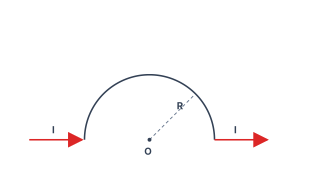
- CBSE 2025Set 55/6/11 markMCQQ.The value of magnetic field at point O in the given figure is: (A) 2πRμ0I (B) πRμ0I (C) 4Rμ0I (D) Rμ0I
›Reveal solutionSolution
The magnetic field at the centre of a semicircular current-carrying arc is found using the Biot-Savart law; each element contributes perpendicular to the plane, and integration over the arc gives 4Rμ0I.
Figure — 55/6/1 Q3 The magnetic field at a point due to a current-carrying conductor is governed by the Biot-Savart law. For symmetric geometries like the circular arc shown in the figure, the calculation simplifies beautifully because every current element contributes in the same direction at the centre.
When a current I flows through a circular arc, each infinitesimal element dl produces a magnetic field at the centre that points perpendicular to the plane of the arc (determined by the right-hand rule). The key insight is that for a circular arc of radius R, the perpendicular distance from every element to the centre is exactly R, and the angle between dl and the position vector is always 90°.
For a circular arc subtending angle θ at its centre, the magnetic field is:
B=4πRμ0Iθ
Let me show you why this formula works and apply it to our semicircle.
- Apply the Biot-Savart law to a circular arc element For an element dl on the arc at distance R from point O:
dB=4πμ0Ir3∣dl×r∣=4πR2μ0Idl
Since dl=Rdθ (arc length element), we have:
dB=4πRμ0Idθ
- Integrate over the semicircular arc A semicircle subtends an angle θ=π radians at its centre. All field contributions point in the same direction (into or out of the page), so: …
- CBSE 2025Set ANNUAL1 markMCQQ.The magnetic field at the centre of a circular coil of radius 5 cm carrying a current of 1 A is 1.256 T. If the radius is made 10 cm, then the magnetic field at the centre of the loop carrying the same current will be(a) 2.512 T(b) 0.628 T(c) 5.024 T(d) 0.314 T
›Reveal solutionSolution
For a circular coil, Bcentre=μ0I/(2R), so B∝1/R at fixed current; doubling R halves B, giving 0.628 T.
Formula for field at the centre of a circular coil
B=2Rμ0I
For a fixed current I, B is inversely proportional to the radius R:
B1B2=R2R1
Substituting the given values
R1=5 cm, B1=1.256 T, R2=10 cm (current unchanged at 1 A):
B2=B1×R2R1=1.256×105=0.628 T
…
- CBSE 2025Set ANNUAL1 markMCQQ.Due to 10 amperes of current flowing in a circular coil of 10 cm radius, the magnetic field produced at its centre is 3.14 x 10^-3 weber/m^2. The number of turns in the coil will be(i) 5000(ii) 100(iii) 50(iv) 25
›Reveal solutionSolution
N = B(2r)/(mu0 I) = 50 turns.
The field at the centre of a coil of N turns is B=2rμ0NI. Solving for N: …
- CBSE 2024Set A1 markMCQQ.The magnetic field produced at the centre of current carrying circular coil is (A) on the plane of coil (B) perpendicular to the plane of coil (C) at 45° to the plane of coil (D) at 180° to the plane of coil
›Reveal solutionSolution
At the centre the magnetic field points along the axis — perpendicular to the plane of the coil.
Using the Biot–Savart law, every current element of a circular coil contributes a field at the centre that points along the axis of the coil (perpendicular to its plane); by symmetry the in-plane components cancel. The magnitude at the centre is
B=2Rμ0NI.
…
- CBSE 2024Set ANNUAL1 markQ.A semi-circular arc of radius 20 cm carries a current of 10 A. What is the magnitude of the magnetic field at the centre of the arc? OR A galvanometer with a coil of resistance 12.0 Ω shows full-scale deflection for a current 2.5 mA. How will you convert the galvanometer into an ammeter of range 0 to 7.5 A?
›Reveal solutionSolution
A semicircular arc contributes exactly half the field of a full circular loop of the same radius at the centre, since the field from a circular arc is proportional to the angle it subtends. The alternative converts a galvanometer to an ammeter using a low-resistance shunt in parallel.
Field at the centre of a semicircular arc
For a full circular loop of radius R carrying current I, the field at the centre is Bloop=2Rμ0I. A semicircular arc subtends half the angle (π instead of 2π) at the centre, so it contributes exactly half this field:
B=4Rμ0I
Substituting I=10A, R=20cm=0.20m:
B=4(0.20)(4π×10−7)(10)=0.84π×10−6=0.812.566×10−6=1.57×10⁻⁵T
…
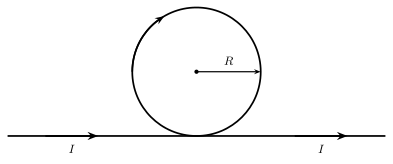
- CBSE 2024Set ANNUAL1 markMCQQ.An infinitely long straight conductor is bent into the shape as shown in the figure. The magnetic field at the centre of the circular part is -(a) (μ₀/4π)·(2πI/R)(b) (μ₀/4π)·(2I/R)(π+1)(c) (μ₀/4π)·(2I/R)(π−1)(d) Zero
›Reveal solutionSolution
The field at the centre is the sum of the field from the full circular loop and the field from the two straight semi-infinite wire segments (which together act like one infinite straight wire tangent to the circle).
Field due to the circular loop (radius R, full turn):
Bcircle=2Rμ0I
Field due to the straight parts: The two straight segments are collinear and tangent to the circle at the junction point, so together they behave like a single infinite straight wire at perpendicular distance R from the centre:
Bstraight=2πRμ0I
…
- CBSE 2023Set ANNUAL1 markMCQQ.A circular coil of radius 10 cm having 100 turns carries a current of 3.2 A. The magnetic field at the centre of the coil is(1) 2.01 x 10^-3 T(2) 5.64 x 10^-3 T(3) 2.64 x 10^-4 T(4) 5.64 x 10^-4 T
›Reveal solutionSolution
Use the formula for the magnetic field at the centre of a circular current loop, scaled by the number of turns.
B=2Rμ0NI=2(0.1)(4π×10−7)(100)(3.2)
…
- CBSE 2022Set ANNUAL1 markQ.Draw a diagram of the magnetic field lines due to a current carrying circular loop.
›Reveal solutionSolution
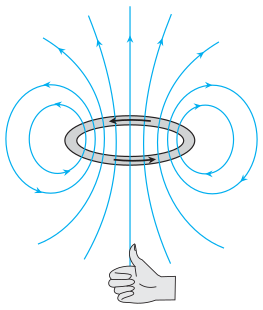
Figure — Stem asks to draw the magnetic field lines due to a current-carrying circular loop; the catalog figure is prec The magnetic field lines of a current-carrying circular loop form closed loops threading through the coil, straight along the central axis, and curving back around outside — the same pattern as the field of a bar magnet.
Description of the field-line pattern for a circular current loop (current flowing, say, anticlockwise when viewed from the front):
- Near the wire itself, the field lines are small concentric circles around the wire (as for any straight current element), by the right-hand rule.
- At the centre of the loop and along its axis, the field lines are straight, directed along the axis (perpendicular to the plane of the loop), all pointing the same way (say, out of the page if current is anticlockwise). …
- CBSE 2022Set ANNUAL1 markQ.Consider the circuit shown where APB and AQB are semicircles. What will be the magnetic field at the centre O of the circle?
›Reveal solutionSolution
The two semicircular arcs carry equal currents in opposite senses about O, so their fields cancel: BO=0.
The current i entering at A divides between the upper arc APB and the lower arc AQB. Since the two semicircles have the same radius and hence the same length and resistance, the current divides equally: each carries i/2.
The magnetic field at the centre of a semicircular arc of radius R carrying current I is
B=4Rμ0I.
So each arc gives a field of magnitude
B1=B2=4Rμ0(i/2)=8Rμ0i.
…
- CBSE 2019Set ANNUAL1 markMCQQ.Figure shows a circular coil with centre 'O'. If current flows through the coil, the magnetic field produced by it is maximum at :(a) Point O(b) Point P(c) Point K(d) Point N
›Reveal solutionSolution
For a current-carrying circular coil, the magnetic field on its axis is strongest exactly at the centre and falls off as you move away along the axis.
For a circular coil of radius R carrying current I, the magnetic field at a point on its axis at distance x from the centre is
B(x)=2(R2+x2)3/2μ0IR2
…
- CBSE 2018Set ANNUAL1 markMCQQ.The magnetic field at the centre of a circular coil of radius 5 cm carrying a current of 1 A is 1.256 T. If the radius is made 10 cm, then the magnetic field at the centre of the loop carrying same current is(a) 0.628 T(b) 2.512 T(c) 5.024 T(d) 0.314 T
›Reveal solutionSolution
The field at the centre of a circular current loop scales as 1/r at fixed current, so doubling the radius halves the field.
Step 1 — Field at centre of a circular loop
B=2rμ0I⟹B∝r1 (for fixed I)
…
🎓Unlock everything free for 14 days
- ✓Full step-by-step solutions
- ✓Concept-first explanations
- ✓Methods, shortcuts & mistakes
- ✓PYQ mapping + timed mock tests
Full access for 14 days. No credit card required.