Mathematics · Ch 9 — Straight Lines
Distance Between Two Parallel Lines
Distance Between Two Parallel Lines
Distance Between Two Parallel Lines
The idea is simple: two parallel lines never meet, so the distance between them is constant — the length of the perpendicular segment joining them. Because they have the same slope, we can write both lines in a form that makes this distance easy to compute.
Deriving the Formula for Slope-Intercept Form
Take two parallel lines in slope-intercept form:
The first line meets the x-axis where , giving , so . That point is .
The distance between the two parallel lines is the perpendicular distance from point to the second line . Rewrite the second line in general form: .
Using the perpendicular distance formula from a point to a line :
Here , , , and . Substituting:
Since distance is always positive, we take the absolute value. This gives the distance between the two parallel lines.
The General Form Formula
If the lines are given in general form:
Notice the coefficients and are the same — that's what makes them parallel. The slope of each line is , so . Substituting this into the slope-intercept formula:
Now, the y-intercept in slope-intercept form relates to the general form. From , we have . So and . Then: …
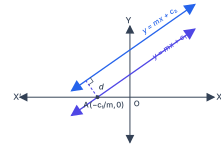
Drawn by us to help you understand the concept clearly, and verified to make sure it's accurate. For exams, practice from your NCERT textbook's own diagram.
What Fig. 9.15 Shows
The figure is a simple coordinate-plane sketch that builds the distance formula for parallel lines. Two parallel lines are drawn: one in indigo labelled , the other in blue labelled . Both have the same slope , so they never meet. The lower line (indigo) crosses the x-axis at point A, whose coordinates are given as . This is obtained by setting in and solving for .
A dashed perpendicular segment connects point A on the lower line to the upper line. A small right-angle mark at the foot of this dashed segment confirms it is truly perpendicular. The length of this dashed segment is labelled — the distance between the two parallel lines.
The key idea: the distance between two parallel lines is the length of the perpendicular from any point on one line to the other line. The figure chooses the x-intercept of the lower line as that convenient point.
The Formula Derived
From the figure, the distance is the perpendicular distance from point to the line . Using the point-to-line distance formula:
Here and are the y-intercepts of the two parallel lines, and is their common slope. The absolute value ensures the distance is positive regardless of which line is above the other.
The General Form
When the lines are given in general form and , the formula becomes:
This follows directly from the slope-intercept version because and (when ). Substituting these into the first formula and simplifying gives the general form.
The general-form formula uses and as the constant terms in . Students often mistakenly use the coefficients of or — only the constants change between the two parallel lines.
Why This Figure Matters …
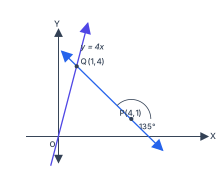
Drawn by us to help you understand the concept clearly, and verified to make sure it's accurate. For exams, practice from your NCERT textbook's own diagram.
Fig. 9.16 is a coordinate-plane diagram that illustrates a specific kind of distance problem: finding how far a given point is from a line, but measured along a second line (not along the perpendicular). This is a different idea from the perpendicular distance formula you use in most problems.
The plot shows two lines. The first is the line , which passes through the origin and has slope — it is quite steep. The second line passes through the point and has slope (because ). Its equation is . These two lines intersect at the point . At point , the angle that the second line makes with the positive -axis is marked.
The physical idea is this: you are standing at point and you walk along the line of slope until you hit the line . The distance you travel is the straight-line distance from to the intersection point . That distance is what the problem calls "the distance of the line from the point measured along the line making an angle of with the positive -axis."
The textbook uses this figure to develop the method for such problems. The key steps are:
-
Find the equation of the line along which you measure. Here, slope , passing through , giving , i.e. .
-
Find the intersection of this line with the given line . Solving the system:
gives , , so .
- The required distance is simply the distance between and :
…