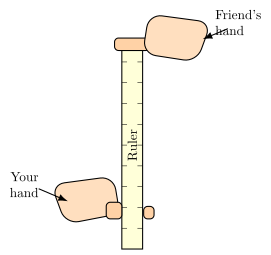
Q.Reaction time: When a situation demands our immediate action, it takes some time before we really respond. Reaction time is the time a person takes to observe, think and act. For example, if a person is driving and suddenly a boy appears on the road, then the time elapsed before he slams the brakes of the car is the reaction time. Reaction time depends on complexity of the situation and on an individual. You can measure your reaction time by a simple experiment. Take a ruler and ask your friend to drop it vertically through the gap between your thumb and forefinger. After you catch it, find the distance travelled by the ruler. In a particular case, was found to be . Estimate reaction time.
You're viewing a preview — the full solution, concept, methods & PYQ mapping are locked.
Start your 14-day free trial to unlock the full solution →The reaction time is estimated by modelling the ruler’s fall as free fall under gravity. Using with and , we get .
The idea behind this experiment is beautifully simple. When your friend releases the ruler, it begins to fall freely under gravity. Your job is to catch it as fast as you can after you see it drop. The distance the ruler falls before you catch it is directly related to how long it took your brain and muscles to react — that’s your reaction time. Because the ruler starts from rest and accelerates uniformly (ignoring air resistance), we can use the equations of motion for constant acceleration.
The key assumption is that the ruler’s motion is pure free fall, so its acceleration is downward. The distance it falls in time is given by , since initial velocity is zero. We just need to solve for .
-
Convert distance to metres. The given must be in SI units to match in .
.
-
Write the free-fall equation.
- Solve for .
- Substitute the numbers.
Compute the fraction:
Then take the square root:
…
Unlock everything free for 14 days
- Full step-by-step solutions
- Concept-first explanations
- Methods, shortcuts & mistakes
- PYQ mapping + timed mock tests
Full access for 14 days. No credit card required.