Q.Name the two important enzymes of C4 pathway, and explain their role in fixing CO2?
🔒You're viewing a preview — the full solution, concept, methods & PYQ mapping are locked.
🔒 Start your 14-day free trial to unlock the full solution →Concept understanding — C4 Pathway
The Problem C4 Plants Solve
Imagine a plant trying to photosynthesise on a hot, dry day. To stop water from escaping, it closes its stomata. But with stomata closed, CO₂ can't enter easily, and the oxygen produced inside the leaf builds up. The Calvin cycle's key enzyme, RuBisCO, is terrible at telling CO₂ apart from O₂. When O₂ levels are high, RuBisCO grabs oxygen instead of carbon dioxide, starting a wasteful process called photorespiration — it burns up energy and releases already-fixed CO₂. The plant is stuck: open stomata and lose water, or close them and starve the Calvin cycle.
C4 plants evolved a clever workaround. They don't try to make RuBisCO better. Instead, they build a CO₂-concentrating pump that delivers a high dose of CO₂ directly to RuBisCO, even when the leaf's air spaces are low on CO₂. This pump is the Hatch-Slack pathway.
The Two-Cell Strategy
C4 plants separate the initial capture of CO₂ from the Calvin cycle into two different types of cells:
- Mesophyll cells — the outer, sun-exposed layer. Here, CO₂ is caught quickly and converted into a 4-carbon compound (hence "C4").
- Bundle sheath cells — a tightly packed inner layer surrounding the leaf veins. Here, the 4-carbon compound releases its CO₂, creating a high local concentration for the Calvin cycle.
The mesophyll cells act like a trap, and the bundle sheath cells are where the real carbon fixation happens — but only after the trap has concentrated the CO₂.
The Hatch-Slack Pathway Step by Step
Step 1 — Fixation in mesophyll. CO₂ from the air (or from respiration inside the leaf) combines with phosphoenolpyruvate (PEP), a 3-carbon molecule. The enzyme PEP carboxylase catalyses this reaction, producing oxaloacetate (a 4-carbon compound). PEP carboxylase has no affinity for oxygen, so it never wastes time on photorespiration — it just grabs CO₂.
PEP+CO2PEP carboxylaseoxaloacetate
Step 2 — Conversion to a transport form. Oxaloacetate is unstable and is quickly reduced to malate (another 4-carbon compound) using NADPH. In some plants, it is converted to aspartate instead — the principle is the same.
Step 3 — Transport to bundle sheath. Malate moves from the mesophyll cell into the bundle sheath cell through plasmodesmata (tiny channels connecting plant cells).
Step 4 — Decarboxylation. Inside the bundle sheath, malate is broken down. It releases CO₂ and leaves behind pyruvate (a 3-carbon compound). The CO₂ now floods the bundle sheath, raising its concentration many times above what the air could provide.
Step 5 — Calvin cycle runs. RuBisCO in the bundle sheath now sees a high CO₂ / low O₂ environment. It fixes CO₂ into 3-phosphoglycerate (3-PGA) without wasting energy on photorespiration.
Step 6 — Pyruvate returns. The leftover pyruvate goes back to the mesophyll cell, where it is converted back into PEP using ATP. The cycle is ready to catch another CO₂.
Overall: CO2+PEPATP, NADPH3-PGA+PEP
The PEP is regenerated; the net gain is one CO₂ fixed into the Calvin cycle.
Why It Costs More but Works Better …
The two important enzymes of the C4 pathway are PEP carboxylase and RuBisCO.
- PEP carboxylase (PEPcase) is present in the mesophyll cells of C4 plants and catalyses the initial fixation of CO2 onto the 3-carbon phosphoenol pyruvate (PEP), forming the 4-carbon acid oxaloacetic acid (OAA) — the first step of the Hatch and Slack pathway.
- RuBisCO (RuBP carboxylase) is present in the bundle sheath cells and catalyses the fixation of the CO2 that is released there (from the breakdown of the transported C4 acid) onto RuBP, feeding it into the Calvin cycle to form PGA. …
The C4 pathway relies on two key enzymes working in two different cell types — PEP carboxylase in the mesophyll for initial CO2 capture, and RuBisCO in the bundle sheath cells for the actual Calvin-cycle fixation.
The C4 pathway achieves its distinctive two-step capture of carbon dioxide through the coordinated action of two enzymes located in two different cell types of the leaf.
The first enzyme, PEP carboxylase (PEPcase), is found in the mesophyll cells, which notably lack RuBisCO altogether. PEP carboxylase catalyses the fixation of atmospheric CO2 onto the 3-carbon acceptor phosphoenol pyruvate (PEP), producing the 4-carbon acid oxaloacetic acid (OAA) as the first stable product of the pathway. This OAA is subsequently converted into other 4-carbon compounds, such as malic acid or aspartic acid, which are then transported into the bundle sheath cells. …
Method 1 — Step by step
- Name the two enzymes: PEP carboxylase (PEPcase) and RuBisCO (RuBP carboxylase).
- Locate PEPcase's role: in the mesophyll cells, it fixes atmospheric CO2 onto the 3-C acceptor PEP, forming the 4-C acid OAA — the first step of the Hatch and Slack pathway.
- Trace the transport step: OAA is converted to malate/aspartate and moved into the bundle sheath cells. …
- AP EAPCET 2026Set ap-2026-05-19-AN1 markMCQQ.Choose the incorrect statements I) Productivity and yields are better in C4 than C3 plants. II) C4 plants show photorespiration. III) C4 acid from the mesophyll move to bundle sheath cells to release CO2. IV) In C4 plants intra cellular CO2 concentration is decreased. (A) I and IV (B) II and IV (C) I and III (D) III and IV
›Reveal solutionSolution
Statements II ('C4 plants show photorespiration') and IV ('CO2 concentration is decreased in C4 plants') are the incorrect ones; I and III correctly describe C4 physiology.
Concept and Intuition
The entire evolutionary advantage of the C4 pathway is to pump CO2 into the bundle sheath cells (via the mesophyll-to-bundle-sheath C4-acid shuttle), raising local CO2 concentration around RuBisCO enough to suppress its oxygenase activity — hence little to no photorespiration and higher productivity compared with C3 plants.
Step-by-Step Solution
- I: C4 plants like maize and sugarcane are indeed more productive than C3 plants due to reduced photorespiratory losses — this statement is correct, so it is not one of the 'incorrect' statements sought.
- II: claims C4 plants show photorespiration — in reality, their CO2-concentrating mechanism largely eliminates photorespiration; this statement is incorrect (qualifies as an answer).
- III: correctly describes the C4 shuttle — C4 acid formed in mesophyll cells moves to bundle sheath cells and is decarboxylated to release CO2 for the Calvin cycle — this statement is correct, so it is not sought. …
- AP EAPCET 2025Set ap-2025-05-19-AN1 markMCQQ.Choose the correct statement from the following I) In Hatch-Slack pathway mesophyll cells lack RuBisCO enzyme II) PEP carboxylase is present in bundle sheath of chloroplast III) OAA is formed in mesophyll cells. IV) PEP is primary CO2 acceptor present in chloroplast of bundle sheath cells. (A) I, II (B) II, III (C) I, III (D) II, IV
›Reveal solutionSolution
The C4/Hatch–Slack pathway spatially separates CO2 fixation (mesophyll, via PEP carboxylase forming OAA) from the Calvin cycle (bundle sheath, via RuBisCO). Statements I and III capture this correctly.
Concept and Intuition
C4 plants use "kranz anatomy" — two cell types cooperate. Mesophyll cells fix atmospheric CO2 using PEP carboxylase, which has a very high affinity for CO2 and no oxygenase activity, converting phosphoenolpyruvate (PEP, a 3-carbon compound) plus CO2 into oxaloacetic acid (OAA, 4 carbons). Mesophyll chloroplasts therefore do not need RuBisCO. The 4-carbon acid is shuttled (as malate/aspartate) into the bundle sheath cells, decarboxylated to release CO2 near RuBisCO, which then drives the ordinary Calvin cycle in the bundle sheath chloroplasts.
Step-by-Step Solution
- Statement I: "mesophyll cells lack RuBisCO" — true, RuBisCO is present only in bundle sheath chloroplasts.
- Statement II: "PEP carboxylase is present in bundle sheath" — false, PEP carboxylase is a mesophyll-cell (cytosolic) enzyme.
- Statement III: "OAA is formed in mesophyll cells" — true, this is exactly where PEP carboxylase fixes CO2. …
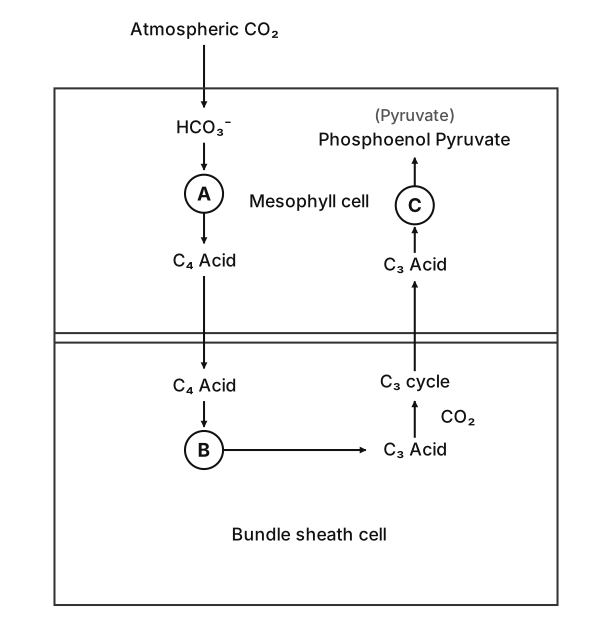
- AP EAPCET 2024Set ap-2024-05-16-FN1 markMCQQ.Identify A, B, and C in the given Hatch and slack pathway. [FIGURE] (a diagram of the Hatch and Slack (C4) pathway: Atmospheric CO2 enters the Mesophyll cell to form HCO3-, which is converted at step A into C4 Acid; the C4 Acid passes into the Bundle sheath cell where step B converts it to C3 Acid while releasing CO2 into the C3 cycle; in the Bundle sheath cell, Phosphoenol Pyruvate is regenerated from Pyruvate at step C, which diffuses back to the mesophyll cell) (A) A – Fixation B – Regeneration C – Decarboxylation (B) A – Regeneration B – Fixation C – Decarboxylation (C) A – Decarboxylation B – Regeneration C – Fixation (D) A – Fixation B – Decarboxylation C – Regeneration
›Reveal solutionSolution
The Hatch-Slack (C4) pathway involves three key steps: fixation of CO₂ into a C4 acid in mesophyll cells, decarboxylation of that C4 acid in bundle sheath cells to release CO₂ for the Calvin cycle, and regeneration of phosphoenol pyruvate from pyruvate. Matching these to the diagram gives A = Fixation, B = Decarboxylation, C = Regeneration, which corresponds to option (D).
The question asks us to identify the three labelled steps (A, B, C) in the classic C4 (Hatch-Slack) photosynthetic pathway. The diagram shows a flow from atmospheric CO₂ through mesophyll cells into bundle sheath cells and back, with three circled letters marking where key enzymatic reactions occur.
Concept and intuition:
In C4 plants, the problem is that the Calvin cycle’s main enzyme (RuBisCO) also reacts with oxygen (photorespiration). To avoid this, C4 plants concentrate CO₂ in bundle sheath cells. They do this by first fixing CO₂ into a 4-carbon acid in mesophyll cells, then transporting that acid to bundle sheath cells, where it is decarboxylated to release CO₂ for the Calvin cycle. The leftover 3-carbon compound (pyruvate) is then sent back to mesophyll cells to regenerate the initial CO₂ acceptor (phosphoenol pyruvate, PEP). So the three steps are: Fixation (A), Decarboxylation (B), Regeneration (C).
Now let’s match this to the diagram step by step.
-
Step A – Fixation
In the mesophyll cell, atmospheric CO₂ is first converted to bicarbonate (HCO₃⁻). Then, the enzyme PEP carboxylase combines HCO₃⁻ with phosphoenol pyruvate (PEP) to form a 4-carbon acid (oxaloacetate, then malate or aspartate). This is the fixation of CO₂ into a C4 compound. In the diagram, circled A sits between HCO₃⁻ and “C4 Acid” in the mesophyll cell. So A must be Fixation.
-
Step B – Decarboxylation
The C4 acid moves into the bundle sheath cell. There, it is broken down (decarboxylated) to release CO₂, which enters the Calvin cycle (C3 cycle), and a 3-carbon acid (pyruvate or alanine) remains. In the diagram, circled B sits between “C4 Acid” and “C3 Acid” in the bundle sheath cell, with CO₂ being released toward the C3 cycle. So B is Decarboxylation.
-
Step C – Regeneration …
-
- AP EAPCET 2023Set ap-2023-05-22-AN1 markMCQQ.Assertion (A): C4 plant loses only half of the water compared to C3 plant for the same amount of CO2 fixed. Reason (R): C4 photosynthetic system is evolved for maximizing the availability of CO2 while minimizing water loss. (A) Both A and R are correct. R is the correct explanation for A. (B) Both A and R are correct, but R is not the correct explanation for A. (C) A is correct but R is incorrect. (D) A is incorrect but R is correct.
›Reveal solutionSolution
C4 plants really do use about half the water of C3 plants per unit CO2 fixed, and this is precisely because the C4 pathway evolved to concentrate CO2 efficiently while minimizing water loss — so both statement and reason are true, and R explains A.
Concept and Intuition
C4 plants possess a specialized "CO2-pump" (Kranz anatomy, PEP carboxylase in mesophyll cells concentrating CO2 into bundle-sheath cells for RuBisCO) that lets them achieve efficient carbon fixation with less stomatal opening (and hence less transpirational water loss) than C3 plants, while also suppressing wasteful photorespiration.
Step-by-Step Solution
- Assertion: C4 plants lose only about half the water of C3 plants for the same amount of CO2 fixed — this is a well-documented, quantitatively established physiological fact (reflected in water-use efficiency comparisons between C4 crops like maize/sugarcane and C3 crops like rice/wheat).
- Reason: the C4 photosynthetic system (Kranz anatomy + the PEP carboxylase CO2-concentrating step) evolved specifically to maximize CO2 availability at the site of RuBisCO while allowing stomata to remain more closed, thereby minimizing water loss. …
- AP EAPCET 2023Set ap-2023-05-23-AN1 markMCQQ.Primary CO2 acceptor in C4 plants (A) Phospho enol pyruvic acid (B) Ribulose 1,5 bis phosphate carboxylase (C) Oxalo acetic acid (D) Phospho glyceric acid.
›Reveal solutionSolution
This tests recall of the primary CO2-fixing molecule in the C4 pathway of photosynthesis — phosphoenolpyruvate (PEP).
Concept and Intuition
C4 plants use a specialised carbon-fixation pathway (the Hatch-Slack pathway) as an initial CO2-concentrating step before the Calvin cycle. In mesophyll cells, CO2 is combined with a 3-carbon compound, phosphoenolpyruvic acid (PEP), by the highly CO2-affinitive enzyme PEP carboxylase, producing the 4-carbon compound oxaloacetic acid (OAA). This is distinct from C3 plants, where CO2 is fixed directly onto RuBP by RuBisCO.
Step-by-Step Solution
- Recall that C4 plants have a two-stage carbon fixation process — an initial fixation in mesophyll cells followed by the Calvin cycle in bundle sheath cells.
- The initial (primary) CO2 acceptor in mesophyll cells is phosphoenolpyruvic acid (PEP), not RuBP (which is the acceptor in the Calvin cycle, common to both C3 and C4 plants).
- PEP + CO2 → Oxaloacetic acid (OAA), catalysed by PEP carboxylase. …
- AP EAPCET 2022Set ap-2022-07-11-FN1 markMCQQ.Growing CAM plants in the bed room is advantageous because (A) They release CO2 during night time (B) They release O2 in the night (C) They fix CO2 in the night (D) They release H2O during night
›Reveal solutionSolution
CAM plants are recommended for bedrooms because they take up (fix) CO2 at night rather than adding to it, unlike the usual nighttime respiration pattern of most plants.
Concept and Intuition
Crassulacean Acid Metabolism (CAM) is a water-conserving adaptation of succulents (cacti, Bryophyllum, Agave etc.) native to arid habitats: stomata open only at night to minimise transpirational water loss, and CO2 entering then is fixed by PEP-carboxylase into oxaloacetate, reduced to malic acid and stored in the vacuole. During the day, stomata stay shut (preventing water loss) while the stored acid is decarboxylated, releasing CO2 internally for the light-independent (Calvin cycle) reactions — powered by the light reactions, which necessarily still occur only in daylight.
Step-by-Step Solution
- Note CAM's defining feature: night-time stomatal opening and CO2 fixation into organic acids. …
- AP EAPCET 2022Set ap-2022-07-11-FN1 markMCQQ.Identify the type of CO2 fixation pathway seen in the succulent plant species (A) CAM pathway (B) C3 pathway (C) C2 pathway (D) C4 pathway
›Reveal solutionSolution
Succulents fix carbon dioxide through the CAM pathway as a water-conserving adaptation.
Concept and Intuition
Succulent (water-storing) plants live in hot, dry habitats where daytime stomatal opening would cause excessive water loss. Their solution is to open stomata only at night, fixing CO2 into organic acids (via PEP carboxylase) that are stored and only released internally for the Calvin cycle during the day when stomata are shut. This is Crassulacean Acid Metabolism (CAM), distinct from ordinary C3 photosynthesis (no such nocturnal storage), C4 photosynthesis (spatial, not temporal, separation of CO2 fixation across mesophyll and bundle-sheath cells, with stomata open by day), and the C2 (photorespiratory) pathway which is not a primary carbon-fixation route.
Step-by-Step Solution
- Identify the ecological clue: "succulent plant species" strongly signals a xerophytic water-conservation adaptation. …
- AP EAPCET 2021Set ap-2021-09-06-AN1 markMCQQ.The first stable compound formed in C4 plants ________ (A) Phospho glyceric Acid (B) Pyruvic acid (C) Oxalo acetic acid (D) Succinic acid
›Reveal solutionSolution
Tests the defining feature of C4 photosynthesis — the identity of the first CO2-fixation product; the answer is oxaloacetic acid (OAA).
Concept and Intuition
C3 and C4 plants are named after the number of carbons in the first stable product of CO2 fixation. In C3 plants (Calvin cycle only), RuBisCO fixes CO2 onto RuBP to directly give two molecules of the 3-carbon PGA. In C4 plants, CO2 is first captured in mesophyll cells by PEP carboxylase (PEPcase), which combines CO2 with the 3-carbon PEP to form a 4-carbon acid. This initial "CO2 pump" concentrates CO2 before it ever reaches RuBisCO in the bundle sheath, suppressing photorespiration — the core adaptive advantage of the C4 pathway.
Step-by-Step Solution
- Recall that C4 plants possess Kranz anatomy: mesophyll cells (outer) and bundle sheath cells (inner, around the vein) with division of labour.
- In the mesophyll cytoplasm, PEP carboxylase catalyzes: PEP (3C) + CO2 → OAA (4C).
- OAA, being unstable, is quickly converted to malate or aspartate (also 4C) for transport to the bundle sheath cells.
- In the bundle sheath, the 4C acid is decarboxylated to release CO2, which then enters the ordinary Calvin cycle (C3 pathway) via RuBisCO. …
- AP EAPCET 2021Set ap-2021-09-06-FN1 markMCQQ.Identify the reaction for which the C4 plants require some extra ATP molecules in comparison to C3 plants? (A) Conversion of PEP to OAA (B) Conversion of Pyruvate to PEP (C) Conversion of Malate to OAA (D) Conversion of PEP to Malate
›Reveal solutionSolution
The extra ATP cost unique to C4 photosynthesis comes from regenerating PEP from pyruvate in the mesophyll cell, via the enzyme pyruvate orthophosphate dikinase.
Concept and Intuition
C4 plants use a two-cell, two-step CO2-concentrating mechanism: mesophyll cells fix atmospheric CO2 onto PEP (via PEP carboxylase) to form a 4-carbon acid (oxaloacetate), which is converted to malate/aspartate and moved to bundle sheath cells. There, CO2 is released for fixation by RuBisCO/Calvin cycle (as in C3 plants), and the resulting 3-carbon compound, pyruvate, diffuses back to the mesophyll. To sustain the cycle, pyruvate must be reconverted into PEP — this regeneration step uses the enzyme pyruvate orthophosphate dikinase and effectively consumes two high-energy phosphate bonds (ATP → AMP + PPi, and PPi is hydrolysed to 2 Pi), i.e., an extra ATP-equivalent cost not present in C3 photosynthesis.
Step-by-Step Solution
- Recall that C3 photosynthesis fixes CO2 directly onto RuBP using RuBisCO in a single cell type — no extra ATP beyond the standard Calvin cycle cost.
- Recall the C4 pathway's extra steps: PEP carboxylation in mesophyll, decarboxylation in bundle sheath, and pyruvate shuttling back. …
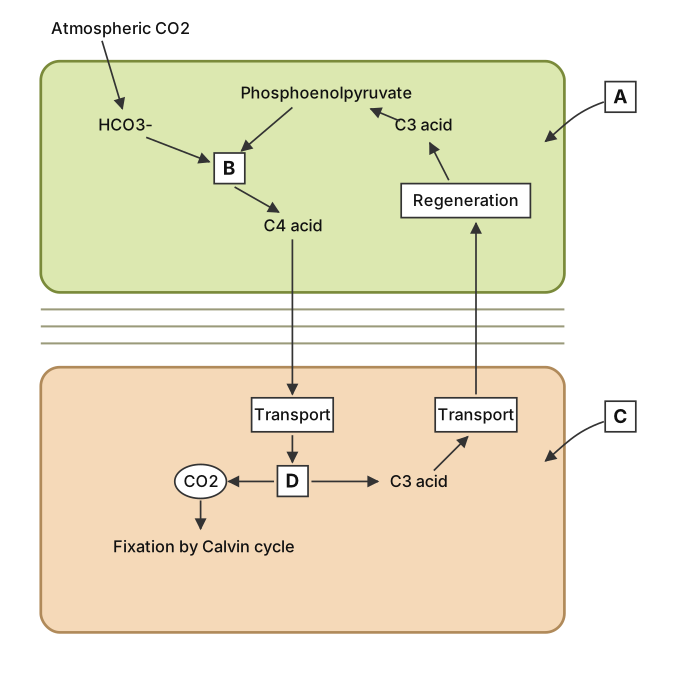
- AP EAPCET 2021Set ap-2021-10-05-FN1 markMCQQ.Identify A, B, C and D in the given figure and choose the correct option accordingly? [FIGURE] (a C4 photosynthesis pathway diagram showing a mesophyll-cell-like structure connected via plasmodesmata to a bundle-sheath-cell-like structure; box A points into the outer/upper cell; box B sits where HCO3- and phosphoenolpyruvate combine to form C4 acid, with 'Regeneration' producing C3 acid alongside it; box C points into the lower/inner cell; box D sits where CO2 is released from C4 acid, feeding the Calvin cycle and regenerating C3 acid) (A) A – Mesophyll cell, B – Fixation, C – Bundle sheath cell, D – Decarboxylation (B) A – Mesophyll cell, B – Decarboxylation, C – Bundle sheath cell, D – Fixation (C) A – Chloroplast, B – Decarboxylation, C – Bundle sheath cell, D – Fixation (D) A – Chloroplast, B – Fixation, C – Bundle sheath cell, D – Fixation
›Reveal solutionSolution
The figure shows the C4 photosynthetic pathway: A is the mesophyll cell, B is the initial CO₂ fixation (forming C4 acid), C is the bundle sheath cell, and D is the decarboxylation step that releases CO₂ for the Calvin cycle. The correct option is (A).
The key to this question is recognizing the two-cell architecture of C4 photosynthesis. In C4 plants, CO₂ is first fixed in mesophyll cells (the upper cell) into a four-carbon acid, which is then shuttled to bundle sheath cells (the lower cell), where CO₂ is released and refixed by the Calvin cycle. The labels in the diagram correspond to these distinct steps and cell types.
Let’s walk through each label step by step:
-
Label A – The upper cell
The diagram shows an upper cell with an arrow pointing into it, labeled “Atmospheric CO₂” entering. This cell is where the initial capture of CO₂ occurs. In C4 photosynthesis, this is the mesophyll cell (not a chloroplast alone, because the entire cell is involved in the pathway). So A = Mesophyll cell.
-
Label B – The box where HCO₃⁻ and PEP combine
Inside the mesophyll cell, a box labeled B shows the reaction: HCO₃⁻ + phosphoenolpyruvate (PEP) → C4 acid. This is the first fixation of CO₂ (as bicarbonate) into a four-carbon compound. The enzyme PEP carboxylase catalyzes this. Therefore, B = Fixation (specifically, the initial CO₂ fixation step).
-
Label C – The lower cell
The lower cell receives the C4 acid via plasmodesmata. This is where the Calvin cycle operates and CO₂ is released from the C4 acid. In C4 plants, this is the bundle sheath cell. So C = Bundle sheath cell.
-
Label D – The box where CO₂ is released from C4 acid
Inside the bundle sheath cell, a box labeled D shows the C4 acid being broken down to release CO₂, which then enters the Calvin cycle. This step is decarboxylation (the release of CO₂ from the four-carbon acid). The regenerated C3 acid is sent back to the mesophyll cell. Thus, D = Decarboxylation. …
-
🎓Unlock everything free for 14 days
- ✓Full step-by-step solutions
- ✓Concept-first explanations
- ✓Methods, shortcuts & mistakes
- ✓PYQ mapping + timed mock tests
Full access for 14 days. No credit card required.