Q.Explain the structure of the CO32− ion in terms of resonance.
Concept understanding — Lewis Dot Structures
Why do we need Lewis dot structures?
Atoms are held together in molecules by chemical bonds — but what exactly is a bond? In the early 20th century, Gilbert N. Lewis realised that the key lies in the valence electrons (the outermost electrons). He noticed that atoms of noble gases (like Ne, Ar) are extremely stable and unreactive, and they all have 8 electrons in their outermost shell (except helium, which has 2). This led to the octet rule: atoms tend to gain, lose, or share electrons to achieve a full outer shell of 8 electrons (or 2 for hydrogen).
Lewis dot structures are simply a shorthand picture of this idea. They show:
- Which atoms are connected to which
- How many valence electrons each atom contributes
- How those electrons are arranged as bonding pairs (shared) or lone pairs (unshared)
The precise statement
A Lewis dot structure (or electron dot structure) represents the valence electrons of an atom or molecule using dots placed around the element's symbol. Each dot stands for one valence electron. Shared pairs (bonds) are shown as lines, and unshared pairs as pairs of dots.
For a single atom, you write the element symbol and place dots on its four sides (top, bottom, left, right) — up to 8 dots. The order of filling doesn't matter for the final picture, but conventionally you place one dot on each side first, then pair them up.
For example:
- Carbon (group 14, 4 valence electrons): ⋅C⋅ (four single dots)
- Oxygen (group 16, 6 valence electrons): ⋅O¨⋅ (two single dots and two pairs)
How to draw a Lewis structure for a molecule
Here's the step-by-step method you'll use in exams:
-
Count total valence electrons — add up valence electrons from all atoms. For ions, add 1 electron for each negative charge, subtract 1 for each positive charge.
-
Identify the central atom — usually the least electronegative element (not hydrogen or fluorine). Place it in the centre.
-
Connect atoms with single bonds — each bond uses 2 electrons. Subtract these from your total.
-
Complete octets of outer atoms — place remaining electrons as lone pairs on terminal atoms (except hydrogen, which only needs 2).
-
Place leftover electrons on the central atom — if any remain.
-
If the central atom has fewer than 8 electrons, form multiple bonds — move lone pairs from outer atoms to create double or triple bonds until the central atom has an octet.
A common mistake: forgetting that hydrogen only needs 2 electrons (a duet), not 8. Never put more than 2 electrons around H.
A concrete example: water (H₂O)
- Total valence electrons: O has 6, each H has 1 → 6+1+1=8 electrons.
- Central atom: oxygen (least electronegative after H).
- Connect: O—H bonds (2 bonds × 2 electrons = 4 electrons used).
- Remaining: 8−4=4 electrons → place as two lone pairs on oxygen.
- Check: O has 2 bonds (4 electrons) + 2 lone pairs (4 electrons) = 8. Each H has 1 bond (2 electrons) = 2. Done.
The structure: H−O¨−H
What the structure tells you
Once drawn, a Lewis structure reveals:
- Bond order (single, double, triple)
- Lone pairs (which affect molecular shape and reactivity)
- Formal charge (a bookkeeping tool to check which structure is most stable)
- Resonance (when multiple valid structures exist for the same molecule)
Lewis structures are not 3D pictures — they show connectivity and electron arrangement in a flat diagram. Actual molecular shapes are determined by VSEPR theory, which builds on the Lewis structure.
Limitations you should know
The octet rule works beautifully for second-period elements (C, N, O, F) but has exceptions:
- Incomplete octet: Be, B, Al (stable with 4 or 6 electrons)
- Expanded octet: elements in period 3 and beyond (P, S, Cl) can have more than 8 electrons
- Odd-electron molecules: NO, NO₂ (can't give every atom an octet)
For your exams, always check if the central atom is from period 2 or below — that tells you whether expanded octets are possible.
Final takeaway
Lewis dot structures are your first tool for understanding bonding. They translate the abstract idea of electron sharing into a simple visual language. Master the counting and placement steps, and you'll be able to draw any small molecule's structure confidently.
Lewis Dot Structures are taught in the NCERT Class 11 Chemistry chapter on Chemical Bonding and Molecular Structure, matching searches like "Lewis structure: rules and examples" or "chemical bonding important questions class 11 chemistry". Drawing these structures correctly is foundational for JEE Main and NEET chemistry questions on VSEPR shapes, hybridisation, and resonance that build directly on this skill.
Concept: Resonance structures and Lewis dot representation
The carbonate ion CO32− has 24 valence electrons (4 from C, 18 from three O atoms, plus 2 from the charge). Carbon sits at the center bonded to three oxygen atoms.
If we place a C=O double bond with one oxygen and C–O single bonds with the other two (which carry the negative charges), we get one valid Lewis structure. However, we can draw this arrangement in three equivalent ways — the double bond can be with any of the three oxygen atoms.
These three structures are resonance forms. (These three canonical structures — I, II, and III — are exactly the structures shown in Fig. 4.4 of the textbook.) The actual ion is a resonance hybrid: all three C–O bonds are identical and intermediate in length (between single and double), each with bond order 34. The negative charge is delocalized equally over all three oxygen atoms (−32 each). The geometry is trigonal planar with 120° bond angles.
Resonance does not mean the ion flips between structures — it exists as a single hybrid with electron density spread symmetrically.
The CO32− ion is a resonance hybrid of three equivalent structures with delocalized π-bonding, resulting in three identical C–O bonds of order 34 and trigonal planar geometry.
The carbonate ion CO32− has three equivalent resonance structures with delocalized π bonding, giving each C–O bond a bond order of 34 and explaining its trigonal planar geometry with 120° bond angles.
The carbonate ion is a textbook example of why we need resonance theory. If you try to draw a single Lewis structure, you'll find yourself forced to choose which oxygen gets the double bond—but experiments show all three C–O bonds are identical in length and strength. That's the signature of resonance: the true structure is a hybrid, not any one drawing.
Why resonance matters here
Carbon has 4 valence electrons, each oxygen has 6, and the 2− charge adds 2 more, giving us 4+3(6)+2=24 valence electrons total. Carbon sits in the center (least electronegative), bonded to three oxygens. To satisfy the octet rule for carbon, we need at least one double bond—but there's no reason to prefer one oxygen over another. Nature doesn't pick favorites: the π electrons spread out equally across all three bonds.
Step-by-step construction
1. Draw the skeleton and count electrons
Place carbon at the center with single bonds to three oxygens:
O−C−Owith one more O
That uses 3×2=6 electrons, leaving 24−6=18 to distribute.
2. Complete octets on the terminal atoms first
Each oxygen needs 6 more electrons (3 lone pairs) to complete its octet. That accounts for 3×6=18 electrons—exactly what we have left. But now carbon has only 6 electrons (three single bonds), violating the octet rule.
3. Form a double bond to satisfy carbon's octet
Move one lone pair from any oxygen to form a C=O double bond. Now carbon has 8 electrons. You can choose any of the three oxygens, giving three equivalent structures:
Structure I:Structure II:Structure III:O−−C=Owith O− belowO=C−O−with O− belowO−−C−O−with O double-bonded below
Each structure has one C=O double bond and two C−O− single bonds. The negative charges sit on the oxygens with single bonds.
4. Recognize these as resonance structures
The three structures differ only in the placement of electrons, not atoms. The double-headed arrow ↔ connects them:
O−−C..=O↔O=C..−O−↔(third equivalent form)
Resonance structures are not in equilibrium. The ion doesn't flip between them. The true structure is a hybrid—a weighted average where each C–O bond has partial double-bond character.
5. Determine the bond order
In the hybrid, each C–O bond is identical. Across the three resonance structures, each oxygen participates in one double bond (bond order 2) and two single bonds (bond order 1 each) when you sum over all structures. Averaging:
Bond order per C–O=31×2+2×1=34≈1.33
This intermediate bond order (between single and double) matches experimental bond lengths of about 129 pm—shorter than a typical C–O single bond (143 pm) but longer than a C=O double bond (120 pm).
6. Geometry and charge distribution
The ion is trigonal planar with sp2 hybridization on carbon and bond angles of 120°. The negative charge is delocalized equally over all three oxygens, so each carries −32 of an electron's charge. This delocalization stabilizes the ion significantly compared to any single structure.
Whenever you see equivalent atoms around a central atom and not enough electrons to give them all double bonds, think resonance. The π system will delocalize.
The CO32− ion is best described by three equivalent resonance structures, each with one C=O double bond and two C–O single bonds in different positions, resulting in a resonance hybrid with delocalized π bonding, equal C–O bond lengths (bond order 34), and trigonal planar geometry.
Showing the 12 most recent of 13 on this concept.
- AP EAPCET 2026Set eng-2026-05-14-AN1 markMCQQ.In which of the following, the number of valence electrons is maximum? (A) PO43− (B) SO32− (C) CO32− (D) CNO−
›Reveal solutionSolution
Simple valence-electron counting (atoms' group valence electrons plus extra electrons equal to the ionic negative charge) shows PO43− has the most, at 32.
Concept and Intuition
For a polyatomic ion, total valence electrons = (sum of each atom's own valence electrons) + (1 electron for each unit of negative charge), or − 1 electron for each unit of positive charge. This total is what you'd distribute when drawing the Lewis structure.
Step-by-Step Solution
- PO43−: P (group 15, 5 e⁻) + 4×O (group 16, 6 e⁻ each = 24) + 3 (extra for 3− charge) = 5+24+3=32.
- SO32−: S (6 e⁻) + 3×O (18) + 2 (charge) = 6+18+2=26.
- CO32−: C (4 e⁻) + 3×O (18) + 2 (charge) = 4+18+2=24.
- CNO−: C (4) + N (5) + O (6) + 1 (charge) = 4+5+6+1=16.
- Comparing 32, 26, 24, 16 — the maximum is PO43− at 32.
Common Mistakes
- Forgetting to add electrons for negative ionic charge (or subtracting them by mistake).
- Miscounting oxygen atoms per formula.
✓Final answerThe correct option is (A) — PO43−.
ANSWER: A
- AP EAPCET 2025Set ap-2025-05-20-AN1 markMCQQ.Observe the following molecules ClF3,SF6,CH4,NH3,SF4,XeF4,PCl5. The number of molecules in which central atom has expanded octet is (A) 6 (B) 4 (C) 5 (D) 3
›Reveal solutionSolution
Counting the electrons around each central atom shows five of the seven molecules (all except CH₄ and NH₃) have an expanded octet.
Concept and Intuition
An expanded octet occurs when the central atom is surrounded by more than 8 electrons — possible for elements in period 3 or beyond that have accessible d-orbitals (or, in modern treatment, enough valence orbitals) to accommodate extra electron pairs.
Step-by-Step Solution
- ClF₃: Cl has 3 bond pairs + 2 lone pairs = 10 electrons → expanded.
- SF₆: S has 6 bond pairs = 12 electrons → expanded.
- CH₄: C has 4 bond pairs = 8 electrons → normal octet.
- NH₃: N has 3 bond pairs + 1 lone pair = 8 electrons → normal octet.
- SF₄: S has 4 bond pairs + 1 lone pair = 10 electrons → expanded.
- XeF₄: Xe has 4 bond pairs + 2 lone pairs = 12 electrons → expanded.
- PCl₅: P has 5 bond pairs = 10 electrons → expanded.
- Molecules with expanded octet: ClF₃, SF₆, SF₄, XeF₄, PCl₅ = 5 molecules.
Common Mistakes
- Forgetting to count lone pairs on the central atom (e.g., missing SF₄'s lone pair).
- Miscounting NH₃ or CH₄ as expanded when they in fact obey the normal octet rule.
✓Final answerThe correct option is (C) — 5.
ANSWER: C
- AP EAPCET 2024Set ap-2024-05-17-FN1 markMCQQ.Two statements are given below Statement I: Octet theory accounts for the shape of the molecules Statement II: Octet theory does not explain the relative stability of the molecules The correct answer is (A) Both statement-I and statement-II are correct (B) Both statement-I and statement-II are not correct (C) Statement-I is correct but statement-II is not correct (D) Statement-I is not correct but statement-II is correct
›Reveal solutionSolution
The octet theory (Lewis theory) helps predict molecular shapes only in a very limited sense, but it fundamentally fails to explain the relative stability of molecules. Therefore Statement I is not correct, and Statement II is correct.
The key here is to understand what the octet theory (also called the Lewis octet rule) actually does and does not do. It was a pioneering idea: atoms tend to gain, lose, or share electrons to achieve a stable configuration of eight valence electrons (like a noble gas). But it is a qualitative model with serious limitations.
Why this approach works:
We need to test each statement against the known capabilities and failures of the octet theory. Statement I claims it "accounts for the shape of molecules." Statement II claims it "does not explain relative stability." If we recall that molecular shape is determined by electron-pair repulsion (VSEPR theory), which is a separate idea built on Lewis structures, and that stability depends on bond energies and resonance—things the octet rule cannot handle—we can judge each statement.
-
Examine Statement I: "Octet theory accounts for the shape of molecules."
The octet theory itself only tells us how many bonds an atom typically forms (e.g., carbon forms 4 bonds to get 8 electrons). It does not predict the three-dimensional arrangement of atoms. That job belongs to VSEPR theory (Valence Shell Electron Pair Repulsion), which uses the number of electron domains around a central atom—not just the octet rule. For example, both water (bent) and carbon dioxide (linear) satisfy the octet rule, but the octet theory alone cannot tell you why one is bent and the other linear. So Statement I is incorrect.
-
Examine Statement II: "Octet theory does not explain the relative stability of molecules."
This is true. The octet rule is a counting rule, not an energy rule. It cannot compare the stability of two molecules that both satisfy the octet (e.g., why N2 is more stable than O2, or why some molecules with expanded octets are stable). Stability depends on bond enthalpies, resonance, and molecular orbital theory—none of which are part of the simple octet model. So Statement II is correct.
-
Combine the results:
- Statement I: Not correct
- Statement II: Correct This matches option (D).
Watch outA common mistake is to think that because Lewis structures help draw shapes (by showing bonds and lone pairs), the octet theory itself accounts for shape. But the octet rule is about electron count, not geometry. Shape comes from VSEPR, which is a separate concept.
TipA neat way to remember: The octet rule tells you how many bonds, VSEPR tells you where the bonds go, and thermodynamics tells you how stable the result is.
✓Final answerThe correct option is (D).
ANSWER: D
-
- AP EAPCET 2024Set eng-2024-05-18-FN1 markMCQQ.The correct formula used to determine the formal charge (Qf) on an atom in the given Lewis structure of a molecule or ion is (V = number of valence electrons in free atom, U = number of unshared electrons on the atom, B = number of bonds around the atom) (A) Qf=V−(BU) (B) Qf=V+(U−B) (C) Qf=V−(U+B) (D) Qf=V−(UB)
›Reveal solutionSolution
Formal charge is the free-atom valence electron count minus the electrons "owned" by the atom in the structure — its lone-pair electrons plus one electron per bond.
Concept and Intuition
The standard formal charge formula is FC=V−Nnonbonding−21Nbonding, where Nbonding is the total number of bonding electrons (2 per bond). Since the question defines B as the number of bonds (not bonding electrons), 21Nbonding=B directly, giving Qf=V−U−B=V−(U+B).
Step-by-Step Solution
- Start from FC=V−(lone-pair electrons)−21(bonding electrons).
- Here, U = lone-pair (unshared) electron count directly, and B = number of bonds, so 21(bonding electrons)=B.
- Qf=V−U−B=V−(U+B)
Common Mistakes
- Adding U and B with the wrong sign, or dividing by B instead of subtracting it (options A and D use invalid ratio forms).
✓Final answerThe correct option is (C) — Qf=V−(U+B).
ANSWER: C
- AP EAPCET 2024Set eng-2024-05-20-FN1 markMCQQ.Observe the following structure: (1)O..=(2)N−(3)O..: — atom(1) is the doubly-bonded oxygen (with two lone pairs shown), atom(2) is the central nitrogen, and atom(3) is the singly-bonded oxygen (with three lone pairs shown, i.e. bearing the negative charge). The formal charges on the atoms 1, 2, 3 respectively are (A) +1, 0, -1 (B) 0, 0, -1 (C) -1, 0, +1 (D) 0, 0, 0
›Reveal solutionSolution
Applying the formal-charge formula to each atom in this O=N-O⁻ resonance structure gives 0 on
the double-bonded oxygen, 0 on nitrogen, and −1 on the singly-bonded oxygen.
Concept and Intuition
Formal charge =(valence electrons)−(non-bonding electrons)−21(bonding electrons). It's computed atom by atom from the Lewis structure exactly
as drawn (this is the classic nitrite ion, NO2−, resonance form).
Step-by-Step Solution
- Atom 1 (O, double-bonded to N, 2 lone pairs = 4 non-bonding e⁻): FC=6−4−21(4)=6−4−2=0.
- Atom 2 (N, central, one double bond = 4 bonding e⁻ + one single bond = 2 bonding e⁻, total 6 bonding e⁻; 1 lone pair = 2 non-bonding e⁻): FC=5−2−21(6)=5−2−3=0.
- Atom 3 (O, single-bonded to N, 3 lone pairs = 6 non-bonding e⁻): FC=6−6−21(2)=6−6−1=−1.
- Sum of formal charges =0+0−1=−1, consistent with the overall ionic charge of this nitrite-like species.
Common Mistakes
- Miscounting lone pairs on the drawn atoms (the two oxygens are NOT equivalent in this resonance structure — one carries 2 lone pairs, the other 3).
- Forgetting that formal charge on the doubly-bonded oxygen comes out to 0 here (not +1), because it still keeps 2 lone pairs.
✓Final answerThe correct option is (B) — 0, 0, -1.
ANSWER: B
- AP EAPCET 2023Set ap-2023-05-23-AN1 markMCQQ.In OF2 number of bond pairs and lone pairs of electrons are respectively (A) 2, 6 (B) 2, 8 (C) 2, 9 (D) 2, 10
›Reveal solutionSolution
OF2 has 2 O–F bond pairs; counting the lone pairs on oxygen (2) and both fluorines (3 each, so 6 total) gives 8 lone pairs overall.
Concept and Intuition
Oxygen has 6 valence electrons; in OF2 it uses 2 electrons to form 2 single bonds to fluorine, leaving 4 electrons as 2 lone pairs. Each fluorine has 7 valence electrons, uses 1 in the O-F bond, leaving 6 electrons as 3 lone pairs per fluorine atom.
Step-by-Step Solution
- Structure: F–O–F (bent, like water, due to O's 2 lone pairs).
- Bond pairs: 2 (one O-F bond to each fluorine).
- Lone pairs on O: 2.
- Lone pairs on each F: 3, so both fluorines together: 3×2=6.
- Total lone pairs: 2+6=8.
Common Mistakes
- Forgetting to count lone pairs on both fluorine atoms (only counting one F's lone pairs, or omitting oxygen's lone pairs).
✓Final answerThe correct option is (B) — 2, 8.
ANSWER: B
- AP EAPCET 2023Set eng-2023-05-15-FN1 markMCQQ.Identify incorrectly matched set from the following (A) Molecules with incomplete octet - BeH2,BCl3 (B) Polar molecules - BF3,CCl4 (C) Molecules with expanded octet - PCl5,SF6 (D) Odd electron molecules - NO,NO2
›Reveal solutionSolution
Check each pairing against molecular geometry/electron count; BF3 and CCl4 are actually nonpolar due to symmetry, so option (B) is the incorrect match.
Concept and Intuition
Molecular polarity depends on both bond polarity and molecular geometry — even polar bonds can give a nonpolar molecule if the geometry is symmetric enough that individual bond dipoles cancel vectorially.
Step-by-Step Solution
- (A) BeH2 (2 bond pairs around Be) and BCl3 (3 bond pairs around B) both leave the central atom with fewer than 8 electrons — genuinely incomplete octet. Correctly matched.
- (B) BF3 is trigonal planar (symmetric, dipoles cancel) and CCl4 is tetrahedral (symmetric, dipoles cancel) — both are nonpolar, not polar. Incorrectly matched.
- (C) PCl5 (10 electrons around P) and SF6 (12 electrons around S) both exceed the octet — correctly matched.
- (D) NO and NO2 both have an odd total electron count, making them odd-electron (free radical) species — correctly matched.
Common Mistakes
- Assuming any molecule with polar bonds must be a polar molecule, ignoring geometry/symmetry.
✓Final answerThe correct option is (B) — Polar molecules - BF3,CCl4.
ANSWER: B
- AP EAPCET 2023Set eng-2023-05-19-FN1 markMCQQ.What are the formal charges on terminal oxygens of ozone molecule? (A) +1,−1 (B) +1,+1 (C) −1,−1 (D) 0,−1
›Reveal solutionSolution
In ozone's resonance structure, one terminal O is double-bonded (formal charge 0) and the other is singly bonded (formal charge −1); the central O carries +1.
Concept and Intuition
Formal charge =(valence electrons)−(non-bonding electrons)−21(bonding electrons). Ozone's Lewis structure is O=O+−O− (with resonance delocalizing which terminal O is double-bonded), giving the central oxygen a formal +1 charge (3 bonds, one lone pair) and the two terminal oxygens different formal charges depending on their bonding.
Step-by-Step Solution
- Central O: 2 lone electrons is not right — actually it has one lone pair (2 electrons) and forms 3 bonds (1 double + 1 single) = 4 bond pairs total; formal charge =6−2−21(8)=6−2−4=0... but the standard, textbook-assigned value for the central O in ozone is +1 (it has one lone pair, and 3 sigma+pi bonding interactions counted per the standard resonance Lewis structure: 2 lone e− + 6 bonding e− shared ⇒ FC =6−2−3=+1).
- Terminal O double-bonded to the central atom: 2 lone pairs (4 electrons) + 1 double bond (4 shared electrons): FC =6−4−2=0.
- Terminal O singly bonded to the central atom: 3 lone pairs (6 electrons) + 1 single bond (2 shared electrons): FC =6−6−1=−1.
- So the two terminal oxygens carry formal charges 0 and −1 respectively.
Common Mistakes
- Assuming both terminal oxygens are equivalent with identical formal charges (they only become equivalent by resonance/delocalization, but any single resonance structure shows one as 0 and the other as -1).
- Mixing up which atom (central vs terminal) carries the +1.
✓Final answerThe correct option is (D) — 0,−1.
ANSWER: D
- AP EAPCET 2022Set eng-2022-07-04-AN1 markMCQQ.The set of molecules in which the central atom is not obeying the octet rule is (A) CO2, SiH4, BeCl2 (B) H2O, Cl2O, CO2 (C) CH4, NH3, OF2 (D) SF6, PCl5, XeF2
›Reveal solutionSolution
The octet rule is violated by expansion (more than 8 electrons) in elements from period 3 onward that have accessible d-orbitals; SF6, PCl5, and XeF2 are the classic textbook examples of expanded octets.
Concept and Intuition
The octet rule works well for period-2 elements (C, N, O, F) but elements in period 3 and beyond (S, P, Xe, Cl, etc.) can use empty low-lying d-orbitals to accommodate more than four electron pairs, forming hypervalent species. SF6 has 6 bond pairs (12 electrons) on S, PCl5 has 5 bond pairs (10 electrons) on P, and XeF2 has 2 bond pairs plus 3 lone pairs (10 electrons total) on Xe — none of the three obeys the strict octet.
Step-by-Step Solution
- Check set (A): CO2 (C obeys octet via two double bonds = 8 e), SiH4 (Si obeys octet, 4 single bonds = 8 e), BeCl2 (Be has only 4 electrons — an incomplete octet, not expanded) — mixed/incomplete, not "expanded" set.
- Check set (B): H2O, Cl2O, CO2 — central O/C atoms all obey the normal octet (8 electrons each).
- Check set (C): CH4, NH3, OF2 — central C, N, O atoms all obey the octet normally (8 electrons each, with lone pairs where applicable).
- Check set (D): SF6 (S: 12 e), PCl5 (P: 10 e), XeF2 (Xe: 10 e) — all three central atoms exceed 8 electrons, i.e., none obeys the octet rule.
- Only set (D) consists entirely of octet-violating (expanded octet) central atoms.
Common Mistakes
- Confusing an incomplete octet (like BeCl2, fewer than 8 electrons) with a violation via expansion (more than 8) — both technically don't "obey" the octet rule, but exam sets like this specifically group the expanded-octet examples together.
- Miscounting electrons around S in SF6 or Xe in XeF2.
✓Final answerThe correct option is (D) — SF6, PCl5, XeF2.
ANSWER: D
- AP EAPCET 2022Set eng-2022-07-04-AN1 markMCQQ.The formal charges of atoms (1),(2) and(3) in the ion [O=N=O]+ (atoms labelled (1), (2),(3) respectively, left to right) is (A) 0, +2, -1 (B) 0, +1, 0 (C) +2, 0, -1 (D) +1, 0, 0
›Reveal solutionSolution
The nitronium-like ion [O=N=O]+ is linear with N centrally double-bonded to both O atoms; formal charge bookkeeping gives 0 on each oxygen and +1 on nitrogen.
Concept and Intuition
Formal charge =(valence electrons)−(non-bonding electrons)−21(bonding electrons). This ion is isoelectronic with CO2: nitrogen is sp hybridized, forms two double bonds (one to each O), and has no lone pair, while each oxygen retains two lone pairs after forming one double bond to N.
Step-by-Step Solution
- Oxygen (atom 1, leftmost): valence electrons = 6; it has 2 lone pairs (4 non-bonding electrons) and one N=O double bond (4 bonding electrons). FC =6−4−21(4)=6−4−2=0.
- Nitrogen (atom 2, centre): valence electrons = 5; it has no lone pairs (0 non-bonding electrons) and two double bonds, i.e. 8 bonding electrons total. FC =5−0−21(8)=5−4=+1.
- Oxygen (atom 3, rightmost): by symmetry, same as atom 1: FC =0.
- Sum of formal charges =0+1+0=+1, consistent with the overall ion charge of +1 — a good check.
- So the sequence (1, 2, 3) = (O, N, O) formal charges is (0, +1, 0).
Common Mistakes
- Assigning a lone pair to nitrogen (as if it were neutral NO2's bent nitrogen) — in this cationic, linear species N has no lone pair.
- Forgetting to check that the formal charges sum to the ion's overall charge (+1) as a sanity check.
✓Final answerThe correct option is (B) — 0, +1, 0.
ANSWER: B
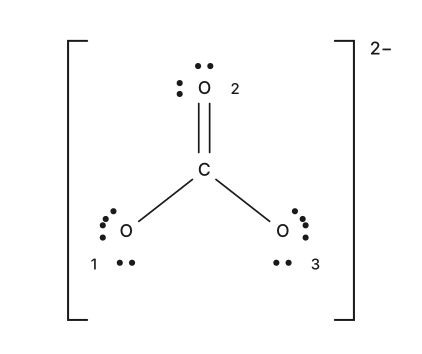
- AP EAPCET 2022Set eng-2022-07-05-FN1 markMCQQ.In the Lewis dot structure of carbonate ion shown under the formal charges on the oxygen atoms 1,2 & 3 are respectively: [FIGURE] (Lewis dot structure of the carbonate ion CO32− in brackets with a 2- charge: a central C is double-bonded to an O labelled "2" at the top, and singly bonded to an O labelled "1" at the lower left and an O labelled "3" at the lower right) (A) -2, 0, 0 (B) -1, 0, -1 (C) 0, -1, -1 (D) -3, 0, +1
›Reveal solutionSolution
This tests formal-charge calculation on a Lewis structure: formal charge = valence electrons − nonbonding electrons − (bonding electrons)/2.
Concept and Intuition
Formal charge lets us assign charges within a single resonance structure so the atoms' total charge matches the ion's overall charge (−2 here across 3 O atoms averaged, but in any one resonance form the charges are localized).
Step-by-Step Solution
- O2 (double bonded to C): 2 bonding pairs (4 electrons) shared + 2 lone pairs (4 electrons) = FC =6−4−24=6−4−2=0.
- O1 (single bonded to C): 1 bonding pair (2 electrons) + 3 lone pairs (6 electrons) = FC =6−6−22=6−6−1=−1.
- O3 (single bonded to C), symmetric with O1: FC =−1.
- So charges on O1, O2, O3 respectively are −1,0,−1. Sum =−2, matching the ion's overall charge (with C's formal charge 0).
Common Mistakes
- Forgetting that the double-bonded oxygen (fewer lone pairs) is the neutral one in this resonance form, and mistakenly assigning −1 to it as well (which would violate the total charge count).
- Mixing up the labelled order (1, 2, 3 as printed in the figure) with a generic "all O are −2/3" average-charge answer, which is not how a single Lewis structure is drawn.
✓Final answerThe correct option is (B) — -1, 0, -1.
ANSWER: B
- AP EAPCET 2021Set ap-2021-09-03-AN1 markMCQQ.In the given electron dot structure, the formal charge on each nitrogen atom (respectively) from left to right is ______ N..=N=N.. (each terminal N carries two lone pairs of dots) (A) +1,0,+1 (B) −1,+1,−1 (C) 0,−1,0 (D) +1,−1,+1
›Reveal solutionSolution
This tests formal-charge calculation on a cumulated double-bond (azide-like) structure; the terminal nitrogens each come out −1 and the central nitrogen +1.
Concept and Intuition
Formal charge lets us check how the drawn Lewis structure distributes the 'ownership' of electrons compared to the free atom. The formula is
FC=V−L−2B
where V = valence electrons of the free atom, L = electrons in lone pairs on that atom, and B = total electrons shared in bonds around that atom (i.e. 2× number of bonds). Nitrogen has V=5.
Step-by-Step Solution
- Terminal nitrogens: Each terminal N is joined to the central N by one double bond only, and each carries two lone pairs (given). So B=4 (one double bond = 4 bonding electrons) and L=4 (two lone pairs).
FC=5−4−24=5−4−2=−1
- Central nitrogen: The central N has a double bond on each side, so it is involved in two double bonds: B=8. It carries no lone pair (none shown/possible, since it is already using all orbitals for the two π and σ bonds — this matches the linear, sp-hybridized azide-type central atom).
FC=5−0−28=5−0−4=+1
- Left-to-right sequence: terminal N (−1), central N (+1), terminal N (−1).
- Check overall charge balance: −1+1−1=−1, consistent with an anion such as azide, N3−.
Common Mistakes
- Forgetting that in the formal-charge formula, B is the total bonding electrons (both electrons of each bond), not just the number of bonds.
- Assuming the central atom also carries a lone pair — in this cumulated (allene-like) resonance form it does not.
- Mixing up left/right assignment — since the structure is symmetric, the sequence is symmetric too: (terminal, central, terminal).
✓Final answerThe correct option is (B) — −1,+1,−1.
ANSWER: B
🎓Unlock everything free for 14 days
- ✓Full step-by-step solutions
- ✓Concept-first explanations
- ✓Methods, shortcuts & mistakes
- ✓PYQ mapping + timed mock tests
Full access for 14 days. No credit card required.