Q.Explain with the help of a suitable example a polar covalent bond.
🔒You're viewing a preview — the full solution, concept, methods & PYQ mapping are locked.
🔒 Start your 14-day free trial to unlock the full solution →Concept understanding — Dipole Moment Applications
Dipole Moment Applications: From Intuition to Precision
Imagine you have a magnet. One end pulls, the other pushes. Now imagine a molecule that behaves like a tiny magnet — not because of iron, but because of how its electrons are distributed. That's the idea behind a dipole moment.
A dipole moment arises when there's a separation of charge inside a molecule. One end becomes slightly negative (δ−), the other slightly positive (δ+). This imbalance creates a tiny electric "arrow" pointing from positive to negative. The arrow has both a size (how much charge is separated) and a direction (which way the molecule is polar).
The dipole moment is a vector quantity. Its magnitude is given by μ=q×d, where q is the magnitude of separated charge and d is the distance between the charge centers. The unit is the Debye (D).
Now, why does this matter? Because this tiny electric arrow determines how a molecule behaves around other molecules, around electric fields, and even how it interacts with light. Let's see the key applications.
1. Predicting Molecular Shape (Symmetry Check)
This is the most common exam application. If a molecule has polar bonds (like C–Cl or O–H), does it have a net dipole moment? The answer depends on symmetry.
Consider carbon dioxide, CO₂. Each C=O bond is polar (oxygen pulls electrons). But the molecule is linear: O=C=O. The two dipole arrows point in opposite directions and cancel out. Net dipole moment = zero. The molecule is nonpolar.
Now consider water, H₂O. Each O–H bond is polar. But water is bent (104.5°). The two arrows do not cancel — they add up to a net dipole pointing upward through the oxygen. Net dipole moment = 1.85 D. Water is polar.
Symmetry kills polarity. If a molecule has a center of symmetry or identical polar bonds arranged symmetrically, the net dipole moment is zero. This is how you distinguish between linear CO₂ (nonpolar) and bent SO₂ (polar, 1.63 D).
Exam tip: For molecules like CH₄ (tetrahedral, zero dipole) vs. CH₃Cl (tetrahedral but one C–Cl bond, dipole = 1.87 D), the key is whether the polar bonds are arranged so their vectors cancel.
2. Determining Bond Character (Ionic vs. Covalent)
The dipole moment tells you how "unequal" the sharing of electrons is in a bond. A pure covalent bond (like H–H) has zero dipole. A pure ionic bond (like Na⁺Cl⁻) would have a huge dipole — but in reality, ions are separate.
For a bond like H–Cl, the measured dipole moment is 1.08 D. If the bond were 100% ionic (one full electron transferred), the dipole would be much larger (about 6.1 D for the same bond length). The ratio gives you the percent ionic character:
% ionic character=μcalculated for 100% ionicμobserved×100
For HCl: 6.11.08×100≈17.7%. So the H–Cl bond is about 18% ionic, 82% covalent.
This is a standard numerical problem. Remember: μionic=e×d, where e=4.8×10⁻¹⁰ esu (or 1.6×10⁻¹⁹ C in SI). Convert bond length to cm or m accordingly.
3. Intermolecular Forces and Physical Properties
Polar molecules (with a nonzero dipole) experience dipole-dipole interactions — the positive end of one molecule attracts the negative end of another. This is stronger than the London dispersion forces in nonpolar molecules of similar size.
Consequences:
- Boiling points: Polar molecules have higher boiling points than nonpolar ones of similar molar mass. Example: HCl (polar, bp −85°C) vs. F₂ (nonpolar, bp −188°C). Both have about 38 g/mol, but HCl's dipole adds extra attraction.
- Solubility: "Like dissolves like." Polar solutes dissolve in polar solvents (water, ethanol). Nonpolar solutes dissolve in nonpolar solvents (hexane, CCl₄). The dipole moment explains why NaCl dissolves in water but not in oil.
- Dielectric constant: Polar liquids have high dielectric constants (water = 80), meaning they can weaken the electric field between charges. This is why water is such a good solvent for ionic compounds.
Don't confuse dipole moment with boiling point directly. A molecule can have a large dipole but low boiling point if it's very small (like HF, bp 19.5°C, dipole 1.91 D). Hydrogen bonding (a special case of dipole interaction) is even stronger.
4. Reactivity and Orientation in Electric Fields
In an external electric field, polar molecules align themselves with the field. This is the principle behind microwave heating — water molecules in food rotate to align with the alternating microwave field, generating heat through friction.
In organic chemistry, the dipole moment helps predict reaction sites. The negative end of a dipole (where electrons are concentrated) is where electrophiles attack. The positive end (electron-deficient) is where nucleophiles attack. …
Concept: Polar Covalent Bond
A polar covalent bond forms when two atoms share electrons unequally due to a difference in their electronegativities. The more electronegative atom pulls the shared electron pair closer, acquiring a partial negative charge (δ−), while the less electronegative atom acquires a partial positive charge (δ+). This creates a bond dipole.
Example: Hydrogen Chloride (HCl)
Chlorine (electronegativity ≈3.0) is significantly more electronegative than hydrogen (electronegativity ≈2.1). When they form a covalent bond, the shared electron pair spends more time near chlorine. The bond is represented as:
HXδ+−ClXδ− …
A polar covalent bond forms when two atoms of different electronegativities share electrons unequally, creating partial charges. The classic example is the H–Cl bond, where chlorine pulls the shared electrons closer, becoming partially negative while hydrogen becomes partially positive.
What makes a bond polar?
When two atoms form a covalent bond, they share electrons. But not all atoms pull on those shared electrons with equal strength. Electronegativity measures an atom's ability to attract bonding electrons toward itself. When two atoms with different electronegativities bond, the electron cloud shifts toward the more electronegative atom. This creates a separation of charge: one end becomes slightly negative (δ⁻), the other slightly positive (δ⁺). That's a polar covalent bond.
The key difference from a pure covalent bond (like H–H, where both atoms are identical) is this asymmetry. The electrons aren't shared equally, so the bond has a dipole moment — a vector pointing from the positive end to the negative end.
The hydrogen chloride (HCl) example
Let's walk through hydrogen chloride, one of the clearest demonstrations of polarity.
-
Identify the atoms and their electronegativities
Hydrogen has an electronegativity of about 2.1 on the Pauling scale, while chlorine sits at 3.0. Chlorine is significantly more electronegative.
-
Electron sharing is unequal
When H and Cl form a single covalent bond, they share one pair of electrons. But chlorine's stronger pull means the shared electron pair spends more time near the Cl nucleus than near the H nucleus.
-
Partial charges develop
Because the electron density is greater around chlorine, it acquires a partial negative charge (δ⁻). Hydrogen, now electron-deficient in that region, carries a partial positive charge (δ⁺). We write this as:
HXδ+−ClXδ−
- The bond has a dipole moment The dipole moment μ is defined as:
μ=q×d
where q is the magnitude of the partial charge and d is the distance between the charges (the bond length). For HCl, μ≈1.08D (Debye units). The arrow representing the dipole points from H (positive) toward Cl (negative), or sometimes a crossed arrow (→) is drawn with the cross at the positive end. …
- AP EAPCET 2026Set eng-2026-05-15-FN1 markMCQQ.Given below are two statements Statement – I: London forces between two particles are proportional to r−6, where 'r' is the distance between two particles Statement – II: The dipole-dipole interaction energy in a solid is proportional to r−3, where r is the distance between two polar molecules Correct answer is (A) Both statement I and statement II are correct (B) Both statement I and statement II are not correct (C) Statement I is correct, but statement II is not correct (D) Statement I is not correct, but statement II is correct
›Reveal solutionSolution
Both statements are textbook-correct: London forces ∝r−6, and fixed-orientation dipole-dipole energy in a solid ∝r−3.
Concept and Intuition
Intermolecular force laws depend on whether molecules can freely rotate or are held fixed:
- London dispersion forces arise from instantaneous induced dipoles and their interaction energy always falls off as r−6, regardless of phase.
- Dipole-dipole interactions: if the dipoles are free to rotate/tumble (as in gases and liquids), thermal averaging over all orientations gives a net energy ∝r−6 (the Keesom formula). But if the dipoles are held in a fixed, favourable orientation — as happens for molecules locked into a lattice in a solid — there's no rotational averaging, and the direct dipole-dipole interaction energy varies as r−3.
Step-by-Step Solution
- Recall the dispersion (London) energy formula: ELondon∝−r61 — this is true in all phases. Statement I ✓.
- Recall the dipole-dipole interaction: instantaneous energy between two fixed dipoles at a given orientation is E∝r31; only when free rotational averaging is invoked (gas/liquid, Boltzmann-weighted) does this become r−6. …
- AP EAPCET 2025Set eng-2025-05-21-FN1 markMCQQ.Identify the correct set of molecules with zero dipole moment. (A) CO2,NH3,H2O (B) NH3,NF3,BF3 (C) PF3,NH3,CH4 (D) CH4,BF3,CO2
›Reveal solutionSolution
A molecule has zero dipole moment when its geometry is symmetric enough that individual bond dipoles cancel; only the set {CH4,BF3,CO2} satisfies this fully.
Concept and Intuition
Dipole moment is a vector sum of individual bond dipoles. Even if a molecule has polar bonds, the molecule can be net non-polar if its geometry is symmetric enough that the bond dipole vectors cancel exactly. Common zero-dipole geometries: linear symmetric (like CO2, O=C=O), trigonal planar symmetric (like BF3), and tetrahedral with identical substituents (like CH4). In contrast, molecules with a lone pair distorting the geometry (pyramidal NH3, PF3; bent H2O) or with an asymmetric substituent (like NF3, where the lone pair and F atoms don't cancel) are polar.
Step-by-Step Solution
- Option A (CO2, NH3, H2O): CO2 is zero, but NH3 (pyramidal) and H2O (bent) are both polar → rejected.
- Option B (NH3, NF3, BF3): BF3 is zero, but NH3 and NF3 (both pyramidal with a lone pair) are polar → rejected.
- Option C (PF3, NH3, CH4): CH4 is zero, but PF3 and NH3 (pyramidal) are polar → rejected. …
- AP EAPCET 2025Set ap-2025-05-20-FN1 markMCQQ.A diatomic molecule has a dipole moment of 4×10⁻³⁰ Cm. If the bond distance is 1.0 Å, what fraction of an electronic charge exists on each atom? (Actual value of electronic charge =1.6×10⁻¹⁹ C) (A) 0.33 (B) 0.50 (C) 0.25 (D) 0.66
›Reveal solutionSolution
This tests the relation between dipole moment, bond length, and effective partial charge. The computed fractional charge is 0.25e.
Concept and Intuition
A polar diatomic molecule can be modelled as two point charges +δ and −δ separated by the bond length d. The dipole moment is μ=δ×d. If the bond were perfectly ionic, δ would equal a full electronic charge e; the ratio δ/e tells us the actual fractional (partial) ionic character of the bond.
Step-by-Step Solution
- Convert bond length: d=1.0A˚=1.0×10⁻¹⁰m.
- Given μ=4×10⁻³⁰Cm. …
- AP EAPCET 2025Set eng-2025-05-26-AN1 markMCQQ.Match the following. List-I (Molecule): A) HCl B) NH3 C) H2O D) NF3. List-II (Dipole moment in D): I) 1.85 II) 1.07 III) 0.23 IV) 1.47. The correct answer is (A) A-II, B-IV, C-I, D-III (B) A-IV, B-III, C-I, D-II (C) A-II, B-I, C-IV, D-III (D) A-III, B-II, C-IV, D-I
›Reveal solutionSolution
This is a recall-and-match question on standard dipole moment values; the key trick is remembering NF₃'s unusually low dipole moment.
Concept and Intuition
Dipole moment depends on both bond polarity and lone-pair contribution, all added vectorially. In NH₃, the lone pair on N points away from the three N–H bonds (same general direction as the resultant bond dipole), so they reinforce, giving a sizeable dipole (1.47 D). In NF₃, F is more electronegative than N, so the N–F bond dipoles point toward F (away from N), while the lone pair on N points the opposite way — these two contributions largely cancel, leaving NF₃ with an unusually small dipole moment (0.23 D) despite the highly polar N–F bonds.
Step-by-Step Solution
- Recall standard dipole moments (Debye): HCl≈1.07D, NH3≈1.47D, H2O≈1.85D, NF3≈0.23D. …
- AP EAPCET 2023Set eng-2023-05-18-FN1 markMCQQ.Match the following List-I (Molecules): A) H2O B) BF3 C) NH3 D) NF3 List-II (Dipole moment μ, D): I) 0 II) 0.23 III) 1.47 IV) 1.85 The correct answer is (A) A-IV, B-I, C-II, D-III (B) A-IV, B-I, C-III, D-II (C) A-IV, B-III, C-I, D-II (D) A-III, B-IV, C-II, D-I
›Reveal solutionSolution
Matching each molecule to its standard dipole moment value: H2O (1.85 D) = IV, BF3 (0 D, symmetric) = I, NH3 (1.47 D) = III, NF3 (0.23 D) = II.
Concept and Intuition
Net molecular dipole moment depends both on individual bond dipoles and molecular geometry. A perfectly symmetric molecule (like trigonal planar BF3) has bond dipoles that cancel, giving zero net dipole moment. Pyramidal molecules with a lone pair (NH3, NF3, H2O) have a net dipole, but its magnitude depends on whether the lone-pair dipole reinforces or opposes the bond dipoles.
Step-by-Step Solution
- BF3: trigonal planar, all B–F bond dipoles cancel by symmetry → μ=0 D → matches I.
- NF3: pyramidal, but F is more electronegative than N, so the bond dipoles point away from N while the lone pair also points away from the F atoms — the lone-pair dipole partly opposes/cancels the bond dipoles, giving a small net moment, μ=0.23 D → matches II.
- NH3: pyramidal, H is less electronegative than N, so bond dipoles point toward N, and the lone pair adds in the same general direction, giving a moderate net moment, μ=1.47 D → matches III. …
- AP EAPCET 2022Set eng-2022-07-07-AN1 markMCQQ.The standard molar enthalpy of vaporisation (ΔvapH∘) of A, B and C liquids is 23.3, 41 and 29 kJ mol−1 respectively. The correct order of dipole-dipole attractive forces in these liquids is: (A) B > C > A (B) B > A > C (C) A > C > B (D) A > B > C
›Reveal solutionSolution
Enthalpy of vaporisation is a direct measure of intermolecular attractive-force strength; ranking the given values ranks the dipole-dipole forces: B > C > A.
Concept and Intuition
To vaporise a liquid, energy must be supplied to overcome the intermolecular attractions holding molecules together in the liquid state. The stronger these attractions (here assumed to be dominated by dipole-dipole forces), the more energy (higher ΔvapH∘) is required. So a higher enthalpy of vaporisation directly implies stronger dipole-dipole attraction.
Step-by-Step Solution
- List the given values: ΔvapH∘(A)=23.3, ΔvapH∘(B)=41, ΔvapH∘(C)=29 kJ/mol. …
- AP EAPCET 2021Set ap-2021-09-06-FN1 markMCQQ.How many among C6H6, CO, SO2 and NH3 has/have zero dipole moment? (A) 0 (B) 1 (C) 2 (D) 3
›Reveal solutionSolution
Of C6H6, CO, SO2, NH3, only benzene (C6H6) has a genuinely zero dipole moment due to its symmetric structure; the other three are all polar. Count = 1.
Concept and Intuition
A molecule has zero net dipole moment only when its bond dipoles cancel by symmetry. Benzene's perfectly symmetric hexagonal, non-polar C–H/C–C framework gives zero net dipole. CO, despite looking "balanced," actually has a small residual dipole due to electronegativity difference and lone-pair/back-bonding effects. SO2 is bent (not linear), so its two S=O dipoles do not cancel. NH3 is pyramidal with an asymmetric lone pair, giving a clear net dipole.
Step-by-Step Solution
- C6H6: symmetric planar ring, all C–H bond dipoles cancel by the hexagonal symmetry ⇒μ=0.
- CO: two atoms, different electronegativities, no symmetry to cancel ⇒μ=0 (small, ~0.11 D). …
- AP EAPCET 2021Set eng-2021-08-19-AN1 markMCQQ.Which compound among the following has the highest dipole moment? (A) NH3 (B) SO2 (C) N2O (D) CO2
›Reveal solutionSolution
Dipole moment depends on both bond polarity and molecular geometry. CO2 cancels to zero by symmetry, N2O's asymmetry gives only a tiny net dipole, while bent SO2's two polar S–O bonds and lone pair combine to give the largest net dipole moment of the four.
Concept and Intuition
Net dipole moment is the vector sum of individual bond dipoles. Perfectly symmetric linear molecules (CO2: O=C=O) cancel completely. Molecules with a bent or pyramidal shape (a lone pair breaking symmetry) retain a significant net dipole.
Step-by-Step Solution
- CO2: linear, O=C=O, the two C=O bond dipoles point in opposite directions and cancel exactly ⇒ μ=0.
- N2O: linear (N=N=O), but the two ends are chemically different, so the bond dipoles don't fully cancel — still, the net dipole is quite small (≈0.17 D) since the molecule is nearly balanced.
- NH3: trigonal pyramidal with a lone pair on N; bond dipoles and the lone pair's contribution add up to a moderate net dipole (≈1.47 D). …
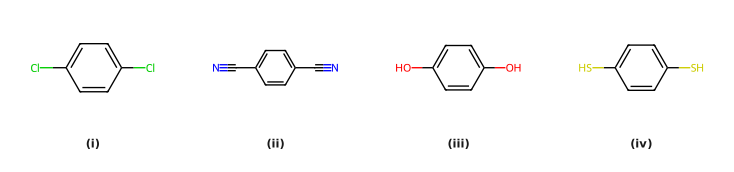
- AP EAPCET 2021Set eng-2021-08-19-FN1 markMCQQ.For which molecules among the following, the resultant dipole moment (μ) =0? [FIGURE] (four para-disubstituted benzene rings labelled (i)-(iv):(i) 1,4-dichlorobenzene, Cl at both para positions;(ii) 1,4-dicyanobenzene, CN at both para positions;(iii) 1,4-dihydroxybenzene, OH at both para positions;(iv) 1,4-benzenedithiol, SH at both para positions) (A)(iii) &(iv) only (B)(i) &(ii) only (C)(ii) &(iii) only (D)(iv) only
›Reveal solutionSolution
Linear/axial substituents (Cl, C≡N) cancel exactly in a symmetric para-disubstituted benzene, giving zero dipole; bent substituents (OH, SH) don't cancel fully, leaving a nonzero net dipole moment.
Concept and Intuition
For a 1,4-disubstituted benzene with two IDENTICAL substituents, the molecule has a centre of symmetry if the substituent's own dipole lies exactly along the C–X bond axis (like Cl, or the linear C≡N group) — the two bond dipoles then point in exactly opposite directions and cancel completely, giving μ=0 (this is the well-known case of p-dichlorobenzene). However, groups like –OH and –SH are bent (the O–H or S–H bond makes an angle with the C–O/C–S axis), so the group's own dipole has a component off the ring axis. Even in the para arrangement, this off-axis component does not exactly cancel between the two substituents, so the molecule retains a small net dipole moment.
Step-by-Step Solution
- (i) 1,4-dichlorobenzene: Cl is axially symmetric on the C–Cl bond; the two bond dipoles are collinear and opposite → cancel → μ=0.
- (ii) 1,4-dicyanobenzene: C≡N is a linear group along the C–C(N) axis; same cancellation as Cl → μ=0. …
- AP EAPCET 2021Set eng-2021-08-20-AN1 markMCQQ.A covalent molecule X−Y is found to have a dipole moment of 1.5×10⁻²⁹ C.m and a bond length of 150 pm. The percent ionic character of the bond will be ________ (A) 50 % (B) 62.5 % (C) 75 % (D) 80 %
›Reveal solutionSolution
Compare the molecule's measured dipole moment to the dipole moment it would have if it were 100% ionic (charge e separated by the bond length); the ratio, as a percentage, is the % ionic character — here 62.5%.
Concept and Intuition
If a bond were purely ionic, the two atoms would carry full charges +e and −e, giving a theoretical (maximum possible) dipole moment μionic=e×d, where d is the bond length. In a real (partially covalent) bond, the measured dipole moment μobs is smaller than this theoretical maximum, because the charge separation is only partial. The ratio μobs/μionic, expressed as a percentage, is defined as the percent ionic character of the bond.
Step-by-Step Solution
- Theoretical 100%-ionic dipole moment: μionic=e×d=(1.6×10⁻¹⁹ C)(150×10−12 m)=2.4×10⁻²⁹ C·m. …
- AP EAPCET 2021Set eng-2021-08-23-AN1 markMCQQ.The geometry and dipole moment of H2S respectively are ______________ (A) Angular and Non-zero (B) Angular and Zero (C) Linear and Zero (D) Linear and Non-zero
›Reveal solutionSolution
H2S, like H2O, is a bent (angular) molecule due to two lone pairs on sulphur, and its bond dipoles do not cancel, giving it a non-zero net dipole moment.
Concept and Intuition
Molecular geometry is determined by VSEPR theory: sulphur in H2S has 6 valence electrons, forms 2 bond pairs with the two hydrogens, and retains 2 lone pairs. Four electron domains around a central atom arrange themselves tetrahedrally, but with two lone pairs pushed into two of the tetrahedral positions, the observed molecular shape (ignoring the lone pairs, which are not "seen" in molecular geometry) is bent/angular, not linear. Whenever a molecule is bent (asymmetric charge distribution) rather than linear/symmetric, the individual bond dipole moments do not fully cancel, so the molecule has a net dipole moment.
Step-by-Step Solution
- Determine the electron geometry: S has 6 valence electrons; 2 are used to bond with 2 H atoms, leaving 2 lone pairs — total 4 electron domains around S.
- Four electron domains adopt (approximately) a tetrahedral arrangement, but the molecular shape is described only by the positions of the atoms (H atoms), not the lone pairs.
- With 2 bonded atoms and 2 lone pairs on a central atom with 4 electron domains, the resulting molecular geometry is bent/angular (analogous to water, though H2S's H–S–H bond angle, ~92°, is smaller than water's ~104.5° because sulphur's lone pairs occupy more nearly pure p-orbitals with less s-character mixing). …
🎓Unlock everything free for 14 days
- ✓Full step-by-step solutions
- ✓Concept-first explanations
- ✓Methods, shortcuts & mistakes
- ✓PYQ mapping + timed mock tests
Full access for 14 days. No credit card required.