Q.Which of the following is not an actinoid?
Concept understanding — Periodic Table Blocks
The Intuition: Why "Blocks" at All?
Imagine you're building a house of cards. Each card has a specific shape and a specific place where it fits. The periodic table is like that house — but instead of cards, we have elements, and instead of shapes, we have electron configurations.
The periodic table is arranged in rows (periods) and columns (groups). But if you look closely, you'll notice that the table isn't a perfect rectangle. There's a detached island of elements (the f-block) floating below, and the main body has a strange "staircase" shape. That shape isn't random — it's dictated by which orbital the last electron enters.
That's the core idea: A block is a set of elements whose last electron enters the same type of orbital (s, p, d, or f).
The Precise Statement
Periodic Table Blocks are regions of the periodic table where elements share the same valence subshell — the subshell being filled as you move across that block.
There are four blocks, named after the four types of atomic orbitals:
| Block | Orbital being filled | Location in the table | Number of groups |
|---|---|---|---|
| s-block | ns | Leftmost 2 columns (Groups 1 & 2) | 2 |
| p-block | np | Rightmost 6 columns (Groups 13–18) | 6 |
| d-block | (n−1)d | Middle 10 columns (Groups 3–12) | 10 |
| f-block | (n−2)f | Two rows below the main table (Lanthanides & Actinides) | 14 |
The "n" in the orbital notation refers to the principal quantum number (the period number). Notice how for d and f blocks, the orbital being filled has a lower n than the period you're in. That's because of the Aufbau principle — orbitals fill in order of increasing energy, and 4s fills before 3d, etc.
How to Read the Blocks
s-block (Groups 1 & 2)
- Last electron enters an s orbital.
- Examples: Hydrogen (1s1), Lithium (2s1), Beryllium (2s2).
- These are highly reactive metals (except H and He). They lose their s electron(s) easily.
p-block (Groups 13–18)
- Last electron enters a p orbital.
- Examples: Carbon (2p2), Oxygen (2p4), Chlorine (3p5).
- This block contains metals, non-metals, and metalloids — the most chemically diverse block.
d-block (Groups 3–12)
- Last electron enters a d orbital — specifically, the (n−1)d subshell.
- Examples: Iron (3d6), Copper (3d10), Zinc (3d10).
- These are transition metals. They often have variable oxidation states and form coloured compounds.
f-block (Lanthanides & Actinides)
- Last electron enters an f orbital — specifically, the (n−2)f subshell.
- Examples: Cerium (4f1), Uranium (5f3).
- These are inner transition metals. They are placed below to keep the table from being absurdly wide.
A common mistake: thinking that the block tells you the group number. It doesn't. The block tells you the orbital type, not the group. For example, both Carbon (Group 14) and Oxygen (Group 16) are in the p-block, but they're in different groups.
Why This Matters
Knowing the block of an element tells you three things instantly:
- Which orbital is being filled — the heart of its electron configuration.
- General chemical behaviour — s-block elements are electropositive, p-block are diverse, d-block are transition metals, f-block are inner transition metals.
- Position in the table — you can locate any element just by knowing its block and period.
To find an element's block from its electron configuration: look at the last subshell that has electrons. If it ends in s, it's s-block; if p, p-block; if d, d-block; if f, f-block. For example, [Ar]4s23d6 ends in 3d6 → d-block.
The Big Picture
The periodic table is not just a list — it's a map of how electrons fill orbitals. The blocks are the continents on that map. s-block on the left, p-block on the right, d-block in the middle, and f-block as the two islands below.
Once you see the blocks, the periodic table stops being a random grid and becomes a logical, predictable structure. Every element's position tells you its electron configuration, and every configuration tells you its block.
The s, p, d, and f block classification of the periodic table is a foundational topic in the NCERT Class 11 Chemistry chapter on Classification of Elements and Periodicity, and "periodic table blocks explained with examples" is a commonly searched revision topic for CBSE boards and JEE Main/NEET. Quickly identifying an element's block from its electron configuration is also a frequently tested skill in "periodic table important questions" for competitive chemistry.
Concept: Definition of the Actinoid Series
The actinoid series comprises the 15 elements from actinium (Z = 89) through lawrencium (Z = 103), characterized by progressive filling of the 5f subshell.
Reasoning:
-
Curium (Z = 96), californium (Z = 98), and uranium (Z = 92) all lie within the range Z = 89–103 and belong to the actinoid series.
-
Terbium (Z = 65) falls in the lanthanoid series (Z = 57–71), where the 4f subshell is being filled.
-
The lanthanoids occupy the first f-block row (period 6), while actinoids occupy the second f-block row (period 7).
The element that is not an actinoid is (D) Terbium (Z = 65).
Actinoids are the fourteen elements from thorium (Z=90) to lawrencium (Z=103) in which the 5f subshell is progressively filled. Terbium (Z=65) lies in the lanthanoid series, not the actinoid series. The answer is (D).
The actinoid series is defined by the progressive filling of the 5f orbitals, just as the lanthanoid series is characterized by the filling of 4f orbitals. Understanding where these series begin and end in the periodic table immediately tells us which elements belong to each family.
The actinoids span from thorium (Z=90) to lawrencium (Z=103), occupying the bottom row of the f-block. These elements follow actinium (Z=89) and are characterized by electrons entering the 5f subshell (though there are some irregularities in electron configurations due to the close energy levels of 5f, 6d, and 7s orbitals).
Let me examine each option:
-
Curium (Z=96): This element falls squarely in the middle of the actinoid series. With 96 protons, it lies between americium (Z=95) and berkelium (Z=97), well within the Z=90 to 103 range. Curium is definitely an actinoid.
-
Californium (Z=98): Similarly, californium sits comfortably within the actinoid series. Named after California (where it was first synthesized), it continues the 5f filling pattern. This is an actinoid.
-
Uranium (Z=92): The most famous actinoid, uranium is the heaviest naturally occurring element in significant quantities. At Z=92, it's the third member of the actinoid series (after thorium and protactinium). Uranium is certainly an actinoid.
-
Terbium (Z=65): Here's the outlier. With only 65 protons, terbium falls far short of the actinoid range. In fact, Z=65 places it in the lanthanoid series (also called the rare earth elements), which runs from cerium (Z=58) to lutetium (Z=71). Terbium belongs to the 4f block, not the 5f block.
The lanthanoids occupy the first row of the f-block (elements 58–71), while the actinoids occupy the second row (elements 90–103). The two series are often placed below the main periodic table to keep the table compact.
The correct option is (D) — Terbium is a lanthanoid, not an actinoid.
Showing the 12 most recent of 17 on this concept.
- AP EAPCET 2026Set eng-2026-05-14-AN1 markMCQQ.Which of the following sets contain atomic numbers of only representative elements? I. 3, 33, 53, 87 II. 2, 10, 22, 36 III. 9, 35, 51, 88 IV. 17, 25, 37, 48 The correct answer is (A) I & II only (B) II & III only (C) I & III only (D) II & IV only
›Reveal solutionSolution
Requires identifying, for each set of atomic numbers, whether every element is a representative (s-block or p-block, non-transition) element — only sets I and III pass.
Concept and Intuition
"Representative elements" refers to the s-block (groups 1–2) and p-block (groups 13–18) elements, as opposed to the d-block (transition metals) and f-block (lanthanides/actinides) elements. To check a set, identify each element by its atomic number and classify its block; if even one element belongs to the d- or f-block, the whole set is disqualified.
Step-by-Step Solution
- Set I (3, 33, 53, 87): Z=3 is Li (s-block, group 1), Z=33 is As (p-block, group 15), Z=53 is I (p-block, group 17), Z=87 is Fr (s-block, group 1). All representative — qualifies.
- Set II (2, 10, 22, 36): Z=2 is He, Z=10 is Ne, Z=36 is Kr (all noble gases), but Z=22 is Ti — a d-block transition metal. Disqualified.
- Set III (9, 35, 51, 88): Z=9 is F (p-block, group 17), Z=35 is Br (p-block, group 17), Z=51 is Sb (p-block, group 15), Z=88 is Ra (s-block, group 2). All representative — qualifies.
- Set IV (17, 25, 37, 48): Z=17 is Cl (p-block), but Z=25 is Mn (d-block) and Z=48 is Cd (d-block). Disqualified.
- Only Sets I and III contain exclusively representative elements.
Common Mistakes
- Missing that a set contains just one transition-metal atomic number buried among otherwise-representative numbers (e.g., Ti at Z=22, Mn at Z=25, Cd at Z=48).
- Forgetting that noble gases (Z=2,10,36 etc.) are themselves representative (p-block, or s-block for He) elements, not transition metals — their presence alone doesn't disqualify a set.
✓Final answerThe correct option is (C) — I & III only.
ANSWER: C
- AP EAPCET 2025Set eng-2025-05-21-FN1 markMCQQ.Match the following List-I (Atomic number, Z) : List-II (Block) A) 112 : I) s B) 116 : II) p C) 88 : III) d D) 100 : IV) f The correct answer is (A) A-III, B-I, C-II, D-IV (B) A-III, B-II, C-I, D-IV (C) A-IV, B-II, C-III, D-I (D) A-II, B-III, C-IV, D-I
›Reveal solutionSolution
Matching atomic numbers to periodic-table blocks: Z=112→d, Z=116→p, Z=88→s, Z=100→f, giving A-III, B-II, C-I, D-IV.
Concept and Intuition
The block of an element is determined by which subshell receives the last (differentiating) electron in its ground-state electron configuration: s-block fills the outermost s subshell, p-block the outermost p, d-block the (n−1)d subshell, and f-block the (n−2)f subshell (lanthanides/actinides).
Step-by-Step Solution
- A) Z = 112 (Copernicium): lies in Group 12, at the end of the 6d transition series → d-block (III).
- B) Z = 116 (Livermorium): lies in Group 16, a p-block element (below tellurium/polonium) → p-block (II).
- C) Z = 88 (Radium): Group 2 element, alkaline earth metal → s-block (I).
- D) Z = 100 (Fermium): an actinide → f-block (IV).
- So the mapping is A-III, B-II, C-I, D-IV.
Common Mistakes
- Assuming very high atomic number elements are automatically f-block; block membership follows strictly from position in the periodic table / electron configuration, not just "heaviness".
- Mixing up which superheavy elements belong to group 12 (d-block, e.g. Cn) versus group 16 (p-block, e.g. Lv).
✓Final answerThe correct option is (B) — A-III, B-II, C-I, D-IV.
ANSWER: B
- AP EAPCET 2024Set eng-2024-05-20-AN1 markMCQQ.Match the following. List I: A. Technicium B. Fluorine C. Tellurium D. Dysprosium List II: I. Non-metal II. Transition metal III. Lanthanoid IV. Metalloid (A) A-II, B-I, C-III, D-IV (B) A-III, B-I, C-IV, D-II (C) A-II, B-I, C-IV, D-III (D) A-IV, B-I, C-II, D-III
›Reveal solutionSolution
Matching each element to its periodic-table classification (Tc = transition metal, F = non-metal, Te = metalloid, Dy = lanthanoid) gives A-II, B-I, C-IV, D-III.
Concept and Intuition
Classifying elements requires knowing their position in the periodic table: Technetium sits in the d-block (transition metals); Fluorine is a halogen (non-metal); Tellurium lies along the metalloid staircase (Group 16, period 5); Dysprosium is one of the f-block lanthanoids.
Step-by-Step Solution
- Technetium (Tc, Z=43): d-block element → transition metal (II).
- Fluorine (F, Z=9): p-block halogen → non-metal (I).
- Tellurium (Te, Z=52): lies on the metalloid staircase → metalloid (IV).
- Dysprosium (Dy, Z=66): f-block element → lanthanoid (III).
- Combine: A-II, B-I, C-IV, D-III, matching option (C).
Common Mistakes
- Confusing Tellurium (a metalloid) with a simple non-metal — its position on the staircase is what makes it a metalloid.
- Mixing up lanthanoids with actinoids, or transition metals with lanthanoids.
✓Final answerThe correct option is (C) — A-II, B-I, C-IV, D-III.
ANSWER: C
- AP EAPCET 2023Set ap-2023-05-22-AN1 markMCQQ.The element with atomic number 118 will be (A) Alkali element (B) Lanthanide (C) Noble gas (D) Transition element
›Reveal solutionSolution
Element 118 (Oganesson) lies in Group 18 of the periodic table, making it a noble gas by position.
Concept and Intuition
The periodic table is built on periodicity of electron configuration — elements in the same group share the same outer-shell pattern and hence similar chemistry. Group 18 (noble gases) consists of elements whose atoms have a completely filled outermost shell (or, in modern terms, ns2np6), giving them exceptional chemical stability.
Step-by-Step Solution
- The periodic table has 18 groups, and elements are added in order of atomic number, filling successive periods (rows).
- Period 7 runs from atomic number 87 (Fr) to 118 (Og), exactly mirroring Period 6 (Cs at 55 to Rn at 86) in terms of group placement.
- Since Rn (Z=86) is a noble gas at the end of Period 6, its Period-7 analogue at the end of the row, Z=118, must fall in the same group — Group 18.
- Element 118 was named Oganesson (Og) and is placed directly under Xe and Rn.
- Hence, by position in the periodic table, it is classified as a noble gas.
Common Mistakes
- Confusing period 7's superheavy elements' group placement with their (largely theoretical/relativistic) actual chemistry — the question only asks about periodic classification.
- Assuming very heavy/radioactive elements can't be placed in a "chemical family" — position in the table is still determined by electron configuration trends.
✓Final answerThe correct option is (C) — Noble gas.
ANSWER: C
- AP EAPCET 2023Set ap-2023-05-22-AN1 markMCQQ.Match the following: List-I (Atomic Number (Z)) | List-II (Block) A. 117 | I. s B. 87 | II. d C. 70 | III. p D. 46 | IV. f (A) A-III, B-I, C-II, D-IV (B) A-III, B-I, C-IV, D-II (C) A-III, B-IV, C-I, D-II (D) A-IV, B-II, C-I, D-III
›Reveal solutionSolution
Assigning each atomic number to its block by identifying the last-filled subshell gives A–III, B–I, C–IV, D–II.
Concept and Intuition
The block of an element is named after the subshell (s,p,d,f) that is being filled last according to the Aufbau principle. Recognizing which period/group a given atomic number falls into immediately tells you the block.
Step-by-Step Solution
- A. Z = 117 — this is Tennessine, in Period 7, Group 17 (the halogen column). Group 17 elements fill np orbitals, so this is p-block → matches III.
- B. Z = 87 — this is Francium, in Period 7, Group 1 (alkali metals). Group 1 fills the outermost ns orbital, so this is s-block → matches I.
- C. Z = 70 — this is Ytterbium, one of the lanthanides (Period 6, the row inserted after La). Lanthanides fill the 4f subshell, so this is f-block → matches IV.
- D. Z = 46 — this is Palladium, a Period 5 transition metal (Group 10). Transition metals fill the (n−1)d subshell, so this is d-block → matches II.
- Combine: A–III, B–I, C–IV, D–II.
Common Mistakes
- Mixing up f-block (lanthanides/actinides) with d-block transition metals just because both are "metals in the middle."
- Forgetting that Group 1 elements are s-block even though they appear at the far left of a "wide" periodic table layout.
✓Final answerThe correct option is (B) — A – III, B – I, C – IV, D – II.
ANSWER: B
- AP EAPCET 2023Set ap-2023-05-23-AN1 markMCQQ.Among the following, which statement is not correct? (A) Non-metals and metalloids exist only in the p-block of the periodic table (B) Generally, non-metals have higher ionization enthalpies than metals (C) The compounds formed by highly reactive non-metals with highly reactive metals are generally ionic nature (D) The non-metal oxides are basic.
›Reveal solutionSolution
This is a "which is NOT correct" question about general trends of metals/non-metals; the false statement is that non-metal oxides are basic — they are actually acidic.
Concept and Intuition
Across the periodic table, oxide character tracks metallic character: metal oxides are generally basic, non-metal oxides are generally acidic, and oxides of metalloids/elements near the metal–non-metal border are amphoteric. This trend is a direct consequence of electronegativity — non-metal oxides readily accept OH⁻/donate H⁺ in water, forming oxoacids.
Step-by-Step Solution
- Option (A): Non-metals and metalloids do occupy the p-block predominantly (true, taking hydrogen's special/anomalous position aside as usual in this context) — correct statement.
- Option (B): Non-metals generally have higher ionisation enthalpies than metals because of their smaller size and higher effective nuclear charge — correct statement.
- Option (C): A highly reactive metal (strong reducing agent, low IE) reacting with a highly reactive non-metal (strong oxidising agent, high electron affinity) gives a compound with large electronegativity difference — essentially ionic — correct statement.
- Option (D): Non-metal oxides such as CO2, SO2, N2O5, P4O10 dissolve in water to give acids (H2CO3, H2SO3, HNO3, H3PO4) — i.e., they are acidic (or at most neutral, like CO, NO), never basic. So (D) is factually wrong.
- Hence (D) is the statement that is NOT correct.
Common Mistakes
- Confusing "non-metal oxide" behaviour with "metal oxide" behaviour (metal oxides ARE basic).
- Overlooking that a handful of non-metal oxides (CO, NO, N₂O) are neutral, but none are basic.
✓Final answerThe correct option is (D) — "The non-metal oxides are basic" is NOT correct.
ANSWER: D
- AP EAPCET 2023Set ap-2023-05-23-FN1 markMCQQ.The metal and metalloid in 5th period of long form of periodic table are respectively (A) Sb, Sn (B) Ga, As (C) In, Te (D) Si, Ge
›Reveal solutionSolution
Period 5 spans Rb to Xe; among the options, only In (a metal) and Te (a metalloid) actually sit in period 5 — the other pairs are period-4 or mixed-period elements.
Concept and Intuition
The periodic table's metalloids (elements with intermediate metal/non-metal properties) form a diagonal staircase: B, Si, Ge, As, Sb, Te, Po. Checking periods: Si and Ge are in periods 3 and 4; As and Sb are in periods 4 and 5; Te and Po are in periods 5 and 6. So the metalloid that belongs specifically to period 5 is tellurium (Te). For the metal partner, we need an element from the same period 5 that is unambiguously metallic — indium (In, Z=49), a soft post-transition metal, fits this well.
Step-by-Step Solution
- Identify period 5 elements: Rb, Sr, Y, Zr, Nb, Mo, Tc, Ru, Rh, Pd, Ag, Cd, In, Sn, Sb, Te, I, Xe.
- Check option (A) Sb, Sn: Sb is actually a metalloid (not simply "the metal"), and the pairing/order is inconsistent with "metal, metalloid" — eliminate.
- Check option (B) Ga, As: both are period 4 elements (Ga: Z=31, As: Z=33), not period 5 — eliminate.
- Check option (C) In, Te: In (Z=49) is a period-5 metal; Te (Z=52) is a period-5 metalloid — fits perfectly.
- Check option (D) Si, Ge: Si is period 3, Ge is period 4 — neither is period 5, and both are metalloids anyway, not "metal, metalloid" — eliminate.
- Correct pairing: (C) In, Te.
Common Mistakes
- Misplacing Ga and As in period 5 instead of their actual period 4.
- Forgetting that Sb (antimony) is classified as a metalloid, not a metal, which breaks option (A)'s intended metal/metalloid order.
✓Final answerThe correct option is (C) — In, Te.
ANSWER: C
- AP EAPCET 2023Set eng-2023-05-19-FN1 markMCQQ.The number of metalloids in the following elements are Si, Mn, B, F, Cu, Ag, K, Sb, As, Na, Ge (A) 4 (B) 5 (C) 6 (D) 7
›Reveal solutionSolution
This tests recognizing the classic metalloid set from the periodic table's metal/non-metal dividing staircase. Out of the 11 listed elements, exactly 5 (Si, B, Sb, As, Ge) are metalloids.
Concept and Intuition
Metalloids (semi-metals) are elements lying along the diagonal "staircase" line in the p-block that separates metals from non-metals — they show intermediate physical/chemical properties (e.g. semiconducting behaviour). The universally agreed metalloids are Boron (B), Silicon (Si), Germanium (Ge), Arsenic (As), Antimony (Sb), Tellurium (Te), with Polonium and Astatine sometimes included at the edges. Everything else in a typical list is cleanly either a metal (left/centre of the table, including all alkali/alkaline-earth and transition metals) or a non-metal (top-right, including all halogens).
Step-by-Step Solution
Go through the given list one element at a time:
- Si (Silicon) — group 14, classic metalloid. ✓
- Mn (Manganese) — transition metal. ✗
- B (Boron) — group 13, classic metalloid. ✓
- F (Fluorine) — halogen, a non-metal. ✗
- Cu (Copper) — transition metal. ✗
- Ag (Silver) — transition metal. ✗
- K (Potassium) — alkali metal. ✗
- Sb (Antimony) — group 15, classic metalloid. ✓
- As (Arsenic) — group 15, classic metalloid. ✓
- Na (Sodium) — alkali metal. ✗
- Ge (Germanium) — group 14, classic metalloid. ✓
Counting the checkmarks: Si, B, Sb, As, Ge → 5 metalloids.
Common Mistakes
- Confusing metalloids with "post-transition metals" (like Al, which is a metal, not a metalloid, despite sitting near the staircase).
- Miscounting by including a clear metal (Mn, Cu, Ag, K, Na) or a clear non-metal (F) as a metalloid.
- Forgetting Sb (Antimony) or As (Arsenic), which are less commonly memorised than B/Si/Ge.
✓Final answerThe correct option is (B) — 5.
ANSWER: B
- AP EAPCET 2022Set ap-2022-07-11-AN1 markMCQQ.The period number and group number of the element, platinum in the long form of periodic table are respectively (A) 5, 11 (B) 5, 10 (C) 6, 11 (D) 6, 10
›Reveal solutionSolution
Platinum is a 5d transition metal with atomic number 78; it lies in period 6, group 10 of the modern long-form periodic table.
Concept and Intuition
The long-form periodic table arranges elements by period (the outermost/highest principal quantum number shell being filled, here n = 6 for the 5d/6s block) and by group (based on similar valence electron configuration, grouping Pt with Ni and Pd, whose ground-state configurations end similarly). Locating any transition element correctly requires knowing which period's d-block it belongs to and its vertical group family.
Step-by-Step Solution
- Platinum's atomic number is 78, with electron configuration [Xe]4f145d96s1 (an exception due to near-filled d-subshell stability).
- It is a member of the third transition (5d) series, which occupies period 6 of the periodic table.
- Within the d-block, Pt belongs to the same vertical family as nickel (Ni) and palladium (Pd) — this is group 10.
- Hence period = 6, group = 10.
Common Mistakes
- Confusing Pt's group with group 11 (the coinage-metal group of Cu, Ag, Au) — Pt is one column to the left of Au, in group 10.
- Miscounting the period as 5 by mistaking the 5d designation for period 5 (period number always follows the row number in the table, which is 6 for the 5d series).
✓Final answerThe correct option is (D) — 6, 10.
ANSWER: D
- AP EAPCET 2022Set ap-2022-07-12-AN1 markMCQQ.Match the following. List – I (At.no. of element): (I) 56 (II) 48 (III) 53 (IV) 67 List – II (Type of block):(a) d-block(b) p-block(c) f-block(d) s-block The correct answer is (A) (I) – (b); (II) – (c); (III) – (a); (IV) –(d) (B) (I) – (c); (II) – (a); (III) – (d); (IV) –(b) (C) (I) – (d); (II) – (a); (III) – (b); (IV) –(c) (D) (I) – (d); (II) – (c); (III) – (a); (IV) – (b)
›Reveal solutionSolution
Identifying each element by atomic number (Ba, Cd, I, Ho) and its block gives (I)-d, (II)-a, (III)-b, (IV)-c.
Concept and Intuition
The block of the periodic table an element belongs to is determined by which subshell its last (highest-energy, differentiating) electron enters: s-block fills s-orbitals, p-block fills p-orbitals, d-block fills d-orbitals, and f-block fills f-orbitals (lanthanides/actinides).
Step-by-Step Solution
- Z=56: Barium, [Xe]6s2 — s-block.
- Z=48: Cadmium, [Kr]4d105s2 — d-block.
- Z=53: Iodine, [Kr]4d105s25p5 — p-block.
- Z=67: Holmium, [Xe]4f116s2 — f-block.
- Matching to the given List II codes: (a)=d-block, (b)=p-block, (c)=f-block, (d)=s-block.
- So (I)→d, (II)→a, (III)→b, (IV)→c.
Common Mistakes
- Classifying Cd as p-block by miscounting its electron configuration.
- Forgetting that lanthanides (like Ho) belong to the f-block despite appearing in a "d-block-adjacent" position in short-form periodic tables.
✓Final answerThe correct option is (C) — (I)–(d); (II)–(a); (III)–(b); (IV)–(c).
ANSWER: C
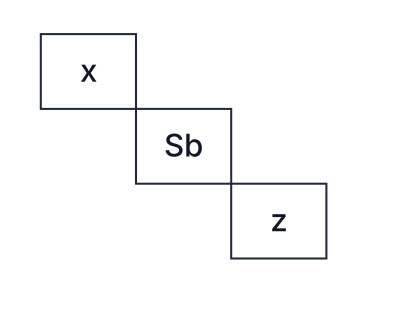
- AP EAPCET 2022Set eng-2022-07-06-AN1 markMCQQ.Identify the elements x and z in the following representation. (Sb=antimony) [FIGURE] (a periodic-table staircase diagram: three diagonal boxes arranged in a descending staircase, labelled X (top box), Sb (middle box), Z (bottom box), representing successive periods along the metalloid staircase around antimony) (A) Ge, Po (B) Sn, Ga (C) Ga, Bi (D) Si, Te
›Reveal solutionSolution
Reading the diagonal staircase around Sb (period 5, group 15): one step up-left is Ge (period 4, group 14); one step down-right is Po (period 6, group 16).
Concept and Intuition
The periodic table's metalloid ("staircase") boundary runs diagonally down and to the right, roughly along B–Si–Ge–As–Sb–Te–Po, with elements along it related by moving one period down and one group right from each neighbour. Antimony (Sb) sits in period 5, group 15, right in the middle of this run, flanked diagonally by Ge (period 4, group 14, up-left) and Po (period 6, group 16, down-right).
Step-by-Step Solution
- Locate Sb: period 5, group 15.
- X is diagonally up-left of Sb (one period earlier, one group left): period 4, group 14 ⇒ Germanium (Ge).
- Z is diagonally down-right of Sb (one period later, one group right): period 6, group 16 ⇒ Polonium (Po).
- This matches the well-known Ge–Sb–Po diagonal relationship among the metalloids.
Common Mistakes
- Confusing the diagonal relationship with the vertical (same-group) relationship, which would instead give Sn/Bi type answers.
- Mixing up which corner (up-left vs down-right) is X vs Z.
✓Final answerThe correct option is (A) — Ge, Po.
ANSWER: A
- AP EAPCET 2021Set ap-2021-09-06-FN1 markMCQQ.Identify the correct statement(s) from the following:i) There are four d-block series.ii) Total d-block elements are 40iii) Third d-block series starts with Lanthanum & ends with mercuryiv) All the d-block members are metals & found in nature (A)(i) &(iii) only (B)(i) &(iv) only (C) (i),(ii) &(iii) only (D) (i), (ii),(iii) & (iv)
›Reveal solutionSolution
Checking each statement against d-block facts: four series exist (i, true), totalling 40 elements (ii, true), the third series runs La to Hg (iii, true), but not every d-block element occurs naturally — some are synthetic (iv, false). So (i),
(ii),
(iii) only.
Concept and Intuition
The d-block of the periodic table is organized into four "transition series" based on which shell's d-orbitals are being filled: 3d (period 4), 4d (period 5), 5d (period 6), and 6d (period 7). Each series has 10 elements (for the d-subshell's 5 orbitals × 2 electrons), giving 40 elements in total. However, "d-block" doesn't guarantee natural occurrence — some d-block elements (like technetium, or many of the heavy period-7 d-block elements) are exclusively synthesized in labs and never found in nature.
Step-by-Step Solution
- Statement (i): The d-block series are 3d, 4d, 5d, 6d — four series. TRUE.
- Statement (ii): 4×10=40 total d-block elements. TRUE.
- Statement (iii): The third d-block series (5d) is conventionally: La, then Hf through Hg (10 elements, La–Hg span). TRUE as commonly presented.
- Statement (iv): Not all d-block elements are metals found in nature — e.g., technetium (Tc, 4d series) does not occur naturally and is synthetically produced; some period-7 (6d) elements are also purely synthetic. FALSE.
- So the correct statements are (i), (ii), (iii) only — option C.
Common Mistakes
- Assuming every "block" element must be naturally occurring — synthetic elements exist within blocks too.
- Miscounting the d-block series as 3 instead of 4 (forgetting the incomplete 6d series).
✓Final answerThe correct option is (C) — (i), (ii) & (iii) only.
ANSWER: C
🎓Unlock everything free for 14 days
- ✓Full step-by-step solutions
- ✓Concept-first explanations
- ✓Methods, shortcuts & mistakes
- ✓PYQ mapping + timed mock tests
Full access for 14 days. No credit card required.