Q.How will you convert ethanoic acid into benzene?
🔒You're viewing a preview — the full solution, concept, methods & PYQ mapping are locked.
🔒 Start your 14-day free trial to unlock the full solution →Concept understanding — Organic Synthesis
Organic Synthesis: Building Molecules from Scratch
Imagine you're a chef who wants to make a complex dish like biryani. You don't just throw rice, chicken, and spices into a pot and hope for the best. You follow a recipe: first marinate the meat, then fry the onions, layer everything, and cook on a slow flame. Each step transforms simple ingredients into something more complex, and the order matters.
Organic synthesis is exactly that — but for molecules. It's the art and science of building a desired organic compound (the "target molecule") from simpler, readily available starting materials, using a sequence of chemical reactions.
The Core Intuition
Nature gives us simple molecules: methane (CH4), ethene (C2H4), benzene (C6H6), ethanol (C2H5OH). But we need complex ones: medicines like paracetamol, polymers like nylon, dyes, pesticides, and plastics. Organic synthesis is how we bridge that gap.
Think of it like Lego. You have basic bricks (functional groups like -OH, -COOH, -NH₂). You have connectors (reagents like H2SO4, KMnO4, NaBH4). And you have instructions (reaction conditions: temperature, solvent, catalyst). Your job is to click the right bricks in the right order to build the exact structure you want.
The Precise Statement
Organic synthesis is the deliberate construction of organic compounds through a planned sequence of chemical reactions, where each step transforms a starting material into an intermediate, ultimately yielding the target molecule with the desired structure and stereochemistry.
The Two Big Challenges
1. Selectivity — You want only one product, not a mixture. For example, if you want to convert an alcohol (R−OH) to an aldehyde (R−CHO), you must stop the reaction before it over-oxidises to a carboxylic acid (R−COOH). This requires choosing the right reagent (e.g., PCC instead of K2Cr2O7).
2. Yield — Every reaction loses some material. If you have 10 steps, each with 90% yield, your final yield is only 0.910≈35%. Good synthesis minimises steps and maximises yield per step.
How It Actually Works: Retrosynthesis
Chemists don't start from the beginning. They start from the target molecule and work backwards, asking: "What simpler molecule could I make this from?" This reverse-thinking is called retrosynthesis.
Retrosynthesis is like solving a maze backwards — you start at the cheese and find the path to the entrance.
Example: Suppose you want to make paracetamol (acetaminophen). The target has a benzene ring with an -OH group and an -NHCOCH₃ group. Working backwards:
- The -NHCOCH₃ group can come from reacting an amine (−NH2) with acetic anhydride ((CH3CO)2O).
- The -OH group can come from a diazonium salt (made from an amine).
- The amine can come from reducing a nitro group (−NO2).
- The nitro group can come from nitrating phenol.
So the forward synthesis becomes: Phenol → Nitration → Reduction → Acetylation → Paracetamol.
Why It Matters
Every medicine you take, every plastic bottle you use, every synthetic fabric you wear exists because someone figured out how to synthesise it. The 2010 Nobel Prize in Chemistry went to Heck, Negishi, and Suzuki for developing palladium-catalysed cross-coupling reactions — tools that let chemists join carbon atoms together with precision, revolutionising how we make complex molecules. …
The strategy: benzene is made by the cyclic polymerisation of ethyne (§9.5.4), so the conversion reduces to "ethanoic acid → ethyne", built from reactions already covered in this unit.
The route:
- CHX3COOHNaOHCHX3COONa — form the sodium salt.
- CHX3COONa+NaOHCaO,ΔCHX4+NaX2COX3 — sodalime decarboxylation to methane.
- CHX4+ClX2hνCHX3Cl+HCl — photochemical chlorination.
- 2CHX3Cl+2Nadry etherCX2HX6+2NaCl — Wurtz reaction builds the C2 chain.
- CX2HX6+ClX2hνCX2HX5Cl+HCl — chlorination of ethane.
- CX2HX5Clalc. KOHCHX2=CHX2+HCl — dehydrohalogenation to ethene.
- CHX2=CHX2+BrX2CHX2Br−CHX2Br — bromine addition.
- CHX2Br−CHX2Bralc. KOHCHX2=CHBrNaNHX2HC≡CH — double dehydrohalogenation to ethyne. …
Degrade the acid to methane (sodalime decarboxylation), couple up to a C2 unit (Wurtz), strip it down to ethyne (two dehydrohalogenations), then let three ethyne molecules cyclise to benzene in a red-hot iron tube at 873 K: CHX3COOHCHX3COONaCHX4CHX3ClCX2HX6CX2HX5ClCHX2=CHX2CHX2BrCHX2BrCHX2=CHBrHC≡CHCX6HX6.
The strategy
There is no one-step path from a two-carbon acid to a six-carbon aromatic ring. But this unit gives us one reaction that builds benzene directly: the cyclic polymerisation of ethyne (§9.5.4, method (i)) — three HC≡CH molecules passed through a red-hot iron tube at 873 K join into one benzene ring. So the whole conversion becomes: turn ethanoic acid into ethyne, then cyclise.
Step-by-step route
1. Acid → salt. Neutralise ethanoic acid: CHX3COOH+NaOHCHX3COONa+HX2O.
2. Salt → methane. Sodalime decarboxylation removes the carboxyl carbon: CHX3COONa+NaOHCaO,ΔCHX4+NaX2COX3.
3. Methane → chloromethane. Photochemical chlorination (§9.2.3): CHX4+ClX2hνCHX3Cl+HCl.
4. Chloromethane → ethane. The Wurtz reaction couples two methyl groups: 2CHX3Cl+2Nadry etherCHX3−CHX3+2NaCl. This is the step that grows the carbon count from 1 to 2.
5. Ethane → chloroethane. CX2HX6+ClX2hνCX2HX5Cl+HCl.
6. Chloroethane → ethene. Dehydrohalogenation with alcoholic KOH: CX2HX5Clalc. KOHCHX2=CHX2+HCl.
7. Ethene → 1,2-dibromoethane. Addition of bromine: CHX2=CHX2+BrX2CHX2Br−CHX2Br. …
Showing the 12 most recent of 34 on this concept.
- AP EAPCET 2026Set eng-2026-05-12-FN1 markMCQQ.Isobutyl alcohol can be prepared from which of the following reactions? I. (CH3)2C=CH2 (isobutylene) $\xrightarrow{\text{(i) } HBr/(C_6H_5CO)_2O_2 \text{(ii) } OH^-}$ II. (CH3)2C=O (acetone) $\xrightarrow{\text{(i) } MeMgBr \text{(ii) } H_2O}$ III. (CH3)2CH−MgBr (isopropylmagnesium bromide) $\xrightarrow{\text{(i) } HCHO \text{(ii) } H_2O}$ Correct answer is (A) I, II only (B) II, III only (C) I, III only (D) I, II, III
›Reveal solutionSolution
This tests which classic routes actually deliver isobutyl alcohol, (CH3)2CHCH2OH: the peroxide-effect hydration of isobutylene and the Grignard-formaldehyde route both work; the acetone + methyl Grignard route gives a tertiary alcohol instead.
Concept and Intuition
Isobutyl alcohol is a primary alcohol: (CH3)2CH-CH2-OH. To build it you need to end up with a −CH2OH group attached to an isopropyl carbon. Grignard reagents reacting with formaldehyde (HCHO) always give a primary alcohol (one carbon longer than the Grignard's carbon skeleton, with a CH2OH end), which is exactly what's needed here. But a Grignard reacting with a ketone like acetone gives a tertiary alcohol, not primary — so route II can never give isobutyl alcohol regardless of which Grignard is used, because the ketone carbon becomes the fully-substituted alcohol carbon.
Step-by-Step Solution
- Route I: Isobutylene (CH3)2C=CH2 + HBr with peroxide (C6H5CO)2O2 → anti-Markovnikov addition (radical mechanism) puts Br on the less substituted (terminal, CH2) carbon: (CH3)2CH-CH2Br. Then OH− (SN2) replaces Br with OH: (CH3)2CH-CH2OH = isobutyl alcohol. Works.
- Route II: Acetone (CH3)2C=O + CH3MgBr → addition across C=O gives (CH3)2C(CH3)-OMgBr, and after H2O workup: (CH3)3C-OH, tert-butyl alcohol — a tertiary alcohol, not isobutyl alcohol. Fails. …
- AP EAPCET 2026Set eng-2026-05-12-AN1 markMCQQ.What are A and B respectively in the following reaction sequence? C2H4273 KAHO−CH2CH2−OH(i) CH3COCH3(ii) B [cyclic ketal product: 2,2-dimethyl-1,3-dioxolane] (A) KMnO4/H+ ; dil HCl (B) KMnO4/H+ ; dry HCl (C) dil KMnO4 ; dil HCl (D) dil KMnO4 ; dry HCl
›Reveal solutionSolution
Cold dilute KMnO4 converts ethylene to ethylene glycol by syn-dihydroxylation (A); reacting the glycol with acetone under anhydrous (dry HCl) acid catalysis then forms the cyclic ketal (B).
Concept and Intuition
This sequence tests two classic named transformations: (i) cold, dilute, alkaline permanganate as a mild oxidant that adds two -OH groups across a C=C double bond without further oxidative cleavage (unlike hot/concentrated/acidic permanganate, which cleaves the alkene), and (ii) protection of a ketone as a cyclic ketal using a diol and an anhydrous acid catalyst — anhydrous conditions are essential because ketal formation is an equilibrium that water reverses.
Step-by-Step Solution
- A: C2H4A, 273KHOCH2CH2OH. This is the standard test/preparation: cold, dilute (Baeyer's) KMnO4 syn-adds two hydroxyls across the double bond, giving ethylene glycol without breaking the C–C bond. So A = dilute KMnO4 (not the hot/acidic KMnO4/H+ form, which would cleave the alkene to smaller acids).
- Ethylene glycol then reacts with acetone, CH3COCH3. …
- AP EAPCET 2026Set eng-2026-05-15-FN1 markMCQQ.The product Z of the given reaction sequence is C2H4(i) H+/H2O(ii) H+/KMnO4XSOCl2Y(C2H5)2CdZ (A) An acid chloride (B) A ketone (C) An aldehyde (D) An ester
›Reveal solutionSolution
Diorganocadmium reagents are the classic way to stop an acid-chloride reaction cleanly
at the ketone stage, so Z here is a ketone. Answer: (B).
Concept and Intuition
This sequence walks through a standard functional-group conversion chain:
- H+/H2O hydrates ethylene (Markovnikov addition of water) to ethanol.
- H+/KMnO4 (acidic potassium permanganate) is a strong oxidiser; a primary alcohol like ethanol is oxidised all the way through the aldehyde to the carboxylic acid (acetic acid), so X=CH3COOH.
- SOCl2 is the standard reagent to convert a carboxylic acid cleanly into the acid chloride (with only gaseous byproducts SO2 and HCl), so Y=CH3COCl (acetyl chloride).
- Dialkylcadmium reagents, R2Cd, are a classically taught way to convert an acid chloride selectively into a ketone: they are much less reactive than Grignard or organolithium reagents, so they react once with the acid chloride and then stop — they do not attack the resulting ketone further (whereas a Grignard reagent would add twice, over-reacting to give a tertiary alcohol). So CH3COCl+(C2H5)2Cd→CH3COC2H5 (butan-2-one), a ketone.
Step-by-Step Solution
- C2H4H+/H2OCH3CH2OH (ethanol).
- CH3CH2OHH+/KMnO4CH3COOH=X (acetic acid; full oxidation of a 1° alcohol under acidic KMnO4). …
- AP EAPCET 2026Set eng-2026-05-15-FN1 markMCQQ.What are X and Y respectively in the following set of reactions? Y(i) NH2OH(ii) (CH3CO)2OC6H5CHO(i) LiAlH4, H2O (ii) PBr3(iii) KCNX (major product) (A) C6H5CN ; C6H5NC (B) C6H5CN ; C6H5CN (C) C6H5CH2NC ; C6H5NC (D) C6H5CH2CN ; C6H5CN
›Reveal solutionSolution
One arm reduces the aldehyde, brominates, then displaces with cyanide to give benzyl
cyanide (X); the other arm forms the oxime and dehydrates it with acetic anhydride
to give benzonitrile (Y). Answer: (D).
Concept and Intuition
Benzaldehyde is the common starting point for two different named transformations here:
Path to X (reduce → halogenate → substitute):
- LiAlH4 reduces the aldehyde to a primary alcohol: C6H5CHO→C6H5CH2OH (benzyl alcohol).
- PBr3 swaps the −OH for −Br: C6H5CH2OH→C6H5CH2Br (benzyl bromide), a reactive, unhindered primary/benzylic halide.
- KCN performs a clean SN2 displacement of bromide by cyanide (benzylic + primary = ideal SN2 substrate): C6H5CH2Br→C6H5CH2CN.
- So X=C6H5CH2CN (phenylacetonitrile / benzyl cyanide) — note the extra CH2 compared to a direct nitrile on the ring carbon.
Path to Y (oxime formation, then dehydration to nitrile):
- NH2OH converts the aldehyde directly to its oxime: C6H5CHO→C6H5CH=N−OH (benzaldoxime).
- Acetic anhydride, (CH3CO)2O, is the classic reagent to dehydrate an aldoxime to a nitrile (it acetylates the oxime −OH, and elimination of acetic acid then forms the C≡N triple bond): C6H5CH=NOH→C6H5C≡N.
- So Y=C6H5CN (benzonitrile) — directly on the ring carbon, no extra CH2.
Step-by-Step Solution
- Reduce: C6H5CHOLiAlH4,H2OC6H5CH2OH.
- Brominate: C6H5CH2OHPBr3C6H5CH2Br.
- Substitute: C6H5CH2BrKCNC6H5CH2CN=X. …
- AP EAPCET 2026Set ap-2026-05-20-FN1 markMCQQ.What are X and Y in the following reaction sequence? Ethanal (i) O3(ii) Zn+H2O C4H8 (i) Br2/CCl4(ii) X Y (A) X = alcoholic KOH, NaNH2; Y = CH3CH2C≡CH (B) X = alcoholic KOH, NaNH2; Y = CH3C≡CCH3 (C) X = alcoholic KOH; Y = CH3CH2C≡CH (D) X = aq KOH; Y = CH3C≡CCH3
›Reveal solutionSolution
Ozonolysis pins C4H8 as the symmetric but-2-ene; double dehydrohalogenation of its Br2-addition product (alcoholic KOH then NaNH2) gives the symmetric alkyne but-2-yne. Answer: X = alc. KOH, NaNH2; Y = CH3C≡CCH3.
Concept and Intuition
Reductive ozonolysis (O3 then Zn/H2O) cleaves a C=C bond into two carbonyl fragments. Getting only ethanal (CH3CHO) as product means the alkene must be symmetric with a CH3CH=CHCH3 skeleton (but-2-ene) — each half of the cleaved double bond is CH3CH=, giving CH3CHO on both sides. Separately, this same alkene undergoes anti addition of Br2 across the double bond to give a vicinal dihalide (2,3-dibromobutane). Converting a vicinal dihalide fully to an alkyne requires two eliminations: alcoholic KOH removes the first HBr (giving a bromoalkene), and because the remaining vinylic C–H is much less acidic/harder to eliminate with a mild base, a much stronger base like sodamide (NaNH2) is needed to complete the second elimination to the alkyne.
Step-by-Step Solution
- Ozonolysis of C4H8 gives only ethanal ⇒C4H8=CH3−CH=CH−CH3 (but-2-ene, symmetric alkene).
- But-2-ene + Br2/CCl4 (anti addition) → 2,3-dibromobutane, CH3CHBr−CHBrCH3.
- Treat with X = alcoholic KOH: first dehydrohalogenation removes one HBr, forming 2-bromobut-2-ene (a vinylic bromide).
- Treat further with NaNH2 (strong base): removes the second (vinylic) H–C–Br unit, completing elimination to the alkyne. …
- AP EAPCET 2026Set ap-2026-05-20-FN1 markMCQQ.Identify the major product 'P' in the following sequence of reactions (Conc. = concentrated, major = major, dil = dilute) CH3COCH2CH3(i) NaBH4(ii) Conc. H2SO4 X (major) (i) O3(ii) Zn/H2O Y dil NaOHC6H5CHO,Δ P (A) C6H5−CH=CH−CHO (cinnamaldehyde) (B) C6H5−CH(OH)−CH2−CHO (C) CH3−CH=CH−C6H5 (D) [FIGURE] (a benzene ring bearing a −CHO group and, at the meta position, a −CH=CH2 vinyl group)

›Reveal solutionSolution
Butan-2-one → (NaBH₄) butan-2-ol → (H₂SO₄, Zaitsev) but-2-ene → (ozonolysis) two acetaldehyde molecules → (crossed Claisen–Schmidt aldol with benzaldehyde, heat) cinnamaldehyde.
Concept and Intuition
This is a classic multi-step synthesis chain that combines four separate named ideas: chemoselective ketone reduction (NaBH₄ leaves other functionality alone), acid-catalysed E1 dehydration favouring the Zaitsev (more substituted, more stable) alkene, reductive ozonolysis (which cleaves a C=C bond into two carbonyl fragments without further oxidising them to acids), and finally a crossed aldol condensation: when only one of the two carbonyl partners has α-hydrogens (acetaldehyde does; benzaldehyde does not), the enolate of the α-H-bearing partner attacks the other carbonyl, and base + heat drives the reaction through dehydration to the thermodynamically stable, conjugated α,β-unsaturated carbonyl product.
Step-by-Step Solution
- CH3COCH2CH3 (butan-2-one) NaBH4 selective reduction of the ketone (NaBH₄ doesn't touch other groups) gives butan-2-ol, CH3CH(OH)CH2CH3.
- Butan-2-ol conc. H2SO4 X: acid-catalysed E1 dehydration. Two alkenes are possible (but-1-ene, terminal, and but-2-ene, internal); by Zaitsev's rule the more substituted, more stable alkene is the major product: but-2-ene, CH3CH=CHCH3.
- But-2-ene (i)O3 (ii)Zn/H2O Y: reductive ozonolysis cleaves the C=C bond. Since but-2-ene is symmetric (methyl on each end of the double bond), cleavage gives two identical molecules of acetaldehyde, CH3CHO — so Y = acetaldehyde. …
- AP EAPCET 2025Set eng-2025-05-21-FN1 markMCQQ.Consider the following reaction sequence Vinylbenzene KMnO4+KOHΔXNaOH+CaOΔY 'Y' can also be formed from (A) Polymerisation of ethylene (B) Polymerisation of propyne (C) Aromatisation of n-hexane (D) Aromatisation of n-heptane
›Reveal solutionSolution
This tests recognizing the oxidative-cleavage + decarboxylation sequence from styrene to benzene, and knowing that catalytic aromatisation of n-hexane (a 6-carbon chain) also produces benzene.
Concept and Intuition
Vinylbenzene (styrene, C6H5−CH=CH2) has a reactive alkene side chain. Hot alkaline KMnO4 vigorously oxidizes alkenes attached to an aromatic ring, cleaving the double bond: the carbon directly attached to the benzene ring is oxidized up to a carboxylic acid (giving benzoic acid), while the terminal =CH2 carbon is fully oxidized away (as CO2/formic acid, lost from the mixture). So X = benzoic acid, C6H5COOH. Heating a sodium carboxylate salt with soda lime (NaOH+CaO) causes decarboxylation, replacing −COONa with −H: benzoate → benzene. So Y = benzene. The question then asks for another synthetic route to benzene: catalytic reforming (aromatisation/dehydrocyclization) of n-hexane, a straight six-carbon alkane, cyclizes and dehydrogenates over a catalyst (e.g. Pt/Cr₂O₃) to directly give benzene, releasing hydrogen gas — this exactly matches Y.
Step-by-Step Solution
- Identify X: styrene + hot alkaline KMnO4 → oxidative cleavage of the −CH=CH2 group → benzoic acid (C6H5COOH) after acidification.
- Identify Y: benzoic acid (as its sodium salt) + soda lime, heat → decarboxylation → benzene (C6H6).
- Evaluate the options for alternate synthesis of benzene (Y):
- (A) Polymerisation of ethylene gives polyethylene, a saturated polymer — not benzene. …
- AP EAPCET 2025Set eng-2025-05-22-AN1 markMCQQ.What are X, Y, Z in the following reaction sequence? But-2-ene X Ethanoic acid Y Ethanoyl chloride BenzeneAnhy. AlCl3 Z (A) KMnO4/H+; SOCl2; Acetophenone (B) KMnO4/H+; Cl2; Propiophenone (C) Cold KMnO4; SOCl2; Propiophenone (D) Cold KMnO4; Cl2; Acetophenone
›Reveal solutionSolution
Hot acidic KMnO4 cleaves but-2-ene's double bond to two moles of ethanoic acid; SOCl2 converts the acid to ethanoyl chloride; Friedel–Crafts acylation on benzene then gives acetophenone. The answer is (A).
Concept and Intuition
Each step here tests a classic named transformation:
- Oxidative cleavage of alkenes: hot, acidified KMnO4 is a strong oxidant that completely cleaves a C=C bond. A =CH–R carbon (one H on the double-bond carbon) is oxidised all the way to –COOH (R–COOH), while a =CR₂ carbon (no H) is oxidised only to a ketone. Cold, dilute KMnO4 is much milder — it only syn-dihydroxylates the double bond to a vicinal diol, it does not cleave it.
- Acid → acid chloride: SOCl2 (thionyl chloride) is the standard, clean reagent for converting a carboxylic acid to its acyl chloride, releasing only gases (SO2 and HCl) that leave the product pure. Cl2 is not a reagent for this conversion.
- Friedel–Crafts acylation: an acyl chloride + arene, catalysed by anhydrous AlCl3, installs an acyl (–CO–R) group onto the ring, giving an aryl ketone.
Step-by-Step Solution
- But-2-ene: CH3−CH=CH−CH3 — a symmetric internal alkene; each alkene carbon carries exactly one H (a mono-substituted vinylic carbon).
- Treat with hot, acidified KMnO4 (X): the double bond is oxidatively cleaved, and since each carbon bears one H, each half becomes a –COOH group: CH3−CH=CH−CH3KMnO4/H+2 CH3COOH (ethanoic acid). This rules out the "Cold KMnO4" options (C, D), since cold KMnO4 would only give butane-2,3-diol, not cleave the double bond.
- Convert ethanoic acid to ethanoyl chloride using Y = SOCl2: CH3COOH+SOCl2→CH3COCl+SO2↑+HCl↑. This rules out option B, which proposes Cl2 (not a reagent for this conversion). …
- AP EAPCET 2025Set ap-2025-05-19-AN1 markMCQQ.The IUPAC name of the product Z in the reaction sequence is C3H6H2O/H+XCrO3Y (major)(2) Δ⇌(1) Ba(OH)2Z (A) But-2-enal (B) 4-Methylpent-3-enal (C) 4-Methylpent-3-en-2-one (D) 2-Methylpent-2-enal
›Reveal solutionSolution
This chains Markovnikov hydration, alcohol oxidation, and base-catalyzed acetone self-aldol condensation to arrive at mesityl oxide — answer (C).
Concept and Intuition
Propene's acid-catalyzed hydration follows Markovnikov's rule (H adds to the carbon with more H's already), giving the secondary alcohol isopropanol, not the primary alcohol. Oxidizing a secondary alcohol with CrO3 stops cleanly at the ketone (no further oxidation possible, since there's no H left on that carbon after forming the C=O). Finally, acetone — having α-hydrogens — undergoes a classic base-catalyzed aldol condensation with itself: two acetone molecules combine to a β-hydroxy ketone (diacetone alcohol), and heating drives dehydration to the conjugated enone, mesityl oxide.
Step-by-Step Solution
- CH2=CHCH3H2O/H+ Markovnikov addition places OH on the more substituted carbon: X=(CH3)2CHOH (isopropanol).
- XCrO3 oxidation of a 2° alcohol gives a ketone: Y=(CH3)2CO (acetone), the major product.
- Acetone + Ba(OH)₂ (base catalyst): self-aldol addition — the enolate of one acetone molecule attacks the carbonyl carbon of another, forming diacetone alcohol, (CH3)2C(OH)CH2COCH3. …
- AP EAPCET 2025Set eng-2025-05-24-FN1 markMCQQ.An alcohol X(C4H10O) on dehydration gave alkene (C4H8) as major product, which on bromination followed by treatment with Y gave alkyne C4H6. Alkyne C4H6 does not react with sodium metal. What are X and Y? (alc. = alcoholic, aq. = aqueous) (A) CH3−CH(OH)−CH2−CH3 ; aq. KOH (B) CH3−CH(OH)−CH2−CH3 ;(i) alc.KOH(ii) NaNH2 (C) CH3−CH2−CH2−CH2−OH ; alc. KOH (D) CH3−CH2−CH2−CH2−OH ;(i) alc.KOH(ii) NaNH2
›Reveal solutionSolution
The clue "alkyne C4H6 does not react with sodium" identifies it as internal 2-butyne (no acidic terminal H); tracing that back through dehydration → bromination → double dehydrohalogenation identifies X as 2-butanol and Y as alc. KOH then NaNH2.
Concept and Intuition
Terminal alkynes (R−C≡C−H) have an acidic ≡C−H (sp carbon, high s-character) and react with active metals like sodium, releasing H2 and forming an acetylide. Internal alkynes (R−C≡C−R′) have no such H and are inert to Na. This distinction is the key to identifying which C4H6 isomer is meant, and that in turn tells us which alcohol/alkene/dihalide the synthesis must have passed through.
Step-by-Step Solution
- C4H6 alkynes: but-1-yne (CH≡C−CH2−CH3, terminal) and but-2-yne (CH3−C≡C−CH3, internal). Since the product does not react with Na, it must be the internal isomer, but-2-yne (2-butyne).
- To make an internal alkyne symmetrically by double dehydrohalogenation of a vicinal dihalide, the dihalide must be 2,3-dibromobutane, CH3−CHBr−CHBr−CH3.
- That dibromide comes from bromination of the alkene 2-butene, CH3−CH=CH−CH3 (adding Br2 across the double bond).
- 2-Butene, in turn, is the Zaitsev (major, more-substituted) product of acid-catalysed dehydration of 2-butanol, CH3−CH(OH)−CH2−CH3 — matching alcohol X = C4H10O. …
- AP EAPCET 2025Set eng-2025-05-27-FN1 markMCQQ.What are B and C respectively in the following set of reactions ? CZnΔ1,2-dibromopropane(i) alc.KOH(ii) NaNH2ALindlarCatalystB (A) [FIGURE] (two three-carbon skeletal alkene structures drawn side by side: the first has its double bond on the left segment of the zigzag; the second has its double bond on the right segment of the zigzag) (B) [FIGURE] (two three-carbon skeletal chains drawn side by side with no double bond shown on either) (C) [FIGURE] (a three-carbon skeletal structure with a double bond on the left segment, next to a three-carbon skeletal chain with no double bond) (D) [FIGURE] (a three-carbon skeletal chain with no double bond, next to a three-carbon skeletal structure with a double bond on the right segment)
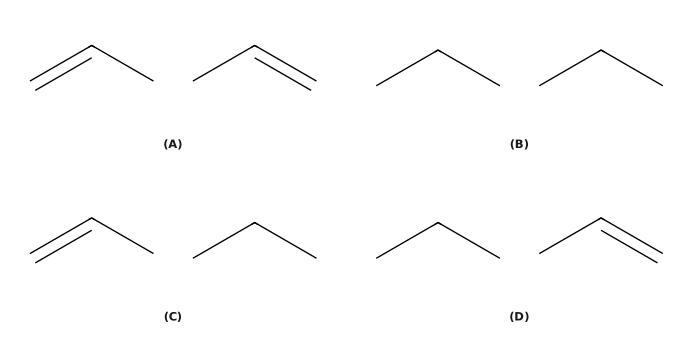
›Reveal solutionSolution
Both routes from 1,2-dibromopropane — direct Zn debromination (giving C) and alc. KOH/NaNH2 then Lindlar hydrogenation (giving B) — converge on the same terminal alkene, propene; so B and C are both alkene structures, just drawn with the double bond at opposite ends of the chain.
Concept and Intuition
Zinc dust with heat is the classic reagent for debrominating a vicinal dihalide: it removes the two halogens from adjacent carbons and reforms the C=C bond exactly where they were, regenerating the parent alkene (this is the reverse of the bromine-addition test for unsaturation). Separately, alcoholic KOH under heat performs double dehydrohalogenation on a vicinal dihalide, eliminating two equivalents of HX to build a triple bond — giving an alkyne. Since 1,2-dibromopropane's two bromines are on C1–C2, this produces propyne, which is already a terminal alkyne; treating a terminal alkyne with the very strong base NaNH2 merely removes its acidic ≡C–H proton (forming the sodium acetylide), it does not change the carbon skeleton. Finally, Lindlar's poisoned catalyst partially hydrogenates a triple bond to a cis-alkene — but because this alkyne is terminal, the product carbon bears two H atoms and there is no cis/trans distinction: hydrogenation simply gives propene again.
Step-by-Step Solution
- 1,2-Dibromopropane: CH2Br-CHBr-CH3.
- Zn/Δ (debromination): removes both Br atoms, forms the double bond between C1–C2 → C=CH2=CH−CH3 (propene).
- (i) alc. KOH, heat: eliminates 2 HBr in succession to form the triple bond at the same position → propyne, CH3−C≡CH (already a terminal alkyne).
- (ii) NaNH2: deprotonates the terminal ≡C-H (forms sodium propynide); the carbon skeleton and unsaturation position are unchanged, so this intermediate is effectively still propyne (call it A) once reprotonated. …
- AP EAPCET 2024Set ap-2024-05-16-AN1 markMCQQ.What are X and Y in the following reactions? benzyl alcohol (C6H5CH2OH) X benzoic acid (C6H5COOH) (i) SOCl2(ii) Y benzaldehyde (C6H5CHO) (A) X = B2H6; Y = H2/Pd (B) X = B2H6; Y = H2, Pd-BaSO4 (C) X =(i) NaBH4(ii) H2O; Y = H2, Pd-BaSO4 (D) X =(i) NaBH4(ii) H2O; Y = H2/Pd
›Reveal solutionSolution
Benzoic acid → benzyl alcohol needs a reagent strong enough to reduce −COOH (B2H6, not NaBH4); benzoic acid → benzaldehyde via the acid chloride needs Rosenmund's poisoned-catalyst hydrogenation (H2,Pd-BaSO4) to avoid over-reduction to the alcohol.
Concept and Intuition
Reducing agents differ sharply in strength: NaBH4 is a mild reducing agent that reduces aldehydes/ketones but is generally too weak to touch carboxylic acids or esters; LiAlH4 and B2H6 (diborane) are strong enough to reduce −COOH all the way to −CH2OH. Separately, converting an acid to an aldehyde (rather than over-reducing to the alcohol) requires stopping hydrogenation exactly at the aldehyde stage — achieved industrially/academically via Rosenmund's reduction: the acid chloride is hydrogenated over Pd poisoned with BaSO4 (or quinoline-S), which prevents further reduction to the alcohol.
Step-by-Step Solution
- Benzoic acid → benzyl alcohol: this is a reduction of −COOH to −CH2OH. NaBH4 cannot reduce carboxylic acids, ruling out options (C) and (D). B2H6 (diborane) selectively reduces −COOH to −CH2OH — so X = B2H6.
- Benzoic acid + SOCl2 → benzoyl chloride (C6H5COCl), releasing SO2 and HCl — a clean, standard way to make an acid chloride. …
🎓Unlock everything free for 14 days
- ✓Full step-by-step solutions
- ✓Concept-first explanations
- ✓Methods, shortcuts & mistakes
- ✓PYQ mapping + timed mock tests
Full access for 14 days. No credit card required.