Q.Arrange the following hydrogen halides in order of their decreasing reactivity with propene.
🔒You're viewing a preview — the full solution, concept, methods & PYQ mapping are locked.
🔒 Start your 14-day free trial to unlock the full solution →Concept understanding — Markovnikov vs Anti Markovnikov Addition
Markovnikov vs Anti-Markovnikov Addition
Imagine you're adding something across a double bond — say, H–Br. The double bond is like a crowded room: one carbon has more friends (alkyl groups) attached, the other has fewer. Where does the hydrogen go? That's the core question.
The Intuition: Stability Wins
A carbocation (a carbon with a positive charge) forms as an intermediate in many addition reactions. The more alkyl groups attached to that positively charged carbon, the more stable it is — alkyl groups push electrons toward the positive centre, stabilising it.
So when H⁺ from H–Br attacks the double bond, it will choose the path that leads to the more stable carbocation. That means the hydrogen goes to the carbon that already has more hydrogens (the less substituted carbon), leaving the positive charge on the more substituted carbon (which has more alkyl groups to stabilise it).
This is the Markovnikov rule in its original form: "The rich get richer." The carbon that already has more hydrogens gets the new hydrogen.
The Precise Statement
Markovnikov Addition: When H–X adds to an unsymmetrical alkene, the hydrogen attaches to the carbon with more hydrogen atoms already attached, and the halogen (or other group) attaches to the carbon with fewer hydrogen atoms.
Anti-Markovnikov Addition: The opposite — hydrogen attaches to the carbon with fewer hydrogen atoms, and the other group attaches to the carbon with more hydrogen atoms.
Why Does Anti-Markovnikov Happen?
Normal H–Br addition follows Markovnikov. But if you add peroxides (ROOR) to the reaction, the mechanism changes from ionic to free radical. In the radical mechanism, the bromine radical attacks first, and it prefers to form the more stable radical intermediate — which is the more substituted carbon radical. That forces the hydrogen to go to the other carbon, giving anti-Markovnikov product.
Anti-Markovnikov addition only works reliably with H–Br. H–Cl and H–I do not give clean anti-Markovnikov products under radical conditions — H–Cl's bond is too strong, and H–I's radical is too unstable.
Quick Comparison Table
| Feature | Markovnikov | Anti-Markovnikov |
|---------|-------------|------------------| …
The key idea is that the addition of hydrogen halides to an alkene follows Markovnikov’s rule, and the reactivity depends on the bond dissociation enthalpy of the H–X bond — the weaker the bond, the faster the addition.
- Propene is an unsymmetrical alkene. The reaction proceeds via an electrophilic addition where the H–X bond breaks heterolytically.
- The rate-determining step involves breaking the H–X bond. Bond dissociation enthalpy decreases down the group: …
The reactivity of hydrogen halides with propene follows the bond dissociation enthalpy trend: weaker H–X bonds react faster. The correct order is HI > HBr > HCl, which corresponds to option (iii).
The question asks about the reactivity of hydrogen halides (HCl, HBr, HI) with propene — an electrophilic addition reaction. This is not about the stability of the final product, but about how fast each HX adds across the double bond.
The key concept is that the rate-determining step in electrophilic addition is the proton transfer from HX to the alkene, forming a carbocation. The ease of this step depends on how readily the H–X bond breaks. The bond dissociation enthalpy (BDE) of H–X decreases down the group: H–Cl (431 kJ/mol), H–Br (366 kJ/mol), H–I (298 kJ/mol). A weaker bond breaks more easily, so HI donates a proton fastest.
A common mistake is to confuse reactivity with the stability of the product. The addition of HI is fastest, but the product (2-iodopropane) is less stable than the chloro or bromo analogue. Reactivity and product stability are separate ideas.
Let’s walk through the reasoning step by step.
-
Identify the reaction type. Propene (CHX3CH=CHX2) is an unsymmetrical alkene. With HX, it undergoes electrophilic addition following Markovnikov’s rule: the hydrogen adds to the carbon with more hydrogens, giving 2-halopropane as the major product. The mechanism begins with the π bond attacking the H of HX.
-
Focus on the rate-determining step. The first step — protonation of the double bond — is slow. The H–X bond must break heterolytically: H−XHX++XX−. The easier this bond breaks, the faster the reaction. …
- AP EAPCET 2026Set eng-2026-05-15-FN1 markMCQQ.An alkene (X) with formula C5H10 on ozonolysis gives butanone and methanal. X with HBr in the presence of organic peroxide gives Y as major product. When Y is subjected to Wurtz reaction gives Z. The number of 1°,2° and 3° carbons in Z respectively are (A) 4, 4, 2 (B) 4, 2, 4 (C) 3, 3, 4 (D) 5, 3, 2
›Reveal solutionSolution
Working backwards from ozonolysis products identifies the alkene, then anti-Markovnikov HBr addition and Wurtz coupling build up the final hydrocarbon Z, whose carbons are classified as 1°, 2°, 3° by counting carbon neighbours. The answer is 4, 4, 2.
Concept and Intuition
Ozonolysis cleaves a C=C bond and replaces it with two C=O bonds — each alkene carbon becomes a carbonyl carbon, retaining its other two substituents. So the two products, put back together end-to-end at their carbonyl carbons (removing the O's and joining the carbons with a double bond), reconstruct the alkene. HBr addition to an alkene in presence of peroxide follows the anti-Markovnikov rule (via a free-radical mechanism): Br ends up on the carbon that already carries more hydrogens (less substituted, i.e. terminal) carbon. The Wurtz reaction couples two molecules of an alkyl halide with sodium metal, joining the two carbons that held the halogen and forming a new C–C bond, doubling the chain.
Step-by-Step Solution
- Butanone is CH3–CO–CH2–CH3; its carbonyl carbon carries a CH3 and a C2H5 group. Methanal is H2C=O; its carbonyl carbon carries two H's (i.e., it was a terminal =CH2).
- Joining these two carbonyl carbons back into a C=C bond gives X: CH2=C(CH3)(C2H5), i.e. 2-methylbut-1-ene, C5H10 — matches the given formula.
- HBr + peroxide → anti-Markovnikov addition: Br goes to the terminal =CH2 carbon (more H's), H goes to the substituted carbon. So Y=BrCH2–CH(CH3)–CH2–CH3 (1-bromo-2-methylbutane).
- Wurtz reaction: 2RBr+2Na→R–R+2NaBr. The two CH2Br carbons couple directly, doubling the chain: Z=CH3–CH2–CH(CH3)–CH2–CH2–CH(CH3)–CH2–CH3 (3,6-dimethyloctane), 10 carbons total.
- Classify every carbon in Z by how many other carbons it is bonded to: …
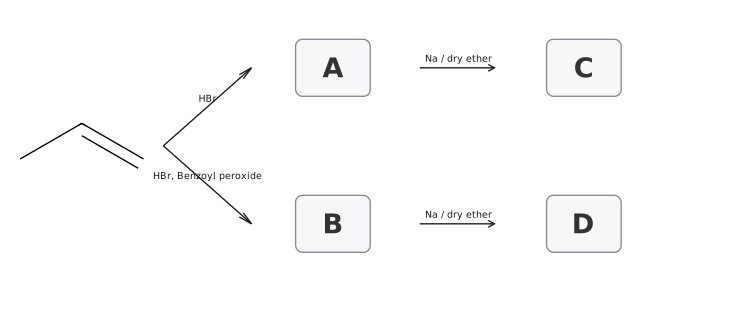
- AP EAPCET 2026Set ap-2026-05-19-AN1 markMCQQ.Consider the following reactions [FIGURE] (reaction scheme: propene (CH2=CH−CH3) treated with HBr gives (A) [major product], which on treatment with Na/dry ether gives (C); propene treated with HBr in the presence of Benzoyl Peroxide gives (B) [major product], which on treatment with Na/dry ether gives (D)) The number of 1∘ carbons in C and D are respectively (A) 3, 3 (B) 4, 2 (C) 2, 4 (D) 3, 4
›Reveal solutionSolution
The key idea is that HBr adds to propene via two different mechanisms: ionic (Markovnikov) gives 2‑bromopropane, and radical (anti‑Markovnikov) gives 1‑bromopropane. Wurtz coupling of these bromides yields alkanes C (2,3‑dimethylbutane) and D (n‑hexane), which have 4 and 2 primary carbons respectively. The correct option is (B).
Concept and Intuition
This problem tests two classic reaction pathways for adding HBr to an unsymmetrical alkene, and then a Wurtz coupling step. The twist is that the number of primary carbons in the final products depends entirely on which regioisomer of the alkyl bromide is formed first.
- Markovnikov addition (ionic mechanism, no peroxides): The hydrogen adds to the less substituted carbon of the double bond, so the bromine ends up on the more substituted carbon. For propene, this gives 2‑bromopropane (isopropyl bromide).
- Anti‑Markovnikov addition (radical mechanism, with benzoyl peroxide): The bromine radical adds to the less substituted carbon, so the hydrogen ends up on the more substituted carbon. This gives 1‑bromopropane (n‑propyl bromide).
Then, each bromide undergoes the Wurtz reaction (2 R–Br + 2 Na → R–R + 2 NaBr) in dry ether. The coupling product’s carbon skeleton is simply two alkyl groups joined together. Counting primary carbons (carbons bonded to exactly one other carbon) in the resulting alkane gives the answer.
Step‑by‑Step Reasoning
- Identify the major product from propene + HBr (no peroxide) Propene is CHX3−CH=CHX2. In the absence of peroxides, HBr adds via an ionic mechanism: the proton attacks the less substituted end (the CHX2 group) to form a more stable secondary carbocation. Bromide then attacks the carbocation.
CHX3−CH=CHX2+HBrCHX3−CHBr−CHX3
This is 2‑bromopropane (isopropyl bromide). It is the major product (A).
- Identify the major product from propene + HBr with benzoyl peroxide Benzoyl peroxide initiates a radical chain. The bromine radical adds to the less substituted carbon of the double bond (the terminal CHX2), giving a more stable secondary radical. The radical then abstracts a hydrogen from HBr, yielding the anti‑Markovnikov product.
CHX3−CH=CHX2+HBrBenzoyl peroxideCHX3−CHX2−CHX2Br
This is 1‑bromopropane (n‑propyl bromide). It is the major product (B).
- Wurtz reaction of 2‑bromopropane (A) to give C Two molecules of 2‑bromopropane react with sodium in dry ether:
2CHX3−CHBr−CHX3+2NaCHX3−CH(CHX3)−CH(CHX3)−CHX3+2NaBr
The product is 2,3‑dimethylbutane. Its structure:
CHX3−CH(CHX3)−CH(CHX3)−CHX3
Count primary carbons: The two end CHX3 groups and the two CHX3 branches are each bonded to exactly one other carbon. That gives 4 primary carbons.
- Wurtz reaction of 1‑bromopropane (B) to give D …
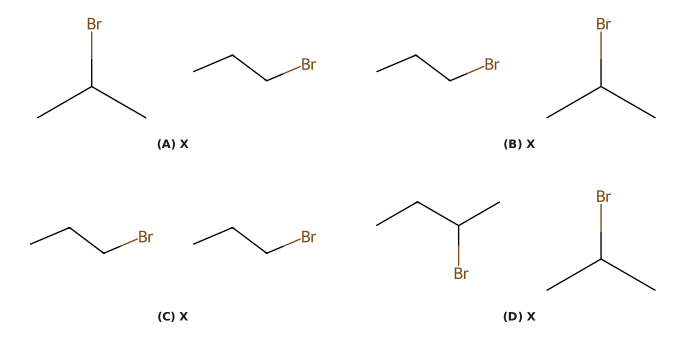
- AP EAPCET 2025Set eng-2025-05-27-FN1 markMCQQ.What are X and Y respectively in the following sets of reactions ? (major = ప్రధాన) I. [FIGURE] (a straight-chain skeletal structure ending in −OH, reacting with PBr3 to give X) II. [FIGURE] (a terminal-alkene skeletal structure reacting with HBr in the presence of (C6H5COO)2 to give Y (major)) (A) [FIGURE] (a branched, isopropyl-type alkyl bromide, next to a straight-chain alkyl bromide) (B) [FIGURE] (a straight-chain alkyl bromide, next to a branched, isopropyl-type alkyl bromide) (C) [FIGURE] (a straight-chain alkyl bromide with a longer chain, next to a straight-chain alkyl bromide with a shorter chain) (D) [FIGURE] (a branched alkyl bromide with Br on a carbon bearing a methyl branch, next to a branched, isopropyl-type alkyl bromide)
›Reveal solutionSolution
PBr3 on a 1° alcohol keeps the carbon skeleton straight; HBr + peroxide on a terminal alkene undergoes anti-Markovnikov addition, which for propene also lands the Br on the terminal (least hindered) carbon. Both products are straight-chain n-propyl bromide. Answer: (C).
Concept and Intuition
Reaction I: PBr3 converts an alcohol R−OH to R−Br by first forming an alkyl dibromophosphite intermediate, which is then displaced by bromide in an SN2-like step at the original carbinol carbon. For a primary alcohol like 1-propanol, there is no possibility of rearrangement — the product is simply 1-bromopropane, CH3CH2CH2Br, straight-chained.
Reaction II: Ordinarily, HBr adds to an alkene following Markovnikov's rule (H to the carbon with more H's already, Br to the more substituted carbon), because the reaction proceeds through the more stable carbocation. But in the presence of a peroxide like benzoyl peroxide, (C6H5COO)2, the mechanism switches to a free-radical chain mechanism: peroxide homolysis generates a radical that abstracts a Br from HBr, generating Br∙, which adds to the alkene at the less hindered (terminal) carbon to give the more stable secondary radical intermediate — this is the peroxide effect / Kharasch effect, and it results in anti-Markovnikov addition. For propene (CH2=CH−CH3), Br ends up on the terminal CH2 carbon, giving CH3CH2CH2Br — again straight-chain 1-bromopropane.
Step-by-Step Solution
- Reaction I: 1-propanol (CH3CH2CH2OH) + PBr3 → SN2-type substitution at the primary carbon, no rearrangement → X = CH3CH2CH2Br (straight chain). …
- AP EAPCET 2024Set ap-2024-05-16-AN1 markMCQQ.An alkyl halide C4H9Br(X) undergoes hydrolysis preferably in polar protic solvents. X can be prepared from which of the following reactants? (A) 2-methylprop-1-ene (isobutylene), HBr (B) 2-methylprop-1-ene (isobutylene), HBr/(C6H5CO)2O2 (C) but-2-ene, Br2/Δ (D) but-1-ene, HBr/(C6H5CO)2O2
›Reveal solutionSolution
SN1 solvolysis in polar protic solvents needs a tertiary substrate; X must be tert-butyl bromide, formed by Markovnikov (ionic, no peroxide) addition of HBr to isobutylene.
Concept and Intuition
Polar protic solvents stabilize carbocations by hydrogen bonding/solvation, which is exactly what an SN1 mechanism needs (rate-determining ionization to a carbocation). Only a sufficiently stable carbocation (tertiary > secondary ≫ primary) makes SN1 the preferred pathway. So the question is really asking: which alkyl bromide C4H9Br is tertiary?
Step-by-Step Solution
- The only tertiary C4H9Br isomer is tert-butyl bromide, (CH3)3CBr — this ionizes readily to the stable tertiary carbocation, favouring SN1 hydrolysis in polar protic solvents.
- Option (A): isobutylene CH2=C(CH3)2 + HBr (no peroxide) proceeds via Markovnikov ionic addition — H adds to the terminal CH2, Br⁻ attacks the more stable tertiary carbocation intermediate, giving (CH3)3CBr directly.
- Option (B): isobutylene + HBr/peroxide gives anti-Markovnikov addition (radical, Kharasch effect) — Br ends up on the primary carbon, giving isobutyl bromide (primary), not the target. …
- AP EAPCET 2024Set ap-2024-05-16-AN1 markMCQQ.What is Z in the following set of reactions? An alkene (propene, CH2=CH−CH3) reacts via two parallel paths:(i) HBr, (C6H5CO)2O2 → X (major product)(ii) H2O/H+ → Y (major product) X and Y then react together (with Na) to give Z. (A) dipropyl ether, CH3CH2CH2−O−CH2CH2CH3 (B) diisopropyl ether, (CH3)2CH−O−CH(CH3)2 (C) propyl isopropyl ether, CH3CH2CH2−O−CH(CH3)2 (D) dipropyl ether, CH3CH2CH2−O−CH2CH2CH3 + propan-1-ol, CH3CH2CH2OH
›Reveal solutionSolution
Propene gives a primary bromide via the peroxide (anti-Markovnikov) route and a secondary alcohol via Markovnikov hydration; sodium then drives a Williamson ether synthesis between the two to form the unsymmetrical ether Z.
Concept and Intuition
The peroxide effect only reverses regiochemistry for HBr addition (radical chain mechanism), giving the anti-Markovnikov product; direct acid-catalysed hydration of an alkene proceeds through the more stable carbocation (Markovnikov). Combining a primary alkyl halide with a sodium alkoxide is the classic Williamson ether synthesis (SN2), which works cleanly only when the halide is primary (avoids competing elimination).
Step-by-Step Solution
- Propene + HBr, (C6H5CO)2O2 (peroxide): radical (anti-Markovnikov) addition places Br on the terminal (less substituted) carbon, giving X = 1-bromopropane, CH3CH2CH2Br (primary bromide).
- Propene + H2O/H+: acid-catalysed Markovnikov hydration proceeds via the more stable secondary carbocation, giving Y = propan-2-ol, (CH3)2CHOH (isopropanol).
- X and Y "react together with Na": sodium metal first reacts with the alcohol Y to generate sodium isopropoxide, (CH3)2CHO−Na+ (+ H2). …
- AP EAPCET 2024Set eng-2024-05-19-AN1 markMCQQ.The major product (X) formed in the given reaction is an example of C6H5CH2CH=CH2HBr(C6H5CO)2O2X (A) Secondary alkyl halide (B) Primary alkyl halide (C) Tertiary alkyl halide (D) Benzylic halide
›Reveal solutionSolution
Peroxide-mediated HBr addition to a terminal alkene proceeds anti-Markovnikov via a free-radical chain mechanism, placing Br on the terminal carbon and giving a primary halide.
Concept and Intuition
Normally HBr adds Markovnikov (H to the carbon with more H's, Br to the more substituted carbon) via a carbocation mechanism. But in the presence of peroxides, a radical chain mechanism operates instead (the Kharasch/peroxide effect), and Br∙ adds first to the terminal, less hindered carbon of the double bond — because this generates the more stable (more substituted) carbon radical at the other position. The final product therefore has Br on the terminal carbon: anti-Markovnikov addition.
Step-by-Step Solution
- The alkene is C6H5−CH2−CH=CH2 (allylbenzene); the double bond is between the middle and terminal carbons.
- Under peroxide, Br∙ adds to the terminal =CH2 carbon (less hindered), producing the radical C6H5−CH2−C∙H−CH2Br (a secondary radical, further stabilised by the adjacent benzylic-type chain).
- This radical abstracts H from another HBr molecule, regenerating Br∙ and giving the final product C6H5−CH2−CH2−CH2−Br. …
- AP EAPCET 2024Set eng-2024-05-20-AN1 markMCQQ.Styrene on reaction with reagent X gave Y which on hydrolysis followed by oxidation gave Z. Z gives positive 2,4-DNP test but does not give iodoform test. What are X and Z respectively? (A) HBr ; C6H5COCH3 (B) HBr ; C6H5CH2CHO (C) HBr / (C6H5CO)2O2 ; C6H5CH2CHO (D) HBr / (C6H5CO)2O2 ; C6H5COCH3
›Reveal solutionSolution
The peroxide effect on styrene gives the anti-Markovnikov bromide, which on hydrolysis + oxidation becomes phenylacetaldehyde — an aldehyde (2,4-DNP+) but not a methyl ketone (iodoform−).
Concept and Intuition
The clue "2,4-DNP positive but iodoform negative" pins down Z's functional class precisely: it must be a carbonyl compound (aldehyde or ketone), but NOT one bearing a CH3CO− group or a CH3CH(OH)− group. That single clue is enough to distinguish between the two possible regiochemical outcomes of adding HBr to styrene.
Step-by-Step Solution
- Styrene is C6H5−CH=CH2. Two very different additions of HBr are possible depending on the reagent:
- Plain HBr (ionic, Markovnikov): H+ adds to the terminal CH2, forming the highly stable benzylic carbocation on the ring-attached carbon; Br− attacks there, giving C6H5CHBrCH3 (Markovnikov product, Br next to the ring).
- HBr with peroxide (C6H5CO)2O2 (radical, anti-Markovnikov / "peroxide effect"): Br∙ adds first to the terminal CH2 (leaving the more stable benzylic radical on the ring carbon), and after H-abstraction the net product is C6H5CH2CH2Br — Br on the far (primary) carbon.
- If X were plain HBr, Y = C6H5CHBrCH3 → hydrolysis (SN1, benzylic) → C6H5CH(OH)CH3 (1-phenylethanol) → oxidation → C6H5COCH3 (acetophenone). But acetophenone is a methyl ketone and gives a positive iodoform test — this contradicts the given fact that Z is iodoform-negative. So X ≠ plain HBr. …
- Styrene is C6H5−CH=CH2. Two very different additions of HBr are possible depending on the reagent:
- AP EAPCET 2024Set eng-2024-05-20-AN1 markMCQQ.Which of the following sequence of reagents convert propene to 1-chloropropane? (dil. = dilute, Conc. = concentrated) (A)(i) (BH3)2(ii) H2O2/OH− ; HCl, ZnCl2 (B)(i) (BH3)2(ii) H2O2/OH− ; NaCl (C)(i) dil. H2SO4 ; HCl, ZnCl2 (D)(i) dil. H2SO4 ; Conc. HCl
›Reveal solutionSolution
Direct Markovnikov hydration/HX addition on propene always gives the 2-substituted (secondary) product; only the anti-Markovnikov hydroboration route followed by OH→Cl conversion delivers the terminal, 1-chloropropane.
Concept and Intuition
Propene, CH3−CH=CH2, undergoes Markovnikov addition (dil. H2SO4/water, or direct HX) to put the new group on the more substituted (middle) carbon, giving 2-substituted products (isopropanol, 2-chloropropane). To land the substituent on the terminal carbon instead (1-chloropropane), you need the anti-Markovnikov route — hydroboration–oxidation — which places −OH on the terminal carbon, then a separate step to swap that −OH for −Cl.
Step-by-Step Solution
- Option A: (BH3)2 then H2O2/OH− is hydroboration–oxidation. Boron adds to the less-substituted (terminal) carbon (anti-Markovnikov), so oxidation gives the terminal alcohol, 1-propanol, CH3CH2CH2OH.
- Treating 1-propanol with HCl/ZnCl2 (Lucas-type reagent) replaces −OH with −Cl at the same carbon, giving 1-chloropropane, CH3CH2CH2Cl — exactly the target.
- Option B proposes the same first step but then "NaCl" as the second reagent — NaCl has no mechanism to convert an alcohol's −OH into −Cl (chloride ion alone isn't nucleophilic/electrophilic enough to displace an unactivated −OH); no reaction occurs. Rejected. …
- AP EAPCET 2024Set eng-2024-05-21-AN1 markMCQQ.What are X and Y respectively in the following reaction sequence? C3H6HBr(C6H5CO)2O2XC6H5BrNa / dry etherY (A) X=(CH3)2CHBr (2-bromopropane), Y=C6H5CH2CH2CH3 (1-phenylpropane, straight chain) (B) X=(CH3)2CHBr (2-bromopropane), Y=C6H5CH(CH3)2 (isopropylbenzene / cumene) (C) X=CH3CH2CH2Br (1-bromopropane), Y=C6H5CH(CH3)2 (isopropylbenzene / cumene) (D) X=CH3CH2CH2Br (1-bromopropane), Y=C6H5CH2CH2CH3 (1-phenylpropane, straight chain)
›Reveal solutionSolution
Peroxide-catalyzed HBr addition to propene gives the anti-Markovnikov (primary) bromide, and its Wurtz-Fittig coupling with bromobenzene gives straight-chain propylbenzene.
Concept and Intuition
Normally HBr adds to an alkene by Markovnikov's rule (H to the carbon with more H's, Br to the more substituted carbon, via a carbocation intermediate). But in the presence of peroxides, the mechanism switches to a free-radical chain addition (the Kharasch/peroxide effect), which reverses the regiochemistry — Br adds to the terminal (less substituted) carbon, giving the primary bromide instead. The Wurtz-Fittig reaction then couples an aryl halide with an alkyl halide using sodium metal in dry ether, forming a new C–C bond directly (no rearrangement), preserving the alkyl chain as-is.
Step-by-Step Solution
- Propene, CH2=CH−CH3, reacts with HBr in presence of peroxide (C6H5CO)2O2 — this triggers the anti-Markovnikov (free-radical) addition mechanism.
- The bromine radical adds to the terminal CH2 carbon (less hindered, forms the more stable secondary radical intermediate at the middle carbon), ultimately placing Br on the terminal carbon: X=CH3CH2CH2Br (1-bromopropane, a primary bromide).
- X is then treated with bromobenzene (C6H5Br) and sodium metal in dry ether — this is the Wurtz-Fittig reaction, which directly couples the alkyl group of X to the phenyl ring of bromobenzene. …
- AP EAPCET 2024Set eng-2024-05-21-FN1 markMCQQ.Which of the following alkenes does not undergo anti Markownikov addition of HBr? (A) Propene (B) 1-Butene (C) 2-Butene (D) 3-Methyl-2-Pentene
›Reveal solutionSolution
This tests recognizing that the peroxide (anti-Markovnikov) effect only produces a distinguishable product for unsymmetrical alkenes; 2-butene is symmetrical, so it shows no distinct anti-Markovnikov addition product.
Concept and Intuition
In the presence of peroxides, HBr adds to alkenes via a free-radical mechanism, placing Br on the less substituted carbon (anti-Markovnikov), which is the opposite regiochemistry to the normal ionic (Markovnikov) mechanism that places Br on the more substituted carbon. This distinction between the two mechanisms only matters — i.e., only gives a genuinely different product — when the two carbons of the C=C double bond are not equivalent (different substitution). If the alkene is symmetrical about the double bond, both mechanisms deposit Br at chemically equivalent positions, so the anti-Markovnikov product is identical to the normal (Markovnikov) product.
Step-by-Step Solution
- Propene, CH3−CH=CH2: unsymmetrical (one carbon has a methyl + H, the other has 2 H's). Markovnikov gives 2-bromopropane; anti-Markovnikov (peroxide) gives 1-bromopropane — genuinely different products.
- 1-Butene, CH3CH2−CH=CH2: unsymmetrical (terminal alkene). Markovnikov gives 2-bromobutane; anti-Markovnikov gives 1-bromobutane — different products.
- 2-Butene, CH3−CH=CH−CH3: symmetrical — both alkene carbons carry an identical methyl group. Whichever carbon Br adds to, the product is 2-bromobutane either way. So there is no observable anti-Markovnikov product distinct from the normal product — the peroxide effect makes no difference here. …
- AP EAPCET 2022Set eng-2022-07-04-FN1 markMCQQ.In the presence of peroxide, styrene reacts with HBr to give X. When X reacted with magnesium in dry ether followed by CO2 and hydrolysis gave Y. Treatment of Y with PCl5 and then next with H2, Pd-BaSO4 gave Z. What is Z? (A) 3-Phenylpropanal (Ph−CH2−CH2−CHO) (B) 2-Phenylpropanal (Ph−CH(CH3)−CHO) (C) 3-Phenylpropanoic acid (Ph−CH2−CH2−COOH) (D) Propylbenzene (Ph−CH2−CH2−CH3)
›Reveal solutionSolution
This tests the peroxide (anti-Markovnikov) HBr addition, Grignard carbonation to a carboxylic acid, and Rosenmund reduction back to an aldehyde — a classic four-step conversion. The answer is (A) 3-phenylpropanal.
Concept and Intuition
In the presence of peroxides, HBr adds to an alkene by a free-radical mechanism (Kharasch effect), which reverses the usual Markovnikov regiochemistry: the bromine ends up on the less substituted (terminal) carbon because the more stable, more substituted radical forms first. A Grignard reagent reacting with CO2 and then aqueous acid is a standard one-carbon homologation to a carboxylic acid. PCl5 is a routine way to convert −COOH to −COCl. Finally, Rosenmund reduction uses a poisoned Pd catalyst (Pd-BaSO4, often with a quinoline/sulfur poison) so that hydrogenation of the acid chloride stops cleanly at the aldehyde stage instead of continuing to the alcohol/alkane.
Step-by-Step Solution
- Styrene Ph−CH=CH2 + HBr, peroxide ⇒ anti-Markovnikov addition ⇒ X=Ph−CH2−CH2−Br (2-bromoethylbenzene).
- X + Mg / dry ether ⇒ Grignard reagent Ph−CH2−CH2−MgBr.
- Grignard + CO2, then H3O+ hydrolysis ⇒ Y=Ph−CH2−CH2−COOH (3-phenylpropanoic acid). …
- AP EAPCET 2021Set eng-2021-08-20-FN1 markMCQQ.Identify the product of the following reaction. A benzene ring bearing a −CH=CH−CH3 substituent (1-propenylbenzene, i.e. C6H5−CH=CH−CH3) HBr ? (A) C6H5−CH2−CH(Br)−CH3 (B) C6H5−CH(Br)−CH2−CH3 (C) C6H5−CH2−CH2−CH3−Br (D) C6H4(Br)−CH2−CH2−CH3
›Reveal solutionSolution
Markovnikov addition of HBr across C6H5–CH=CH–CH3 proceeds through the more stable benzylic carbocation, giving C6H5–CHBr–CH2–CH3.
Concept and Intuition
Electrophilic addition of HX to an unsymmetrical alkene follows Markovnikov's rule: the proton adds first, generating whichever carbocation is more stable, and the halide then attacks that carbocation. When one end of a double bond is attached to an aromatic ring, protonating the other carbon creates a carbocation directly on the ring-attached (benzylic) carbon — and this cation is strongly stabilised by resonance delocalisation into the aromatic ring. That stabilisation vastly outweighs the modest stability of an ordinary secondary alkyl cation, so the benzylic pathway dominates.
Step-by-Step Solution
- Number the alkene carbons: C6H5–CH(=C1)=CH(=C2)–CH3(C3).
- Two possible protonation modes: (i) H+ adds to C1 (ring carbon) ⇒ cation on C2, a plain secondary alkyl cation; (ii) H+ adds to C2 ⇒ cation on C1, a benzylic cation stabilised by the phenyl ring's π system.
- The benzylic cation (mode ii) is far more stable, so this pathway is strongly preferred. …
🎓Unlock everything free for 14 days
- ✓Full step-by-step solutions
- ✓Concept-first explanations
- ✓Methods, shortcuts & mistakes
- ✓PYQ mapping + timed mock tests
Full access for 14 days. No credit card required.