Q.Write down the products of ozonolysis of 1,2-dimethylbenzene (o-xylene). How does the result support Kekulé structure for benzene?
🔒You're viewing a preview — the full solution, concept, methods & PYQ mapping are locked.
🔒 Start your 14-day free trial to unlock the full solution →Concept understanding — Benzene Aromatic Stability
Benzene Aromatic Stability
Imagine you have a ring of six carbon atoms, each holding one hydrogen atom. That's benzene — C6H6. Now, if you drew it with alternating single and double bonds (the Kekulé structure), you'd expect it to behave like any other alkene: reactive, ready to add things across those double bonds.
But benzene doesn't behave that way. It's stubbornly unreactive toward addition reactions. It burns with a sooty flame, yes, but it resists the kind of chemistry that typical alkenes love. Why?
The Intuition: A Circle of Electrons
The key is that the double bonds in benzene aren't really "fixed" in place. The six p orbitals (one on each carbon, perpendicular to the ring) overlap sideways to form a continuous ring of electron density — a delocalised π system. Picture a doughnut of negative charge above and below the plane of the carbon atoms.
This delocalisation spreads the electrons out, lowering the energy of the molecule. It's like having six people in a room who can all share one big, comfortable sofa instead of being forced into three separate, cramped chairs. The shared arrangement is far more stable.
The Precise Statement
Benzene is aromatic — a term that describes a cyclic, planar molecule with a continuous ring of overlapping p orbitals containing 4n+2 π electrons (Hückel's rule, where n is a whole number). For benzene, n=1, so it has 6 π electrons.
Aromatic stability=Resonance energy≈150 kJ/mol
This resonance energy is the extra stability benzene has compared to a hypothetical "cyclohexatriene" with three fixed double bonds. It's not a small effect — it's about the energy of a strong covalent bond.
Why It Matters
Because benzene is so stable, it doesn't undergo addition reactions (which would break the aromatic ring). Instead, it undergoes electrophilic substitution — a reaction that preserves the aromatic system. This is the single most important reaction in aromatic chemistry. …
The key idea is that ozonolysis cleaves each C=C double bond and turns each doubly-bonded carbon into a carbonyl group, so the products reveal where the double bonds were.
For o-xylene (methyls on adjacent carbons C1, C2), a fixed Kekulé structure would give the products of only one arrangement of double bonds. Considering both equivalent Kekulé structures:
- Form I (double bonds 1-2, 3-4, 5-6) → 2 methylglyoxal + 1 glyoxal
- Form II (double bonds 2-3, 4-5, 6-1) → 1 dimethylglyoxal + 2 glyoxal
Since both contribute equally, the combined products are glyoxal : methylglyoxal : dimethylglyoxal = 3 : 2 : 1:
- Glyoxal, OHC−CHO
- Methylglyoxal, CHX3CO−CHO
- Dimethylglyoxal, CHX3CO−COCHX3 …
Ozonolysis of o-xylene, worked out by considering both equivalent Kekulé structures, gives three dicarbonyl products — glyoxal, methylglyoxal and dimethylglyoxal in a 3 : 2 : 1 ratio. That all three appear cannot be explained by any single fixed-double-bond (Kekulé) structure and is exactly what a delocalised, resonance-stabilised ring with all six C–C bonds equivalent predicts.
Ozonolysis cleaves each carbon–carbon double bond and caps each of the two carbons with a carbonyl (C=O) group. If benzene really had three fixed, alternating double bonds, ozonolysis of o-xylene would reveal exactly where they are. The surprising result is one of the classic pieces of evidence that benzene's bonds are not localised.
What a single Kekulé structure predicts
Number the ring carbons 1–6, with the two methyl groups on C1 and C2 (ortho). A Kekulé structure has three fixed double bonds and three fixed single bonds. When ozone cleaves the double bonds, the ring falls apart into three fragments — each held together by one of the surviving single bonds, with a carbonyl at each end.
Kekulé form I (double bonds at C1=C2, C3=C4, C5=C6; single bonds at C2–C3, C4–C5, C6–C1). The fragments are the pairs still joined by a single bond:
- C2–C3 → one methyl, one H → methylglyoxal (CHX3CO−CHO)
- C4–C5 → both H → glyoxal (OHC−CHO)
- C6–C1 → one H, one methyl → methylglyoxal
So form I gives 2 methylglyoxal + 1 glyoxal.
Kekulé form II (double bonds at C2=C3, C4=C5, C6=C1; single bonds at C1–C2, C3–C4, C5–C6). The fragments are:
- C1–C2 → both methyl → dimethylglyoxal (CHX3CO−COCHX3)
- C3–C4 → both H → glyoxal
- C5–C6 → both H → glyoxal
So form II gives 1 dimethylglyoxal + 2 glyoxal.
Combining the two forms
A fixed Kekulé structure would give the products of only one form. But the real molecule is a resonance hybrid in which both patterns of overlap are equally probable, so both sets of fragments form with equal weight. Adding them:
- Glyoxal: 1 (form I) + 2 (form II) = 3
- Methylglyoxal: 2 (form I) = 2
- Dimethylglyoxal: 1 (form II) = 1
giving glyoxal : methylglyoxal : dimethylglyoxal = 3 : 2 : 1. …
- AP EAPCET 2026Set eng-2026-05-13-AN1 markMCQQ.In the four species (I, II, III and IV) given below, σ and π-electrons are delocalized in two species (X). Only π-electrons are delocalized in other two species (Y). What are X and Y respectively? I. But-2-ene II. Tropylium Cation III. Nitrobenzene IV. Toluene (A) X = II, IV ; Y = I, III (B) X = II, III ; Y = I, IV (C) X = I, III ; Y = II, IV (D) X = I, IV ; Y = II, III
›Reveal solutionSolution
Species with an allylic/benzylic sp3 C–H (but-2-ene, toluene) show both σ- and π-electron delocalization (hyperconjugation + conjugation); fully-conjugated all-sp2 systems (tropylium cation, nitrobenzene) show only π-delocalization.
Concept and Intuition
Delocalization of π electrons happens through resonance across a conjugated π system. Delocalization of σ electrons happens only through hyperconjugation — a σ(C–H) bond adjacent to a π system (or a carbocation/radical) overlapping with it. So the key discriminator is: does the species have a C–H bond on an sp3 carbon directly attached to the conjugated system?
Step-by-Step Solution
- But-2-ene (CH3–CH=CH–CH3): the C=C is a π system, and each terminal CH3 has C–H σ-bonds adjacent to it → allylic hyperconjugation. Both σ and π delocalized.
- Tropylium cation (C7H7+): a fully conjugated 7-membered ring, all carbons sp2, 6 π electrons delocalized over all 7 p-orbitals (aromatic). No adjacent sp3 C–H exists for hyperconjugation — only π delocalized.
- Nitrobenzene: the −NO2 group conjugates with the ring via resonance (its lone pair/π system merges with the ring π cloud). No sp3 C–H is involved anywhere — only π delocalized. …
- AP EAPCET 2024Set eng-2024-05-19-AN1 markMCQQ.Tropolone is an example for which of the following class of compounds? (A) Benzenoid aromatic compound (B) Non-Benzenoid aromatic compound (C) Alicylic compound (D) Heterocyclic aromatic compound
›Reveal solutionSolution
This tests recognizing an aromatic compound based on a non-six-membered, non-benzene ring system. The answer is (B).
Concept and Intuition
Aromaticity is not restricted to benzene-derived (benzenoid) rings. Certain non-six-membered ring systems can also satisfy Huckel's rule (4n+2 pi electrons in a cyclic, planar, conjugated system) and display aromatic stability. Tropolone (2-hydroxy-2,4,6-cycloheptatrien-1-one) is a classic example: it is a seven-membered ring related to the tropylium cation system, exhibiting aromatic character without containing a benzene ring -- making it a non-benzenoid aromatic compound.
Step-by-Step Solution
- Recall the structure of tropolone: a seven-membered ring with alternating double bonds, a ketone, and a hydroxyl group, related to cycloheptatriene.
- Recognize that its pi-electron system can be described in terms of an aromatic tropylium-like cation stabilized by the adjacent oxygen functionalities, giving it aromatic character. …
- AP EAPCET 2024Set eng-2024-05-21-AN1 markMCQQ.Which of the allotropic forms of carbon is aromatic in nature? (A) Diamond (B) Graphite (C) Buckminster fullerene (D) coke
›Reveal solutionSolution
Among carbon's allotropes, buckminsterfullerene (C60) is the one with delocalized aromatic π-electron character over its cage structure.
Concept and Intuition
Aromaticity requires a cyclic, planar (or near-planar over local rings), conjugated system with delocalized π electrons obeying Hückel-type stabilization. Diamond is purely sp3-hybridized with no π system at all. Graphite has delocalized electrons but is an extended 2D sheet, not typically described as 'aromatic' in the classic molecular sense, though it does have conjugation. Coke is impure, largely amorphous carbon with no ordered conjugated framework. Buckminsterfullerene, C60, consists of 12 pentagons and 20 hexagons of sp2 carbon atoms with a continuous conjugated π system over the whole cage — it is explicitly described in NCERT/standard texts as having aromatic character.
Step-by-Step Solution
- Diamond: all carbons sp3, no π electrons → not aromatic.
- Graphite: sp2 layers with delocalized electrons, but it's an infinite planar sheet, not a discrete aromatic molecule. …
- AP EAPCET 2024Set eng-2024-05-23-FN1 markMCQQ.The number of alicyclic compounds from the following is Cyclohexene, Anisole, Pyridine, Tetrahydrofuran, Biphenyl (A) 2 (B) 3 (C) 1 (D) 4
›Reveal solutionSolution
Alicyclic compounds are non-aromatic cyclic compounds; among the five given, only cyclohexene and tetrahydrofuran qualify — a count of 2.
Concept and Intuition
Cyclic organic compounds split into aromatic (planar, conjugated, obeying Hückel's rule, e.g. benzene derivatives and pyridine) and alicyclic (aliphatic-type rings — saturated or unsaturated but without aromatic character). Recognizing which rings are aromatic versus simply cyclic aliphatic structures is the key skill tested here.
Step-by-Step Solution
- Cyclohexene: a six-membered carbocyclic ring with one C=C double bond, not aromatic — alicyclic.
- Anisole: methoxybenzene — an aromatic benzene ring with an –OCH3 substituent — not alicyclic.
- Pyridine: an aromatic six-membered N-heterocycle (isoelectronic with benzene) — not alicyclic.
- Tetrahydrofuran: a fully saturated five-membered cyclic ether, non-aromatic — alicyclic. …
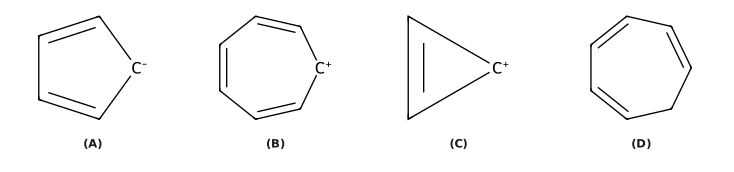
- AP EAPCET 2023Set eng-2023-05-15-FN1 markMCQQ.Which of the following molecule is not aromatic? (A) [FIGURE] (a five-membered ring with two double bonds and a negative charge on one ring carbon - drawn as the cyclopentadienyl anion) (B) [FIGURE] (a seven-membered ring with two double bonds and a positive charge on one ring carbon) (C) [FIGURE] (a three-membered ring with one double bond and a positive charge on one ring carbon - drawn as the cyclopropenyl cation) (D) [FIGURE] (a seven-membered ring with three double bonds and no charge shown - drawn as cycloheptatriene)
›Reveal solutionSolution
Aromaticity requires a cyclic, planar, fully conjugated system with 4n+2 π electrons (Hückel’s rule). The molecule that fails this rule is the non‑conjugated cycloheptatriene, option (D).
Why Aromaticity? The Core Idea
Aromatic compounds are unusually stable because their π electrons are delocalised around a closed loop. For a monocyclic, planar molecule to be aromatic, it must have a continuous ring of overlapping p orbitals (full conjugation) and exactly 4n+2 π electrons (where n=0,1,2,…). If the ring is not fully conjugated, or if the π count is 4n, the molecule is antiaromatic or non‑aromatic. Here we test each structure against these criteria.
Step‑by‑Step Analysis
1. Option (A) – Cyclopentadienyl anion
- Structure: A five‑membered ring with two double bonds and a negative charge on one carbon.
- Conjugation: The negative charge means that carbon has a lone pair in a p orbital. All five ring carbons are sp² hybridised, so the p orbitals form a continuous loop.
- π electron count: Each double bond contributes 2 π electrons → 2×2=4. The lone pair on the anionic carbon contributes 2 more π electrons. Total = 6 π electrons.
- Hückel check: 4n+2=6 gives n=1. Planar, cyclic, fully conjugated → aromatic.
- Result: Aromatic.
2. Option (B) – Tropylium cation (cycloheptatrienyl cation)
- Structure: A seven‑membered ring with three double bonds and a positive charge on one carbon.
- Conjugation: All seven carbons are sp² hybridised; the positive charge means the charged carbon has an empty p orbital. The p orbitals overlap all around the ring.
- π electron count: Three double bonds → 3×2=6 π electrons. The empty p orbital contributes 0. Total = 6 π electrons.
- Hückel check: 4n+2=6 → n=1. Planar, cyclic, fully conjugated → aromatic.
- Result: Aromatic.
3. Option (C) – Cyclopropenyl cation
- Structure: A three‑membered ring with one double bond and a positive charge on one carbon.
- Conjugation: All three carbons are sp² hybridised; the charged carbon has an empty p orbital. The three p orbitals overlap in a triangle.
- π electron count: One double bond → 2 π electrons. The empty p orbital contributes 0. Total = 2 π electrons.
- Hückel check: 4n+2=2 gives n=0. Planar, cyclic, fully conjugated → aromatic (the smallest aromatic system).
- Result: Aromatic.
4. Option (D) – Cycloheptatriene (neutral, with only two double bonds) …
- AP EAPCET 2022Set eng-2022-07-04-FN1 markMCQQ.The compound or ion which is not aromatic in the following is (A) Pyridine (six-membered aromatic ring with one nitrogen) (B) Cyclopentadienyl cation (a five-membered ring bearing a positive charge) (C) Anthracene (three linearly fused benzene rings) (D) Furan (five-membered aromatic ring with one oxygen)
›Reveal solutionSolution
Only the cyclopentadienyl cation fails Huckel's (4n+2)π rule (it has 4pi electrons) -- pyridine, anthracene, and furan are all aromatic.
Concept and Intuition
A ring system is aromatic if it is (i) cyclic, (ii) planar, (iii) fully conjugated (every ring atom has a p-orbital), and (iv) has 4n+2 pi electrons delocalized in that ring (Huckel's rule, n=0,1,2,…). Getting exactly 4n pi electrons in such a system instead makes it antiaromatic (destabilized), not merely "non-aromatic."
Step-by-Step Solution
- Pyridine: six-membered ring, each carbon and the nitrogen contribute one p-electron each to the ring pi-system = 6pi electrons (n=1); nitrogen's lone pair sits in an sp2 orbital in the plane of the ring (not part of the pi system). Aromatic.
- Cyclopentadienyl cation (C5H5+): five-membered ring with only 4 pi electrons (one fewer than the aromatic cyclopentadienyl anion, which has 6pi and is famously aromatic). 4π electrons = Huckel's 4n pattern (n=1) leads to antiaromatic, i.e. NOT aromatic (in fact destabilized relative to a non-cyclic reference).
- Anthracene: three linearly fused benzene rings, fully conjugated planar polycyclic aromatic hydrocarbon with 14 pi electrons overall -- aromatic (each individual ring, and the whole system, is stabilized). …
- AP EAPCET 2021Set eng-2021-08-20-FN1 markMCQQ.An organic compound of molecular formula C6H6Br2 has six carbon atoms in a ring system, two non-conjugate double bonds and two bromo groups at 1,4 positions. Then the compound is ____ (A) aromatic but non-homo-cyclic (B) aromatic and hetero-cyclic (C) homo-cyclic but not aromatic (D) neither homo-cyclic nor hetero-cyclic
›Reveal solutionSolution
The molecular formula C6H6Br2 (two H's more than a dibromobenzene) reveals a dibromo-cyclohexadiene, not a benzene derivative — a carbon-only (homocyclic) ring that fails aromaticity because its double bonds aren't conjugated into a continuous π system. Answer (C).
Concept and Intuition
Counting hydrogens/degrees of unsaturation is a quick way to distinguish an aromatic ring from a partially saturated one bearing the same substituents. Aromaticity additionally requires a cyclic, planar, fully conjugated π system (Hückel's rule) — merely having double bonds in a ring is not sufficient if they are not conjugated around the whole ring.
Step-by-Step Solution
- Benzene is C6H6; a 1,4-dibromobenzene (aromatic) would be C6H4Br2.
- The given compound is C6H6Br2 — TWO more hydrogens than the aromatic dibromobenzene, meaning the ring is not fully unsaturated/aromatic; it corresponds to a dibromo-substituted cyclohexadiene (only 2 ring double bonds, not benzene's 3 alternating ones).
- The problem explicitly states "two non-conjugate double bonds," confirming a 1,4-cyclohexadiene-type skeleton, not benzene's continuous conjugated system. …
- AP EAPCET 2021Set eng-2021-08-25-FN1 markMCQQ.Which of the following compounds are aromatic?(i) [FIGURE] (a five-membered ring containing one oxygen atom, resembling furan)(ii) [FIGURE] (a four-membered ring, resembling cyclobutadiene)(iii) [FIGURE] (a three-membered ring bearing a negative charge, resembling the cyclopropenyl anion)(iv) [FIGURE] (a six-membered ring containing one nitrogen atom, resembling pyridine)(v) [FIGURE] (a seven-membered ring bearing a positive charge, resembling the tropylium cation) (A) (i),(ii) &(iii) only (B) (ii),(iii) &(iv) only (C) (i),(iv) &(v) only (D) (iii),(iv) &(v) only 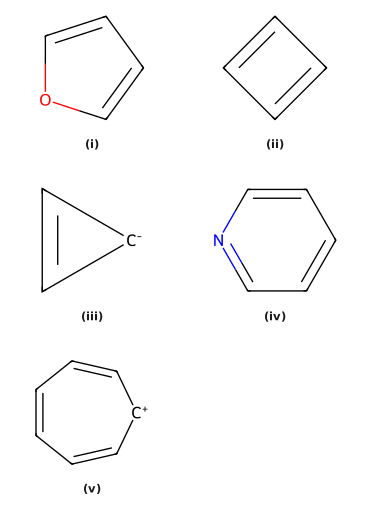
›Reveal solutionSolution
Aromatic compounds must be cyclic, planar, fully conjugated, and obey Hückel's rule (4n+2 π electrons). Applying these criteria: furan (i) is aromatic (6 π electrons), cyclobutadiene (ii) is antiaromatic (4 π electrons), the cyclopropenyl anion (iii) is antiaromatic (4 π electrons), pyridine (iv) is aromatic (6 π electrons), and the tropylium cation (v) is aromatic (6 π electrons). Thus the aromatic ones are (i), (iv), and (v) — option (C).
Concept and Intuition: Hückel's Rule
Aromaticity is a special stability found in certain cyclic, planar molecules with a fully conjugated π-electron system. The key test is Hückel's rule: a planar, monocyclic, fully conjugated ring is aromatic if it contains 4n+2 π electrons (n = 0, 1, 2, …). Rings with 4n π electrons are antiaromatic. For each compound, check: (1) Is it cyclic and planar? (2) Is every ring atom sp²-hybridized so the p-orbitals overlap continuously? (3) Does it have 4n+2 π electrons?
Step-by-Step Analysis
-
Furan (i): Cyclic, planar, all atoms sp². Oxygen contributes 2 π electrons from one lone pair (its other lone pair lies in the ring plane and is not part of the π system); the two double bonds contribute 2 π electrons each. Total = 2+2+2 = 6 π electrons. 6 = 4(1)+2 → aromatic. ✓
-
Cyclobutadiene (ii): Cyclic, planar, two double bonds → 4 π electrons. 4 = 4(1) → antiaromatic. ✗
-
Cyclopropenyl anion (iii): Cyclic, planar. The double bond contributes 2 π electrons; the negatively charged sp²-carbon contributes 2 more from its lone pair. Total = 4 π electrons → antiaromatic (note: the cyclopropenyl cation, with 2 π electrons, is aromatic — but the anion is not). ✗ …
-
🎓Unlock everything free for 14 days
- ✓Full step-by-step solutions
- ✓Concept-first explanations
- ✓Methods, shortcuts & mistakes
- ✓PYQ mapping + timed mock tests
Full access for 14 days. No credit card required.