Q.The following reaction is classified as: CH3CH2I + KOH(aq) → CH3CH2OH + KI.
🔒You're viewing a preview — the full solution, concept, methods & PYQ mapping are locked.
🔒 Start your 14-day free trial to unlock the full solution →Concept understanding — Nucleophilic Substitution
Nucleophilic Substitution: The Intuitive Idea
Imagine you're holding a key that fits perfectly into a lock. Now imagine someone else comes along with a different key, pushes yours out, and takes your place. That's the core picture of nucleophilic substitution — one group (the leaving group) gets kicked out of a molecule, and a new group (the nucleophile) takes its spot.
In organic chemistry, carbon atoms often carry a leaving group — something like a halogen (Cl, Br, I) or a good leaving group like tosylate. The carbon is slightly positive because the leaving group pulls electron density away. A nucleophile — a species rich in electrons, often with a lone pair or a negative charge — is attracted to this positive carbon. It attacks, and the leaving group departs with its bonding electrons.
The word "nucleophile" means "nucleus-loving" — it's attracted to positive (electron-deficient) centres. "Leaving group" is exactly what it sounds like: a group that can leave, taking its electron pair with it.
The Precise Statement
Nucleophilic substitution is a reaction where a nucleophile (Nu⁻ or Nu:) replaces a leaving group (L) attached to a carbon atom. The general equation is:
Nu−+R-L⟶R-Nu+L−
Here, R is the carbon skeleton (alkyl group), L is the leaving group, and Nu is the nucleophile. The reaction happens because the nucleophile is a stronger base (or has a stronger desire for the carbon) than the leaving group.
Two Main Mechanisms: SN1 and SN2
This isn't just one reaction — it's a family with two distinct pathways, depending on the structure of the carbon and the conditions.
SN2: One Step, Backside Attack
In SN2 (Substitution, Nucleophilic, Bimolecular), the nucleophile attacks the carbon from the opposite side of the leaving group. The leaving group departs at the same time. It's like a dance where one partner enters as the other leaves — a single, concerted step.
- Rate depends on both the nucleophile and the substrate: rate = k[Nu][R-L]
- Stereochemistry: The carbon inverts (like an umbrella turning inside out). If the starting carbon is chiral, you get the opposite configuration.
- Best for: Primary carbons (least steric hindrance). Methyl and primary alkyl halides are ideal.
SN2 is very sensitive to steric hindrance. Tertiary carbons are so crowded that the nucleophile cannot reach the backside — SN2 essentially does not happen there.
SN1: Two Steps, Carbocation Intermediate
In SN1 (Substitution, Nucleophilic, Unimolecular), the leaving group leaves first, forming a carbocation (a carbon with only six electrons, positively charged). Then the nucleophile attacks this flat, planar carbocation from either side.
- Rate depends only on the substrate: rate = k[R-L] (the slow step is the leaving group departing)
- Stereochemistry: The nucleophile can attack from either face of the planar carbocation, so you get a racemic mixture (both configurations) if the carbon was chiral.
- Best for: Tertiary carbons (they form stable carbocations). Secondary carbons can work under certain conditions. Primary carbons almost never do SN1 because the carbocation would be too unstable.
The key difference: SN2 is one step with inversion; SN1 is two steps with racemisation. SN2 needs a good nucleophile and an unhindered carbon; SN1 needs a stable carbocation and a polar solvent that can stabilise ions.
How to Tell Which One Happens
| Factor | Favours SN2 | Favours SN1 |
|--------|-------------|-------------| …
The key idea is nucleophilic substitution — the hydroxide ion (OH−) from KOH attacks the electrophilic carbon bonded to iodine, replacing the leaving group (I−).
Reasoning:
- The substrate is a primary alkyl halide (CH3CH2I) with a polar C–I bond.
- Aqueous KOH provides OH− ions, which are strong nucleophiles (and weak bases in water). …
This is a classic nucleophilic substitution (SN2) reaction where the hydroxide ion (OH−) from KOH attacks the electrophilic carbon bearing iodine, displacing iodide (I−) to form ethanol.
The reaction is:
CH3CH2I+KOH (aq)→CH3CH2OH+KI
Let’s understand why this is nucleophilic substitution and not any of the other options.
1. Identify the functional group and the reagent
The substrate is ethyl iodide — a primary alkyl halide. The carbon bonded to iodine is sp³-hybridised and carries a partial positive charge because iodine is more electronegative than carbon. The reagent is aqueous KOH, which provides OH− ions in solution.
The OH− ion is a strong nucleophile (electron-rich, with a lone pair) and also a strong base. In aqueous solution, its nucleophilic character dominates over its basicity because water is a protic solvent that solvates the base, but here the key is that the substrate is primary — so substitution is strongly favoured over elimination.
2. What happens at the molecular level?
The hydroxide ion attacks the carbon that holds the iodine. This carbon is electrophilic (electron-deficient) because iodine pulls electron density away. The attack happens from the opposite side of the iodine (backside attack), pushing the iodine out as a leaving group.
The bond between carbon and iodine breaks heterolytically — iodine takes both electrons and leaves as I−. Simultaneously, the OH− forms a new bond with carbon.
The product is ethanol (CH3CH2OH) and potassium iodide (KI).
In aqueous KOH, the OH− is the actual nucleophile. The potassium ion (K+) is a spectator — it just balances charge. So the net reaction is:
CH3CH2I+OH−→CH3CH2OH+I−
3. Why is this not elimination?
Elimination would require the OH− to abstract a β-hydrogen (a hydrogen on the carbon next to the one bearing iodine), forming a double bond and producing ethene (CH2=CH2) plus water and I−.
But here, the product is ethanol — an alcohol — not an alkene. So elimination is not happening. Also, primary alkyl halides strongly favour substitution over elimination when a strong nucleophile like OH− is used, especially in aqueous conditions.
4. Why is this not electrophilic substitution?
Electrophilic substitution involves an electrophile (electron-deficient species) attacking a substrate, typically an aromatic ring. Here, the attacking species is OH−, which is a nucleophile (electron-rich). So this is the opposite — it’s nucleophilic, not electrophilic. …
Showing the 12 most recent of 29 on this concept.
- AP EAPCET 2026Set eng-2026-05-12-FN1 markMCQQ.Consider the following reactions in which 'P' is the major product CH3−CH=CH2HBrBenzoyl peroxidePFinkelstein reactionQ PSwarts reactionR The correct order of reactivity of P,Q and R towards SN2 reaction is (A) P>Q>R (B) R>Q>P (C) Q>P>R (D) Q>R>P
›Reveal solutionSolution
This tests the peroxide (anti-Markovnikov) effect, halogen-exchange reactions, and leaving-group trends in SN2; the answer is Q>P>R.
Concept and Intuition
The peroxide effect reverses the regiochemistry of HBr addition to an alkene via a radical mechanism, placing Br on the LESS substituted carbon. Once we have the alkyl bromide P, the Finkelstein reaction (NaI in dry acetone, driven by NaBr's insolubility in acetone) swaps Br for I, while the Swarts reaction (using a metal fluoride like AgF/Hg2F2/SbF3) swaps a halogen for F. SN2 reaction rates on the same carbon skeleton are governed almost entirely by how good a leaving group the halide is — better leaving groups (weaker, more polarisable C–X bonds) react faster.
Step-by-Step Solution
- CH3−CH=CH2+HBrperoxide: anti-Markovnikov addition via radical mechanism gives CH3CH2CH2Br (1-bromopropane) = P.
- PFinkelstein (NaI/acetone)CH3CH2CH2I (1-iodopropane) = Q — Br is replaced by I.
- PSwartsCH3CH2CH2F (1-fluoropropane) = R — Br is replaced by F. …
- AP EAPCET 2026Set eng-2026-05-12-AN1 markMCQQ.Observe the following reactions I. CH3CH2CH2CH2OHKI95% H3PO4 II. CH3CH2CH2CH2OHHCl273 K III. CH3CH2CH2CH2ClNaIdry CH3COCH3 Feasible reactions are (dry = dry; only = only) (A) I, II only (B) I only (C) I, III only (D) I, II, III
›Reveal solutionSolution
(I) KI/95% H3PO4 converts a 1° alcohol to the iodide — feasible; (II) plain HCl at 273 K on a 1° alcohol without ZnCl2 is not; (III) NaI in dry acetone (Finkelstein) converts the chloride to the iodide — feasible.
Concept and Intuition
Alcohol → alkyl halide conversions and halide-exchange reactions each need the right combination of reagent, catalyst and conditions; simply naming an acid/halide isn't enough — the specific catalyst (or its absence) decides whether the reaction actually goes.
Step-by-Step Solution
- I: ROH+KI+95%H3PO4→RI. Phosphoric acid generates HI in situ without oxidising it to I2 (unlike conc. H2SO4, which does oxidise HI) — this is the standard, reliable lab preparation of alkyl iodides from alcohols. Feasible.
- II: Conversion of an alcohol to the chloride by plain HCl requires anhydrous ZnCl2 (the Lucas reagent) as a Lewis-acid catalyst, and even then primary alcohols react extremely slowly, needing heat, not a cold 273 K bath. With no catalyst mentioned and a low temperature specified, this reaction is not expected to proceed. Not feasible. …
- AP EAPCET 2026Set eng-2026-05-15-AN1 markMCQQ.Consider the two chlorides given below (I) (R)-2-Chloropentane (II) (R)-3-Chloroheptane Chloride (I) undergoes nucleophilic substitution reaction (X) in single step Chloride (II) undergoes nucleophilic substitution reaction (Y) in two steps Stereochemistry involved in reactions X and Y respectively is (A) Retention ; racemisation (B) Inversion ; retention (C) Inversion ; racemisation (D) Racemisation ; inversion
›Reveal solutionSolution
Single-step substitution = SN2 = inversion; two-step substitution = SN1 = racemisation via a planar carbocation.
Concept and Intuition
The number of "steps" in a nucleophilic substitution directly tells you the mechanism and hence the stereochemical outcome. SN2 is a single concerted step: the nucleophile attacks from the side opposite the leaving group (backside attack), so the configuration at that carbon inverts (like an umbrella flipping inside out) — this is the Walden inversion. SN1 proceeds in two steps: first the leaving group departs to form a planar, sp2-hybridised carbocation, then the nucleophile attacks; because the carbocation is planar, the nucleophile can attack from either face with roughly equal probability, so the product is (partially or fully) racemic.
Step-by-Step Solution
- (R)-2-Chloropentane undergoes reaction X in a single step ⇒ this is SN2 ⇒ backside attack ⇒ configuration at that carbon inverts. …
- AP EAPCET 2026Set eng-2026-05-15-FN1 markMCQQ.Consider the following organic halides (I) CH3−CH2−CH2−Br (II) CH2=CH−CH2−Br (III) CH3−CH=CH−Br The correct order of reactivity towards SN2 reaction is (A) I > II > III (B) III > II > I (C) II > I > III (D) III > I > II
›Reveal solutionSolution
Allylic halides are the fastest SN2 substrates (resonance-stabilised TS), plain
primary halides are intermediate, and vinylic halides essentially do not undergo
SN2 at all. Answer: (C).
Concept and Intuition
SN2 reactivity is governed by (a) how open backside attack is and (b) how stable the
transition state (partial carbanion-like character at the reacting carbon) is.
- Allylic systems (CH2=CH−CH2−Br): the transition state's developing negative character can delocalise into the adjacent π bond (resonance stabilisation), which lowers the activation energy — allylic halides are more reactive toward SN2 than simple unactivated primary halides.
- Simple primary alkyl halides (CH3CH2CH2Br): normal, unassisted SN2 rate — no rate-enhancing or -retarding electronic effect, but no steric hindrance either.
- Vinylic halides (CH3−CH=CH−Br): the C–Br bond here is an sp2–halogen bond, shorter and stronger than an sp3 C–X bond, and the halogen lone pairs / π system make backside approach and sp3-like transition-state geometry essentially impossible. Vinylic (and aryl) halides are effectively inert to SN2.
Step-by-Step Solution
- Rank by transition-state stabilisation: allylic (resonance-assisted) > plain primary …
- AP EAPCET 2026Set ap-2026-05-19-AN1 markMCQQ.Consider the following reaction and statements given about X 1-Ethylcyclohexene + HBr → X (major product) I. It undergoes nucleophilic substitution generally in polar protic solvents II. C-Br bond is cleaved in rate determining step in its nucleophilic substitution reaction III. The rate of its nucleophilic substitution depends on concentration of nucleophile Correct statements are (only) (A) I, III only (B) I, II only (C) II only (D) II, III only
›Reveal solutionSolution
The major product of HBr addition to 1-ethylcyclohexene is a tertiary bromide, which reacts by SN1; only statements I and II (protic-solvent preference, and C–Br cleavage in the RDS) are true of SN1 — nucleophile concentration does not affect its rate.
Concept and Intuition
Markovnikov's rule: in HX addition to an unsymmetrical alkene, H adds to the carbon that already has more hydrogens, and X adds to the more substituted carbon (via the more stable carbocation intermediate). A tertiary halide formed this way reacts via SN1: a two-step mechanism where the rate-limiting step is unimolecular ionisation of the substrate to form a carbocation, so the rate law is Rate=k[RX] only — the nucleophile attacks in a fast, non-rate-determining second step.
Step-by-Step Solution
- 1-Ethylcyclohexene has its ring double bond between C1 (bearing the ethyl substituent) and C2. Protonation (Markovnikov) puts H on C2 (more H's already), generating the more stable 3° carbocation at C1 (stabilised by the ring + ethyl group).
- Br− then attacks this cation, giving 1-bromo-1-ethylcyclohexane, X — a tertiary alkyl halide.
- Tertiary halides react via SN1 (steric hindrance disfavours back-side SN2 attack, and the cation is stable enough to form).
- Statement I: SN1 needs a solvent that can solvate/stabilise both the developing carbocation and the leaving group — polar protic solvents do this well (H-bonding to Br−, dipole stabilisation of the cation). TRUE. …
- AP EAPCET 2026Set eng-2026-05-18-AN1 markMCQQ.In which of the following, the given four compounds (I to IV) are correctly arranged in the decreasing order of reactivity towards SN2 reaction? 1-Bromobutane (I) 1-Bromo-2,2-dimethylpropane (II) 1-Bromo-2-methylbutane (III) 1-Bromo-3-methylbutane (IV) (A) I>IV>III>II (B) I>II>III>IV (C) I>III>IV>II (D) IV>III>II>I
›Reveal solutionSolution
This tests how β- vs γ-branching affects SN2 rate through steric hindrance to backside attack. All four are primary bromides, so the ranking comes purely from how much alkyl bulk sits near the reacting carbon.
Concept and Intuition
An SN2 reaction requires the nucleophile to attack the carbon bearing the leaving group from the back side, opposite the C–Br bond. Anything that crowds that back side — especially bulky groups on the β-carbon (the carbon next to the one bearing Br) — dramatically slows the reaction, because the incoming nucleophile has to squeeze past those groups. Branching further away, on the γ-carbon, still slows things down but far less, since it's one more bond removed from the transition state.
The four bromides, drawn out:
- I: 1-Bromobutane — CH3CH2CH2CH2Br — no branching anywhere near C1.
- II: 1-Bromo-2,2-dimethylpropane (neopentyl bromide) — BrCH2C(CH3)3 — the β-carbon (C2) carries three methyl groups, making it maximally crowded right next to the reaction site.
- III: 1-Bromo-2-methylbutane — BrCH2CH(CH3)CH2CH3 — one methyl branch on the β-carbon (C2).
- IV: 1-Bromo-3-methylbutane (isoamyl bromide) — BrCH2CH2CH(CH3)CH3 — the branch is on the γ-carbon (C3), not the β-carbon.
Step-by-Step Solution
- Rank by hindrance at the β-carbon first, since that's what dominates the SN2 transition state.
- I has zero β-branching → most reactive. …
- AP EAPCET 2025Set ap-2025-05-19-AN1 markMCQQ.What are X and Y in the following set of reactions? (dry acetone) CH3CH2CH2FYCH3CH2CH2BrXCH3CH2CH2I (A) NaI / dry acetone; SbF3 (B) NaI / H2O; NaF (C) NaI / H2O; SbF3 (D) NaI / dry acetone; NaF
›Reveal solutionSolution
This tests the two classic reagent-specific halogen-exchange reactions on alkyl halides — Finkelstein (→ iodide) and Swarts (→ fluoride); answer is (A).
Concept and Intuition
Converting one alkyl halide into another by simple halide exchange relies on choosing a reagent/solvent combination that drives the equilibrium in the desired direction, since the incoming and outgoing halide ions could in principle both act as nucleophiles.
- Finkelstein reaction: NaI dissolved in dry acetone reacts with an alkyl chloride/bromide. NaI is soluble in acetone, but the NaBr (or NaCl) byproduct is NOT — it precipitates out of solution. Removing a product drives the SN2 equilibrium continually toward the iodide, even though I⁻ is also a good leaving group.
- Swarts reaction: direct nucleophilic displacement of Cl/Br by F⁻ is inefficient because F⁻ is a poor nucleophile and C–F bond formation needs a different activation route. Instead, treating the alkyl halide with an inorganic metal fluoride (AgF, Hg₂F₂, CoF₂, or SbF₃) selectively installs fluorine.
Step-by-Step Solution
- Identify the two transformations shown: CH3CH2CH2Br→CH3CH2CH2I (via X) and CH3CH2CH2Br→CH3CH2CH2F (via Y).
- Br → I is the textbook Finkelstein reaction: reagent NaI in dry acetone. So X=NaI/dry acetone. …
- AP EAPCET 2025Set ap-2025-05-19-AN1 markMCQQ.The SN2 reactivity of the following compounds will be in the order I) C6H5CH(CH3)Br II) (C6H5)2CHBr III) (C6H5)2C(CH3)Br IV) C6H5CH2Br (A) III < II < I < IV (B) III < I < II < IV (C) II < III < IV < I (D) II < IV < I < III
›Reveal solutionSolution
SN2 reactivity falls as steric bulk around the reacting carbon rises; ranking these four benzylic halides by hindrance gives III < II < I < IV — answer (A).
Concept and Intuition
SN2 is a single concerted step where the nucleophile attacks from the side opposite the leaving group. Anything that crowds that backside approach — extra alkyl/aryl groups on the reacting carbon — slows the reaction sharply, regardless of any electronic (resonance) stabilization that might matter for SN1. So for a purely SN2 ranking, count and identify substituents on the carbon bearing Br.
Step-by-Step Solution
- IV (C6H5CH2Br): primary carbon, only one phenyl + two H's — least hindered, reacts fastest by SN2.
- I (C6H5CH(CH3)Br): secondary carbon, one phenyl + one methyl + one H.
- II ((C6H5)2CHBr): secondary carbon, but now TWO phenyl groups + one H — bulkier than I, since two aromatic rings crowd the transition state more than one phenyl + one small methyl. …
- AP EAPCET 2025Set ap-2025-05-19-FN1 markMCQQ.What are X and Y respectively in the following set of reactions ? (red = red) CH3CH2CH2OHBr2red PX CH3CH2COOH(i) Br2/red P(ii) H2OY (A) CH3CH2CH2Br , CH3CH2COBr (B) CH3CH2CH2Br , CH3CHBrCOOH (C) CH3CHBrCH2OH , CH3CH2COBr (D) (CH3)2CHBr , CH3CHBrCOOH
›Reveal solutionSolution
Br2/red P converts an alcohol to the corresponding alkyl bromide by simple
substitution, but converts a carboxylic acid (with an α-H) into an
α-bromo acid via the Hell–Volhard–Zelinsky reaction.
Concept and Intuition
Red phosphorus with Br2 generates phosphorus tribromide (PBr3) in situ. PBr3
reacts with an alcohol's −OH group by simple nucleophilic substitution, replacing
−OH with −Br — no α-carbon chemistry is involved here because the substrate
is an alcohol, not a carbonyl compound.
With a carboxylic acid instead, Br2/red P behaves completely differently: it is the
Hell–Volhard–Zelinsky (HVZ) reaction. The acid first forms a small amount of acid
bromide (via PBr3), which enolises far more readily than the acid itself; Br2 then
adds at the α-carbon of this enol. Aqueous work-up hydrolyses the acid bromide
back to the free acid, now carrying a bromine on the α-carbon.
Step-by-Step Solution
- Top reaction: CH3CH2CH2OH (1-propanol) + Br2/red P → the red P + Br2 combination is simply a way of forming PBr3, which substitutes the −OH for −Br. Product X=CH3CH2CH2Br (1-bromopropane), with no change to the carbon skeleton.
- Bottom reaction: CH3CH2COOH (propanoic acid) + (i) Br2/red P — this is the HVZ reaction. The α-carbon (the CH2 next to −COOH) is brominated via the acid bromide/enol intermediate, giving the acid bromide CH3CHBrCOBr. …
- AP EAPCET 2025Set ap-2025-05-20-AN1 markMCQQ.Observe the following reactions I) CH3CH2C(CH3)2Cl (2-chloro-2-methylbutane) OH− CH3CH2C(CH3)2OH (2-methylbutan-2-ol) II) 1-chloro-4-nitrobenzene (benzene ring with Cl at C1 and NO2 at C4) (i) OH−, 443K (ii) H+ 4-nitrophenol (benzene ring with OH at C1 and NO2 at C4) The correct statement regarding the mechanism involved in the above reactions is (A) In both I, II C – Cl bond is cleaved in slow step of the reaction (B) In both I, II C – Cl bond is cleaved in fast step of the reaction (C) In I C – Cl bond is cleaved in slow step and in II fast step of the reaction (D) In I C – Cl bond is cleaved in fast step and in II slow step of the reaction
›Reveal solutionSolution
Reaction I is SN1 (C–Cl cleaves in the rate-determining, slow, ionisation step); Reaction II is nucleophilic aromatic substitution (addition–elimination), where C–Cl cleaves only after the slow nucleophilic-addition step, i.e., in the fast step.
Concept and Intuition
Mechanism dictates when the leaving group departs relative to the rate-determining step. A tertiary substrate reacting with a hydroxide nucleophile goes by SN1: the substrate first ionises to a stabilised tertiary carbocation (this ionisation, involving C–Cl bond cleavage, IS the slow, rate-determining step), and the nucleophile then attacks rapidly. An activated aryl halide (electron-withdrawing −NO2 para to the leaving group) instead reacts by nucleophilic aromatic substitution: the nucleophile first adds to the ring (slow step, forming a resonance-stabilised Meisenheimer/anionic intermediate) and only afterwards does the halide leave (fast step) to restore aromaticity.
Step-by-Step Solution
- Reaction I: CH3CH2C(CH3)2ClOH−CH3CH2C(CH3)2OH. The substrate is a 3° alkyl chloride, and 3° substrates with a weak-to-moderate nucleophile like OH− typically proceed via SN1: rate-determining ionisation to the 3° carbocation (C–Cl bond breaks HERE, in the slow step), followed by fast capture of OH−. …
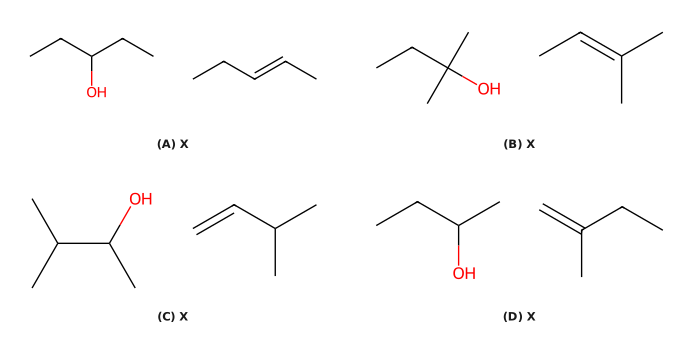
- AP EAPCET 2025Set eng-2025-05-26-FN1 markMCQQ.An alcohol X(C5H12O) on dehydration gives Y (major product). Reaction of Y with HBr gave Z(C5H11Br, major product). Z undergoes nucleophilic substitution in two steps. What are X and Y? (A) [FIGURE] (skeletal structure of a straight-chain 5-carbon alcohol with OH on the middle (3rd) carbon, i.e. pentan-3-ol) ; [FIGURE] (skeletal structure of a straight-chain 5-carbon alkene with the C=C double bond between the 2nd and 3rd carbons, i.e. pent-2-ene) (B) [FIGURE] (skeletal structure of a branched 5-carbon alcohol: an ethyl chain attached to a carbon bearing a methyl branch and the OH group, a tertiary alcohol) ; [FIGURE] (skeletal structure of a branched 5-carbon alkene with the more-substituted internal C=C double bond, drawn with a methyl branch at the alkene carbon) (C) [FIGURE] (skeletal structure of a branched 5-carbon alcohol with the OH on a carbon flanked by two methyl-bearing branch points) ; [FIGURE] (skeletal structure of a branched 5-carbon alkene with a terminal =CH2 and a methyl branch near it) (D) [FIGURE] (skeletal structure of a branched 5-carbon alcohol: an ethyl chain attached to a carbon bearing a methyl branch and the OH group) ; [FIGURE] (skeletal structure of a branched 5-carbon alkene with a terminal =CH2 and a methyl branch, an ethyl group on the other side)
›Reveal solutionSolution
This tests tracing a dehydration/HBr-addition sequence and recognising that 'substitution in two steps' signals an SN1 mechanism, which requires Z to be a tertiary halide. The answer is (B): X = 2-methylbutan-2-ol, Y = 2-methyl-2-butene.
Concept and Intuition
Nucleophilic substitution can proceed by two mechanisms: SN2 (one concerted step — backside attack and leaving-group departure happen simultaneously) or SN1 (two steps — first the leaving group departs to form a carbocation, then the nucleophile attacks it). SN1 is favoured when the resulting carbocation is highly stabilized, i.e., for tertiary (and benzylic/allylic) halides. So 'Z undergoes nucleophilic substitution in two steps' is the key clue telling us Z must be a stable, typically tertiary, alkyl halide.
Step-by-Step Solution
- Work backward from the clue: Z (C5H11Br) reacts via a two-step (SN1) mechanism, so Z should be a tertiary bromide, since tertiary carbocations are the most stabilized and SN1 is strongly favoured there.
- Test option (B): X = 2-methylbutan-2-ol, CH3CH2C(CH3)(OH)CH3 — a tertiary alcohol (C5H12O ✓).
- Dehydrate X (E1, acid-catalyzed, Zaitsev's rule: more substituted alkene is major): removing water and an H from the adjacent CH2 gives the more substituted (trisubstituted) alkene, Y = 2-methyl-2-butene, (CH3)2C=CHCH3. Since X is already tertiary at the OH carbon, no carbocation rearrangement is needed — this is a clean, direct major product.
- Add HBr to Y (Markovnikov addition): the proton adds to the carbon that gives the more stable carbocation. Protonating the =CH– carbon (attached to CH3 and H) leaves the positive charge on the (CH3)2C= carbon, forming a stabilized tertiary carbocation. Br− then attacks this carbon, giving Z = 2-bromo-2-methylbutane, (CH3)2C(Br)CH2CH3 (C5H11Br ✓, a tertiary bromide).
- Z being tertiary reacts via SN1 (2 steps: ionize to the tertiary carbocation, then nucleophile attacks) — exactly matching the clue. …
- AP EAPCET 2024Set ap-2024-05-17-FN1 markMCQQ.What is X in the following reaction? (CH3)3C−Br+OH−→X (A) Butan-2-ol (B) 2-methyl propan-2-ol (C) 2-Methyl propan-1-ol (D) Butan-1-ol
›Reveal solutionSolution
Substitution of Br by OH− on the tertiary carbon of tert-butyl bromide gives
tert-butyl alcohol, i.e. 2-methylpropan-2-ol, with the same carbon skeleton.
Concept and Intuition
(CH3)3C−Br is a tertiary alkyl halide (the carbon bearing Br
is attached to three methyl groups). Tertiary halides react with nucleophiles/hydroxide
predominantly via the SN1 mechanism: the halide leaves to form a stable
tertiary carbocation, which is then captured by OH− (or water) to directly
give the alcohol with the same carbon skeleton — no rearrangement is needed since
the carbocation is already the most stable (tertiary) form.
Step-by-Step Solution
- Starting material: (CH3)3C−Br, i.e. 2-bromo-2-methylpropane (tert-butyl bromide).
- OH− substitutes for Br− at the same (tertiary) carbon: (CH3)3C−Br+OH−→(CH3)3C−OH+Br−.
- (CH3)3C−OH is named 2-methylpropan-2-ol (tert-butanol) — the OH is on the same central carbon that held Br, still bonded to three methyl groups.
- This rules out Butan-1-ol/Butan-2-ol (those imply a straight 4-carbon chain, but the …
🎓Unlock everything free for 14 days
- ✓Full step-by-step solutions
- ✓Concept-first explanations
- ✓Methods, shortcuts & mistakes
- ✓PYQ mapping + timed mock tests
Full access for 14 days. No credit card required.