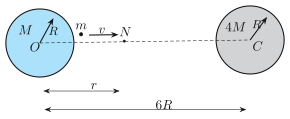
Q.Two uniform solid spheres of equal radii R, but mass M and 4M have a centre to centre separation 6R, as shown in Fig. 7.10. The two spheres are held fixed. A projectile of mass m is projected from the surface of the sphere of mass M directly towards the centre of the second sphere. Obtain an expression for the minimum speed v of the projectile so that it reaches the surface of the second sphere.
🔒You're viewing a preview — the full solution, concept, methods & PYQ mapping are locked.
🔒 Start your 14-day free trial to unlock the full solution →Concept understanding — Conservation Of Mechanical Energy
Conservation of Mechanical Energy
The Intuition First
Imagine you're holding a heavy stone at shoulder height. Your arm is tired. That stone has potential energy — energy stored because of its position. Now let it go. As it falls, it speeds up. The potential energy is turning into kinetic energy — the energy of motion. Just before it hits the ground, all the original potential energy has become kinetic energy.
Now imagine the reverse: you throw a ball straight up. It leaves your hand fast (lots of kinetic energy), rises, slows down, stops for an instant at the top (zero kinetic energy), then falls back. At the top, all the kinetic energy you gave it has turned back into potential energy.
This back-and-forth transformation — potential ↔ kinetic — is the heart of the idea. Energy doesn't disappear; it just changes form. That's conservation.
The Precise Statement
Conservation of Mechanical Energy: In an isolated system where only conservative forces (like gravity or an ideal spring) do work, the total mechanical energy of the system remains constant.
Total mechanical energy is the sum of kinetic energy (K) and potential energy (U):
Emech=K+U
The law says:
Kinitial+Uinitial=Kfinal+Ufinal
Or, in symbols:
Emech, initial=Emech, final
What This Means in Practice
Let's go back to the falling stone. Suppose you hold it 5 metres above the ground. Its mass is 2 kg. Take g=10 m/s2.
-
At the top (initial):
Ki=0 (not moving)
Ui=mgh=2×10×5=100 J
Emech=0+100=100 J
-
Just before hitting ground (final):
Uf=0 (height = 0)
Kf=21mv2
Conservation says Kf=100 J, so 21×2×v2=100, giving v=10 m/s.
You never needed to know the time of fall or acceleration. Energy conservation gave you the speed directly.
The Two Critical Conditions
Mechanical energy is not always conserved. It is conserved only when:
- No non-conservative forces (like friction, air resistance, or applied pushes/pulls) do work.
- The system is isolated — no external forces transfer energy in or out.
If friction is present, some mechanical energy turns into heat (thermal energy). The total energy of the universe is still conserved, but mechanical energy alone is not.
A Simple Example to Cement It …
The projectile only needs to just crest the neutral point (where the two spheres' pulls balance, at x=2R from the M-sphere), not reach the far sphere's surface with zero speed — the stronger sphere's gravity does the rest. …
The projectile needs just enough speed to crest the gravitational potential 'hill' between the two spheres — the point where the pulls from the two spheres exactly balance — after which the second sphere's gravity carries it the rest of the way. Using conservation of energy between the launch point and that balance point gives a minimum speed of v=5R3GM.
Setting up
Place the centre of the sphere of mass M at x=0 and the centre of the sphere of mass 4M at x=6R; both spheres have radius R, so their surfaces are at x=R and x=5R. The projectile is launched from x=R (the surface of the M-sphere) toward the other sphere.
Finding the neutral point
Between the spheres, the projectile is pulled left by M and right by 4M. These pulls balance at the point where
x2GMm=(6R−x)2G(4M)m
x21=(6R−x)24⇒x1=6R−x2⇒6R−x=2x⇒x=2R
This neutral point N (at x=2R) is where the projectile's gravitational potential energy is at its highest along the path — beyond it, the pull from the 4M sphere dominates and pulls the projectile the rest of the way in.
The minimum-speed condition is that the projectile just reaches this neutral point with zero leftover speed — not that it reaches the far sphere's surface with zero speed. Once past the neutral point, the stronger sphere's gravity takes over and accelerates it the rest of the way, so no extra launch speed is needed for that part of the journey.
Applying conservation of energy
The potential energy of the projectile at position x is
U(x)=−xGMm−6R−xG(4M)m …
Step 1: Find the neutral point where the two spheres' pulls on the projectile balance: x2GM=(6R−x)24GM, giving x=2R from the M-sphere's centre.
Step 2: The projectile only needs to just crest this neutral point with zero speed — beyond it, the stronger 4M sphere's pull takes over and pulls it the rest of the way, so this is the minimum-speed condition.
Step 3: Write the potential energy of the projectile at position x between the spheres: U(x)=−xGMm−6R−x4GMm.
Step 4: Evaluate at launch (x=R, the surface of the M-sphere): U(R)=−RGMm−5R4GMm=−5R9GMm. …
Showing the 12 most recent of 16 on this concept.
- AP EAPCET 2026Set eng-2026-05-14-FN1 markMCQQ.Two blocks each of mass m are connected to a spring of spring constant K. If both are given velocity V in opposite directions as shown in figure (diagram: block m on the left moving left with velocity V, connected by a spring to block m on the right moving right with velocity V), then the maximum elongation of the spring is (A) KmV2 (B) K2mV2 (C) 2KmV2 (D) 2KmV2
›Reveal solutionSolution
This tests energy conservation for a two-mass spring system with zero total momentum. Maximum elongation occurs when both blocks are momentarily at rest. The answer is K2mV2.
Concept and Intuition
Both blocks have equal mass and equal-and-opposite velocities, so the total momentum of the system is zero, and it stays zero (no external horizontal force). The centre of mass is therefore permanently at rest. Maximum elongation of the spring happens at the instant the relative velocity between the blocks is zero — and since total momentum is zero, this means both individual velocities must be zero at that instant (not just equal to each other, but each equal to the stationary centre-of-mass velocity).
Step-by-Step Solution
- Initial total kinetic energy: KEi=21mV2+21mV2=mV2.
- At maximum elongation, since total momentum = 0 and both blocks move together (zero relative velocity), each block's velocity must individually be zero.
- So at maximum elongation, KEf=0, and all the initial kinetic energy converts to spring potential energy: mV2=21Kx2. …
- AP EAPCET 2026Set eng-2026-05-14-AN1 markMCQQ.A massless spring with a spring constant k is fixed at its upper end. A block of mass M is attached to the lower end of the spring and released from rest in its unstretched position. The maximum elongation of the spring is (A) k4Mg (B) k2Mg (C) kMg (D) 2kMg
›Reveal solutionSolution
Maximum elongation of a spring under a suddenly-released hanging mass is TWICE the equilibrium (static) elongation, giving xmax=k2Mg.
Concept and Intuition
A common trap is to compute only the EQUILIBRIUM extension (Mg/k), where net force is zero. But here the block is released from rest at the unstretched position and allowed to fall freely under gravity and the spring force — it overshoots the equilibrium point due to inertia, and (with no energy loss) comes to rest momentarily at the point where ALL the gravitational PE lost has converted into spring PE. This maximum extension is twice the equilibrium extension.
Step-by-Step Solution
- Let x be the elongation at the lowest point (where velocity is momentarily zero — the block turns around there).
- By conservation of energy (no friction/air resistance mentioned): loss in gravitational PE = gain in spring PE. Mgx=21kx2 …
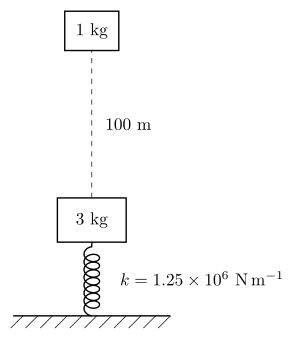
- AP EAPCET 2026Set eng-2026-05-13-AN1 markMCQQ.A block of mass 1 kg is dropped on a spring - mass system as shown in the figure. The block travels 100 m in the air before striking the 3 kg mass. Calculate the maximum compression in the spring, if both the blocks move together after the collision (Spring constant of the spring, k=1.25×10⁶ N/m, g=10 ms−2). [FIGURE: a 1 kg block dropped from 100 m above a 3 kg block, which rests on a spring of constant k=1.25×10⁶ Nm−1 fixed to the ground] (A) Zero (B) 2 cm (C) 0.2 cm (D) 4 cm
›Reveal solutionSolution
After a perfectly inelastic collision, the combined 4 kg mass's kinetic energy converts almost entirely into spring PE, giving a maximum additional compression of 2 cm — option (B).
Concept and Intuition
This is a two-stage problem: first a free-fall + perfectly-inelastic-collision stage (which fixes the combined velocity right after impact), then an energy-conservation stage (kinetic energy converting into spring potential energy as the spring compresses further). Because the spring constant is extremely stiff (1.25×10⁶ N/m), the extra compression due to the added weight alone is utterly negligible compared to the compression produced by the sudden kinetic energy of impact — so we can treat the spring's pre-existing (equilibrium) compression as effectively zero for this calculation.
Step-by-Step Solution
- Speed of the falling 1 kg block just before hitting the 3 kg block (free fall through 100 m): v=2gh=2×10×100=2000 ms−1.
- Perfectly inelastic collision (masses move together afterward) — momentum conservation: v′=m1+m2m1v=1+31×v=4v, so v′2=16v2=162000=125 m2s−2.
- Just after collision, the combined mass (4 kg) moving at v′ compresses the spring further by an amount s. Using energy conservation (KE converts to spring PE, with gravity's contribution over the small extra distance s being negligible next to the huge 250 J of kinetic energy): 21(4)v′2≈21ks2. …
- AP EAPCET 2025Set eng-2025-05-21-AN1 markMCQQ.The bob of a simple pendulum of length 200 cm is released from horizontal position. If 10% of its initial energy is lost due to air resistance, then the speed of bob at the mean position is (Acceleration due to gravity =10 ms−2) (A) 6 ms−1 (B) 3 ms−1 (C) 12 ms−1 (D) 2 ms−1
›Reveal solutionSolution
A pendulum released from horizontal falls through a height equal to its length; with 10% energy loss, the speed at the mean position works out to (A) 6 ms−1.
Concept and Intuition
When a pendulum bob is released from the horizontal position (string horizontal, bob level with the pivot), the vertical drop to the lowest (mean) point equals the full length L of the pendulum — think of the bob sweeping through a quarter circle of radius L, dropping from the height of the pivot to a height L below it. Normally all this gravitational PE would convert to KE, but here air resistance dissipates 10% of it, so only 90% survives as kinetic energy at the bottom.
Step-by-Step Solution
- Length of pendulum: L=200 cm=2 m.
- Height dropped from horizontal release to the mean (lowest) position: h=L=2 m.
- Initial (maximum) potential energy relative to the mean position: PE=mgh=mgL.
- 10% of this energy is lost to air resistance, so only 90% converts to kinetic energy at the mean position: KE=0.9mgL=21mv2. …
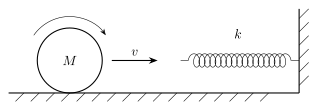
- AP EAPCET 2025Set ap-2025-05-19-FN1 markMCQQ.As shown in the figure, if a solid sphere of mass M rolling with a speed 'v' on a horizontal surface strikes a spring of force constant 'k', then the maximum compression of the spring is [FIGURE] (a solid sphere M rolling with speed v along a horizontal surface towards a horizontal spring of force constant k, which is fixed to a wall) (A) 3k5Mv2 (B) 5k7Mv2 (C) kMv2 (D) 2k3Mv2
›Reveal solutionSolution
The sphere’s total kinetic energy (translational + rotational) is completely converted into elastic potential energy of the spring at maximum compression. Using conservation of mechanical energy and the moment of inertia of a solid sphere, the maximum compression is x=5k7Mv2, which corresponds to option (B).
Concept and Intuition
When a rolling object compresses a spring, it’s not just its forward motion that matters — the rotation stores energy too. A solid sphere rolling without slipping has both translational kinetic energy (21Mv2) and rotational kinetic energy (21Iω2). As the sphere pushes into the spring, all this mechanical energy is transferred into the spring’s elastic potential energy (21kx2) at the moment of maximum compression, when the sphere momentarily stops. Because no non-conservative forces do work (the surface is horizontal and friction is static, doing no net work), total mechanical energy is conserved. This is the key: we must include both forms of kinetic energy, not just the translational part.
Step-by-step solution
-
Write the total initial kinetic energy of the rolling sphere.
For a solid sphere of mass M and radius R, rolling without slipping with speed v, the angular speed is ω=v/R. The moment of inertia about its centre is I=52MR2.
Translational KE: Ktrans=21Mv2
Rotational KE: Krot=21Iω2=21(52MR2)(Rv)2=51Mv2
Total initial KE: Ktotal=21Mv2+51Mv2=107Mv2
-
At maximum compression, the sphere is momentarily at rest.
All kinetic energy has been converted into elastic potential energy of the spring: Uspring=21kx2, where x is the maximum compression.
-
Apply conservation of mechanical energy. …
-
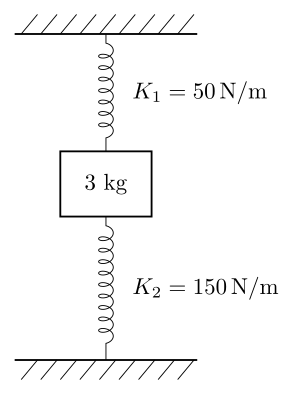
- AP EAPCET 2024Set eng-2024-05-20-FN1 markMCQQ.A 3 kg block is connected as shown in the figure. Spring constants of two springs K1 and K2 are 50 Nm−1 and 150 Nm−1 respectively. The block is released from rest with the springs unstretched. The acceleration of the block in its lowest position is (g=10 ms−2) [FIGURE] (a 3 kg block connected vertically between two springs: spring K1 above, connecting the block to a fixed ceiling support, and spring K2 below, connecting the block to a fixed floor support) (A) 10 ms−2 (B) 12 ms−2 (C) 8 ms−2 (D) 8.8 ms−2
›Reveal solutionSolution
The block executes SHM about the point where the two spring forces balance gravity; the release point is exactly one amplitude away from equilibrium, so the acceleration at the extreme (lowest) point works out to exactly g=10 ms−2.
Concept and Intuition
When a mass hangs between two springs and is released from the unstretched configuration (not the equilibrium configuration), it performs SHM about the true equilibrium point, with the release point as one turning point. The other turning point (lowest position) is symmetric on the far side of equilibrium. At any turning point, velocity is zero and acceleration is maximum, directed toward equilibrium.
Step-by-Step Solution
- Let downward displacement from the release point (unstretched springs) be x. As the block moves down by x: spring K1 (above) stretches by x, pulling up with force K1x; spring K2 (below) compresses by x, pushing up with force K2x. Net upward spring force =(K1+K2)x=200x N.
- Equilibrium position: (K1+K2)xeq=mg⇒xeq=2003×10=0.15 m.
- Since the block starts at x=0 with zero velocity, this is one extreme of the SHM, at distance 0.15 m from equilibrium — so the amplitude A=0.15 m, and the block's lowest point is at x=2xeq=0.30 m (verify by energy conservation: mgx=21(K1+K2)x2⇒x=K1+K22mg=2002×30=0.30 m — consistent). …
- AP EAPCET 2023Set eng-2023-05-16-AN1 markMCQQ.A car of mass 1000 kg having a velocity of 10 ms−1 collides a horizontally mounted spring. If the spring constant is 4000 Nm−1, then the maximum compression of the spring is (A) 25 m (B) 15 m (C) 5 m (D) 10 m
›Reveal solutionSolution
Energy conservation between the car's kinetic energy and the spring's stored elastic potential energy at maximum compression gives x=5 m.
Concept and Intuition
At maximum compression, the car is momentarily at rest (relative to the spring), so all its kinetic energy has been transferred into the spring's elastic potential energy. This is a direct application of the work-energy theorem for an ideal spring.
Step-by-Step Solution
- Initial KE of car: 21mv2=21(1000)(10)2=50,000 J.
- At maximum compression, all this KE is stored as spring PE: 21kx2=50,000. …
- AP EAPCET 2023Set eng-2023-05-19-FN1 markMCQQ.A ball is dropped from some height and after first collision with the ground if it reaches 43th of its original height, then the % loss of its energy (A) 25 (B) 75 (C) 50 (D) 55
›Reveal solutionSolution
This tests energy conservation in a bounce: PE before drop and PE at rebound height
are both proportional to height, so the % energy loss equals the % height loss.
Answer: 25%.
Concept and Intuition
The ball's mechanical energy just before the first collision equals mgh (all PE
converted to KE just before impact, from height h). After the collision it rebounds
to height h′=43h, so its energy immediately after collision is mgh′. Since
m and g are unchanged, the ratio of energies after and before is simply
h′/h, and the percentage lost is 1−h′/h expressed as a percentage.
Step-by-Step Solution
- Energy before collision (dropped from height h): Ei=mgh. …
- AP EAPCET 2022Set ap-2022-07-11-AN1 markMCQQ.A person of mass 80 kg sits on a spring and the spring compresses by 2 m. If the person himself is projected at 20 ms−1 velocity by the spring then the spring constant of the spring in Nm−1 is (A) 2000 (B) 4000 (C) 6000 (D) 8000
›Reveal solutionSolution
Energy stored in a compressed spring converts into kinetic energy of the launched person; solving 21kx2=21mv2 gives k=8000Nm−1.
Concept and Intuition
A compressed spring stores elastic potential energy 21kx2. When released, this energy is transferred to the object it launches, appearing as kinetic energy 21mv2. Equating the two lets us solve for the one unknown, the spring constant k, given the compression distance and the launch speed.
Step-by-Step Solution
- Elastic PE stored at compression x=2m: U=21kx2=21k(2)2=2k.
- Kinetic energy of the person launched at v=20ms−1, mass m=80kg: KE=21mv2=21(80)(20)2=21(80)(400)=16000J. …
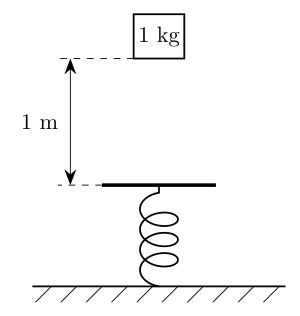
- AP EAPCET 2022Set eng-2022-07-04-FN1 markMCQQ.A mass of 1 kg falls from a height of 1 m and lands on a mass less platform supported by a spring having spring constant 15 Nm−1 as shown in the figure. The maximum compression of the spring is. (acceleration due to gravity =10 ms−2) [FIGURE] (a 1 kg mass falling from a height of 1 m above a massless platform, which rests on a vertical spring fixed to the ground) (A) 2 m (B) 2 m (C) (32) m (D) 3 m
›Reveal solutionSolution
Energy conservation: the block falls (h+x) before stopping, so mg(h+x)=21kx2. Solving gives maximum compression x=2 m — option (A).
Given: m=1 kg, h=1 m, k=15 N m−1, g=10 m s−2.
At maximum compression the block is momentarily at rest, so all the gravitational PE lost (falling through the drop height plus the compression x) is stored in the spring:
mg(h+x)=21kx2
1×10×(1+x)=21×15×x2
10+10x=7.5x2⇒7.5x2−10x−10=0 …
- AP EAPCET 2022Set eng-2022-07-08-AN1 markMCQQ.A system consists of two springs connected in series and each having the spring constant 10 Nm−1. The minimum work required to stretch this system by 1 cm in erg is (A) 1500 (B) 2000 (C) 3000 (D) 2500
›Reveal solutionSolution
Series springs combine as keff=k1k2/(k1+k2)=5 N/m; the stored elastic PE for a 1cm stretch is 2.5×10⁻⁴ J =2500 erg.
Concept and Intuition
Springs in series share the same force but stretch by different amounts each (softer overall); their effective stiffness is smaller than either individual spring, combining like resistors in parallel: keff1=k11+k21. The minimum work to stretch a spring system is exactly the elastic potential energy stored, 21keffx2 (with no losses, e.g. quasi-statically).
Step-by-Step Solution
- Series combination: keff1=101+101=102⇒keff=5 N/m.
- Minimum work = elastic PE stored =21keffx2, with x=1cm=0.01m.
- W=21(5)(0.01)2=21(5)(0.0001)=0.00025J=2.5×10⁻⁴J. …
- AP EAPCET 2021Set ap-2021-09-06-FN1 markMCQQ.Two particles of equal mass 'm' are connected by a spring of force constant 'k'. The spring is compressed through a distance 'x' and released. As the spring elongates if it breaks, find the velocities of particles? (A) x2mk (B) xmk (C) xm2k (D) 2xmk
›Reveal solutionSolution
This tests conservation of momentum + energy for a compressed spring between two equal masses on a frictionless surface. The answer is v=x2mk.
Concept and Intuition
Before release, the system (two masses + compressed spring) is at rest, so total momentum is zero. As the spring pushes the masses apart, momentum stays conserved at zero (no external horizontal force), so at every instant the two masses (being equal in mass) must have equal and opposite velocities: mv1=mv2⇒v1=v2=v. All the elastic potential energy stored in the compressed spring converts into the kinetic energy of the two masses as the spring returns toward and past its natural length (the point at which it would break/separate, since a spring can only push while compressed and this is precisely where all the stored energy has been transferred to kinetic energy of the masses).
Step-by-Step Solution
- Momentum conservation: since the system starts at rest, mv1−mv2=0⇒v1=v2=v (equal and opposite directions). …
🎓Unlock everything free for 14 days
- ✓Full step-by-step solutions
- ✓Concept-first explanations
- ✓Methods, shortcuts & mistakes
- ✓PYQ mapping + timed mock tests
Full access for 14 days. No credit card required.