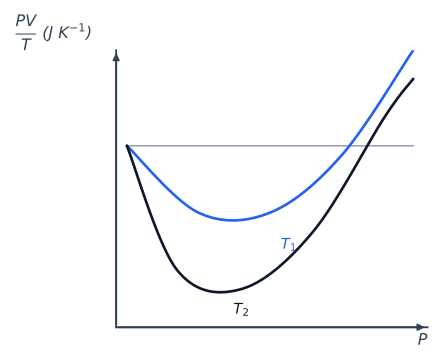
Q.Figure 12.8 shows plot of PV/T versus P for 1.00×10⁻³ kg of oxygen gas at two different temperatures.
Concept understanding — Ideal Gas Law
The Ideal Gas Law: From Intuition to Equation
Imagine you're blowing up a balloon. You feel the resistance as you push more air in. The balloon gets tighter, harder to squeeze. Now imagine leaving that balloon in a hot car — it might even pop. Or take it to the top of a mountain, and it suddenly looks half-deflated.
These everyday experiences are telling you something deep about gases: their pressure, volume, temperature, and the amount of gas inside are all connected. The Ideal Gas Law is the single equation that captures that connection.
The Four Players
Every gas has four measurable properties:
- Pressure (P) — how hard the gas pushes on its container (like the tightness of the balloon)
- Volume (V) — how much space the gas occupies (the size of the balloon)
- Temperature (T) — how hot the gas is (measured in Kelvin, not Celsius)
- Amount (n) — how many gas particles are present (measured in moles)
The Ideal Gas Law says: if you know any three of these, you can calculate the fourth. It's the master relationship.
The Precise Statement
PV=nRT
Where R is the universal gas constant. Its value depends on the units you use, but the most common one for exams is:
R=0.0821 mol⋅KL⋅atm
This means: if pressure is in atmospheres (atm), volume in litres (L), amount in moles (mol), and temperature in Kelvin (K), then R=0.0821.
Temperature must be in Kelvin. Never plug Celsius into this equation. To convert: K=°C+273.15. For most exam problems, using K=°C+273 is fine.
Why It Makes Physical Sense
The equation PV=nRT isn't just a random formula — it's a compact summary of three simpler laws that were discovered earlier:
- Boyle's Law (pressure-volume relationship): At constant n and T, P∝1/V. Squeeze a gas into half the volume, pressure doubles.
- Charles's Law (volume-temperature relationship): At constant n and P, V∝T. Heat a gas, it expands.
- Avogadro's Law (amount-volume relationship): At constant P and T, V∝n. More gas particles need more space.
The Ideal Gas Law combines all three into one clean statement.
What "Ideal" Means
Real gases don't always follow this law perfectly. At very high pressures or very low temperatures, gas particles start interacting with each other and taking up significant space themselves. The "ideal" gas is a simplified model where:
- Particles have negligible volume
- No forces act between particles (except during collisions)
- Collisions are perfectly elastic
For most exam problems at normal conditions (room temperature, atmospheric pressure), real gases behave close enough to ideal that the law works beautifully.
A Quick Example
A 2.0 L container holds 0.50 mol of gas at 300 K. What's the pressure?
P=VnRT=2.0(0.50)(0.0821)(300)
P=2.012.315=6.16 atm
Always write the equation, plug in numbers with units, then calculate. This catches unit mistakes and shows your work for partial credit.
The Big Picture
The Ideal Gas Law is your go-to tool whenever a gas changes conditions or you need to find one property from the others. It's the foundation for understanding how gases behave in everything from car engines to weather balloons to your own breathing.
A quick search for "Ideal Gas Law class 11 physics" or "NCERT physics syllabus ideal gas law" will confirm what's true here: this concept is a standard, curriculum-aligned part of Class 11 Physics and Chemistry. Given how often it's tested in JEE Main, NEET and state CET exams, it's worth revisiting this explanation until the reasoning feels automatic, not just the final formula.
Concept: Real gas vs. ideal gas behaviour — for an ideal gas PV/T=μR is a constant, independent of P, so a horizontal line on a PV/T vs P graph represents ideal behaviour; a real gas approaches this only in the limit P→0.
(a) The dotted plot. The dotted horizontal line represents the ideal-gas prediction PV/T=μR=constant, unaffected by pressure. The solid curves (real oxygen) deviate from this constant value as pressure increases, showing oxygen departing from ideal behaviour at higher pressure.
(b) Comparing T1 and T2. A real gas behaves more like an ideal gas at higher temperature (molecules are farther apart on average relative to their size, so intermolecular interactions matter less). The curve that stays closer to the dotted ideal-gas line is therefore at the higher temperature. Reading the graph, that curve corresponds to T1, so T1>T2.
(c) Value of PV/T where the curves meet the y-axis. As P→0, real-gas behaviour merges with ideal-gas behaviour, so both curves converge to the same value μR. For the given mass 1.00×10⁻³ kg=1 g of O2 (molar mass 32.0 u, so n=1/32 mol):
TPVP→0=nR=321×8.31≈0.26 J K−1
(d) Same mass of hydrogen. PV/T=nR=(μ/M)R depends on the number of moles present, which depends on molar mass M. Since MH2=2.02 u=MO2=32.0 u, the same mass (1.00×10⁻³ kg) of H2 would NOT give the same PV/T — being far lighter per mole, it has many more moles for the same mass, giving a larger PV/T.
To match the same value 0.26 J K−1 with hydrogen, solve μH2R/MH2=0.26 J K−1 for μH2:
μH2=R0.26×MH2=8.310.26×2.02×10−3≈6.3×10⁻⁵ kg
- The dotted line is the ideal-gas prediction PV/T=μR=constant.
- T1>T2 (the curve closer to the ideal-gas line is at the higher temperature).
- PV/T≈0.26 J K−1 (the common P→0 value, =μR for 1 g of O2).
- No — hydrogen gives a different value for the same mass; a mass of 6.3×10⁻⁵ kg (≈0.063 g) of H2 gives the same PV/T≈0.26 J K−1.
The horizontal dotted line is the ideal-gas prediction PV/T=μR, a constant that does not change with pressure. Real oxygen departs from it, and the curve that stays closer to the ideal line is the one at the higher temperature, so T1>T2. Where the curves touch the axis (the P→0 limit) both equal μR≈0.26 J K−1 for 1 g of O2. Because this value depends only on the number of moles, matching it with hydrogen needs a much smaller mass, 6.3×10⁻⁵ kg.
Concept — why PV/T is the natural quantity to plot
The ideal-gas equation is PV=μRT, so
TPV=μR,
where μ is the number of moles and R=8.31 J mol−1K−1. For a fixed mass of gas μ is fixed, so an ideal gas would give a value of PV/T that is completely independent of P and of T — a horizontal straight line. A real gas obeys PV=μRT only approximately (best at low pressure and high temperature), so its PV/T deviates from the constant, dipping and rising as P grows.
(a) Meaning of the dotted straight line
The dotted horizontal line has PV/T constant for all P. That is exactly ideal-gas behaviour:
TPV=μR=constant.
So the dotted line represents the ideal-gas value μR; the solid curves show how real oxygen departs from it.
(b) Ordering of T1 and T2
A real gas behaves more like an ideal gas at higher temperature, i.e. its PV/T stays closer to the constant μR line. The T1 curve lies closer to the dotted line than the T2 curve, so
T1>T2.
(The T2 curve dips further below μR, showing stronger non-ideality, which happens at the lower temperature.)
(c) Value of PV/T where the curves meet the axis
At the axis the pressure is vanishingly small; there every gas is ideal, so both curves converge to PV/T=μR. For m=1.00×10⁻³ kg=1 g of oxygen with molar mass M=32.0 g mol−1:
μ=Mm=32.0 g mol−11 g=0.03125 mol,
TPV=μR=0.03125×8.31=0.2597≈0.26 J K−1.
(d) The same experiment with hydrogen
The intercept value is PV/T=μR, which depends only on the number of moles, not on the identity of the gas. Taking 1.00×10⁻³ kg=1 g of hydrogen (M=2.02 g mol−1) would give
μH2=2.021=0.495 mol,
many more moles than 0.03125 mol, so PV/T would be much larger — not the same value.
To reproduce the oxygen value we need the same number of moles, μ=0.03125 mol. The required mass of hydrogen is
mH2=μMH2=0.03125×2.02=0.0631 g=6.31×10⁻⁵ kg.
- The dotted line is the ideal-gas result PV/T=μR= constant (independent of P).
- T1>T2 — the curve closer to the ideal line is at the higher temperature.
- PV/T=μR=321×8.31≈0.26 J K−1.
- No — the intercept depends on the number of moles, so 1 g of H2 gives a larger value. Equal PV/T requires equal moles, i.e. a hydrogen mass of 6.3×10⁻⁵ kg (≈0.063 g).
One physical idea ties all four parts together: PV/T=μR is exactly constant only for an ideal gas, so the dotted line marks the ideal-gas limit, and how close a real curve sits to that line at a given pressure measures how nearly ideal the gas is behaving there. Real gases behave more ideally at lower pressure and higher temperature (weaker intermolecular interactions, more free volume), which is precisely why the curve lying closer to the dotted line is the higher-temperature one — T1>T2 can be read straight off the graph shape, no calculation needed. Part (d)'s key insight is that PV/T=μR tracks the number of moles, not mass or gas identity — so equal masses of different gases never give equal PV/T unless the mass is deliberately chosen to give equal moles, which is why the matching mass scales by the ratio of molar masses.
Showing the 12 most recent of 19 on this concept.
- AP EAPCET 2026Set eng-2026-05-12-FN1 markMCQQ.An ideal gas of density 'ρ' is enclosed in a vessel of volume V at 0∘C temperature and p0 atmospheric pressure. If the pressure inside the vessel decreased by Δp due to a leakage. The mass of the leaked out gas is (A) V.ρ.p0 (B) Vρ/p0 (C) VΔρ/p (D) p0V.ρ.Δp
›Reveal solutionSolution
With volume and temperature both held fixed, the ideal gas law makes pressure directly proportional to the mass of gas inside — so a pressure drop Δp corresponds to a proportional mass loss, and the known initial density supplies the proportionality constant. Answer: (D).
Concept and Intuition
The ideal gas equation pV=MmolarmRT can be rearranged as p=Vm⋅MmolarRT — i.e., at fixed V and T, pressure is directly proportional to the mass of gas enclosed (through density =m/V). This means we don't need to know the molar mass or R explicitly at all: the given initial density ρ at pressure p0 already encodes the full proportionality constant between mass and pressure for this gas, in this vessel, at this temperature. A pressure drop Δp then converts directly to a mass loss using that same ratio.
Step-by-Step Solution
- Initial state: density ρ=Vm0 at pressure p0 (mass m0, volume V, temperature 0∘C fixed).
- From the ideal gas law, since V and T don't change, p∝m — specifically mp=VMmolarRT= constant. Using the initial values, this constant equals m0p0=ρVp0.
- After the leak, pressure drops by Δp, so mass drops by Δm, and the same proportionality holds for the change:
ΔmΔp=ρVp0⇒Δm=p0ρVΔp.
Common Mistakes
- Trying to bring in the universal gas constant R or molar mass explicitly — they're not needed since the initial density ρ already packages that information for this specific gas/vessel/temperature.
- Sign/ratio confusion — mass lost is proportional to pressure dropped, in the same ratio as the original mass was to the original pressure (not the final pressure).
✓Final answerThe correct option is (D) — p0V.ρ.Δp.
ANSWER: D
- AP EAPCET 2026Set eng-2026-05-14-AN1 markMCQQ.An ideal gas is expanding such that P2T=constant. The coefficient of volume expansion of the gas is (P- Pressure, T- temperature of the gas) (A) T1 (B) T2 (C) T3 (D) 2T3
›Reveal solutionSolution
This tests combining the ideal gas law with a given process equation to find how V depends on T along that specific process, then differentiating to get the volume-expansion coefficient — answer 2T3.
Concept and Intuition
The "coefficient of volume expansion" γ=V1(dTdV) is normally quoted at constant pressure, but here the gas follows a specific process (P2T= constant) where P itself changes with T. So we must first eliminate P using the ideal gas law to get V purely as a function of T along this process, and then differentiate that relation.
Step-by-Step Solution
- Ideal gas law: PV=nRT⟹P=VnRT.
- Given process: P2T=C (constant). Substitute P:
(VnRT)2T=C⟹V2n2R2T3=C
- Solve for V in terms of T:
V2=Cn2R2T3⟹V=(CnR)T3/2
So V∝T3/2.
4. Differentiate:
dTdV=23(CnR)T1/2=23⋅TV
- Coefficient of volume expansion:
γ=V1dTdV=2T3
Common Mistakes
- Assuming P is constant and using the standard γ=1/T result for an isobaric ideal gas — that formula does not apply here because P varies with T along this process.
- Sign/exponent slips when substituting P=nRT/V into P2T=C (easy to drop the square).
✓Final answerThe correct option is (D) — 2T3.
ANSWER: D
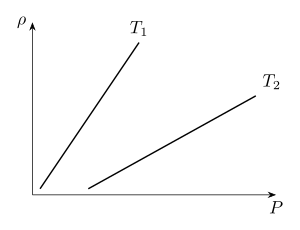
- AP EAPCET 2026Set eng-2026-05-15-AN1 markMCQQ.The density (ρ) versus pressure (P) of a given mass of an ideal gas is shown at two temperatures T1 and T2. The relation between T1 and T2 is [FIGURE: graph of density ρ (y-axis) vs pressure P (x-axis) showing two straight lines; the line labelled T1 has a steeper slope (higher ρ for a given P), and the line labelled T2 has a smaller slope (lower ρ for a given P)] (A) T1>T2 (B) T2>T1 (C) T1=T2 (D) T1>T2 or T2>T1
›Reveal solutionSolution
Tests how the slope of a ρ–P graph for an ideal gas relates inversely to temperature. Since the steeper line (T1) has the larger slope, it corresponds to the lower temperature, giving T2>T1.
Concept and Intuition
Starting from the ideal gas law PV=nRT, and writing n=m/M (mass m, molar mass M):
PV=MmRT⟹P=Vm⋅MRT=ρMRT⟹ρ=RTMP
So for a fixed gas (fixed M), a ρ vs P plot is a straight line through the origin with slope RTM. This slope shrinks as temperature rises — physically, at higher temperature the same pressure supports a lower density (the gas is "puffier"/more expanded), which is exactly the ideal gas law's statement that hot gas at fixed pressure has lower density.
Step-by-Step Solution
- From PV=nRT, derive ρ=RTMP — a straight line through the origin with slope ∝T1.
- The graph shows T1's line steeper than T2's line (higher ρ for the same P), i.e. slope(T1)> slope(T2).
- Since slope ∝1/T, a larger slope means a smaller T: slope(T1)>slope(T2)⟹T1<T2.
- Therefore T2>T1.
Common Mistakes
- Assuming (incorrectly) that a steeper line means a higher temperature — it's the opposite here, because slope is inversely proportional to T.
- Confusing this ρ-P graph with a P-V isotherm graph (where higher T isotherms lie further from the origin) — the relationship is different because density and volume are inversely related.
✓Final answerThe correct option is (B) — T2>T1.
ANSWER: B
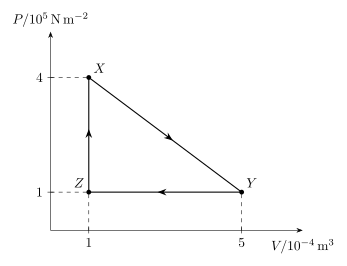
- AP EAPCET 2026Set ap-2026-05-20-FN1 markMCQQ.A mass of an ideal gas of volume V at pressure P undergoes the cycle of changes shown in the graph. At which point is the gas coolest and hottest? [FIGURE] (a P–V graph, axes labelled P/105Nm−2 vertical and V/10−4m3 horizontal; a right-triangle cycle with vertex X at (V=1, P=4), vertex Y at (V=5, P=1), and vertex Z at (V=1, P=1); the cycle runs X down to Y along the hypotenuse, Y back to Z along the bottom, and Z up to X along the left side) (A) coolest – X, hottest – Y (B) coolest – Y, hottest – X (C) coolest – Y, hottest – Z (D) coolest – Z, hottest – Y
›Reveal solutionSolution
Using T∝PV from the ideal gas law at each vertex of the cycle, Z is coolest and Y is hottest.
Concept and Intuition
For a fixed amount of ideal gas, PV=nRT, so temperature is directly proportional to the product PV at any state point on a P–V diagram. Comparing PV at the three vertices of the cyclic process directly ranks their temperatures — no need to trace the path.
Step-by-Step Solution
- At X: P=4×10⁵Nm−2 (in the graph's units, P=4), V=1×10⁻⁴m3 (units, V=1). So PV∝4×1=4.
- At Y: P=1, V=5 (in the same graph units). PV∝1×5=5.
- At Z: P=1, V=1. PV∝1×1=1.
- Since T∝PV: TZ(∝1)<TX(∝4)<TY(∝5).
- Therefore the coolest point is Z and the hottest point is Y.
Common Mistakes
- Assuming the point with highest pressure (X) must be hottest — temperature depends on the product PV, not pressure alone.
- Reading the graph axes' scale factors incorrectly (both axes carry a ×10± multiplier that cancels out when just comparing ratios).
✓Final answerThe correct option is (D) — coolest – Z, hottest – Y.
ANSWER: D
- AP EAPCET 2025Set eng-2025-05-23-FN1 markMCQQ.The work done to increase the volume of 2 moles of an ideal gas from V to 2V at a constant temperature T is W. The work to be done to increase the volume of 2 moles of the same gas from 2V to 4V at the same constant temperature T is (A) 0.5W (B) W (C) 2W (D) 4W
›Reveal solutionSolution
Isothermal work depends only on the ratio of final to initial volume, not their absolute values; since both steps double the volume, they require equal work. Answer: W.
Concept and Intuition
For an isothermal process, W=nRTln(Vf/Vi). The key insight is that this depends only on the ratio Vf/Vi, not on the absolute volumes. Doubling the gas's volume always requires the same work at a given temperature, regardless of where you start.
Step-by-Step Solution
- First process (V→2V, n=2 mol): W=2RTln(V2V)=2RTln2.
- Second process (2V→4V): W′=2RTln(2V4V)=2RTln2.
- Since ln2=ln2 in both cases, W′=W.
Common Mistakes
- Assuming the second step needs more work because the volumes involved are larger in absolute terms — but only the ratio matters for isothermal work.
✓Final answerThe correct option is (B) — W.
ANSWER: B
- AP EAPCET 2025Set eng-2025-05-24-FN1 markMCQQ.In a container of volume 16.62 m3 at 0°C temperature, 2 moles of oxygen, 5 moles of nitrogen and 3 moles of hydrogen are present, then the pressure in the container is (Universal gas constant =8.31 J mol−1 K−1) (A) 1570 Pa (B) 1270 Pa (C) 1365 Pa (D) 2270 Pa
›Reveal solutionSolution
This tests applying the ideal gas law to a mixture of gases, where the total pressure depends only on the total number of moles (Dalton's law is implicit); the answer is (C) 1365 Pa.
Concept and Intuition
For an ideal gas mixture in a fixed volume and temperature, the total pressure obeys PV=ntotalRT, where ntotal is simply the sum of moles of all gases present — the identity of each gas doesn't matter for the total pressure, only the total mole count (this is Dalton's law in disguise).
Step-by-Step Solution
- Total moles: n=nO2+nN2+nH2=2+5+3=10 mol.
- Temperature: T=0°C=273 K.
- Ideal gas law: P=VnRT=16.6210×8.31×273.
- Numerator: 10×8.31=83.1; 83.1×273=22686.3.
- P=16.6222686.3=1365 Pa.
Common Mistakes
- Computing partial pressures separately and forgetting to just sum the moles (equivalent, but more error-prone).
- Using T=0 K instead of converting to Kelvin (273 K).
✓Final answerThe correct option is (C) — 1365 Pa.
ANSWER: C
- AP EAPCET 2024Set ap-2024-05-17-AN1 markMCQQ.A vessel contains 8 g of air at 400 K. Some amount of air leaks out through the hole provided to it. After some time, pressure is halved and temperature is changed to 300 K. Find the mass of the air escaped (A) 5.33 g (B) 2.67 g (C) 6 g (D) 3.27 g
›Reveal solutionSolution
With volume fixed, the mass of gas remaining is proportional to P/T; comparing the initial and final P/T ratios gives the leaked mass as 2.67 g.
Concept and Intuition
For a rigid, sealed (except for the leak) container, PV=nRT=MmRT. Since V, R, and molar mass M don't change, the mass of gas present at any time is directly proportional to P/T at that time. This lets us find the ratio of final to initial mass without knowing M or V explicitly.
Step-by-Step Solution
- Initial state: mass m1=8 g, at pressure P, temperature T1=400 K.
- Final state: mass m2 (unknown), pressure P/2, temperature T2=300 K.
- Since m∝P/T: m1m2=P/400(P/2)/300=P/400P/600=600400=32.
- m2=8×32=5.33 g.
- Mass escaped =m1−m2=8−5.33=2.67 g.
Common Mistakes
- Forgetting that pressure was HALVED (not just given as some new value P2) when substituting.
- Trying to use the ideal gas equation with absolute values of P and V (which aren't given) instead of working with the ratio, where P, V, M, R all cancel out.
✓Final answerThe correct option is (B) — 2.67 g.
ANSWER: B
- AP EAPCET 2024Set ap-2024-05-17-AN1 markMCQQ.A piston divides a closed gas cylinder into two parts. Initially the piston is kept pressed such that one part has pressure P and volume 5V and the other part has pressure 8P and volume V. The piston is now left free. The new pressure if the process is isothermal (A) Po=613P (B) Po=138P (C) Po=813P (D) Po=68P
›Reveal solutionSolution
Applying Boyle's Law separately to the gas on each side of the piston (each undergoes an isothermal change to reach the same final pressure), and using conservation of total volume, gives the equilibrium pressure Po=613P.
Concept and Intuition
The piston is free to slide but the total cylinder volume is fixed. Since the process is isothermal, each trapped gas independently obeys PV=constant as its volume changes, right up until the piston stops moving — at which point both sides must have the SAME pressure Po (otherwise there'd be a net force on the piston and it would keep moving).
Step-by-Step Solution
- Side 1 initially: pressure P, volume 5V. Applying Boyle's Law to its final state at pressure Po: P×5V=Po×V1′⇒V1′=Po5PV.
- Side 2 initially: pressure 8P, volume V. Similarly: 8P×V=Po×V2′⇒V2′=Po8PV.
- Total volume is conserved (rigid cylinder): V1′+V2′=5V+V=6V.
- Substitute: Po5PV+Po8PV=6V⇒Po13PV=6V⇒Po=613P.
Common Mistakes
- Assuming the final pressure is just the average of the initial pressures (which is only true if the volumes were also equal) — it is not, because the two sides have different volumes.
- Forgetting that the total volume (not each side's individual volume) is what's conserved.
✓Final answerThe correct option is (A) — Po=613P.
ANSWER: A
- AP EAPCET 2024Set eng-2024-05-22-AN1 markMCQQ.Two ideal gases A and B of same number of moles expand at constant temperatures T1 and T2 respectively such that the pressure of gas A decreases by 50% and the pressure of gas B decreases by 75%. If the work done by both the gases is same, then T1:T2 (A) 1 : 3 (B) 2 : 3 (C) 3 : 4 (D) 2 : 1
›Reveal solutionSolution
Isothermal expansion work depends logarithmically on the pressure (or volume) ratio; equating the two given works pins down the temperature ratio.
Concept and Intuition
For an isothermal process on an ideal gas, PV=nRT=constant, so as pressure falls the volume must rise proportionally in the reciprocal sense: Vf/Vi=Pi/Pf. The work done in an isothermal expansion is W=nRTln(Vf/Vi), which can therefore be rewritten directly in terms of the pressure ratio — useful because the problem gives percentage pressure drops, not volume ratios.
Step-by-Step Solution
- Gas A: pressure decreases by 50%, so Pf,A=0.5Pi,A, meaning Pi/Pf=2.
- Work by A (n moles, temperature T1): WA=nRT1ln(Pi/Pf)=nRT1ln2.
- Gas B: pressure decreases by 75%, so Pf,B=0.25Pi,B, meaning Pi/Pf=4.
- Work by B (n moles, temperature T2): WB=nRT2ln4=nRT2(2ln2)=2nRT2ln2.
- Given WA=WB: nRT1ln2=2nRT2ln2⇒T1=2T2.
- Hence T1:T2=2:1.
Common Mistakes
- Treating the pressure drop as directly giving the volume ratio without inverting (Vf/Vi=Pi/Pf, not Pf/Pi).
- Forgetting ln4=2ln2 and mishandling the log algebra.
✓Final answerThe correct option is (D) — 2 : 1.
ANSWER: D
- AP EAPCET 2023Set ap-2023-05-23-AN1 markMCQQ.If the percentage increase in the pressure of a given mass of gas in a container at constant temperature is 100%, then its volume (A) decreases by 100% (B) decreases by 50% (C) does not change (D) increases by 100%
›Reveal solutionSolution
Boyle's Law at constant temperature: doubling the pressure halves the volume, a 50% decrease.
Concept and Intuition
At constant temperature, for a fixed mass of an ideal gas, pressure and volume are inversely proportional (PV=constant). Any percentage increase in one directly determines the reciprocal change in the other — it is not a symmetric percentage relationship.
Step-by-Step Solution
- Boyle's Law: P1V1=P2V2.
- Pressure increases by 100%, so P2=2P1.
- Then V2=P2P1V1=2P1P1V1=2V1.
- V2 is half of V1, i.e. the volume has decreased by 50% (not 100%, since volume can never become negative or zero here).
Common Mistakes
- Assuming a 100% increase in pressure causes a 100% decrease in volume (that would make volume zero, which is wrong — inverse proportionality is multiplicative, not additive).
✓Final answerThe correct option is (B) — decreases by 50%.
ANSWER: B
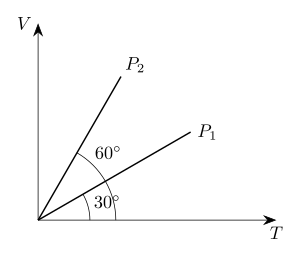
- AP EAPCET 2023Set ap-2023-05-23-FN1 markMCQQ.In the given volume (V) - absolute temperature (T) graph of an ideal gas, the relation between the pressures 'P1' and 'P2' is [FIGURE] (a V-T graph with two straight lines through the origin; the P2 line makes a 60° angle with the T-axis and the P1 line makes a 30° angle with the T-axis) (A) P1=2P2 (B) P1=3P2 (C) P1=3P2 (D) P1=2P2
›Reveal solutionSolution
The slope of a V–T graph for an ideal gas is proportional to nR/P. Since the slope is tanθ (with θ measured from the T‑axis), the ratio of pressures is the inverse ratio of the tangents. Here P1=3P2, so option (C) is correct.
The key is the Ideal Gas Law: PV=nRT. For a fixed amount of gas (constant n), if we plot volume V against absolute temperature T, the equation becomes V=(PnR)T. This is a straight line through the origin with slope m=PnR.
So the slope of the V–T line is inversely proportional to the pressure: a steeper line means a smaller pressure, and a shallower line means a larger pressure. The problem gives the angles the lines make with the T‑axis, so we can find the slopes from those angles.
-
Interpret the angles correctly
The T‑axis is horizontal. The angle a line makes with the horizontal is the same as the angle whose tangent gives the slope.
- For P2: angle = 60∘ → slope m2=tan60∘=3.
- For P1: angle = 30∘ → slope m1=tan30∘=31.
-
Relate slope to pressure
From V=PnRT, we have m=PnR. Therefore:
m1=P1nR,m2=P2nR.
- Take the ratio
m2m1=nR/P2nR/P1=P1P2.
Substitute the slopes:
31/3=P1P2⇒31=P1P2.
Hence P1=3P2.
Watch outA common mistake is to think the larger angle means larger pressure. But slope is tanθ, and tan60∘>tan30∘, so the steeper line (P2) actually has lower pressure. Always check: slope ∝1/P.
TipIf you remember that for an ideal gas at constant pressure, V∝T, then the line’s slope is directly nR/P. So comparing slopes is a quick way to compare pressures without re‑deriving.
✓Final answerThe correct option is (C).
ANSWER: C
-
- AP EAPCET 2023Set eng-2023-05-19-FN1 markMCQQ.In the given pressure (P) – absolute temperature (T) graph of an ideal gas, the relation between volumes V1,V2,V3, and V4 is [FIGURE] (a P-T graph with four straight lines through the origin labelled V1,V2,V3,V4 from steepest to shallowest slope, with dashed vertical reference lines at temperatures 100, 200, 300, 400 K) (A) V1=V2=V3=V4 (B) V1>V2>V3>V4 (C) V1>V2>V3<V4 (D) V1<V2<V3<V4
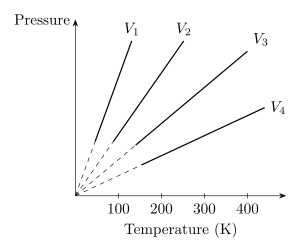
›Reveal solutionSolution
For an ideal gas, the slope of a P–T line through the origin is proportional to nR/V; a steeper slope means a smaller volume. Since the slopes satisfy V1>V2>V3>V4 (steepest to shallowest), the volumes obey V1<V2<V3<V4.
The key to this problem is the Ideal Gas Law, PV=nRT. When we plot pressure P against absolute temperature T for a fixed amount of gas, the relationship is linear if the volume V is constant. Rearranging:
P=(VnR)T
This is of the form y=mx, a straight line through the origin. The slope m is nR/V. Since n (number of moles) and R (gas constant) are the same for all lines in the graph, the slope depends only on V: a larger volume gives a smaller slope, and a smaller volume gives a larger slope.
Now let’s apply this to the given graph.
-
Identify the slopes from the graph
The four lines are labelled V1,V2,V3,V4 in order of decreasing steepness. That is, V1 has the steepest slope, V2 is next, then V3, and V4 has the shallowest slope.
So: slope1 > slope2 > slope3 > slope4.
-
Relate slope to volume
From P=(nR/V)T, the slope is nR/V. Since nR is constant, slope is inversely proportional to V:
slope∝V1
Therefore, a larger slope means a smaller volume, and a smaller slope means a larger volume.
- Order the volumes Because slope1 > slope2 > slope3 > slope4, we have:
V11>V21>V31>V41
Taking reciprocals (which reverses the inequality order):
V1<V2<V3<V4
- Match with the options The correct relation is V1<V2<V3<V4, which corresponds to option (D).
Watch outA common mistake is to think that a steeper line means a larger volume, because “more pressure” might feel like “more gas”. But remember: for a fixed amount of gas, a steeper P–T line means the gas is confined to a smaller volume — it takes less temperature increase to raise the pressure sharply.
TipIf you ever forget the direction, test with a simple case: imagine a very small volume (like a rigid tank). A small temperature increase will cause a huge pressure jump — steep slope. A huge volume (like a balloon) gives a gentle slope. So steep slope = small volume.
✓Final answerThe correct option is (D).
ANSWER: D
-
🎓Unlock everything free for 14 days
- ✓Full step-by-step solutions
- ✓Concept-first explanations
- ✓Methods, shortcuts & mistakes
- ✓PYQ mapping + timed mock tests
Full access for 14 days. No credit card required.