Q.A bullet of mass 0.04 kg moving with a speed of 90 m s−1 enters a heavy wooden block and is stopped after a distance of 60 cm. What is the average resistive force exerted by the block on the bullet?
🔒You're viewing a preview — the full solution, concept, methods & PYQ mapping are locked.
🔒 Start your 14-day free trial to unlock the full solution →Concept understanding — Work Energy Theorem
The Work-Energy Theorem: From Intuition to Precision
Imagine pushing a heavy box across the floor. The harder you push and the farther it slides, the faster it moves when you let go. That connection — the push (force) over a distance (displacement) changing the box's speed — is exactly what the Work-Energy Theorem captures.
The Intuition First
Think of work as the "currency" that buys motion. When you do work on an object, you transfer energy to it. That energy shows up as kinetic energy — the energy of motion. The more work you do, the more the object's kinetic energy changes.
If you push a stationary ball, it starts moving. If you push a moving ball in the same direction, it speeds up. If you push against its motion, it slows down. In every case, the work done equals the change in the ball's kinetic energy.
Work is done by a force on an object. The object's kinetic energy changes by exactly that amount (assuming no other forces do work).
The Precise Statement
Wnet=ΔK=Kf−Ki
Where:
- Wnet is the net work done on the object (the total work from all forces combined)
- Kf is the final kinetic energy
- Ki is the initial kinetic energy
And kinetic energy is defined as:
K=21mv2
So the theorem can also be written as:
Wnet=21mvf2−21mvi2
Why "Net" Work Matters
This is the most common point of confusion. The theorem uses net work — the work done by the net force (the vector sum of all forces). If you push a box and friction opposes it, the net work is the work you do minus the work friction does. Only that net amount changes the kinetic energy.
If you push a box at constant speed, your work is positive, but friction does equal negative work. The net work is zero, so kinetic energy doesn't change — the box keeps moving at the same speed. Your work didn't "disappear"; it was dissipated as heat by friction.
A Simple Derivation (for constant force)
Consider a constant net force Fnet acting on an object of mass m over a displacement s. From Newton's second law:
Fnet=ma
From kinematics (constant acceleration):
vf2=vi2+2as
Multiply both sides by 21m:
21mvf2=21mvi2+mas
But mas=Fnets=Wnet, so:
21mvf2=21mvi2+Wnet
Rearranging:
Wnet=21mvf2−21mvi2=ΔK
The theorem holds even for variable forces and curved paths — the derivation uses calculus then, but the result is the same.
What It Tells You (and What It Doesn't) …
Concept: Work-Energy Theorem — the work done by the net force equals the change in kinetic energy.
The bullet’s initial kinetic energy is
Ki=21mv2=21(0.04)(90)2=162 J.
It comes to rest, so Kf=0. The work done by the resistive force F (opposing motion) over a displacement s=0.60 m is
W=−Fs (negative because force opposes displacement). …
Using the Work-Energy Theorem, the kinetic energy lost by the bullet equals the work done by the resistive force. The average resistive force comes out to 270 N.
The key here is to avoid getting tangled in kinematics (finding acceleration, then force). The Work-Energy Theorem gives a direct path: the net work done on an object equals its change in kinetic energy. Since the bullet starts moving and ends at rest, all its initial kinetic energy is dissipated by the resistive force of the wood.
Work-Energy Theorem: Wnet=ΔK=21mvf2−21mvi2
The only force doing work on the bullet (once it enters the block) is the resistive force F, which acts opposite to the direction of motion. So the work done by this force is negative: W=−F×d, where d is the penetration distance.
Let’s walk through it step by step.
-
Identify the known quantities
Mass of bullet: m=0.04 kg
Initial speed: u=90 m/s
Final speed: v=0 m/s
Penetration distance: s=60 cm=0.6 m
Resistive force: F (to be found, assumed constant on average)
-
Write the initial kinetic energy
Ki=21mu2=21×0.04×(90)2
Compute stepwise: 902=8100, then 21×0.04=0.02, so
Ki=0.02×8100=162 J
-
Final kinetic energy
Since the bullet stops, Kf=0 J.
-
Change in kinetic energy
ΔK=Kf−Ki=0−162=−162 J
- Work done by the resistive force The force F acts opposite to displacement, so work done by it is:
W=−F×s=−F×0.6
- Apply the Work-Energy Theorem
W=ΔK
−F×0.6=−162 …
Concept: Equations of Motion (kinematics) + Newton's Second Law
Step 1: Write down the known quantities
m=0.04 kg, u=90 m s−1, v=0 (bullet stops), s=60 cm=0.6 m.
Step 2: Find the deceleration using v2=u2+2as
0=(90)2+2a(0.6)
a=1.2−8100=−6750 m s−2
The negative sign shows the acceleration opposes the bullet's motion (it is a deceleration).
Step 3: Apply Newton's Second Law to get the force
F=m∣a∣=0.04×6750=270 N
Step 4: State the direction …
Showing the 12 most recent of 42 on this concept.
- AP EAPCET 2026Set eng-2026-05-12-AN1 markMCQQ.If the work done in increasing the velocity of a body by 25% is 900 J, then the work done in decreasing the velocity of the same body by 25% is (A) 700 J (B) 500 J (C) 225 J (D) 450 J
›Reveal solutionSolution
Kinetic energy scales as v2, so a 25% increase and a 25% decrease change KE by different amounts (not symmetric) — the work values are 900 J and 700 J respectively.
Concept and Intuition
Because KE∝v2, percentage changes in velocity do not translate into equal-and-opposite percentage changes in KE. Increasing v by 25% multiplies KE by (1.25)2=1.5625, while decreasing v by 25% multiplies KE by (0.75)2=0.5625 — these are not mirror images, so the two work-done values differ.
Step-by-Step Solution
- Let the initial KE be K=21mv2.
- Increasing velocity by 25%: v′=1.25v, so KE′=21m(1.25v)2=1.5625K.
- Work done to increase =KE′−K=0.5625K=900 J ⇒K=0.5625900=1600 J.
- Decreasing velocity by 25%: v′′=0.75v, so KE′′=21m(0.75v)2=0.5625K=0.5625(1600)=900 J. …
- AP EAPCET 2026Set eng-2026-05-13-FN1 markMCQQ.A block is kept at the top of a rough inclined plane of length 2.8 m and angle of inclination cos−1(0.6). If the coefficient of kinetic friction between the block and the upper half of the plane is 0.3 and between the block and the lower half of the plane is 0.5, then the velocity with which the block reaches the bottom of the plane is (acceleration due to gravity =10 ms−2) (A) 1.4 ms−1 (B) 5.6 ms−1 (C) 4.2 ms−1 (D) 2.8 ms−1
›Reveal solutionSolution
Applying v2=u2+2as separately over the two half-lengths with their different friction coefficients gives a final speed of 5.6 m/s.
Concept and Intuition
Since the coefficient of kinetic friction changes halfway down the incline, the acceleration is piecewise-constant — the problem must be split into two stages, using the velocity at the end of stage one as the initial velocity for stage two.
Step-by-Step Solution
- cosθ=0.6⇒sinθ=1−0.36=0.8 (3-4-5 triangle).
- Upper half, length 1.4 m, μ1=0.3: a1=gsinθ−μ1gcosθ=10(0.8)−0.3(10)(0.6)=8−1.8=6.2 ms−2.
- Starting from rest: v12=0+2(6.2)(1.4)=17.36 m2s−2. …
- AP EAPCET 2026Set eng-2026-05-13-FN1 markMCQQ.A body of mass 5 kg is projected vertically upwards from a point X from the ground with an initial speed of 20 ms−1. It rises to a point Y where its kinetic energy is reduced to 400 J. If the body experiences a constant air resistance of 10 N throughout its motion, then the vertical distance between X and Y is (Acceleration due to gravity =10 ms−2) (A) 5 m (B) 10 m (C) 8 m (D) 16 m
›Reveal solutionSolution
The work-energy theorem, with both gravity and constant air resistance doing negative work on the way up, gives a height of 10 m.
Concept and Intuition
Going up, both gravity and air resistance oppose the motion (both act downward), so the loss in kinetic energy equals the sum of the work done against both — this is a direct energy-balance shortcut, avoiding a separate calculation of a modified "effective g."
Step-by-Step Solution
- Initial KE at X: 21mv2=21(5)(20)2=1000 J.
- KE at Y: given as 400 J.
- Loss in KE =1000−400=600 J, which equals work done against gravity plus air resistance over height h: 600=(mg+Fair)h=(5×10+10)h=60h. …
- AP EAPCET 2026Set eng-2026-05-13-AN1 markMCQQ.A block of mass 0.18 kg is attached to a spring of constant 2 Nm−1 as shown in the figure. The coefficient of friction between block and horizontal surface is 0.1. Initially block is at rest and spring is unstretched. When an impulse is given to the block, it slides through a distance 0.06 m and stops. The velocity of the block just after the impulse is given to it is (Take g=10 ms−2) (A) 4 ms−1 (B) 2 ms−1 (C) 0.4 ms−1 (D) 0.2 ms−1
›Reveal solutionSolution
Work-energy theorem: the block's initial kinetic energy is dissipated by friction and stored as spring PE by the time it stops, giving v=0.4 ms−1 — option (C).
Concept and Intuition
An impulse gives the block an initial velocity; as it slides, friction removes energy (as heat) and the spring stores energy (as elastic PE). Since the block eventually comes to rest, ALL the initial kinetic energy must have gone into these two channels — this is a direct application of the work-energy theorem over the whole sliding distance.
Step-by-Step Solution
- Let v be the speed just after the impulse. Initial KE =21mv2.
- Energy lost to friction over distance d: Wf=μmgd.
- Energy stored in the spring at maximum stretch d (block stops, so this is the full compression): Ws=21kd2.
- Energy conservation (block starts with KE, ends at rest with the energy fully transferred): 21mv2=μmgd+21kd2.
- Substitute numbers: μmgd=0.1×0.18×10×0.06=0.0108 J; 21kd2=0.5×2×0.062=0.0036 J. …
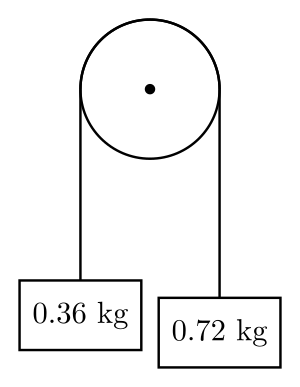
- AP EAPCET 2026Set eng-2026-05-13-AN1 markMCQQ.A light inextensible string connects two masses over a fixed smooth pully as shown in the figure. The workdone by the string on mass 0.36 kg during first second after the masses are released (Take g=10ms−2). [FIGURE: a fixed pulley with a string connecting a 0.36 kg mass hanging on one side and a 0.72 kg mass hanging on the other side] (A) 6 J (B) 5 J (C) 8 J (D) 2 J
›Reveal solutionSolution
The 0.36 kg mass is the lighter side of an Atwood machine and rises; the string (tension) does positive work on it equal to T×s=8 J in the first second — option (C).
Concept and Intuition
In an Atwood machine, the heavier mass falls and the lighter mass rises with the same magnitude of acceleration, connected by a single tension throughout the (light, inextensible) string. The work done by the string on either mass is simply tension times the distance that mass moves (positive if the tension and displacement are in the same direction, as they are here for the rising 0.36 kg mass).
Step-by-Step Solution
- Let m1=0.36 kg (lighter, rises) and m2=0.72 kg (heavier, falls).
- Acceleration of the system: a=m1+m2(m2−m1)g=1.08(0.72−0.36)×10=1.083.6=310 ms−2.
- Tension from the lighter mass's equation of motion (T−m1g=m1a): T=m1(g+a)=0.36(10+310)=0.36×340=4.8 N.
- (Check with the heavier mass: T=m2(g−a)=0.72×320=4.8 N — consistent.) …
- AP EAPCET 2026Set eng-2026-05-15-FN1 markMCQQ.A body of mass 2 kg is thrown vertically upwards from the ground level with kinetic energy of 240 J. The kinetic energy of the body will become half at a height of (g=10 ms−2) (A) 24 m (B) 12 m (C) 6 m (D) 4 m
›Reveal solutionSolution
Mechanical energy is conserved as the body rises (no air resistance mentioned): the kinetic energy lost equals the gravitational PE gained. Setting the KE to half its initial value and solving for height gives x=6m.
Concept and Intuition
As a body is thrown straight up, kinetic energy steadily converts into gravitational potential energy while total mechanical energy stays constant. So at any height x: KE(x)=KE0−mgx. We just need the height at which this has dropped to half the initial value — this is a direct energy-bookkeeping problem, no need to find the initial velocity explicitly (though we could).
Step-by-Step Solution
- Given: m=2kg, KE0=240J, g=10ms−2.
- At height x: KE(x)=KE0−mgx=240−(2)(10)x=240−20x.
- We want KE(x)=2240=120J. …
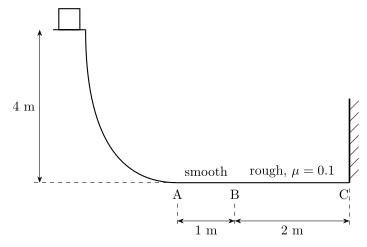
- AP EAPCET 2026Set ap-2026-05-19-FN1 markMCQQ.A block of mass m=0.1 kg is released from a height of 4 m on a curved smooth surface. On the horizontal surface, path AB is smooth and path BC is rough with a coefficient of friction, μ=0.1. If the impact of the block with the vertical wall at C is perfectly elastic, the total distance covered by the block on the horizontal surface before coming to rest will be (g=10 ms−2) [FIGURE] (a block slides down a smooth curved ramp from a height of 4 m onto a horizontal surface; on the horizontal surface, point A is at the base of the curve, then a smooth 1 m segment AB, then a rough 2 m segment BC with a fixed vertical wall at C) (A) 29 m (B) 59 m (C) 60 m (D) 90 m
›Reveal solutionSolution
The block’s initial gravitational potential energy converts to kinetic energy, which is then dissipated by friction over repeated trips across the rough segment, with elastic bounces at the wall. The total distance traveled on the rough surface is 40 m, plus the initial 1 m smooth segment gives 41 m, but the block also travels the smooth segment each time it passes — careful accounting shows the total horizontal distance is 59 m, so the correct option is (B).
Concept and Intuition
The block starts with gravitational potential energy mgh at the top of the smooth curve. Since the curve and the first horizontal segment AB are frictionless, all that energy becomes kinetic energy by the time the block reaches point B. From B onward, the rough segment BC (length 2 m) has friction, which does negative work, slowing the block. When the block hits the vertical wall at C, the collision is perfectly elastic, so the block rebounds with the same speed (but opposite direction) — no energy is lost in the bounce. Then it travels back across the rough segment, losing more energy to friction, until it either stops or reaches the smooth segment again. Because the smooth segment AB has no friction, the block coasts across it without losing energy, then re-enters the rough segment from the left. This back-and-forth continues until all the initial energy is dissipated by friction. The key is to find the total distance traveled on the rough surface, then add the distances traveled on the smooth surface (which are traversed multiple times).
Step-by-Step Solution
- Find the speed at point B (just before entering the rough patch). The block starts from rest at height h=4 m. By conservation of mechanical energy on the smooth curve and smooth AB:
mgh=21mvB2⇒vB=2gh=2⋅10⋅4=80=45 m/s.
So the kinetic energy at B is 21mvB2=mgh=0.1×10×4=4 J.
-
Work done by friction per unit distance.
On the rough segment, the friction force is f=μmg=0.1×0.1×10=0.1 N.
The work done by friction over a distance d is Wf=−fd=−0.1d (in joules). This work removes kinetic energy from the block.
-
First trip from B to C (2 m).
The block travels from B to C, a distance of 2 m. Friction removes 0.1×2=0.2 J of energy.
Kinetic energy remaining at C: 4−0.2=3.8 J.
Speed at C: vC=2×3.8/0.1=76≈8.72 m/s.
The block hits the wall and rebounds elastically — speed magnitude unchanged, direction reversed.
-
First return trip from C to B (2 m).
The block travels back from C to B, again 2 m on rough surface. Friction removes another 0.2 J.
Energy at B (on return): 3.8−0.2=3.6 J.
Since AB is smooth, the block coasts across AB (1 m) without losing energy, then reaches the left end of the rough segment (point B again) with the same 3.6 J. But note: the block has now traveled 2 m (B→C) + 2 m (C→B) = 4 m on rough surface so far.
-
Subsequent trips: each full round trip across the rough segment (B→C→B) is 4 m and removes 0.4 J of energy.
However, the block does not necessarily always make a full round trip — it may stop partway. Let’s track the energy after each pass:
- After first B→C: energy = 3.8 J
- After first C→B: energy = 3.6 J
- After second B→C: energy = 3.4 J
- After second C→B: energy = 3.2 J
- … and so on.
Each full back-and-forth (4 m) reduces energy by 0.4 J. Starting from 4 J, the number of full 4 m cycles possible is ⌊4/0.4⌋=10 full cycles, which would use 10×4=40 m of rough travel and reduce energy to 4−10×0.4=0 J. But wait — does it exactly hit zero? Let’s check: after 10 cycles (20 half-trips of 2 m each), the energy would be exactly 0. That means the block stops exactly at point B after the 20th half-trip (i.e., after returning from C to B for the 10th time). So the total rough distance is exactly 40 m.
-
Now account for the smooth segment AB (1 m).
Each time the block goes from B to the left end of the smooth segment and back to B, it travels 2 m on smooth surface. But careful: the block starts at A (after coming down the curve) and goes to B (1 m smooth). Then after each return to B from the rough side, it coasts across the smooth segment to the left end and back to B. How many times does it cross the smooth segment?
- First time: from A to B (1 m) — this is the initial smooth travel. …
- AP EAPCET 2026Set ap-2026-05-19-FN1 markMCQQ.A body of mass 3 kg is under a force, which causes a displacement in it given by S=3t3 (in m). Find the work done by the force in first 2 seconds (A) 2.4 J (B) 3.8 J (C) 5.2 J (D) 24 J
›Reveal solutionSolution
Differentiating displacement gives velocity at t=2s as 4 m/s; the
work-energy theorem then gives work done = 24 J. Answer: (D).
Concept and Intuition
Rather than computing the force F=md2S/dt2 and integrating FdS
over the interval, the work-energy theorem (W=ΔKE) lets us
shortcut straight to the answer once we know the velocity at the start and
end of the interval — since the body starts from rest (S=0 at t=0 gives
v=0 too), the work done in the first 2 seconds is just the final kinetic
energy.
Step-by-Step Solution
- Given S(t)=3t3 m.
- Velocity: v(t)=dtdS=t2.
- At t=0: v=0 (starts from rest). At t=2 s: v=22=4 ms−1. …
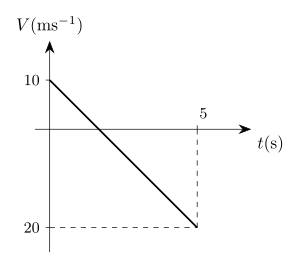
- AP EAPCET 2026Set eng-2026-05-18-AN1 markMCQQ.The velocity–time graph of a body of mass 4 kg moving along a straight line is shown in figure. Work done by all the forces acting on the body from t=0 to t=5s is [FIGURE] (a velocity (V in ms−1) vs time (t in s) graph: the line starts at V=10 at t=0 and decreases linearly, crossing V=0 before t=5, and reaches V=−20 at t=5s) (A) 300 J (B) −300 J (C) −600 J (D) 600 J
›Reveal solutionSolution
This tests the work–energy theorem applied directly from a velocity–time graph — total work equals the change in kinetic energy, regardless of the path velocity takes in between.
Concept and Intuition
The work–energy theorem states that the net work done by all forces on a body equals its change in kinetic energy, W=ΔKE=21mvf2−21mvi2. This holds true no matter how the velocity varies in between (linear decrease, reversal of direction, etc.) — only the initial and final speeds matter. Here the body starts at +10 ms−1 and ends at −20 ms−1; even though the velocity passes through zero and reverses direction, kinetic energy depends only on v2, so the sign reversal doesn't subtract — it's the magnitude that counts in v2.
Step-by-Step Solution
- From the graph: at t=0, vi=10 ms−1; at t=5 s, vf=−20 ms−1.
- Initial KE =21(4)(10)2=200 J. …
- AP EAPCET 2026Set ap-2026-05-20-AN1 markMCQQ.A uniform chain of length 'L' and mass 'M' overhangs a horizontal table with its two-third part on the table. The coefficient of friction between the table and the chain is μ. The work done by friction during the period the chain slips off the table is (A) 9−2μMgL (B) 9−6μMgL (C) 9−1μMgL (D) 9−4μMgL
›Reveal solutionSolution
Integrate the (shrinking) friction force over the length the chain slides, from x=L/3 to x=L; the result is −92μMgL. Answer: (A).
Concept and Intuition
As the chain slips, the length resting on the table (and hence the normal force and friction force) keeps decreasing, so friction is NOT constant — you must integrate. The friction force at any moment is μ times the weight of only the portion still on the table, since the hanging portion contributes no normal force on the table.
Step-by-Step Solution
- Let x = length of chain hanging off the table at some instant; it starts at x0=L/3 and ends at x1=L (whole chain off).
- Mass on table at that instant: mtable=MLL−x.
- Friction force (opposing the slipping motion): f(x)=μmtableg=μLMg(L−x).
- Work done by friction (force opposes displacement dx): Wf=−∫L/3LμLMg(L−x)dx. …
- AP EAPCET 2025Set eng-2025-05-21-FN1 markMCQQ.A person holds a ball of mass 0.25 kg in his hand and throws it, so that it leaves his hand with a speed of 12 ms−1. In this process, if his hand moved through a distance of 0.9 m, then the net force acted on the ball is (A) 40 N (B) 20 N (C) 25 N (D) 10 N
›Reveal solutionSolution
This tests the work–energy theorem for a ball accelerated over a known distance; the net force equals the kinetic energy gained divided by the displacement, giving 20 N.
Concept and Intuition
The hand exerts a net force on the ball while it is still in contact, over the distance the hand travels forward. Since there is no other agent doing work on the ball during this phase (we're told the net force), the work done by that net force converts entirely into the kinetic energy the ball has when it leaves the hand. This is the work–energy theorem: Wnet=ΔKE.
Step-by-Step Solution
- The ball starts at rest in the hand and leaves with speed v=12 ms−1.
- Kinetic energy gained: ΔKE=21mv2=21(0.25)(12)2=21(0.25)(144)=18 J. …
- AP EAPCET 2025Set ap-2025-05-19-FN1 markMCQQ.A body of mass 6 kg is moved with uniform speed on a rough horizontal surface through a distance of 200 cm. If the coefficient of kinetic friction between the surface and the body is 0.1, then the work done against friction is (Acceleration due to gravity =10 ms−2) (A) 12 J (B) 24 J (C) 36 J (D) 48 J
›Reveal solutionSolution
At uniform speed the net work done is zero, so the work done against friction simply equals (friction force) × (distance) = 12 J.
Concept and Intuition
When a body moves at constant velocity, its kinetic energy does not change, so by the work–energy theorem the net work done on it is zero. This means the work done by whatever force is pushing/pulling the body forward is exactly cancelled by the (negative) work done by friction — in other words, all the driving work is "spent" fighting friction. So the magnitude of work done against friction is simply the friction force times the distance moved.
Step-by-Step Solution
- Convert distance: 200 cm=2 m. …
🎓Unlock everything free for 14 days
- ✓Full step-by-step solutions
- ✓Concept-first explanations
- ✓Methods, shortcuts & mistakes
- ✓PYQ mapping + timed mock tests
Full access for 14 days. No credit card required.