Q.Determine the maximum acceleration of the train in which a box lying on its floor will remain stationary, given that the co-efficient of static friction between the box and the train's floor is 0.15.
🔒You're viewing a preview — the full solution, concept, methods & PYQ mapping are locked.
🔒 Start your 14-day free trial to unlock the full solution →Concept understanding — Static Friction Limit
The Static Friction Limit: Why a Heavy Box Won't Move Until You Really Push
Imagine you're trying to push a heavy wooden crate across a rough floor. You lean into it gently — nothing happens. You push a little harder — still nothing. The crate stays perfectly still, as if glued to the spot. Then, at some point, you push just a bit more, and suddenly the crate lurches forward.
That invisible "sticking point" — the exact moment the crate finally gives way — is the static friction limit.
The Intuition: Friction as a "Smart" Force
Friction between two surfaces that aren't sliding is called static friction. What makes it special is that it's self-adjusting. It doesn't have a fixed value. Instead, it automatically grows to match whatever force you apply — up to a point.
Think of it like a tug-of-war where your opponent (static friction) matches your pull exactly, but only until you exceed their maximum strength. As long as you pull less than their limit, you both stay in equilibrium and nothing moves. The moment you exceed that limit, you win — and the crate starts sliding.
Static friction only exists when there is no relative motion between the surfaces. Once sliding begins, it's replaced by kinetic friction, which is usually weaker.
The Precise Statement
The static friction limit (also called limiting friction) is the maximum possible value of static friction that can act between two surfaces in contact before they start sliding relative to each other.
Mathematically:
fs≤μsN
Where:
- fs = static friction force (the actual value, which can be anything from 0 up to the limit)
- μs = coefficient of static friction (a constant that depends on the two materials — rubber on concrete is high, ice on steel is low)
- N = normal reaction force (the force pressing the surfaces together, usually equal to weight on a horizontal surface)
The static friction limit is the equality case:
fs,max=μsN
This is the maximum static friction the surfaces can provide. Apply a force less than this, and the object stays put. Apply a force equal to this, and the object is on the verge of moving (impending motion). Apply a force greater than this, and the object accelerates.
A Concrete Example
A 10 kg block rests on a horizontal floor. μs=0.4 between the block and floor. Take g=10 m/s2.
Normal reaction: N=mg=10×10=100 N
Static friction limit: fs,max=0.4×100=40 N
Now, what happens as you push?
| Applied Force | Static Friction | Result |
|---|---|---|
| 10 N | 10 N (matches) | Block stays still |
| 25 N | 25 N (matches) | Block stays still |
| 40 N | 40 N (matches) | Block is just about to move |
| 45 N | 40 N (cannot exceed limit) | Block accelerates forward |
For the box to remain stationary relative to the accelerating train, static friction must supply the required force, up to its maximum μsN.
- Train accelerates at a; for the box (mass m) to move with it, friction fs=ma.
- Maximum static friction: fs,max=μsN=μsmg (horizontal floor, N=mg).
- At the verge of slipping, mamax=μsmg, so: amax=μsg …
For the box to remain stationary relative to the accelerating train, static friction must provide the necessary force, up to its limiting value. The maximum acceleration is 1.5 m/s2.
When a box is placed on the floor of a train, and the train accelerates, the box tends to resist this change in motion due to its inertia. If there were no friction, the box would slide backward relative to the train. Static friction acts to prevent this relative motion.
For the box to remain stationary relative to the train, it must accelerate with the train. This means the static friction force acting on the box must be precisely what is needed to give the box the same acceleration as the train.
Static friction is self-adjusting: it supplies exactly the force needed to prevent relative motion, up to a maximum value μsN. If the required force exceeds this maximum, the box slides. The maximum train acceleration the box can withstand without sliding occurs when static friction reaches this maximum.
-
Identify the forces acting on the box.
- Gravity (mg): downward.
- Normal force (N): upward, from the train's floor.
- Static friction (fs): horizontal. Since the train accelerates forward, the box tends to lag behind relative to the train, so friction acts forward, in the direction of the train's acceleration, to hold the box with it.
-
Vertical equilibrium.
The box does not accelerate vertically:
N−mg=0⟹N=mg
- Maximum static friction.
fs,max=μsN=μsmg
- Horizontal Newton's second law, at the verge of slipping. …
Concept: Limiting Static Friction supplies the box's acceleration
Step 1: Identify what keeps the box moving with the train
For the box to accelerate along with the train (rather than sliding), static friction alone supplies the horizontal force: fs=ma.
Step 2: Write the maximum friction available
On a horizontal floor, N=mg, so
fs,max=μsN=μsmg
Step 3: Set the required force equal to the maximum available friction …
Showing the 12 most recent of 27 on this concept.
- AP EAPCET 2026Set eng-2026-05-15-AN1 markMCQQ.A 5 kg block on horizontal surface is pulled by 15 N. If the coefficient of friction between the block and surface is 0.2, then the acceleration of the block is _____ [g=10 ms−2] (A) 0 (B) 1 ms−2 (C) 2 ms−2 (D) 3 ms−2
›Reveal solutionSolution
This tests Newton's second law with kinetic friction opposing an applied force. The answer is (B), 1ms−2.
Concept and Intuition
When a block is pulled along a rough horizontal surface, friction opposes the applied force. The net force driving the acceleration is the applied force minus the friction force (which depends on the normal reaction, here equal to weight since the surface is horizontal and the pull is horizontal).
Step-by-Step Solution
- Normal reaction N=mg=5×10=50N (horizontal pull, horizontal surface).
- Maximum (kinetic) friction force f=μN=0.2×50=10N.
- Applied force is 15N, which exceeds friction, so the block does move and kinetic friction of 10N opposes it.
- Net force =15−10=5N.
- Acceleration a=mFnet=55=1ms−2.
Common Mistakes …
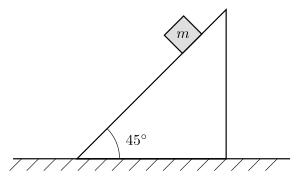
- AP EAPCET 2026Set eng-2026-05-18-AN1 markMCQQ.On a wedge of mass 2m, a block of mass m is sliding as shown in the figure. There is no friction between block and wedge. Then the minimum coefficient of friction between wedge and ground so that the wedge does not move is [FIGURE] (a wedge inclined at 45° to the horizontal ground, with a block of mass m sliding on its incline surface; the wedge itself has mass 2m and rests on the ground) (A) 0.50 (B) 0.25 (C) 0.10 (D) 0.20
›Reveal solutionSolution
This tests force analysis on a wedge system: with the block frictionlessly sliding, the minimum ground friction coefficient needed to keep a wedge stationary comes from balancing the horizontal component of the block's normal reaction against the wedge's total normal reaction from the ground.
Concept and Intuition
Since there's no friction between block and wedge, and we want the minimum μ for the wedge to just barely stay put, the wedge is exactly in equilibrium (on the verge of sliding) while the block slides freely down the incline. Because the wedge doesn't move, the block's acceleration is purely along the incline surface (it cannot leave the surface), so the usual incline result N=mgcosθ holds for the normal contact force between block and wedge. This normal force pushes back on the wedge (Newton's third law) with a horizontal component that friction from the ground must resist, and a vertical component that adds to the wedge's own weight to determine the ground's normal reaction (and hence the maximum available friction).
Step-by-Step Solution
- Block on frictionless incline (wedge fixed): along the incline, mgsinθ=ma; perpendicular to the incline (no perpendicular acceleration since motion is confined to the surface), N=mgcosθ.
- By Newton's third law, the block pushes on the wedge with force N directed into the incline surface. Its horizontal component is Nsinθ=mgsinθcosθ, and its vertical (downward) component is Ncosθ=mgcos2θ.
- Vertical equilibrium of the wedge (mass 2m): ground normal reaction Ng=2mg+mgcos2θ. …
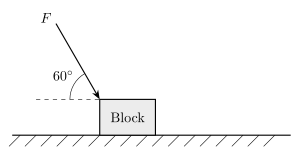
- AP EAPCET 2025Set eng-2025-05-21-FN1 markMCQQ.As shown in the figure, a force F is applied on a block of mass 3 kg placed on a rough horizontal surface. The maximum value of F for the block not to move is (Coefficient of static friction between the block and the surface is 231 and acceleration due to gravity =10 ms−2) [FIGURE] (a force F applied at 60 degrees to the horizontal, pushing down onto a block resting on a rough horizontal surface; the angle between the force line and the surface is marked 60 degrees) (A) 5 N (B) 10 N (C) 15 N (D) 20 N
›Reveal solutionSolution
This tests force resolution for a push applied at an angle below the horizontal, which increases the normal force and hence the maximum friction available; the answer is (D).
Concept and Intuition
When a force is applied downward-and-forward (pushing into the surface) rather than upward-and-forward (pulling away from it), its vertical component adds to the weight, increasing the normal force and therefore the maximum static friction the surface can supply. This means a larger horizontal force can be resisted before slipping begins — unlike a pulling force, which would reduce the normal force.
Step-by-Step Solution
- Resolve F (applied at 60∘ to horizontal, pushing down into the block) into horizontal component Fcos60∘ and vertical (downward) component Fsin60∘.
- Vertical equilibrium: normal force N=mg+Fsin60∘ (since the push adds to the weight pressing the block down).
- At the verge of sliding, horizontal driving force equals maximum static friction: Fcos60∘=μsN=μs(mg+Fsin60∘).
- Substitute values: m=3 kg, g=10 m/s2, μs=231, cos60∘=21, sin60∘=23. …
- AP EAPCET 2025Set ap-2025-05-20-FN1 markMCQQ.A block of mass 2 kg is kept on a rough horizontal surface. If a horizontal force of 4 N is applied on the block, then the acceleration of the block is (Coefficient of static friction between the block and the surface is 0.3) (A) 0.94 ms−2 (B) 1 ms−2 (C) zero (D) 2 ms−2
›Reveal solutionSolution
Since the applied horizontal force (4 N) is smaller than the maximum available static friction (6 N), the block stays at rest and its acceleration is zero.
Concept and Intuition
Static friction is a self-adjusting force — it exactly balances any applied force up to a maximum value μsN (N = normal reaction). Only once the applied force exceeds this maximum does the body start to slide (and then kinetic friction, generally a bit smaller, takes over).
Step-by-Step Solution
- Normal reaction on a horizontal surface: N=mg=2×10=20 N.
- Maximum static friction available: fs,max=μsN=0.3×20=6 N.
- Applied force F=4 N <fs,max=6 N.
- Since the applied force does not exceed the maximum static friction, static friction simply equals the applied force (4 N) in the opposite direction, keeping the block in equilibrium. …
- AP EAPCET 2025Set eng-2025-05-26-FN1 markMCQQ.A block of mass 2 kg is placed on a rough horizontal surface. If a horizontal force of 20 N acting on the block produces an acceleration of 7 ms−2 in it, then the coefficient of kinetic friction between the block and the surface is (Acceleration due to gravity = 10 ms−2) (A) 0.2 (B) 0.3 (C) 0.4 (D) 0.5
›Reveal solutionSolution
This tests Newton's second law with kinetic friction opposing an applied horizontal force: the friction force is whatever is left after accounting for the net force that actually produced the observed acceleration.
Concept and Intuition
When a block accelerates under an applied force with friction present, the friction force isn't found from a formula alone first — it's found by balancing forces: (applied force) − (friction) = (mass)×(acceleration). Once friction's actual magnitude is known, the coefficient of kinetic friction follows from f=μN, with N=mg on a horizontal surface.
Step-by-Step Solution
- Required net force for the given acceleration: Fnet=ma=2×7=14 N.
- Applied force is 20 N, so friction opposing the motion is f=Fapplied−Fnet=20−14=6 N.
- Normal force on a horizontal surface: N=mg=2×10=20 N. …
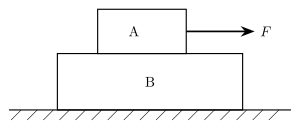
- AP EAPCET 2024Set ap-2024-05-16-AN1 markMCQQ.The blocks A & B weighing 100 N & 250 N respectively are placed one over the other as shown in the figure. Block B rests on a smooth surface. The coefficient of static friction between A & B is 0.4. When F = 250 N, the acceleration of the upper block is (Take acceleration due to gravity, g=10 ms−2) [FIGURE] (block A sits on top of block B, block B rests on the ground; a horizontal force F is applied to block A, arrow pointing to the right) (A) 8.4 ms−2 (B) 25 ms−2 (C) 6 ms−2 (D) 21 ms−2
›Reveal solutionSolution
The key is to check whether the applied force exceeds the maximum static friction between the blocks. If it does, the blocks slip relative to each other and the upper block accelerates under the net force of the applied force minus kinetic friction. Here, the maximum static friction is 40 N, but F = 250 N, so slipping occurs; the acceleration of block A is 21 m/s², corresponding to option (D).
Concept and Intuition: The Static Friction Limit
When you push the top block, the only horizontal force that can make the bottom block move is friction at the contact surface between the blocks. But friction has a maximum value — the static friction limit — given by fmax=μsN, where N is the normal force between the blocks.
If the applied force F is less than or equal to this limit, both blocks move together as one unit (no slipping).
If F exceeds this limit, the top block slips over the bottom block, and the friction becomes kinetic (which is usually slightly less, but here we treat it as equal to the maximum static friction for simplicity, since the problem gives only μs).
So the first step is always: Find the maximum static friction and compare it to the applied force.
Step-by-step solution
- Find the normal force between the blocks Block A weighs 100 N, so the normal force from block B on block A is equal to its weight (since there is no vertical acceleration):
N=100 N
- Calculate the maximum static friction
fmax=μsN=0.4×100=40 N
This is the largest horizontal force that friction can exert on block A (to the left) and on block B (to the right) without slipping.
-
Compare applied force to fmax
The applied force F=250 N is much larger than 40 N. Therefore, the static friction limit is exceeded — the blocks slip relative to each other.
-
Determine the net force on block A after slipping
Once slipping occurs, the friction force becomes kinetic, but here we assume it remains at the maximum value (since μk is not given, we use μs as the sliding friction).
- Applied force to the right: +250 N
- Friction force to the left (opposing motion): −40 N …
- AP EAPCET 2024Set ap-2024-05-16-FN1 markMCQQ.A block of mass 'm' is placed in equilibrium on a moving horizontal plank. The maximum horizontal acceleration of the plank for μ=0.2 is (Acceleration due to gravity = 10 ms−2) (A) 2 ms−2 (B) 3 ms−2 (C) 4 ms−2 (D) 5 ms−2
›Reveal solutionSolution
This tests the maximum acceleration a surface can impart to a resting block purely through static friction, before the block starts to slip.
Concept and Intuition
The block has no other horizontal force acting on it except friction from the plank. As the plank accelerates, friction must act on the block to accelerate it along with the plank (Newton's third law pair on the plank). Friction can only supply a force up to its maximum static value μmg. Beyond that acceleration, friction cannot keep up, and the block starts sliding backward relative to the plank — it is no longer "in equilibrium" (moving together) with the plank.
Step-by-Step Solution
- For the block (mass m) to accelerate along with the plank at acceleration a, the net horizontal force needed is ma.
- The only horizontal force available is static friction, bounded by fmax=μmg.
- At the maximum possible common acceleration, mamax=μmg⇒amax=μg. …
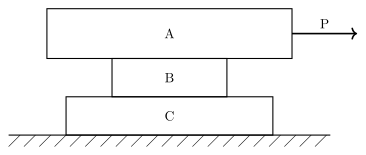
- AP EAPCET 2024Set ap-2024-05-17-AN1 markMCQQ.Find the least horizontal force P to start motion of any part of the system of three blocks resting upon one another as shown in the figure. The weights of blocks are A=300N,B=100N and C=200N. The coefficient of friction between A & B is 0.3, between B & C is 0.2 and between C & ground is 0.1. [FIGURE] (three blocks stacked vertically resting on a horizontal ground: block A on top with a horizontal force P applied to it via an arrow pointing right, block B in the middle, block C at the bottom on the hatched ground) (A) 60 N (B) 90 N (C) 80 N (D) 70 N
›Reveal solutionSolution
The least horizontal force P that will start motion of any part of the system is determined by comparing the friction limits at each interface; the smallest force that overcomes any one of these limits is P=60N, which corresponds to slipping between blocks A and B. The correct option is (A).
Concept and Intuition: The Static Friction Limit
When you push block A with a gradually increasing force P, nothing moves until the static friction at some interface is overcome. The key idea is that motion will begin at the interface with the smallest friction limit — because that is the "weakest link." We do not need to consider all blocks moving together; we only need the first slip. So we compute the maximum static friction force at each contact surface (between A & B, B & C, and C & ground) and see which one is smallest. That smallest value is the force P required to start motion somewhere.
Watch outA common mistake is to assume that all blocks move together, or to add up all friction forces. But the question asks for motion of any part — so only the weakest interface matters.
Step-by-Step Solution
1. Identify the normal forces at each interface.
Since the blocks are stacked vertically, the normal force at each interface equals the total weight above it.
- Between A and B: Only block A sits above.
NAB=WA=300N
- Between B and C: Blocks A and B are above.
NBC=WA+WB=300+100=400N
- Between C and ground: All three blocks are above.
NCg=WA+WB+WC=300+100+200=600N
2. Compute the maximum static friction force at each interface.
Use fmax=μN.
- Between A and B (μ=0.3):
fABmax=0.3×300=90N
- Between B and C (μ=0.2):
fBCmax=0.2×400=80N
- Between C and ground (μ=0.1):
fCgmax=0.1×600=60N
3. Interpret the meaning of each friction limit.
- If P exceeds 90N, block A will slip relative to B (since the friction between them can no longer hold A).
- If P exceeds 80N, block B will slip relative to C (but note: this requires that the force is transmitted through A and B).
- If P exceeds 60N, block C will slip relative to the ground (the entire stack slides as one). …
- AP EAPCET 2024Set ap-2024-05-17-FN1 markMCQQ.A body slides down an inclined plane of angle of inclination 30° with a constant velocity of 10 ms−1. If the body is pushed up the same plane with a velocity of 20 ms−1, the distance moved by the body before coming to rest is (Acceleration due to gravity =10 ms−2) (A) 10 m (B) 15 m (C) 20 m (D) 30 m
›Reveal solutionSolution
This tests friction on an incline. The constant-velocity descent fixes μ=tanθ; going up then combines gravity and friction, both decelerating the body, giving a stopping distance of 20 m.
Concept and Intuition
When a body slides down an incline at CONSTANT velocity, the net force is zero, so kinetic friction exactly balances the component of gravity along the incline: μmgcosθ=mgsinθ⇒μ=tanθ. When the same body is instead pushed UP the incline, both gravity's component and friction act down the slope (opposing the upward motion), so the deceleration is the SUM of the two, not their difference.
Step-by-Step Solution
- From constant-velocity descent: μ=tan30°=31.
- Deceleration while moving up: a=gsinθ+μgcosθ.
- Since μgcosθ=(tanθ)(gcosθ)=gsinθ, we get a=gsinθ+gsinθ=2gsinθ. …
- AP EAPCET 2024Set eng-2024-05-20-AN1 markMCQQ.An insect is crawling in a hemi-spherical bowl of radius R. If the coefficient of friction between the insect and bowl is μ, then the maximum height to which the insect can crawl the bowl is (A) R[1−1+μ21] (B) R[1+1+μ21] (C) R[1+μ21] (D) R[1−μ21]
›Reveal solutionSolution
The insect can climb until the tangential pull of gravity exceeds the maximum static friction the curved surface can supply; that critical angle fixes the maximum height. Answer: R[1−1+μ21].
Concept and Intuition
On a curved surface, gravity naturally splits into a component along the surface (trying to slide the insect down) and a component perpendicular to it (balanced by the normal reaction). Friction can only resist up to μN; the highest point reachable is where the insect is on the verge of slipping — friction is exactly maxed out.
Step-by-Step Solution
- Let θ be the angle between the radius to the insect's position and the vertical (radius to the bottom of the bowl). Height above the bottom: h=R(1−cosθ).
- Resolve gravity: radial component mgcosθ (balanced by normal force, so N=mgcosθ), tangential component mgsinθ (tends to slide the insect down, resisted by friction). …
- AP EAPCET 2024Set eng-2024-05-20-AN1 markMCQQ.A horizontal board is performing simple harmonic oscillations horizontally with an amplitude 0.3 m and a period of 4 s. The minimum coefficient of friction between a heavy body placed on the board if the body is not to slip is. (A) μ=0.05 (B) μ=0.075 (C) μ=0.173 (D) μ=1.14
›Reveal solutionSolution
The body stays with the oscillating board only if friction can supply the needed force at the point of maximum acceleration; equating μmg to mω2A gives μ≈0.075.
Concept and Intuition
For the heavy body to move together with the board (no slipping), the only horizontal force available to accelerate it is friction. Since SHM acceleration is largest at the extreme positions (a=ω2x, maximum at x=A), that is the critical instant: if friction is enough to supply mω2A there, it is enough everywhere else in the cycle too.
Step-by-Step Solution
- Angular frequency: ω=T2π=42π=2π rad s−1.
- Maximum acceleration of the board (and hence of the body, if it doesn't slip): amax=ω2A=(2π)2×0.3=2.467×0.3≈0.740 m/s2.
- The force needed to give the body this acceleration is provided entirely by friction: f=mamax.
- For no slipping, this must not exceed the maximum static friction μmg: …
- AP EAPCET 2023Set eng-2023-05-15-AN1 markMCQQ.The following is not the method of reducing friction (A) using ball bearings (B) applying grease (C) applying paint (D) forming a thin air cushion
›Reveal solutionSolution
Ball bearings, grease, and air cushions are all standard, taught methods of reducing friction; applying paint is not — it is done mainly for protection, not friction reduction.
Concept and Intuition
Friction between two surfaces can be reduced by (i) making the surfaces smoother/lubricating them, (ii) replacing sliding friction with rolling friction (ball bearings), or (iii) separating the surfaces entirely with a fluid layer (air cushion, as in hovercraft/air-track). Painting a surface serves a different purpose — corrosion resistance and finish — and is not among the standard physics methods for reducing friction.
Step-by-Step Solution
- (A) Using ball bearings: converts sliding friction into much smaller rolling friction — a genuine friction-reduction method.
- (B) Applying grease: lubrication reduces the coefficient of friction between contacting surfaces — a genuine method.
- (D) Forming a thin air cushion: keeps the surfaces from direct contact, nearly eliminating friction (used in air-cushion vehicles) — a genuine method. …
🎓Unlock everything free for 14 days
- ✓Full step-by-step solutions
- ✓Concept-first explanations
- ✓Methods, shortcuts & mistakes
- ✓PYQ mapping + timed mock tests
Full access for 14 days. No credit card required.