Q.A metre scale is moving with uniform velocity. This implies
Concept understanding — Newton Second Law
Newton's Second Law: The Law That Connects Force and Motion
Imagine you're pushing a shopping cart. If you push gently, it moves slowly. Push harder, and it speeds up faster. Now imagine the cart is full of groceries — even with the same push, it accelerates much more slowly than an empty cart. This everyday experience is exactly what Newton's Second Law captures.
The Intuition First
Two things matter when you push something:
- How hard you push — the force you apply.
- How heavy the object is — its mass.
The harder you push, the more the object speeds up. The heavier the object, the less it speeds up for the same push. So acceleration depends on both force and mass — and in opposite ways.
"Acceleration" here means any change in velocity — speeding up, slowing down, or changing direction. It's not just "going faster."
The Precise Statement
Newton's Second Law says:
The acceleration of an object is directly proportional to the net force acting on it, and inversely proportional to its mass. The acceleration is in the same direction as the net force.
In one equation:
a=mFnet
Or more commonly:
Fnet=ma
Where:
- Fnet is the net force (the vector sum of all forces acting on the object) — measured in newtons (N)
- m is the mass of the object — measured in kilograms (kg)
- a is the acceleration — measured in metres per second squared (m/s2)
Fnet=ma
What This Really Means
Force causes acceleration, not velocity. A constant net force produces constant acceleration — meaning the velocity keeps changing at a steady rate. If you stop pushing, the net force becomes zero, and acceleration becomes zero (the object continues at constant velocity — that's Newton's First Law).
Mass is a measure of inertia. The more mass an object has, the harder it is to change its motion. A truck needs a much larger force than a bicycle to achieve the same acceleration.
Direction matters. Force and acceleration are vectors — they point the same way. If you push north, the acceleration is north. If multiple forces act, you must add them as vectors to find the net force.
A Simple Example
A 2 kg block is pushed with a net force of 10 N to the right.
a=mFnet=2 kg10 N=5 m/s2
The block accelerates at 5 m/s2 to the right. Every second, its velocity increases by 5 m/s in that direction.
A common mistake: thinking that a constant force means constant velocity. It doesn't — constant force means constant acceleration, so velocity keeps changing. Only when net force is zero does velocity stay constant.
Why This Law Is So Powerful
Newton's Second Law is the bridge between forces (the causes) and motion (the effects). It lets you:
- Predict how an object will move if you know the forces on it
- Calculate the force needed to produce a desired motion
- Understand why heavier things are harder to accelerate
It applies everywhere — from a ball you throw to a rocket launching into space. The same law governs them all.
For quick revision, remember that Newton Second Law is drawn directly from the Laws of Motion coverage of the NCERT/CBSE Class 11 Physics syllabus and recurs often in JEE Main and NEET papers, which is exactly why "Newton Second Law important questions" shows up so often in Physics question banks. The clearest way to build exam confidence here is to combine this explanation with the NCERT Physics textbook's own solved examples and chapter-end questions.
The key idea here is Newton's Laws of Motion, specifically the conditions for translational and rotational equilibrium.
- "Uniform velocity" for an extended object like a metre scale implies that its center of mass moves with constant linear velocity and its angular velocity is also constant (or zero).
- Constant linear velocity means zero linear acceleration (a=0). By Newton's Second Law, the net external force Fnet acting on the scale must be zero (Fnet=ma=m×0=0).
- Constant angular velocity means zero angular acceleration (α=0). By the rotational equivalent of Newton's Second Law, the net external torque τnet acting on the scale must be zero (τnet=Iα=I×0=0).
- If the net torque on the scale is zero, then the torque about any point, including its centre of mass, must also be zero.
The correct option is (B).
A metre scale moving with uniform velocity implies that both its linear and angular accelerations are zero. Consequently, the net force and the net torque acting on it must both be zero. The correct option is (B).
When a rigid body is described as "moving with uniform velocity," it means that its entire state of motion is constant. This includes both its translational motion (the motion of its center of mass) and its rotational motion (its rotation about its center of mass). Let's break this down using Newton's laws.
- Understanding "Uniform Velocity" for Translational Motion: "Uniform velocity" means that the velocity vector v of the centre of mass of the scale is constant in both magnitude and direction. If the velocity is constant, then the linear acceleration a of the centre of mass must be zero:
a=dtdv=0
- Relating Zero Acceleration to Net Force: According to Newton's Second Law of Motion for translational motion, the net external force (ΣF) acting on an object is equal to the product of its mass (m) and its acceleration (a):
ΣF=ma
Since we established that $\vec{a} = 0$ for uniform velocity, it follows that:
ΣF=m(0)=0
Therefore, the net force acting on the scale is zero.
3. Understanding "Uniform Velocity" for Rotational Motion:
For a rigid body, "uniform velocity" also implies that its rotational state is constant. This means its angular velocity vector ω (if it's rotating) is constant in both magnitude and direction. If the angular velocity is constant, then the angular acceleration α must be zero:
α=dtdω=0
If the scale were undergoing angular acceleration, its rotational motion would not be uniform, and the simple phrase "moving with uniform velocity" would be insufficient to describe its state.
4. Relating Zero Angular Acceleration to Net Torque:
According to Newton's Second Law of Motion for rotational motion, the net external torque (Στ) acting on an object about its centre of mass is equal to the product of its moment of inertia (I) about that axis and its angular acceleration (α):
Στ=Iα
Since we established that $\vec{\alpha} = 0$ for uniform velocity, it follows that:
Στ=I(0)=0
Therefore, the net torque acting on the scale about its centre of mass is also zero.

> [!IMPORTANT]
> For a rigid body, "uniform velocity" implies both constant linear velocity (zero linear acceleration) and constant angular velocity (zero angular acceleration). This is a state of dynamic equilibrium.
Combining these two conclusions, both the net force and the net torque acting on the metre scale must be zero.
Let's evaluate the given options:
- (A) the force acting on the scale is zero, but a torque about the centre of mass can act on the scale. (Incorrect, torque must also be zero)
- (B) the force acting on the scale is zero and the torque acting about centre of mass of the scale is also zero. (Correct)
- (C) the total force acting on it need not be zero but the torque on it is zero. (Incorrect, force must be zero)
- (D) neither the force nor the torque need to be zero. (Incorrect, both must be zero)
The correct option is (B), because uniform velocity implies both zero net force and zero net torque.
Concept: Newton's Laws for Translational and Rotational Equilibrium
Step 1: Translational condition
"Moving with uniform velocity" means the centre of mass has constant velocity, so its
linear acceleration is zero: a=0. By Newton's second law, ΣF=ma=0
— the net force must be zero.
Step 2: Rotational condition
For a rigid body, "uniform velocity" (an unchanging state of motion) also requires the
angular velocity to be constant, so angular acceleration α=0. By the
rotational analogue of Newton's second law, Στ=Iα=0 — the net
torque about the centre of mass must also be zero.
Step 3: Combine and evaluate the options
Both the net force AND the net torque must vanish. This rules out (a) (torque could be
nonzero), (c) (force could be nonzero), and (d) (neither need be zero).
Final Answer:
Option (b): the force acting on the scale is zero, and the torque about its centre of mass is also zero.
Showing the 12 most recent of 36 on this concept.
- AP EAPCET 2026Set eng-2026-05-12-FN1 markMCQQ.Two blocks of masses m and M are connected by an inextensible light string [figure: block m rests on the ground on the left; a string runs from the top of block m up at an angle θ to the horizontal to the top of block M on the right]. A constant horizontal force f acts on the block of mass M, then tension in the string is (Neglect friction) (A) (M+m)cosθmf (B) mcosθMf (C) (M+m)cosθMf (D) Mcosθmf
›Reveal solutionSolution
This tests constrained motion with an inclined connector: since the blocks stay on the ground, only the horizontal component of tension does any accelerating work on m. Treat the system together first, then isolate a block. Answer: (A).
Concept and Intuition
Both blocks slide on the same horizontal floor, so both must have the same horizontal acceleration a (the string is inextensible and stays taut). The string leaves the top of m at angle θ to reach the top of M, so tension acts along this slanted direction at each end. But block m cannot move vertically — the floor's normal force silently absorbs the vertical component Tsinθ of the pull on m. Only the horizontal component Tcosθ actually accelerates m along the floor. This is the key simplification: the incline of the string matters only for splitting T into components, not for the kinematics, because both blocks still move purely horizontally together.
Step-by-Step Solution
- Whole system: the only external horizontal force is f (friction is neglected, and the vertical forces — weights, normal reactions, vertical component of T on each block — cancel out with the floor). So
f=(M+m)a⇒a=M+mf.
- Isolate block m: the only horizontal force on m is the horizontal component of the tension, Tcosθ (there is no friction, and the vertical component Tsinθ is balanced by the floor's normal reaction, which adjusts to keep m on the ground). Newton's second law horizontally:
Tcosθ=ma.
- Substitute a:
T=cosθma=cosθm⋅M+mf=(M+m)cosθmf.
Common Mistakes
- Writing the equation for M using T instead of Tcosθ (forgetting the string is inclined for M too — but since we solved via the system + block m, this never needs to be done separately; if you check it as a consistency test, f−Tcosθ=Ma must also hold).
- Including Tsinθ in m's horizontal equation — it's a vertical component and plays no role in horizontal acceleration.
- Forgetting that both blocks must share the same acceleration only because both remain on the (same) floor — this is what lets you add the equations for the whole system cleanly.
✓Final answerThe correct option is (A) — (M+m)cosθmf.
ANSWER: A
- AP EAPCET 2026Set eng-2026-05-12-AN1 markMCQQ.A block of mass 2 kg placed on a rough horizontal surface is pulled with a force of 30 N which makes an angle of sin−1(0.6) with the horizontal. If the coefficient of kinetic friction between the block and the surface is 0.4, then the acceleration of the block is (Acceleration due to gravity = 10 ms−2) (A) 8.8 ms−2 (B) 11.6 ms−2 (C) 5.8 ms−2 (D) 10.6 ms−2
›Reveal solutionSolution
Since the pull has an upward component, it reduces the normal force (and hence friction) below mg. Careful force resolution gives a=11.6 ms−2.
Concept and Intuition
When a force is applied at an angle above the horizontal to drag a block, its vertical component partially lifts the block, reducing the normal reaction from the surface (compared to a purely horizontal pull). Since kinetic friction is μN, a smaller N means less friction opposing the motion — this must be accounted for before computing net horizontal force.
Step-by-Step Solution
- θ=sin−1(0.6)⇒sinθ=0.6, cosθ=0.8 (3-4-5 triangle).
- Horizontal component of applied force: Fx=30cosθ=30(0.8)=24 N.
- Vertical (upward) component: Fy=30sinθ=30(0.6)=18 N.
- Vertical equilibrium (block stays on surface): N+Fy=mg⇒N=mg−Fy=(2)(10)−18=20−18=2 N.
- Kinetic friction: f=μN=0.4(2)=0.8 N.
- Newton's second law horizontally: Fx−f=ma⇒24−0.8=2a⇒a=223.2=11.6 ms−2.
Common Mistakes
- Using N=mg (ignoring the vertical component of the applied force) — this is the classic trap that this question is built to catch.
- Adding rather than subtracting Fy from mg when the pull is above the horizontal (lifting, not pressing down).
✓Final answerThe correct option is (B) — 11.6 ms−2.
ANSWER: B
- AP EAPCET 2026Set eng-2026-05-12-AN1 markMCQQ.A body of mass 5 kg at rest is acted upon by two forces 30 N and F. If the angle between the forces is 600 and the distance travelled by the body in a time of 2s under the action of these forces is 28m, then F = (A) 60N (B) 40N (C) 50N (D) 30N
›Reveal solutionSolution
The kinematics gives the net (resultant) force from the distance-time data; the law of vector addition (parallelogram law / law of cosines) then lets us solve for the unknown force F. The answer is 50 N.
Concept and Intuition
A body starting from rest under a constant net force undergoes uniform acceleration, so s=21at2 gives us the acceleration directly from the motion data — no need to know the individual forces to find the resultant force (R=ma). Once we know R, the two individual forces (30 N and F) at a known angle combine via the standard R2=F12+F22+2F1F2cosθ relation (same as the law of cosines for the resultant of two vectors).
Step-by-Step Solution
- Body starts from rest (u=0); distance s=28 m in t=2 s. Using s=ut+21at2: 28=0+21a(4)=2a⇒a=14 ms−2.
- Resultant force: R=ma=5(14)=70 N.
- Law of cosines for two forces at angle 60∘: R2=302+F2+2(30)(F)cos60∘=900+F2+30F (since cos60∘=0.5).
- Substitute R=70: 4900=900+F2+30F⇒F2+30F−4000=0.
- Solve the quadratic: F=2−30±900+16000=2−30±16900=2−30±130. Taking the positive root: F=2100=50 N.
Common Mistakes
- Forgetting the initial-rest condition and using a wrong kinematic equation.
- Sign/arithmetic slip solving the quadratic, or taking the negative (unphysical) root.
✓Final answerThe correct option is (C) — 50N.
ANSWER: C
- AP EAPCET 2026Set eng-2026-05-14-AN1 markMCQQ.3 kg block on rough incline 37∘ is connected to a hanging mass of 4 kg. If the coefficient of friction between the 3 kg block and the rough incline μ=0.25, then acceleration of the system is [FIGURE: a 3 kg block resting on a frictional incline of angle 37∘, connected by a string over a pulley at the top of the incline to a hanging 4 kg mass] [g=10 ms−2, sin37∘=0.6, cos37∘=0.8] (A) 2.28 ms−2 (B) 1.08 ms−2 (C) 3.2 ms−2 (D) Zero
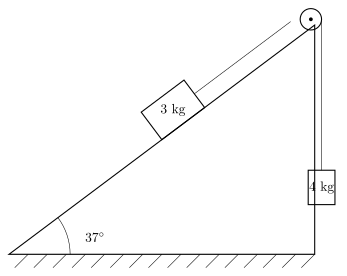
›Reveal solutionSolution
A connected system (block on rough incline + hanging mass over a pulley) is solved with Newton's second law for the system as a whole; the hanging mass wins the tug-of-war and the acceleration comes out to ≈2.28 ms−2.
Concept and Intuition
The string constrains both masses to have the same magnitude of acceleration. To find the direction of motion, we first compare the 'driving' force (weight of the hanging mass) against the 'resisting' forces on the incline (gravity component + friction). Since 40 N>18 N+6 N, the hanging mass falls and the block is dragged up the incline, so friction acts down the incline (opposing relative motion).
Step-by-Step Solution
- Forces on hanging 4 kg mass (taking its falling direction as positive): weight =4×10=40 N downward, tension T upward.
- Forces on the 3 kg block along the incline (block accelerates up the incline): gravity component =3×10×sin37°=3×10×0.6=18 N down the incline; friction f=μN=μmgcos37°=0.25×3×10×0.8=6 N, acting down the incline (opposing the block's upward motion); tension T up the incline.
- Newton's second law for the hanging mass: 40−T=4a.
- Newton's second law for the block: T−18−6=3a.
- Add the two equations to eliminate T: 40−18−6=7a⇒16=7a⇒a=16/7≈2.286 ms−2.
- This rounds to the given option 2.28 ms−2.
Common Mistakes
- Forgetting friction acts opposing relative sliding (i.e., down the incline here, not up).
- Not checking which way the system actually moves before assigning friction's direction.
- Using sin37°=0.6,cos37°=0.8 swapped.
✓Final answerThe correct option is (A) — 2.28 ms−2.
ANSWER: A
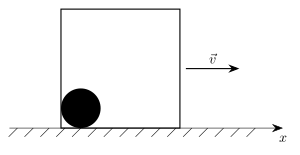
- AP EAPCET 2026Set eng-2026-05-18-FN1 markMCQQ.A solid sphere of mass 2 kg is at rest inside a cube as shown in the figure. [FIGURE] (a cube resting on a horizontal surface, with a solid sphere positioned at its bottom-left inside corner; the cube moves to the right along the x-axis with velocity vector v shown by an arrow) Now the cube moves with a velocity, v=(5ti^+2tj^) ms−1. Here t is time in seconds. If the sphere is at rest with respect to cube, the force exerted by the sphere on the cube is (All surfaces are smooth and take g=10ms−2) (A) 29 N (B) 29 N (C) 26 N (D) 89 N
›Reveal solutionSolution
The sphere accelerates with the cube; applying Newton's second law along both the horizontal (wall-contact) and vertical (floor-contact) directions gives reaction forces of 10 N and 24 N, whose resultant on the cube is 26 N.
Concept and Intuition
Since the sphere is at rest relative to the cube, it must be accelerating with the cube's acceleration in the ground frame. Two contact forces act on the sphere — the normal reaction from the floor (vertical) and from the left wall (horizontal) — and together with gravity they must produce exactly this acceleration. By Newton's third law, the sphere pushes back on the cube's wall and floor with equal and opposite forces; since these two reaction forces are mutually perpendicular (one horizontal, one vertical), their resultant magnitude on the cube is found via Pythagoras.
Step-by-Step Solution
- Cube's velocity: v=(5ti^+2tj^) m/s, so its acceleration a=dtdv=(5i^+2j^) m/s² — constant.
- The sphere (mass m=2 kg) sits in the bottom-left interior corner, touching the floor (vertical normal force N1, upward) and the left wall (horizontal normal force N2, pushing the sphere in +x, away from the wall).
- Since the sphere shares the cube's acceleration, apply Newton's second law componentwise:
- Horizontal (x): N2=max=2×5=10 N.
- Vertical (y): N1−mg=may⇒N1=m(g+ay)=2×(10+2)=24 N.
- By Newton's third law, the sphere exerts a force of magnitude N2=10 N on the wall (directed into the wall, i.e. −x) and a force of magnitude N1=24 N on the floor (directed into the floor, i.e. −y).
- These two reaction forces (on two different, perpendicular surfaces of the cube) combine as a net force on the cube of magnitude N12+N22=242+102=576+100=676=26 N.
Common Mistakes
- Forgetting to add the cube's own acceleration to gravity when computing the vertical normal force (using N1=mg alone).
- Not realizing that "force exerted by the sphere on the cube" is the vector sum (Pythagorean resultant) of the two separate contact reactions, not just one of them.
✓Final answerThe correct option is (C) — 26 N.
ANSWER: C
- AP EAPCET 2026Set ap-2026-05-19-AN1 markMCQQ.A body of mass 5 kg is acted upon by a force Fˉ=(−3i+4j)N. If its initial velocity at t=0 is, uˉ=(6i−12j)ms−1, the time at which it will just have a velocity along the y-axis is (A) Never (B) 10 sec (C) 2 sec (D) 15 sec
›Reveal solutionSolution
The velocity becomes purely along the y-axis when its x-component vanishes; solving vx(t)=0 gives t=10 s.
Concept and Intuition
"Velocity along the y-axis" means the velocity vector has zero x-component (and a non-zero y-component). Since the force is constant, the acceleration is constant, so each velocity component varies linearly with time — we just need to find when the x-component crosses zero.
Step-by-Step Solution
- Acceleration components: a=F/m=5(−3i^+4j^)=(−0.6i^+0.8j^) ms−2.
- Velocity as a function of time: vx(t)=ux+axt=6−0.6t; vy(t)=uy+ayt=−12+0.8t.
- Set vx(t)=0: 6−0.6t=0⟹t=0.66=10 s.
- Check vy(10)=−12+0.8(10)=−4 ms−1=0, confirming the velocity vector is genuinely along the y-axis (not the zero vector) at t=10 s.
Common Mistakes
- Forgetting to check that vy=0 at that instant (otherwise the velocity would be zero, not "along the y-axis").
- Sign errors when dividing the force components by the mass.
✓Final answerThe correct option is (B) — 10 sec.
ANSWER: B
- AP EAPCET 2026Set ap-2026-05-19-AN1 markMCQQ.A body of mass 2kg is at rest. When two forces 3N and 4N act on the body in perpendicular directions simultaneously, magnitude and direction of the resultant acceleration are respectively (A) 2 ms−2, Tan−1(3/4) with 4 N Force (B) 2.5 ms−2, Tan−1(3/4) with 3 N Force (C) 2.5 ms−2, Tan−1(3/4) with 4 N Force (D) 2 ms−2, Tan−1(4/3) with 3 N Force
›Reveal solutionSolution
Two perpendicular forces (3 N, 4 N) combine to a 5 N resultant, giving acceleration 2.5 ms−2 directed at tan−1(3/4) from the 4 N force.
Concept and Intuition
When two forces act perpendicular to each other, they form the two legs of a right triangle, and the resultant is the hypotenuse — a direct application of vector addition (and Newton's second law to get acceleration).
Step-by-Step Solution
- Magnitude of resultant force: F=32+42=9+16=25=5 N.
- Acceleration: a=F/m=5/2=2.5 ms−2.
- Direction: placing the 4 N force along a reference axis, the 3 N force is perpendicular to it. The angle ϕ the resultant makes with the 4 N force satisfies
tanϕ=adjacent (4 N)opposite (3 N)=43⟹ϕ=tan−1(3/4)
(Measuring the angle relative to the 3 N force instead would give tan−1(4/3), a different value — so the reference force matters.)
Common Mistakes
- Swapping which force is used as the reference axis, mixing up tan−1(3/4) with tan−1(4/3).
- Forgetting to divide the resultant force by mass to get acceleration.
✓Final answerThe correct option is (C) — 2.5 ms−2, Tan−1(3/4) with 4 N Force.
ANSWER: C
- AP EAPCET 2025Set eng-2025-05-21-AN1 markMCQQ.A body of mass 5 kg starts from the origin with an initial velocity (30i^+40j^) ms−1. If a constant force −(i^+5j^) N acts on the body, then the time in which the y-component of its velocity becomes zero is (A) 5 s (B) 20 s (C) 40 s (D) 80 s
›Reveal solutionSolution
With constant force −(i^+5j^) N on a 5 kg body, the y-acceleration is −1 ms−2; starting from vy=40 ms−1, it takes (C) 40 s to reach zero.
Concept and Intuition
Since force, mass, and initial velocity are all given in component form, we can treat the x- and y-motions completely independently (Newton's second law applies component-wise). We only need the y-component of the force and initial velocity to find when vy becomes zero — the x-motion is irrelevant to this question.
Step-by-Step Solution
- Given: m=5 kg, u=(30i^+40j^) ms−1, F=−(i^+5j^) N.
- Acceleration: a=F/m=5−(1,5)=(−0.2,−1) ms−2.
- So ay=−1 ms−2, constant.
- y-velocity as a function of time: vy(t)=uy+ayt=40−t.
- Set vy(t)=0: 40−t=0 ⇒ t=40 s.
Common Mistakes
- Using the x-component of force/velocity by mistake instead of the y-component.
- Forgetting to divide the force by mass to get acceleration before using v=u+at.
- Sign errors on the force direction (the force is −j^ direction in the y-component, which correctly decelerates the positive uy=40).
✓Final answerThe correct option is (C) — 40 s.
ANSWER: C
- AP EAPCET 2025Set ap-2025-05-19-AN1 markMCQQ.Two blocks of masses 8 kg and 12 kg kept on smooth horizontal table are connected to the ends of a light string as shown in the figure. If a horizontal force of 500 N is applied to the block of mass 12 kg, then the tension in the string connecting the blocks is [FIGURE] (two blocks, 8 kg and 12 kg, resting on a horizontal table and joined by a string; a horizontal force of 500 N is applied to the 12 kg block, pulling it away from the 8 kg block) (A) 200 N (B) 300 N (C) 500 N (D) 250 N
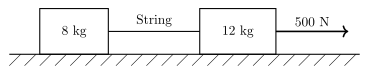
›Reveal solutionSolution
The two blocks accelerate together under the 500 N force; applying Newton’s second law to the whole system gives the acceleration, and then isolating the 8 kg block yields the tension. The tension is 200 N, so option (A) is correct.
Why this approach works
When two objects are connected by a light, inextensible string on a smooth (frictionless) table, they must move with the same acceleration. The string is “light” — its mass is negligible — so the tension is the same at both ends.
Newton’s second law, Fnet=ma, can be applied in two powerful ways:
- To the whole system – this gives the common acceleration directly, because the tension is an internal force and cancels out.
- To just one block – this lets us solve for the tension, since we already know the acceleration.
The key insight: the tension is not the applied force; it is only the force needed to accelerate the 8 kg block at the same rate as the whole system.
Step‑by‑step solution
1. Find the acceleration of the whole system
The total mass being pulled is
mtotal=8 kg+12 kg=20 kg.
The only external horizontal force on the system is the 500 N pull (the string tension is internal, so it does not appear in the system‑level equation).
Applying Newton’s second law to the whole system:
Fnet=mtotala⇒500 N=20 kg×a.
Thus
a=20500=25 m/s2.
TipBecause the table is smooth, there is no friction to subtract. If friction were present, we would need to subtract the total friction from 500 N first.
2. Isolate the 8 kg block to find tension
Now look only at the 8 kg block. The only horizontal force acting on it is the tension T in the string, pulling it to the right.
Since it accelerates at a=25 m/s2 (same as the whole system), Newton’s second law gives:
T=m1a=8 kg×25 m/s2=200 N.
Watch outA common mistake is to think the tension equals the applied force (500 N). That would only happen if the 8 kg block were fixed or if the string were not accelerating the 12 kg block. Here, part of the 500 N is used to accelerate the 12 kg block itself, so the tension is smaller.
3. (Optional) Check with the 12 kg block
For completeness, apply Newton’s second law to the 12 kg block. The forces on it are:
- 500 N to the right (applied),
- Tension T to the left (from the string).
Net force:
500−T=m2a=12×25=300 N.
So 500−T=300 gives T=200 N, confirming our result.
✓Final answerThe correct option is (A).
ANSWER: A
- AP EAPCET 2025Set ap-2025-05-19-AN1 markMCQQ.A force of 18 N is acting in the direction of motion of a body of mass 3 kg moving with a velocity of 2 m s−1. The velocity of the body when it displaces by 5 m is (A) 4 m s−1 (B) 6 m s−1 (C) 10 m s−1 (D) 8 m s−1
›Reveal solutionSolution
This tests the work-energy/kinematics relation for a body under constant force over a given displacement. The answer is (D) 8 m s−1.
Concept and Intuition
A constant force acting in the direction of motion produces constant acceleration (Newton's second law), and once we know that acceleration, the standard kinematic relation connecting velocity and displacement (which doesn't require knowing time) directly gives the final speed after a given displacement.
Step-by-Step Solution
- Acceleration from the applied force: a=F/m=18/3=6 m/s2.
- Initial velocity: u=2 m/s; displacement: s=5 m.
- Apply v2=u2+2as=(2)2+2(6)(5)=4+60=64.
- So v=64=8 m/s.
Common Mistakes
- Forgetting to square the initial velocity or mis-applying the kinematic equation (e.g., using v=u+at without first finding t, which is unnecessary extra work but should still give the same answer if done correctly).
✓Final answerThe correct option is (D) — 8 m s−1.
ANSWER: D
- AP EAPCET 2025Set ap-2025-05-20-AN1 markMCQQ.A force of 10 N acts on a body of mass 2 kg in the direction of motion of the body. If the velocity of the body at a time t = 0 is 13 m s−1, then the velocity of the body at time t = 3s is (A) 20 m s−1 (B) 24 m s−1 (C) 28 m s−1 (D) 32 m s−1
›Reveal solutionSolution
A constant force along the direction of motion produces a constant acceleration; applying v=v0+at with a=5m/s2 gives 28m/s at t=3s.
Concept and Intuition
Since the applied force acts in the same direction as the body's motion, it simply produces a constant acceleration in that same direction (no need to worry about direction reversal or components). This is a direct application of Newton's second law followed by the first equation of motion.
Step-by-Step Solution
- Compute acceleration: a=mF=2kg10N=5 ms−2.
- Apply the kinematic equation: v=v0+at.
- Substitute: v=13+5×3=13+15=28 ms−1.
Common Mistakes
- Forgetting that the force is along the direction of motion (so it simply adds to speed, no vector decomposition needed) and making an arithmetic slip in 5×3.
✓Final answerThe correct option is (C) — 28 ms−1.
ANSWER: C
- AP EAPCET 2025Set ap-2025-05-20-FN1 markMCQQ.The minimum force required to stop a body of mass 4 kg moving along a straight line with a velocity of 54 kmph in a distance of 9 m is (A) 75 N (B) 100 N (C) 50 N (D) 25 N
›Reveal solutionSolution
Using v2=u2−2as to find the deceleration and then F=ma gives the stopping force as 50 N.
Concept and Intuition
A force applied opposite to motion decelerates a body uniformly (constant force ⇒ constant deceleration). Kinematics gives the deceleration needed to stop the body over the given distance, and Newton's second law converts that deceleration into the required force.
Step-by-Step Solution
- Convert the initial speed: u=54 kmph=54×185=15 ms−1.
- Final speed v=0 (body stops), distance s=9 m.
- Use v2=u2−2as:
0=152−2a(9)⟹2a(9)=225⟹a=18225=12.5 ms−2
- Apply Newton's second law: F=ma=4×12.5=50 N.
Common Mistakes
- Forgetting to convert kmph to m/s before using the kinematic equation.
- Sign errors: since the body decelerates, a in v2=u2−2as should be treated as a deceleration (subtracted), which is exactly what was done above.
✓Final answerThe correct option is (C) — 50 N.
ANSWER: C
🎓Unlock everything free for 14 days
- ✓Full step-by-step solutions
- ✓Concept-first explanations
- ✓Methods, shortcuts & mistakes
- ✓PYQ mapping + timed mock tests
Full access for 14 days. No credit card required.