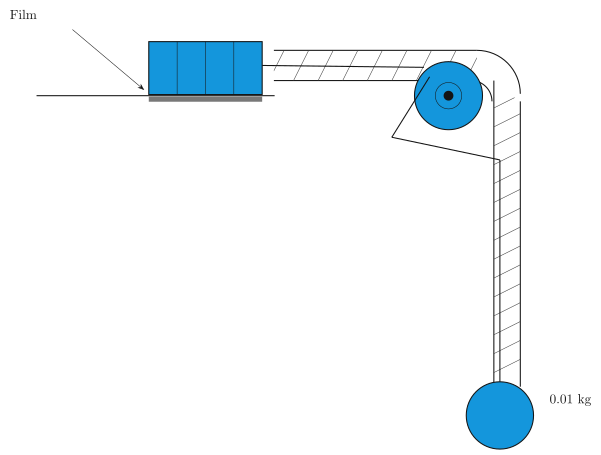
Q.A metal block of area 0.10 m2 is connected to a 0.010 kg mass via a string that passes over an ideal pulley (considered massless and frictionless). A liquid with a film thickness of 0.30 mm is placed between the block and the table. When released the block moves to the right with a constant speed of 0.085 m s−1. Find the coefficient of viscosity of the liquid.
🔒You're viewing a preview — the full solution, concept, methods & PYQ mapping are locked.
🔒 Start your 14-day free trial to unlock the full solution →Concept understanding — Viscous Force Balance
Viscous Force Balance: From Intuition to Precision
Imagine you're pushing a heavy box across a rough floor. The harder you push, the faster it moves — but there's a constant resistance from the floor trying to slow it down. If you push with a steady force, the box eventually moves at a constant speed. At that moment, your pushing force exactly equals the friction force. The box is in force balance.
Now replace the box with a tiny sphere falling through honey. The honey resists the motion — that resistance is a viscous force. As the sphere speeds up, the viscous force grows. Eventually, it becomes large enough to exactly balance the weight pulling the sphere down. The sphere then falls at a constant speed (terminal velocity). That's viscous force balance in action.
The Core Idea
Viscous force balance occurs when the net viscous (drag) force on an object moving through a fluid exactly cancels all other forces acting on it, resulting in zero net force and therefore constant velocity (no acceleration).
This is just Newton's first law applied to a fluid environment: if the sum of forces is zero, the object moves with constant velocity — it doesn't speed up or slow down.
The Precise Statement
For an object moving through a viscous fluid, the equation of motion is:
mdtdv=Fother−Fviscous
where:
- Fother is the sum of all non-viscous forces (gravity, buoyancy, applied forces, etc.)
- Fviscous is the drag force from the fluid
Viscous force balance is the condition:
Fviscous=Fother
which gives dtdv=0, i.e., constant velocity.
The Two Common Forms of Viscous Force
The exact expression for Fviscous depends on the flow regime:
| Regime | Viscous Force Formula | When It Applies |
|---|---|---|
| Stokes' law (low speed, small object) | F=6πηrv | Slow, streamlined flow (low Reynolds number) |
| Quadratic drag (high speed) | F=21CdρAv2 | Turbulent flow (high Reynolds number) |
Here η is fluid viscosity, r is object radius, ρ is fluid density, A is cross-sectional area, Cd is drag coefficient.
A Concrete Example: The Falling Sphere
Consider a sphere of mass m and radius r falling through a viscous fluid of density ρf. The forces are:
- Weight downward: mg
- Buoyancy upward: 34πr3ρfg
- Viscous drag upward (Stokes' law): 6πηrv
The net downward force is:
Fnet=mg−34πr3ρfg−6πηrv
At balance, Fnet=0, so:
mg−34πr3ρfg=6πηrv
Solving for the terminal velocity:
vt=6πηrmg−34πr3ρfg
The numerator is the effective weight (true weight minus buoyancy). The denominator is the viscous resistance coefficient. Terminal velocity is reached when these balance.
Why This Matters
Viscous force balance is not just a textbook concept — it's the principle behind:
- Sedimentation: particles settling in a liquid (used in water treatment, blood tests) …
Concept: Viscous Force Balance — at constant speed, the viscous drag on the block equals the weight of the hanging mass.
Step 1: Identify the forces.
The hanging mass m=0.010 kg provides a tension T=mg. Since the pulley is ideal and the block moves at constant speed (zero acceleration), the tension equals the viscous force F on the block.
Step 2: Write the viscous force formula.
For a thin film of liquid between two parallel surfaces,
F=ηAdv
where A=0.10 m2, v=0.085 m/s, and d=0.30 mm=3.0×10⁻⁴ m.
Step 3: Equate and solve for η. …
The weight of the hanging mass is transmitted as the viscous drag across the thin film. Using F=ηAhv, the coefficient of viscosity is η≈3.46×10⁻³ Pa⋅s.
The block moves at constant speed, so the net force on it is zero: the string tension (equal to the weight of the hanging mass) is exactly balanced by the viscous drag of the liquid film beneath the block. For a thin film confined between a moving surface and a stationary one, the velocity gradient is uniform, so Newton's law of viscosity applies directly.
Driving force. The tension equals the weight of the mass (ideal pulley, no acceleration):
F=mg=(0.010)(9.8)=0.098 N
Newton's law of viscosity. For a film of thickness h sheared at speed v over contact area A:
F=ηAhv⇒η=AvFh …
Constant speed: T=mg=viscous force. Thin-film: F=etaAv/d. eta=mgd/(Av)=(0.010*9. …
Showing the 12 most recent of 19 on this concept.
- AP EAPCET 2026Set eng-2026-05-12-AN1 markMCQQ.A bubble rises in a viscous liquid. If radius of bubble doubles, terminal velocity becomes (A) Double (B) Four times (C) Half (D) Same
›Reveal solutionSolution
Terminal velocity in Stokes' regime scales as r2, so doubling the bubble's radius quadruples its terminal (rise) velocity.
Concept and Intuition
A bubble rising through a viscous liquid reaches terminal velocity when the net upward buoyant force balances the downward viscous drag (given by Stokes' law, F=6πηrv). Balancing these forces shows the terminal speed depends on the square of the radius, because the buoyant/weight-difference force scales with volume (r3) while drag scales with r (at fixed v) — the ratio gives vt∝r2.
Step-by-Step Solution
- At terminal velocity, net force = 0: buoyant force (upward, on the lighter bubble in the denser liquid) equals viscous drag.
- 34πr3(ρliquid−ρgas)g=6πηrvt.
- Solve for vt: vt=9η2r2(ρliquid−ρgas)g.
- All quantities except r are unchanged, so vt∝r2. …
- AP EAPCET 2026Set eng-2026-05-14-AN1 markMCQQ.A small sphere of radius 'r' is dropped in a viscous liquid. When it is moving with terminal velocity in the liquid, the relation between the rate of heat produced (dtdQ) and 'r' is (A) dtdQ∝r2 (B) dtdQ∝r5 (C) dtdQ∝r21 (D) dtdQ∝r51
›Reveal solutionSolution
At terminal velocity, all the gravitational PE lost is converted to heat via viscous drag; combining vt∝r2 (Stokes' law) with the r3-scaling effective weight gives dtdQ∝r5.
Concept and Intuition
At terminal velocity, the sphere moves at constant speed, so its kinetic energy doesn't change — all the gravitational potential energy it loses per second is dissipated as heat by the viscous drag force. The rate of heat production is therefore just the power delivered by gravity (net of buoyancy), i.e., force times velocity, both of which have their own dependence on the sphere's radius.
Step-by-Step Solution
- At terminal velocity, net force = 0: weight = buoyant force + viscous drag. 34πr3ρg=34πr3σg+6πηrvt where ρ = density of sphere, σ = density of liquid.
- This gives vt∝r3/r=r2 (Stokes' law result: vt=9η2r2(ρ−σ)g).
- The viscous drag force at terminal velocity equals the effective weight (weight − buoyancy), which is proportional to the sphere's volume, i.e., Fvisc∝r3. …
- AP EAPCET 2026Set ap-2026-05-19-AN1 markMCQQ.An air bubble of radius 0.5 mm rises in a long vertical column of liquid of coefficient of viscosity 0.2 N s m−2 and density 900 kg m−3. If the density of air is neglected, then the terminal velocity of the air bubble is (Acceleration due to gravity = 10 m s−2) (A) 2.5 mm s−1 (B) 5 mm s−1 (C) 3.5 mm s−1 (D) 7 mm s−1
›Reveal solutionSolution
Applying Stokes' law terminal-velocity formula (with air's density neglected) gives a bubble rise speed of 2.5 mm/s.
Concept and Intuition
An air bubble rising through a viscous liquid experiences an upward net buoyant force (because it's much less dense than the surrounding fluid) balanced by a downward viscous drag (Stokes' drag, proportional to velocity) once it reaches terminal velocity. The magnitude of this terminal velocity has the same form as for a sinking dense sphere, but driven by the density difference (ρliquid−ρbubble)≈ρliquid since the bubble's own density is negligible.
Step-by-Step Solution
- Stokes' terminal velocity formula: v=9η2r2g(ρliquid−ρair). Since ρair≈0 is neglected, this simplifies to v=9η2r2gρliquid.
- Convert radius: r=0.5 mm=5×10⁻⁴ m, so r2=2.5×10⁻⁷ m2.
- Substitute values (g=10 ms−2, ρliquid=900 kgm−3, η=0.2 Nsm−2): …
- AP EAPCET 2026Set ap-2026-05-20-FN1 markMCQQ.Two drops of same radius are falling through air with steady velocity of 5cms−1. If the two drops coalesce, the terminal velocity would be (A) 10cms−1 (B) 5×41/3cms−1 (C) 5×42/3cms−1 (D) 2.5cms−1
›Reveal solutionSolution
Using vt∝r2 and conservation of volume when two drops merge, the new terminal velocity is 5×41/3cm/s.
Concept and Intuition
A small sphere falling through a viscous fluid (Stokes' law regime) reaches a terminal velocity vt=9η2r2(ρ−σ)g∝r2. When two identical drops coalesce, mass (and hence volume, since density is unchanged) is conserved, which fixes the new radius, and from there the new terminal velocity follows via the r2 scaling.
Step-by-Step Solution
- Volume conservation: 34πR3=2×34πr3⇒R3=2r3⇒R=r⋅21/3.
- Terminal velocity scaling: vt∝r2, so vtV=(rR)2=(21/3)2=22/3. …
- AP EAPCET 2025Set eng-2025-05-21-FN1 markMCQQ.If water flows with a velocity of 20 cms−1 in a pipe of radius 2 cm, then the flow is (The coefficient of viscosity of water is 10−3 kgm−1s−1 and density of water is 103 kgm−3) (A) turbulant (B) steady flow (C) non-viscous (D) unsteady
›Reveal solutionSolution
Computing the Reynolds number for water flowing through a pipe shows Re≈8000, far above the critical range, so the flow is turbulent.
Concept and Intuition
Whether a flow is smooth (streamline/laminar) or chaotic (turbulent) is determined by the dimensionless Reynolds number Re=ηρvD, which compares inertial forces to viscous forces. Below roughly 1000–2000 the flow stays laminar; well above it, turbulence sets in.
Step-by-Step Solution
- Given v=20 cms−1=0.2 ms−1, radius =2 cm so diameter D=4 cm=0.04 m.
- η=10−3 kgm−1s−1, ρ=103 kgm−3.
- Re=ηρvD=10−3103×0.2×0.04=10−38=8000. …
- AP EAPCET 2025Set ap-2025-05-19-AN1 markMCQQ.A small solid sphere of mass 10 g and density 2600 kg m−3 is dropped into a long vertical column of glycerine. When the sphere attains terminal velocity, the magnitude of the viscous force acting on the sphere is (Acceleration due to gravity = 10 m s−2 and density of glycerine = 1300 kg m−3) (A) 20×10−3 N (B) 25×10−3 N (C) 75×10−3 N (D) 50×10−3 N
›Reveal solutionSolution
At terminal velocity, the net force is zero, so the viscous drag exactly balances the sphere's effective weight (weight minus buoyant upthrust) — giving 50×10−3 N.
Concept and Intuition
When a sphere falls through a viscous fluid, three forces act on it: gravity (down), buoyancy (up), and viscous drag (up, opposing motion, growing with speed). At terminal velocity the sphere no longer accelerates, so these three forces balance: Fv+Fbuoyancy=mg, i.e. Fv=mg−Fbuoyancy.
Step-by-Step Solution
- Mass of sphere m=10 g=0.01 kg; weight mg=0.01×10=0.1 N.
- Buoyant force =ρfluidVg=ρsphereρfluid×mg (since V=m/ρsphere). …
- AP EAPCET 2025Set ap-2025-05-20-FN1 markMCQQ.If two rain drops of radii r1 and r2 reach the ground with terminal velocities v1 and v2 and linear momenta p and 32p respectively, then r1:r2= (A) 1 : 16 (B) 1 : 2 (C) 2 : 1 (D) 16 : 1
›Reveal solutionSolution
Since terminal velocity scales as r2 and mass as r3, momentum scales as r5; matching the given momentum ratio of 1:32=1:25 gives r1:r2=1:2.
Concept and Intuition
A falling raindrop reaches terminal velocity when viscous drag (Stokes' law, ∝r) balances the net downward weight (buoyancy-corrected gravity, ∝r3), giving vt∝r2. Combined with mass m∝r3 (constant density), the momentum p=mvt scales as r5 — a strong dependence on radius that makes ratios of momentum a sensitive probe of the ratio of radii.
Step-by-Step Solution
- Terminal velocity: vt∝r2 (from balancing Stokes drag against effective weight).
- Mass: m∝r3 (density constant, volume ∝r3).
- Momentum: p=mvt∝r3×r2=r5.
- Given p1:p2=p:32p=1:32=1:25. …
- AP EAPCET 2024Set eng-2024-05-21-AN1 markMCQQ.A spherical ball of radius 1×10⁻⁴ m and of density 104 kgm−3 falls freely under gravity through a distance 'h' before entering a tank of water. After entering water if the velocity of the ball does not change, then 'h' is (The coefficient of viscosity of water 9.8×10⁻⁶ Nsm−2) (A) 20.4 cm (B) 20.4 mm (C) 20.4 m (D) 10.2 m
›Reveal solutionSolution
"Velocity unchanged on entry" means the free-fall speed already equals the water's terminal velocity; computing that terminal velocity and inverting v2=2gh gives h≈20.4 m.
Concept and Intuition
A small sphere falling through a viscous fluid speeds up only until viscous drag balances the net weight (weight minus buoyancy) — beyond that it moves at a constant "terminal velocity." The problem tells us the ball enters the water already moving at exactly this terminal speed (since its velocity doesn't change on entry), so the free-fall height before entering water must be exactly what's needed to reach that speed under gravity alone.
Step-by-Step Solution
- Terminal velocity (Stokes' law): vt=9η2r2(ρ−σ)g, with r=1×10⁻⁴ m, ρ=104 kgm−3, σ=1000 kgm−3 (water), η=9.8×10⁻⁶ Nsm−2, g=9.8 ms−2.
- Numerator: 2×(1×10−4)2×9000×9.8=2×10−8×9000×9.8=1.764×10⁻³.
- Denominator: 9×9.8×10−6=8.82×10⁻⁵. …
- AP EAPCET 2023Set ap-2023-05-23-FN1 markMCQQ.A liquid of density of 3000 kg m−3 and coefficient of viscosity 0.1 Pas flows through a pipe with diameter 0.05 m with a velocity of 0.2 ms−1. The Reynolds number of the fluid is (A) 300 (B) 400 (C) 500 (D) 600
›Reveal solutionSolution
Direct substitution into the Reynolds number formula gives Re=300. Answer: (A).
Concept and Intuition
The Reynolds number is a dimensionless quantity that predicts whether fluid flow will be laminar or turbulent, defined as the ratio of inertial forces to viscous forces in the flow: Re=ηρvD, where ρ is fluid density, v is flow speed, D is the pipe diameter, and η is the coefficient of viscosity.
Step-by-Step Solution
- Given: ρ=3000 kgm−3, η=0.1 Pas, D=0.05 m, v=0.2 ms−1.
- Compute numerator: ρvD=3000×0.2×0.05=30. …
- AP EAPCET 2023Set eng-2023-05-17-AN1 markMCQQ.A steel ball of radius 0.05 cm and density 7.8 gcm−3 is dropped into a tank of water. The terminal velocity of the steel ball is (Density of water = 1 gcm−3 and viscosity of water = 0.001 Pa s) (A) 3.42 ms−1 (B) 1.81 ms−1 (C) 5.11 ms−1 (D) 3.77 ms−1
›Reveal solutionSolution
Stokes' law gives the terminal velocity of a small sphere falling through a viscous fluid; plugging in the given numbers yields ≈3.77 m/s.
Concept and Intuition
A small sphere falling through a viscous fluid quickly reaches a terminal (constant) velocity once the upward viscous drag (Stokes' force 6πηrv) plus buoyancy exactly balance the downward weight. Solving that balance for v gives Stokes' terminal-velocity formula, which depends on the square of the radius (small spheres reach terminal velocity fast and at low speed) and linearly on the density difference between the sphere and the fluid.
Step-by-Step Solution
- Stokes' terminal velocity formula: v=9η2r2(ρ−σ)g, where ρ = density of the ball, σ = density of the fluid.
- Convert given values to SI: r=0.05 cm=5×10⁻⁴ m, so r2=2.5×10⁻⁷ m2; ρ=7800 kg/m3, σ=1000 kg/m3, so ρ−σ=6800 kg/m3; η=0.001 Pa⋅s; g=10 m/s2. …
- AP EAPCET 2022Set ap-2022-07-12-AN1 markMCQQ.Two capillary tubes A and B are connected in series. The length and radius of the bore of tube A are twice those of tube B. The ratio of the pressure difference across the tubes A and B is (A) 8:1 (B) 1:8 (C) 4:1 (D) 1:4
›Reveal solutionSolution
In series flow, the same volume flow rate Q passes through both capillaries, so the pressure drop across each follows Poiseuille's law: ΔP∝L/r4.
Concept and Intuition
Poiseuille's law for laminar flow through a capillary states Q=8ηLπΔPr4, i.e. ΔP=πr48ηLQ. When two capillaries are connected in series, the same liquid (same η) flows through both at the same rate Q, so the pressure drop across each tube is proportional to L/r4.
Step-by-Step Solution
- ΔP∝r4L for fixed Q and η. …
- AP EAPCET 2022Set eng-2022-07-05-AN1 markMCQQ.An object of mass 10 kg is released from rest in a liquid. If the object moves a distance of 2 m while sinking in time duration of 1 s, then the mass of the liquid displaced by the submerged object is (Acceleration due to gravity = 10 ms−2) (A) 5 kg (B) 6 kg (C) 3 kg (D) 4 kg
›Reveal solutionSolution
Find the net downward acceleration from the given kinematics, then use Newton's second law (weight minus buoyant force) to find the mass of displaced liquid.
Concept and Intuition
As the object sinks, two forces act (ignoring viscous drag, which the problem implies by giving constant acceleration): gravity pulling down, and the buoyant force (weight of displaced liquid) pushing up. From the observed uniformly accelerated motion, we can back out the net acceleration and hence the buoyant force.
Step-by-Step Solution
- The object starts from rest and covers s=2m in t=1s, so using s=21at2: 2=21a(1)2⇒a=4m/s2.
- Newton's second law (downward positive): mg−Fbuoyant=ma.
- Fbuoyant=m(g−a)=10(10−4)=60N. …
🎓Unlock everything free for 14 days
- ✓Full step-by-step solutions
- ✓Concept-first explanations
- ✓Methods, shortcuts & mistakes
- ✓PYQ mapping + timed mock tests
Full access for 14 days. No credit card required.