Q.The cylindrical tube of a spray pump has a cross-section of 8.0 cm2 one end of which has 40 fine holes each of diameter 1.0 mm. If the liquid flow inside the tube is 1.5 m min−1, what is the speed of ejection of the liquid through the holes?
🔒You're viewing a preview — the full solution, concept, methods & PYQ mapping are locked.
🔒 Start your 14-day free trial to unlock the full solution →Concept understanding — Equation of Continuity
The Intuition: Why a River Speeds Up in a Narrow Stretch
Imagine you're standing on a bridge watching a river. The river is wide and slow-moving upstream. Then it passes through a narrow gorge — suddenly the water races through, fast and turbulent. Yet the same amount of water must pass every point every second. Water can't pile up or vanish.
That's the core idea: what flows in must flow out. If the pipe (or river) gets narrower, the fluid must move faster to get the same volume through in the same time. If it widens, the fluid slows down.
This is not a guess — it's a direct consequence of mass being conserved. Fluid cannot be created or destroyed inside a pipe (assuming no leaks). So the mass that enters a section per second must equal the mass that leaves it per second.
The Precise Statement
For a fluid flowing steadily through a pipe of varying cross-section, the product of cross-sectional area and flow speed is constant at every point along the pipe.
A1v1=A2v2
Where:
- A = cross-sectional area of the pipe (in m2)
- v = flow speed of the fluid (in m/s)
The product Av is called the volume flow rate (or discharge), often denoted Q. Its SI unit is m3/s.
Why It Works: The Derivation in One Minute
Consider a pipe with cross-sectional area A. In a small time Δt, a fluid particle moves a distance vΔt. The volume of fluid that crosses the section in that time is:
Volume=A×(vΔt)
So the volume flow rate is:
Q=ΔtVolume=Av
Now take two different cross-sections (1 and 2) along the same pipe. If the fluid is incompressible (density constant) and no fluid is added or removed between them, the volume entering section 1 per second must equal the volume leaving section 2 per second:
A1v1=A2v2
That's it. The equation is a direct statement of conservation of mass for an incompressible fluid.
The equation of continuity assumes:
- Steady flow — velocity at any point doesn't change with time.
- Incompressible fluid — density is constant (true for liquids; approximate for gases at low speeds).
- No sources or sinks — no fluid is added or removed between sections.
What It Tells You (and What It Doesn't)
It tells you: If you know the area and speed at one point, you can find the speed at any other point. A garden hose with a nozzle: wide at the tap (A1 large, v1 small), narrow at the nozzle (A2 small, v2 large). That's why water shoots out fast when you cover part of the opening with your thumb.
It does NOT tell you: Why the fluid speeds up or slows down. That's the job of Bernoulli's equation, which relates speed to pressure. The continuity equation is purely geometric — it's about how much fluid must move, not about the forces that make it move.
A Common Mistake to Avoid
Students often think that if the pipe narrows, the fluid must speed up because "pressure pushes it harder." That's backwards. The continuity equation says the speed must increase to conserve mass. The pressure drop (which Bernoulli explains) is a consequence of that speed increase, not its cause.
Quick Example …
Concept: Equation of Continuity — for an incompressible fluid, A1v1=A2v2.
Step 1 — Area of the tube
A1=8.0 cm2=8.0×10⁻⁴ m2
Speed inside tube: v1=1.5 m min−1=601.5 m s−1=0.025 m s−1
Step 2 — Total area of the holes
Each hole diameter =1.0 mm=1.0×10⁻³ m, so radius r=0.5×10⁻³ m.
Area of one hole =πr2=π(0.5×10⁻³)2=π×0.25×10⁻⁶ m2
Total area for 40 holes: A2=40×π×0.25×10−6=10π×10−6 m2=π×10−5 m2
Step 3 — Apply continuity …
The key idea is the equation of continuity — the volume flow rate through the tube equals the total volume flow rate through all the holes. Using A1v1=A2v2 (with A2 being the total area of 40 holes), the ejection speed comes out to 0.637 m/s.
The equation of continuity is simply a statement of conservation of mass for an incompressible fluid: what flows in must flow out. For a pipe that branches into many small openings, the total cross-sectional area times speed stays constant. Here, the liquid moves slowly inside the wide tube but must speed up dramatically when forced through the tiny holes.
Let’s work it out step by step.
- Find the area of the tube. The tube’s cross-section is given directly:
A1=8.0 cm2=8.0×10⁻⁴ m2
- Find the area of one hole. Each hole has diameter 1.0 mm=1.0×10⁻³ m, so radius r=0.5×10⁻³ m. Area of one hole:
Ahole=πr2=π(0.5×10⁻³)2=π×0.25×10−6=7.854×10⁻⁷ m2
- Total area of all 40 holes.
A2=40×Ahole=40×7.854×10−7=3.1416×10⁻⁵ m2
- Convert the tube speed to SI units. The liquid flows inside the tube at 1.5 m/min. Since 1 min=60 s:
v1=601.5=0.025 m/s
- Apply the equation of continuity. For an incompressible fluid:
A1v1=A2v2
where v2 is the ejection speed through the holes.
v2=A2A1v1=3.1416×10⁻⁵(8.0×10−4)×0.025
Compute the numerator: …
A1=8.0e-4 m^2, v1=1.5/60=0.025 m/s. A2=40pi(5e-4)^2=pi1e-5 m^2. Continuity: v2=A1v1/ …
- AP EAPCET 2025Set ap-2025-05-20-AN1 markMCQQ.An incompressible fluid is flowing through a horizontal Y-shaped tube as shown in the figure. The velocity(v) of the fluid in the tube of area of cross-section 1.5A m2 is [FIGURE] (a horizontal Y-shaped tube: the main branch has cross-sectional area A m2 with fluid velocity v1=3 m s−1; it splits into two branches — one of area A m2 with velocity v2=1.5 m s−1, and the other of area 1.5A m2 with velocity v) (A) 3 m s−1 (B) 1.5 m s−1 (C) 2.25 m s−1 (D) 1 m s−1
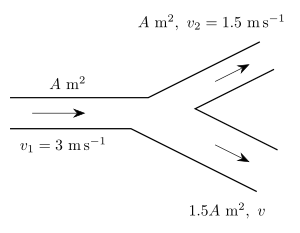
›Reveal solutionSolution
Applying the equation of continuity at the Y-junction (incoming volume flow rate = sum of the two outgoing flow rates) gives v=1 m/s in the 1.5A branch.
Concept and Intuition
For an incompressible fluid, the total volume flow rate into any junction must equal the total volume flow rate out of it (conservation of mass, equation of continuity: ∑Ainvin=∑Aoutvout). Here, the single incoming stem of area A with speed v1 splits into two outgoing branches — one of area A with speed v2, and one of area 1.5A with the unknown speed v.
Step-by-Step Solution
- Write the continuity equation: Av1=Av2+(1.5A)v.
- Substitute known values (v1=3m/s, v2=1.5m/s): A(3)=A(1.5)+1.5Av. …
- AP EAPCET 2024Set eng-2024-05-20-FN1 markMCQQ.The radius of cross-section of the cylindrical tube of a spray pump is 2 cm. One end of the pump has 50 fine holes each of radius 0.4 mm. If the speed of flow of the liquid inside the tube is 0.04 ms−1, the speed of ejection of the liquid from the holes is (A) 6 ms−1 (B) 2 ms−1 (C) 4 ms−1 (D) 3 ms−1
›Reveal solutionSolution
The equation of continuity (conservation of volume flow rate) links the single tube's cross-section and speed to the combined area of the 50 holes and their ejection speed. The result is 2 ms−1.
Concept and Intuition
For an incompressible fluid in steady flow, the volume flow rate must be the same everywhere along the flow path. Since the flow splits into 50 identical holes at the exit, the tube's flow rate must equal the sum of the flow rates through all 50 holes.
Step-by-Step Solution
- Tube radius R=2 cm =0.02 m, so Atube=πR2=π(0.02)2=4π×10−4 m2.
- Each hole radius r=0.4 mm =4×10⁻⁴ m, so Ahole=πr2=π(4×10⁻⁴)2=16π×10−8 m2.
- Total hole area: 50Ahole=800π×10−8=8π×10−6 m2. …
- AP EAPCET 2024Set eng-2024-05-21-FN1 markMCQQ.A large tank filled with water to a height 'h' is to be emptied through a small hole at the bottom. The ratio of the time taken for the level to fall from 'h' to 2h and that taken for the level to fall from 2h to '0' is (A) 2−1 (B) 21 (C) 2 (D) 2−11
›Reveal solutionSolution
Integrating Torricelli's draining-tank law and comparing the two time intervals gives the ratio 2−1.
Concept and Intuition
As a tank drains through a small hole, the exit speed (and hence the rate of fall of the level) is proportional to h (Torricelli's law), so the level falls slower as h decreases. This means it takes progressively less time to drain each successive equal-height layer of water — quite counter to naive intuition that a slower-emptying tank should take more time near the bottom, but the volume being drained also shrinks.
Step-by-Step Solution
- Torricelli's law gives dtdh=−kh for a constant k depending on the hole/tank geometry.
- Separating variables and integrating from h1 to h2: ∫h1h2hdh=−k∫0tdt⇒t=k2(h1−h2).
- Time to fall from h to h/2: t1=k2(h−h/2). …
- AP EAPCET 2023Set ap-2023-05-22-AN1 markMCQQ.A fluid flows through a pipe of diameter 5 cm with a velocity 2 ms−1. If the pipe is constricted to a diameter of 3 cm, the velocity of fluid at the constriction is (A) 4.55 ms−1 (B) 3.55 ms−1 (C) 2.55 ms−1 (D) 5.55 ms−1
›Reveal solutionSolution
Mass conservation for an incompressible fluid means A1v1=A2v2; using A∝d2 gives v2≈5.55 m/s.
Concept and Intuition
For a fluid flowing steadily through a pipe of changing cross-section, mass conservation demands the volume flow rate stays constant: A1v1=A2v2 (the equation of continuity). A narrower pipe (smaller area) must therefore carry a faster stream.
Step-by-Step Solution
- Area A=4πd2, so A∝d2; the equation of continuity becomes d12v1=d22v2.
- v2=v1(d2d1)2=2(35)2. …
- AP EAPCET 2023Set eng-2023-05-17-FN1 markMCQQ.A large open top water tank is completely filled with water. A small hole of diameter 4 mm is made 10 m below the water level. The flow rate of water through the hole is (Acceleration due to gravity =10 ms−2) (A) 14.14×10⁻⁶ m3s−1 (B) 2.1×10⁻⁶ m3s−1 (C) 1.77×10⁻⁶ m3s−1 (D) 0.177×10⁻⁶ m3s−1
›Reveal solutionSolution
v=2gh=14.14 m/s and Q=Av≈1.77×10⁻⁴ m3/s, matching the 1.77 value of option (C).
Concept and Intuition
Water draining from a hole at depth h leaves with speed v=2gh (Torricelli), the same as free fall from height h. The volume flow rate is the exit speed times the hole's cross-sectional area, Q=Av.
Step-by-Step Solution
- Efflux speed: v=2gh=2×10×10=200=14.14 ms−1.
- Hole radius r=24 mm=2×10⁻³ m; area A=πr2=π(2×10⁻³)2=1.256×10⁻⁵ m2.
- Flow rate: Q=Av=1.256×10−5×14.14≈1.77×10⁻⁴ m3s−1.
- The matching printed mantissa is 1.77, i.e. option (C).
Common Mistakes
- Using the diameter instead of the radius in the area, giving four times too large an area. …
- AP EAPCET 2022Set ap-2022-07-11-AN1 markMCQQ.A liquid is flowing through a tube of diameter 9 mm with a speed of 10 cms−1. If this tube is connected to a narrow tube in which the liquid flows with a speed of 90 cms−1, then the diameter of narrow tube is (A) 9 mm (B) 1 mm (C) 3 mm (D) 10 mm
›Reveal solutionSolution
This tests the equation of continuity for incompressible flow; the narrower tube must have a diameter of 3 mm.
Concept and Intuition
For an incompressible fluid flowing through a tube of varying cross-section, mass conservation requires the volume flow rate to be the same everywhere: A1v1=A2v2. A narrower tube forces the fluid to speed up. Since A=πd2/4, this becomes a relation between diameters and speeds.
Step-by-Step Solution
- Continuity: A1v1=A2v2⇒d12v1=d22v2.
- Solve for d2: d2=d1v2v1. …
- AP EAPCET 2022Set ap-2022-07-12-AN1 markMCQQ.Water is flowing through a horizontal pipe of diameter 20 cm. If the velocity of the flow of water is π50 cm s−1, then the volume of the water collected in litres in 1 minute is (A) 150 (B) 50 (C) 100 (D) 300
›Reveal solutionSolution
Volume flow rate is cross-sectional area times flow speed; multiplying by time (60 s) and converting m³ to litres gives the answer.
Concept and Intuition
For flow through a pipe, the volumetric flow rate is Q=Av, where A is the pipe's cross-sectional area and v is the (average) flow speed. Multiplying by elapsed time gives total volume collected.
Step-by-Step Solution
- Radius of pipe: r=10 cm =0.1 m; area A=πr2=π(0.1)2=0.01π m².
- Speed: v=π50 cm/s =π0.5 m/s.
- Flow rate: Q=Av=0.01π×π0.5=0.005 m³/s (the π cancels neatly). …
- AP EAPCET 2021Set ap-2021-09-03-AN1 markMCQQ.The cylindrical tube of a spray pump, having 30 holes each of diameter 1 mm, has a cross-section of 6 cm2. If the liquid flow inside the tube is 1.2 m per minute, then the speed of ejection of the liquid through the spray holes is ______ (A) 58 m.s−1 (B) 85π m.s−1 (C) 5π8 m.s−1 (D) 85 m.s−1
›Reveal solutionSolution
Applying the equation of continuity between the tube and its 30 spray holes gives an ejection speed of 5π8 m.s−1.
Concept and Intuition
For an incompressible fluid in steady flow, the volume flow rate is conserved: A1v1=A2v2 (equation of continuity). Here the "inlet" is the tube cross-section and the "outlet" is the combined area of all 30 tiny holes.
Step-by-Step Solution
- Tube speed: v1=1.2 m/min=601.2=0.02 m.s−1; tube area A1=6 cm2.
- Each hole diameter =1 mm=0.1 cm, so hole area =4π(0.1)2=0.0025π cm2.
- Total hole area for 30 holes: A2=30×0.0025π=0.075π cm2.
- Continuity: v2=A2A1v1=0.075π6×0.02=0.075π0.12=π1.6 m.s−1=5π8 m.s−1. …
- AP EAPCET 2021Set ap-2021-09-06-FN1 markMCQQ.A cylindrical tank has a hole of 1 cm2 in its bottom. If the water is allowed to flow into the tank from a tube above it at the rate of 70 cm3.s−1, then the maximum height up to which water can rise in the tank is ____ (A) 2.5 cm (B) 5 cm (C) 10 cm (D) 0.25 cm
›Reveal solutionSolution
This tests Torricelli's law (efflux speed from a hole) combined with a steady-state balance between inflow and outflow rates. The answer is 2.5 cm.
Concept and Intuition
Water keeps rising in the tank as long as inflow exceeds outflow. The outflow rate through the hole increases with the height of water above it (via Torricelli's theorem, v=2gh), so as the tank fills, the outflow rate grows. The maximum (steady-state) height is reached exactly when the outflow rate catches up to and equals the constant inflow rate — beyond that point the water level stops rising.
Step-by-Step Solution
- Efflux velocity from the hole at water height h: v=2gh (Torricelli's law).
- Outflow rate =av=a2gh, where a=1cm2. …
- AP EAPCET 2021Set eng-2021-08-25-FN1 markMCQQ.A cylindrical tank is filled with water to a level of 3 m. A hole is opened at a height of 52.5 cm from the bottom. The ratio of the area of the hole to that of the cross-sectional area of the tank is 0.1. The square of the speed with which water will be coming out from the orifice is ________ (g=10 m.s−2) (A) 50 m2.s−2 (B) 40 m2.s−2 (C) 51.5 m2.s−2 (D) 50.5 m2.s−2
›Reveal solutionSolution
Apply Torricelli's law with the correction factor for a finite tank cross-section (since the tank's own surface also drops as water drains).
Concept and Intuition
For an idealized tank (infinite cross-section), Torricelli's law gives v2=2gh. But here the ratio of hole area to tank area is a given, non-negligible 0.1, so we must use the equation-of-continuity-corrected version, which accounts for the fact that the free surface of the tank is also moving down as water exits.
Step-by-Step Solution
- Height of water above the hole: h=3 m−0.525 m=2.475 m.
- Using the corrected Torricelli formula: v2=1−(Aa)22gh, where Aa=0.1.
- Numerator: 2gh=2×10×2.475=49.5. …
🎓Unlock everything free for 14 days
- ✓Full step-by-step solutions
- ✓Concept-first explanations
- ✓Methods, shortcuts & mistakes
- ✓PYQ mapping + timed mock tests
Full access for 14 days. No credit card required.