Q.A rectangular frame is to be suspended symmetrically from overhead supports by two strings of equal length, each string tied to one of the two upper corners of the frame. This can be done in three ways that differ only in how steeply the strings are inclined to the vertical: in arrangement
🔒You're viewing a preview — the full solution, concept, methods & PYQ mapping are locked.
🔒 Start your 14-day free trial to unlock the full solution →Concept understanding — Static Equilibrium
Static Equilibrium: The Art of Staying Put
Imagine a book lying flat on a table. It doesn't move. A lamp hanging from the ceiling — still. A bridge holding up cars — motionless. What do all these have in common? They are in static equilibrium.
The word "static" means unchanging or stationary. "Equilibrium" comes from Latin aequilibrium — "equal balance." Put them together: a state where an object is completely at rest, with no tendency to start moving or rotating.
But here's the key insight: being at rest doesn't mean nothing is happening. Forces are still acting on that book — gravity pulls it down, the table pushes it up. The lamp feels tension from the ceiling pulling up and gravity pulling down. These forces are cancelling each other out perfectly.
Static equilibrium is dynamic balance — forces are present, but their net effect is zero. The object "chooses" to stay still because all pushes and pulls are perfectly matched.
The Two Conditions for Static Equilibrium
For an object to be truly static (not moving or rotating), two separate things must be true simultaneously.
Condition 1: No Net Force (Translational Equilibrium)
The sum of all forces acting on the object must be zero. In vector form:
∑F=0
This means:
- All upward forces equal all downward forces
- All leftward forces equal all rightward forces
- All forward forces equal all backward forces
If you break it into components (the standard exam approach):
∑Fx=0,∑Fy=0,∑Fz=0
Why this alone isn't enough: Imagine pushing a door at its handle — it rotates open. The forces might balance (you push, the hinges push back), but the door still moves. That's why we need the second condition.
Condition 2: No Net Torque (Rotational Equilibrium)
The sum of all torques (twisting effects) about any point must be zero:
∑τ=0
Torque depends on three things: the force applied, the distance from the pivot point, and the angle at which you push. For a force F applied at distance r from the pivot, at angle θ:
τ=rFsinθ
A common mistake: thinking torque only matters if the object is actually rotating. Torque can be present even when nothing moves — it's just balanced by other torques. A seesaw with two kids of equal weight at equal distances is a perfect example.
Putting It All Together
For an object to be in static equilibrium:
∑F=0and∑τ=0
Both conditions must hold simultaneously. If either fails, the object will either accelerate (move in a straight line) or start rotating (or both).
A Simple Example: The Book on the Table
Consider a 2 kg book on a horizontal table. Gravity pulls down with force Fg=mg=2×9.8=19.6 N.
The table pushes up with a normal force N=19.6 N.
Check condition 1: ∑Fy=N−Fg=19.6−19.6=0 ✓ …
For two symmetric strings each making angle θ with the vertical, vertical equilibrium gives 2Tcosθ=W, so T=2cosθW. Tension is smallest when cosθ is largest, i.e. θ=0 …
The two strings share the frame's weight. The more they are tilted from the vertical, the larger the tension each must carry. When the strings hang vertically (arrangement b) the tension is smallest, equal to just half the weight.
Concept
The frame (weight W) hangs in equilibrium from two symmetric strings, each making an angle θ with the vertical. Each string carries tension T.
Why this formula
Resolve the two tensions. The horizontal components (Tsinθ) cancel by symmetry; the vertical components (Tcosθ) together support the weight:
2Tcosθ=W⇒T=2cosθW.
Steps
- As θ increases from 0 toward 90∘, cosθ decreases, so T=2cosθW increases.
- T is minimum when cosθ is maximum, i.e. θ=0: strings vertical, giving T=W/2. …
Step 1: 2T*cos(theta)=W by symmetry. Step 2: T=W/(2cos theta), minimized when theta=0 (vertical strings). Step 3: arrangement (b) has vertical strings, …
Showing the 12 most recent of 22 on this concept.
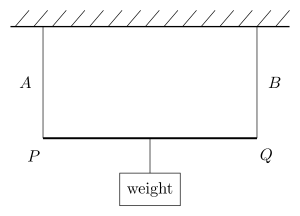
- AP EAPCET 2025Set eng-2025-05-21-FN1 markMCQQ.As shown in the figure, a light uniform rod PQ of length 150 cm is suspended from the ceiling horizontally using two metal wires A and B tied to the ends of the rod. The ratios of the radii and the Young's moduli of the materials of the two wires A and B are respectively 2 : 3 and 3 : 2. The position at which a weight should be suspended from the rod such that the elongations of the two wires become equal is [FIGURE] (a light horizontal rod PQ hung from a ceiling by two vertical wires, wire A at end P and wire B at end Q; a weight hangs from a point on the rod between P and Q) (A) 90 cm from P (B) 100 cm from P (C) 40 cm from Q (D) 45 cm from Q
›Reveal solutionSolution
Combines Young's modulus elongation with torque balance on a light rod suspended by two wires; the weight must hang 90 cm from P.
Concept and Intuition
Each wire stretches according to ΔL=AEFL. Since the rod is horizontal and the ceiling is presumably level, both wires have the same natural length L. For the elongations to be equal, the tension-to-(area×modulus) ratio must be equal in both wires — this fixes the ratio of tensions from the given radii and moduli. Then, because the rod is rigid and light (massless), the actual position of the weight is found from rotational equilibrium (torque balance) using that tension ratio.
Step-by-Step Solution
- Equal elongation: AAEAFAL=ABEBFBL⇒FBFA=ABEBAAEA=rB2EBrA2EA.
- Given rA:rB=2:3 and EA:EB=3:2: FBFA=32×222×3=1812=32.
- Let FA=2k, FB=3k. Since the rod is massless and in equilibrium, FA+FB=W=5k. …
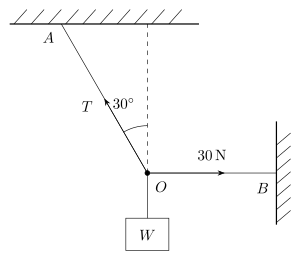
- AP EAPCET 2025Set eng-2025-05-23-FN1 markMCQQ.If the tension in the horizontal wire shown in the figure is 30 N, then the weight W and tension in the wire OA are respectively [FIGURE] (a diagram showing a ceiling with a wire OA inclined at 30° from the vertical dashed line at O, tension T along OA; a horizontal wire OB of tension 30 N connects O to a wall at B; a weight W hangs vertically from O) (A) 303 N,30 N (B) 303 N,60 N (C) 603 N,30 N (D) 603 N,60 N
›Reveal solutionSolution
This tests resolving forces at a junction where three wires meet (a "wire triangle" equilibrium problem): a slanted wire, a horizontal wire, and a hanging weight. Answer: (B).
Concept and Intuition
At the junction O, three forces are in equilibrium: the slanted wire's tension T (along OA), the horizontal wire's tension (30 N, pulling toward the wall), and the weight W hanging straight down. Since the system is static, the net force at O must be zero in both horizontal and vertical directions — this gives two independent equations for the two unknowns T and W.
Step-by-Step Solution
- Set up axes at O: horizontal (x) and vertical (y). Wire OA makes 30° with the vertical, so its tension T has components: horizontal =Tsin30° (toward the ceiling anchor, i.e. opposing the horizontal wire's pull), vertical =Tcos30° (upward).
- Horizontal equilibrium at O: the horizontal wire pulls O toward the wall with 30 N; this must be balanced by the horizontal component of T:
Tsin30°=30⟹T×21=30⟹T=60 N.
- Vertical equilibrium at O: the upward component of T must support the weight hanging below: …
- AP EAPCET 2025Set ap-2025-05-19-FN1 markMCQQ.The upper end of a wire of length 5 m is fixed to a ceiling and a 20 kg mass is attached at its lower end. If the wire makes an angle 60∘ with the horizontal, then the moment of force with respect to the upper end of the wire is (Acceleration due to gravity =10 ms−2) (A) 200 N m (B) 5003 N m (C) 2503 N m (D) 500 N m
›Reveal solutionSolution
The torque of the vertically-hanging weight about the fixed upper end is weight × the horizontal projection of the wire's length; this comes out to exactly 500 N·m.
Concept and Intuition
Torque (moment of force) about a pivot is τ=r×F, with magnitude rFsinϕ where ϕ is the angle between the position vector r (from pivot to point of force application) and the force F. Here the force is gravity, always vertical, while r points along the wire at angle θ to the horizontal. It's usually easiest to instead think of it as: torque = force × perpendicular distance from the pivot to the line of action of the force. Since the force (weight) is vertical, that perpendicular distance is exactly the horizontal separation between the pivot and the mass, i.e. Lcosθ (the horizontal component of the wire's length), where θ is measured from the horizontal.
Step-by-Step Solution
- Horizontal distance (moment arm) from the pivot to the mass: d=Lcosθ=5×cos60∘=5×0.5=2.5 m. …
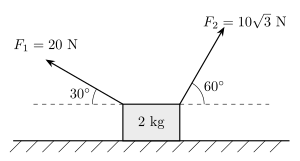
- AP EAPCET 2024Set ap-2024-05-16-FN1 markMCQQ.A body of mass 2 kg is placed on a smooth horizontal surface. Two forces F1=20 N and F2=103 N are acting on the body in the directions making angles of 30° and 60° to the surface. The reaction of the surface on the body is [FIGURE] (a block of mass 2 kg on a horizontal surface, with force F1=20 N acting up-left at 30° to the surface and force F2=103 N acting up-right at 60° to the surface) (A) 20 N (B) 25 N (C) 5 N (D) Zero
›Reveal solutionSolution
The key is to realize that the block is in vertical equilibrium (no vertical acceleration), so the upward normal reaction must balance the downward weight plus any net vertical component of the applied forces. After resolving the two forces into vertical components, the normal reaction comes out to be 5 N, which corresponds to option (C).
Concept & Intuition (Static Equilibrium in the Vertical Direction)
The block rests on a smooth horizontal surface, meaning there is no friction. The only forces in the vertical direction are:
- The weight mg acting downward.
- The normal reaction N from the surface acting upward.
- The vertical components of F1 and F2.
Since the block does not lift off or sink into the surface, its vertical acceleration is zero. Therefore, the net vertical force must be zero. This is a direct application of Newton’s first law (equilibrium) in the vertical direction. The trick is to correctly resolve the forces and account for their directions.
Step-by-step solution
- Identify all vertical forces
- Weight: mg=2×10=20 N downward (taking g=10 m/s2 as standard).
- Normal reaction N upward (unknown).
- F1=20 N at 30∘ above the horizontal, pulling up-left. Its vertical component is upward:
F1y=F1sin30∘=20×21=10 N (upward).
- F2=103 N at 60∘ above the horizontal, pulling up-right. Its vertical component is also upward:
F2y=F2sin60∘=103×23=10×23=15 N (upward).
- Set up the vertical equilibrium equation Choose upward as positive. The sum of vertical forces must be zero:
N+F1y+F2y−mg=0.
Substitute the values:
N+10+15−20=0.
- Solve for N N+5=0⇒N=−5 N. …
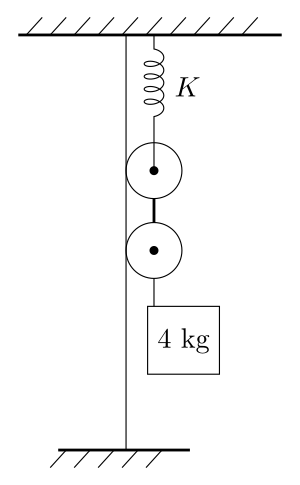
- AP EAPCET 2024Set eng-2024-05-20-FN1 markMCQQ.A 4 kg mass is suspended as shown in figure. All pulleys are frictionless and spring constant K is 8×10³ Nm−1. The extension in spring is (g=10 ms−2) [FIGURE] (a spring K hangs from a fixed ceiling support; its lower end holds a movable pulley, below which a second movable pulley is suspended in series; a string anchored to the ceiling runs down and around both pulleys, with the 4 kg mass hanging from the lower pulley) (A) 2 mm (B) 2 cm (C) 4 cm (D) 4 mm
›Reveal solutionSolution
Two movable pulleys in series give a velocity ratio of 22=4, so the spring bears four times the load: F=4mg=160 N, and the extension is x=F/K=2 cm — option (B).
Step 1 — Load.
W=mg=4×10=40 N
Step 2 — Effect of the two movable pulleys.
The string is fixed at both ends (ceiling and floor) and runs around the two movable pulleys arranged one below the other (a compound / series arrangement). Each movable pulley doubles the displacement of the load relative to the support point, so the lower pulley (carrying the mass) moves 22=4 times as far as the spring's lower end.
By virtual work for an ideal (frictionless, massless) system, the work done by the spring equals the work done against the load: …
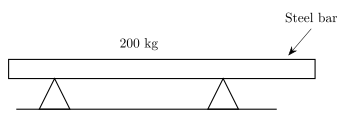
- AP EAPCET 2023Set ap-2023-05-23-AN1 markMCQQ.A 200 kg steel bar sits horizontally on two supports as shown in the figure. The force on each support is (g=9.8ms−2) [FIGURE] (a horizontal steel bar of mass 200 kg resting symmetrically on two triangular knife-edge supports) (A) 960 N (B) 1960 N (C) 490 N (D) 980 N
›Reveal solutionSolution
The bar is in static equilibrium, so the sum of vertical forces equals the weight and the sum of torques about any point is zero. Because the bar is uniform and the supports are symmetric about the center, each support carries exactly half the weight. The weight is 200×9.8=1960 N, so each support force is 980 N. The correct option is (D).
Concept and Intuition: Static Equilibrium
When an object is stationary and not rotating, two conditions must hold:
- The net force on it is zero (translational equilibrium).
- The net torque about any point is zero (rotational equilibrium).
Here, the steel bar is uniform, so its weight acts at its geometric center. The two knife-edge supports exert upward normal forces. The bar extends beyond the right support (an overhang), but the figure shows the supports placed symmetrically relative to the center — the left support is as far left of center as the right support is right of center. That symmetry means each support carries the same load. No distances are given, but symmetry alone suffices.
Step-by-step solution
-
Identify forces and their points of action
- Weight W=mg=200×9.8=1960 N, acting downward at the bar’s center (midpoint).
- Left support force FL upward, right support force FR upward.
- The supports are equidistant from the center (by symmetry of the figure), so let that distance be d.
-
Apply translational equilibrium (vertical forces)
FL+FR=W=1960 N
- Apply rotational equilibrium (torque about the center)
Take torques about the bar’s center. The weight produces zero torque there.
- Left support: torque = FL×d (counterclockwise if we choose positive direction).
- Right support: torque = FR×d (clockwise). For equilibrium: …
- AP EAPCET 2022Set ap-2022-07-11-AN1 markMCQQ.A block of mass 50 kg is pushed at a constant speed up a frictionless inclined plane by a horizontal force F. If the inclined plane makes an angle of 60° with the horizontal, then ∣F∣ is [Acceleration due to gravity =10 ms−2] (A) 31000 N (B) 866 N (C) 654 N (D) 5002 N
›Reveal solutionSolution
A block pushed at constant speed up a frictionless incline by a horizontal force requires F=mgtanθ; here this comes to ≈866N.
Concept and Intuition
Constant speed means zero net force (Newton's first law along the direction of motion). On a frictionless incline, the only forces are gravity, the normal reaction, and the applied horizontal force. Resolving all forces along the incline surface (rather than along horizontal/vertical) makes the "constant speed" condition easy to use directly.
Step-by-Step Solution
- Set up the incline direction as the axis of interest; the incline makes angle θ=60∘ with horizontal.
- Component of gravity along the incline (down-slope): mgsinθ.
- Component of the horizontal force F along the incline (up-slope): Fcosθ (the incline surface is tilted by θ from horizontal).
- Constant speed ⇒ net force along incline is zero: Fcosθ=mgsinθ⇒F=mgtanθ. …
- AP EAPCET 2022Set ap-2022-07-11-AN1 markMCQQ.A small sphere of charge 50 μc and mass 5 g is attached to a horizontal light string and placed in a uniform electric field that makes an angle 30° with the horizontal. The opposite end of the string is attached to a vertical wall. If the sphere is in static equilibrium and the string is horizontal, then the tension in the string is (Acceleration due to gravity =10 ms−2) (A) 5.75×10⁻² N (B) 6.65×10⁻² N (C) 8.66×10⁻² N (D) 0.12 N
›Reveal solutionSolution
Resolving the electric force into components along and perpendicular to the horizontal string gives the string tension as 8.66×10⁻² N.
Concept and Intuition
Three forces act on the sphere: gravity (down), the electric force qE (at 30∘ to the horizontal), and string tension T (purely horizontal, since the string itself is horizontal). Because tension has no vertical component, the vertical component of the electric force alone must support the weight; the horizontal component of the electric force is then balanced by the tension.
Step-by-Step Solution
- Vertical equilibrium: qEsin30∘=mg.
- mg=(5×10⁻³ kg)(10 m/s2)=0.05 N. …
- AP EAPCET 2022Set ap-2022-07-11-FN1 markMCQQ.A small ball of mass 5 g is suspended by a string of length 20 cm in a horizontal uniform electric field of 1×10³ NC−1. If the ball is in equilibrium when the string makes an angle 60° with the vertical, then the net charge on the ball is (Acceleration due to gravity =10 ms−2) (A) 52.5 μC (B) 46.4 μC (C) 96.2 μC (D) 86.6 μC
›Reveal solutionSolution
At equilibrium, the horizontal electric force on the charged ball is balanced against the horizontal component of tension, related to the vertical weight via tanθ=mgqE. Solving with θ=60° gives q≈86.6 μC.
Concept and Intuition
The ball hangs from a string in a uniform horizontal field, so three forces act on it: gravity (mg, downward), the electric force (qE, horizontal), and string tension (T, along the string). For equilibrium at angle θ from vertical, resolving forces gives Tsinθ=qE and Tcosθ=mg; dividing eliminates T.
Step-by-Step Solution
- From equilibrium: tanθ=mgqE.
- Solve for q: q=Emgtanθ.
- Substitute m=5 g=0.005 kg, g=10 ms−2, θ=60° (so tan60°=3≈1.732), E=1×10³ NC−1: …
- AP EAPCET 2022Set ap-2022-07-12-AN1 markMCQQ.A block of mass 20 kg is connected to the top of an inclined plane by a spring of negligible mass, unstretched length 0.7 m and spring constant 200 N m−1. How far is the block from the top along the incline in the equilibrium point? The inclined plane is frictionless and the angle of inclination is 30°. (Acceleration due to gravity =10 m s−2) (A) 1 m (B) 1.2 m (C) 1.5 m (D) 1.7 m
›Reveal solutionSolution
The spring stretches until its restoring force balances the along-incline component of gravity; total distance from the top is the natural length plus this stretch.
Concept and Intuition
The block hangs on the incline via the spring, connected to a fixed point at the top. At equilibrium, the spring tension equals the component of the block's weight pulling it down the incline (the incline is frictionless, so nothing else balances this).
Step-by-Step Solution
- Weight component along the incline: mgsinθ=20×10×sin30∘=200×0.5=100 N.
- Spring force at extension x: F=kx. Setting kx=100 N with k=200 N/m gives x=100/200=0.5 m. …
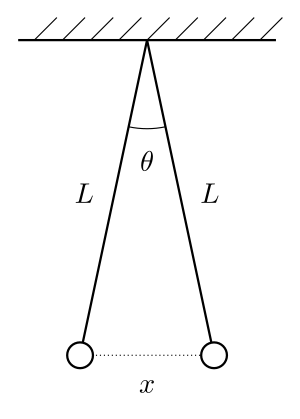
- AP EAPCET 2022Set ap-2022-07-12-AN1 markMCQQ.As shown in the figure, two tiny conducting balls of identical mass and identical charge are suspended by two non-conducting threads of each length L. The separation between the balls in equilibrium is x and is related to L as x∝Lβ. If θ is assumed to be very small then the value of β is [FIGURE] (two small charged balls hang from a common fixed point by two threads, each of length L, making a small angle θ with the vertical on either side; the balls are separated by a horizontal distance x at the bottom) (A) 3 (B) 31 (C) 32 (D) 23
›Reveal solutionSolution
For small angles, the equilibrium condition balances electrostatic repulsion with the horizontal component of tension. Using the small-angle approximation sinθ≈tanθ≈θ and geometry x≈2Lθ, we find x∝L1/3, so β=1/3.
We are dealing with static equilibrium of two identical charged balls. Each ball experiences three forces: its weight mg downward, the tension T along the thread, and the electrostatic repulsion Fe horizontally outward. Because the system is symmetric, we can analyze just one ball.
The key insight: For small θ, the geometry simplifies dramatically — the horizontal distance x is nearly 2Lθ, and the vertical and horizontal force components become directly proportional to θ.
- Geometry and small-angle approximations From the figure, each thread makes an angle θ with the vertical. The horizontal separation between the balls is x. For small θ, the arc length is nearly the chord, so
x≈2Lsinθ≈2Lθ.
Also, tanθ≈θ and sinθ≈θ.
- Force balance on one ball
- Vertical: Tcosθ=mg
- Horizontal: Tsinθ=Fe Dividing the two equations gives
tanθ=mgFe.
For small θ, tanθ≈θ, so
θ≈mgFe.
- Electrostatic force Coulomb’s law: Fe=x2kq2, where k=4πε01 and q is the charge on each ball (same magnitude). Thus
θ≈mgx2kq2.
- Relating θ and x via geometry …
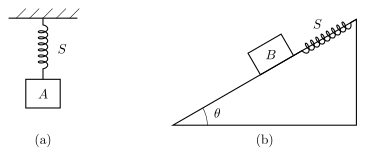
- AP EAPCET 2022Set eng-2022-07-04-AN1 markMCQQ.As shown in the figure, an iron block A of volume 0.25m3 is attached to a spring S of unstretched length 1.0 m and hanging to the ceiling of a roof. The spring gets stretched by 0.2 m. This block is removed and another block B of iron of volume 0.75m3 is now attached to the same spring and kept on a frictionless incline plane of 30∘ inclination. The distance of the block from the top along the incline at equilibrium is [FIGURE] (Panel (a): spring S hanging from a ceiling with block A attached at its lower end. Panel (b): the same spring S attached at the top of an inclined plane of angle θ, with block B resting on the incline connected to the spring along the slope.) (A) 1.1 m (B) 1.3 m (C) 1.6 m (D) 1.9 m
›Reveal solutionSolution
The spring constant is found from the first setup (vertical hanging), then used in the second setup (incline) to compute the stretch; the total distance from the top of the incline is the unstretched length plus the stretch, giving 1.6 m.
Concept & Intuition (Static Equilibrium)
The problem uses the same spring in two different situations. In each case, the block is in static equilibrium — the net force on it is zero.
- In panel (a), the spring force upward balances the weight of block A.
- In panel (b), the spring force along the incline balances the component of block B’s weight parallel to the incline.
Because the spring is the same, its spring constant k is unchanged. We can find k from the first setup, then use it to find the stretch in the second setup. The distance from the top of the incline is the unstretched length plus that stretch.
Step-by-step solution
- Find the spring constant k from the first setup (vertical hanging). Block A has volume VA=0.25 m3. Iron density ρ=7800 kg/m3 (standard value). Mass of A:
mA=ρVA=7800×0.25=1950 kg.
Weight:
WA=mAg=1950×9.8=19110 N.
The spring stretches by xA=0.2 m from its unstretched length. In equilibrium, spring force = weight:
kxA=WA⇒k=xAWA=0.219110=95550 N/m.
- Set up the equilibrium condition for block B on the incline. Block B has volume VB=0.75 m3. Its mass:
mB=ρVB=7800×0.75=5850 kg.
Weight:
WB=mBg=5850×9.8=57330 N.
On an incline of angle θ=30∘, the component of weight pulling the block down the slope is:
WB,∥=WBsin30∘=57330×0.5=28665 N.
The spring force along the incline is kxB, where xB is the stretch. Equilibrium gives:
kxB=WB,∥⇒xB=9555028665=0.3 m.
- Find the distance from the top of the incline. …
🎓Unlock everything free for 14 days
- ✓Full step-by-step solutions
- ✓Concept-first explanations
- ✓Methods, shortcuts & mistakes
- ✓PYQ mapping + timed mock tests
Full access for 14 days. No credit card required.