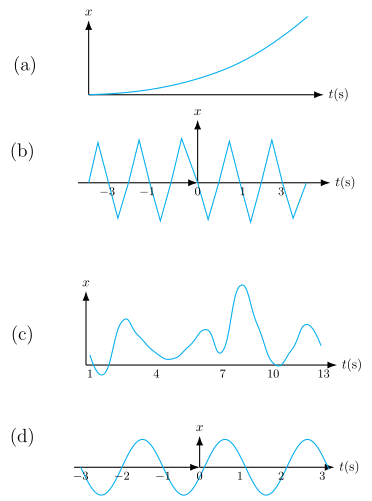
Q.Four displacement-time (x-t) plots for the linear motion of a particle are described below. In each plot x is on the vertical axis and time t (in seconds) on the horizontal axis. State which plots represent periodic motion and give the period in each periodic case.
Concept understanding — Frequency And Period
Frequency and Period: The Rhythm of Repetition
Imagine a child on a swing, going back and forth. Each full cycle — forward, backward, back to the start — takes a certain amount of time. That time is the period. Now count how many such cycles happen in one second — that count is the frequency. Frequency and period describe the same repeating rhythm, just viewed from two different angles.
Everyday Intuition
Think of your own heartbeat. At rest, your heart beats roughly once every second. The period is about 1 second — the time between one beat and the next. The frequency is about 1 beat per second — how many beats occur in that same second.
If your heart speeds up, the period shrinks (less time between beats) and the frequency rises (more beats per second). Slow the heart down, and it's the reverse.
Period and frequency are inversely related — when one increases, the other decreases. Always.
Precise Definitions
Period (T) — the time taken to complete one full cycle of a repeating event, measured in seconds (s).
Frequency (f) — the number of complete cycles occurring per unit time, measured in hertz (Hz), where 1 Hz = 1 cycle per second.
T=f1f=T1
f=T1orT=f1
Worked Example
A pendulum completes 5 full swings in 10 seconds.
- Frequency: f=10 s5 cycles=0.5 Hz
- Period: T=f1=0.51=2 s
Check: in 2 seconds you get one cycle, so in 10 seconds you get 5 cycles — consistent.
Where You'll Meet This
| Context | What repeats | Typical period | Typical frequency |
|---|---|---|---|
| A tuning fork / concert pitch (the note A4) | Vibration of the prongs | ≈ 0.00227 s | 440 Hz |
| The note middle C on a piano | Air-pressure vibration | ≈ 0.0038 s | ≈ 262 Hz |
| AC electricity in India | Voltage polarity | 0.02 s | 50 Hz |
| Earth's rotation | Day and night | 24 h | 1/24 cycle per hour |
Don't confuse ordinary frequency f with angular frequency ω. They're related by ω=2πf, and ω is measured in radians per second, not hertz. You'll meet ω when studying oscillations and circular motion.
Why This Matters
Frequency and period are the basic language of anything that repeats — oscillations, waves, rotations, alternating circuits. When you read "50 Hz" for household AC supply, you now know the voltage completes 50 full cycles every second, each cycle lasting 0.02 s. When a problem gives "period = 2 s" for a pendulum, you know one full swing takes 2 seconds.
Key takeaway: period is time-per-cycle, frequency is cycles-per-time — reciprocals of each other, always.
If you've searched "Frequency And Period class 11 physics notes" or "Frequency And Period NCERT solutions", this page covers exactly that ground — the concept is a standard part of the Class 11 Physics NCERT/CBSE syllabus. It also carries real weight in JEE Main, NEET and state engineering/medical entrance exams, where questions on frequency and period test both conceptual understanding and calculation speed.
A motion is periodic only when its x-t graph repeats identically after a fixed time. Only the saw-tooth (b) and the sine curve (d) repeat, each every 2 s; the ever-rising curve (a) and the irregular humped curve (c) never repeat.
Plots (b) and (d) show a shape that recurs identically after equal time intervals, so they are periodic with period T=2 s. Plot (a) rises without ever returning, and plot (c) is a set of unequal, non-repeating humps, so neither is periodic.
Plots (b) and (d) are periodic, each with period T=2 s. Plots (a) and (c) are non-periodic.
A motion is periodic only when its displacement-time graph repeats exactly after a fixed interval called the period. Of the four plots, only the saw-tooth (b) and the sine curve (d) repeat identically, each after 2 s. The continuously rising curve (a) and the irregular humped curve (c) never repeat, so they are non-periodic.
Concept
A motion is periodic if the particle returns to the same state (same x and same direction of motion) after equal intervals of time T, and keeps doing so indefinitely. On an x-t graph this appears as a shape that repeats identically along the time axis. The period is the smallest time after which one complete pattern recurs.
Examining each plot
- (a) x increases continuously (a concave-up curve) and never comes back to a previous value. There is no repetition, so the motion is not periodic.
- (b) The saw-tooth shape rises, drops sharply, and rises again, the identical pattern recurring along t. Consecutive identical features are 2 s apart, so it is periodic with T=2 s.
- (c) The curve is a collection of humps of unequal height and spacing between t=1 s and t=13 s; no single sub-pattern repeats, so it is not periodic.
- (d) A pure sine curve, one full oscillation occupying 2 s and then repeating, so it is periodic with T=2 s.
Plots (b) and (d) represent periodic motion, each with period T=2 s. Plots (a) and (c) are non-periodic.
Step 1: A motion is periodic only if its x-t graph traces the exact same shape again after a fixed interval T, indefinitely.
Step 2 (a): The curve rises continuously and never returns to an earlier value — non-periodic.
Step 3 (b): The saw-tooth shape recurs identically every 2 s — periodic, T=2 s.
Step 4 (c): The humps between 1 s and 13 s differ in height and spacing, so no fixed sub-pattern repeats — non-periodic.
Step 5 (d): The sinusoidal curve completes one identical up-down cycle every 2 s — periodic, T=2 s.
- AP EAPCET 2026Set eng-2026-05-13-FN1 markMCQQ.β=v2Fcos(αt), if F is force, v is velocity, t is time, then the dimensional formulae of α, β are respectively (A) M0L0T0, ML−1T0 (B) M0L0T−1, MLT0 (C) M0L0T−1, ML−1T0 (D) ML0T−1, ML−1T
›Reveal solutionSolution
A trig function's argument must be dimensionless, which fixes α; then β takes the dimension of F/v2.
Concept and Intuition
Any transcendental function (sin, cos, log, exponential) can only take a pure (dimensionless) number as its argument, and the function's output is likewise dimensionless. This is the standard trick for finding the dimension of a quantity that sits inside such a function.
Step-by-Step Solution
- cos(αt) is dimensionless ⇒αt is dimensionless ⇒[α]=[t]1=T−1=M0L0T−1.
- Since cos(αt) contributes no dimension, [β]=[v2F].
- [F]=MLT−2, [v2]=(LT−1)2=L2T−2.
- [β]=L2T−2MLT−2=ML−1T0.
Common Mistakes
- Assigning α dimension T0 (forgetting it must cancel t's dimension inside the cosine).
- Mis-simplifying L/L2=L−1 as L1 or dropping the M.
✓Final answerThe correct option is (C) — α:M0L0T−1, β:ML−1T0.
ANSWER: C
- AP EAPCET 2025Set ap-2025-05-19-FN1 markMCQQ.If a sound wave emitted by a stationary source of frequency 680 Hz travels towards a stationary observer 150 m away, then the number of waves between the source and observer are (speed of sound in air =340 ms−1) (A) 300 (B) 150 (C) 75 (D) 450
›Reveal solutionSolution
The number of complete wavelengths that fit in the 150 m gap equals distance divided by wavelength, i.e. df/v. Here that comes out to 300.
Concept and Intuition
Sound travels as a wave train; the number of wave crests present in a stretch of space of length d at any instant is simply d/λ, where λ=v/f is the wavelength. Since both source and observer are stationary, there is no Doppler shift — the wavelength in the medium is just v/f throughout.
Step-by-Step Solution
- Wavelength: λ=fv=680340=0.5m.
- Number of waves between source and observer: n=λd=0.5150=300.
Common Mistakes
- Trying to invoke a Doppler formula even though both source and observer are stationary (no relative motion, no shift needed).
- Inverting the ratio (λ/d instead of d/λ).
✓Final answerThe correct option is (A) — 300.
ANSWER: A
- AP EAPCET 2025Set eng-2025-05-24-FN1 markMCQQ.If a travelling wave is given by y(x,t)=0.5sin(70.1x−10πt), where x and y are in metre, the time t is in second, then the frequency of the wave is (A) 6 Hz (B) 7 Hz (C) 4 Hz (D) 5 Hz
›Reveal solutionSolution
This tests reading off frequency from a travelling-wave equation. Only the coefficient of t (the angular frequency ω) matters; the answer is f=5 Hz.
Concept and Intuition
A one-dimensional travelling wave is written as y(x,t)=Asin(kx−ωt), where k=λ2π is the wave number (spatial repetition rate) and ω=2πf is the angular frequency (temporal repetition rate). These two quantities describe two independent periodicities of the wave — one in space, one in time — and only the time-periodicity coefficient tells you the frequency.
Step-by-Step Solution
- Write the given wave: y(x,t)=0.5sin(70.1x−10πt).
- Match with the standard form y=Asin(kx−ωt): here k=70.1 rad/m and ω=10π rad/s.
- Frequency is obtained purely from ω: f=2πω=2π10π=5 Hz.
Common Mistakes
- Trying to use the 70.1x coefficient (the wave number) to compute frequency — it only gives wavelength via λ=2π/k, not frequency.
- Forgetting the factor of 2π and reporting ω itself (i.e., 10π≈31.4) as the frequency.
✓Final answerThe correct option is (D) — 5 Hz.
ANSWER: D
- AP EAPCET 2025Set eng-2025-05-26-FN1 markMCQQ.If the function sin2ωt (t is time in second) represents a periodic motion, then the period of the motion is (A) ωπ s (B) ωπ s (C) ω2π s (D) ω2π s
›Reveal solutionSolution
sin2ωt oscillates twice as fast as sinωt because of the double-angle identity, so its period is π/ω, not 2π/ω — option (B).
Concept and Intuition
A function's period is the smallest T for which f(t+T)=f(t) for all t. Squaring a sinusoid effectively doubles its angular frequency (halves the period), because sin2θ is always non-negative and repeats twice within one full cycle of sinθ. This is captured algebraically by the power-reduction identity.
Step-by-Step Solution
- Use the identity sin2ωt=21−cos(2ωt).
- This is a constant (1/2) plus a cosine term of angular frequency ω′=2ω.
- The period of cos(ω′t) is T=ω′2π=2ω2π=ωπ.
- Adding the constant 1/2 does not change the period, so the period of sin2ωt is ωπ seconds.
Common Mistakes
- Assuming the period of sin2ωt is the same as that of sinωt, i.e. 2π/ω — this ignores the frequency-doubling effect of squaring.
- Misapplying the double-angle formula and getting a in the answer (there is no square root in a period expression here — those options are distractors).
✓Final answerThe correct option is (B) — ωπ s.
ANSWER: B
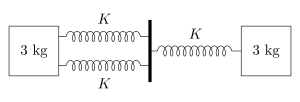
- AP EAPCET 2024Set eng-2024-05-21-AN1 markMCQQ.In a spring block system as shown in figure, if the spring constant K=9π2 Nm−1, then the time period of oscillation is [FIGURE] (two blocks of 3 kg each; the left 3 kg block is connected to a central junction by two springs of constant K arranged in parallel, and that junction is connected to the right 3 kg block by one spring of constant K) (A) 1 s (B) 3.14 s (C) 1.414 s (D) 0.5 s
›Reveal solutionSolution
Combining the parallel pair (2K) in series with the single spring (K) gives an effective spring constant of 2K/3 between the two equal masses; using the reduced-mass two-body oscillator formula gives T=1 s.
Concept and Intuition
Two masses connected through a spring network oscillate about their common centre of mass exactly like a single mass μ (the reduced mass) attached to a spring of the network's effective stiffness. So the first job is to reduce the spring network to one number, keff; the second is to apply the standard two-body oscillator frequency ω=keff/μ.
Step-by-Step Solution
- The two springs of constant K between the left block and the rigid middle junction act in parallel (same displacement): combined constant =2K.
- This combination is in series (through the massless junction) with the single spring K connecting to the right block, so keff1=2K1+K1=2K3⇒keff=32K.
- With K=9π2: keff=32×9π2=6π2 Nm−1.
- Reduced mass for two equal 3 kg blocks: μ=m1+m2m1m2=63×3=1.5 kg.
- Angular frequency: ω=keff/μ=6π2/1.5=4π2=2π rads−1.
- Time period: T=ω2π=2π2π=1 s.
Common Mistakes
- Adding the springs as if all three were in one simple series or parallel chain, without recognising the parallel pair first.
- Using the total mass (6 kg) instead of the reduced mass in a two-body oscillator problem.
✓Final answerThe correct option is (A) — 1 s.
ANSWER: A
- AP EAPCET 2023Set ap-2023-05-22-FN1 markMCQQ.The ac current in a circuit is given by 3sin(ωt) ampere. The time taken by the current to drop from rms value to zero is (A) 2ωπ (B) 4ωπ (C) 6ωπ (D) 8ωπ
›Reveal solutionSolution
Tracking where a sinusoidal current equals its rms value on the way down from the peak, and where it next crosses zero, gives a clean phase interval of π/4.
Concept and Intuition
The current i(t)=3sin(ωt) rises from 0 to a peak of 3 A at ωt=π/2, then falls back through the rms value and down to 0 at ωt=π. We need the point on this falling part of the cycle where i equals the rms value 3/2, then measure the time from there to the next zero.
Step-by-Step Solution
- RMS value of i=3sin(ωt) is irms=23.
- Set 3sin(ωt)=23⇒sin(ωt)=21. This is satisfied at ωt=π/4 (rising) and ωt=π−π/4=3π/4 (falling, i.e. after the peak).
- Since the current is dropping from rms to zero, we take the falling-branch instant: ωt1=3π/4.
- The next zero of the sine after the peak occurs at ωt2=π.
- Time to drop from rms to zero: Δt=ωωt2−ωt1=ωπ−3π/4=ωπ/4=4ωπ.
Common Mistakes
- Using the rising-branch instant (ωt=π/4) instead of the falling one, which would (incorrectly) describe current rising to rms, not dropping from it.
✓Final answerThe correct option is (B) — 4ωπ.
ANSWER: B
- AP EAPCET 2022Set ap-2022-07-11-FN1 markMCQQ.A point on a taut string is moving up and down due to a wave travelling along it. The point completes 120 cycles in one fourth of a minute. The frequency of the wave is (A) 8 Hz (B) 120 Hz (C) 300 Hz (D) 330 Hz
›Reveal solutionSolution
Frequency = number of cycles / time taken. With 120 cycles completed in 15 seconds (a quarter of a minute), the frequency is 8 Hz.
Concept and Intuition
Frequency of oscillation of any point on a wave equals the number of complete cycles it undergoes per unit time, independent of the wave's speed or wavelength (those relate to how far the disturbance travels, not how fast a single point oscillates).
Step-by-Step Solution
- Convert time: one-fourth of a minute =460=15 s.
- Frequency =timenumber of cycles=15120=8 Hz.
Common Mistakes
- Forgetting to convert "a fourth of a minute" into seconds before dividing.
- Confusing frequency of oscillation of a point with the wave's propagation speed.
✓Final answerThe correct option is (A) — 8 Hz.
ANSWER: A
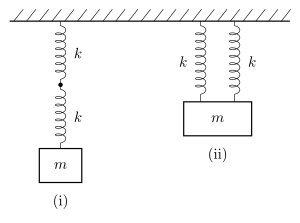
- AP EAPCET 2021Set ap-2021-09-06-FN1 markMCQQ.Two identical springs are connected to mass m as shown (k = spring constant). If the period of the configuration in(i) is 2s, the period of the configuration(ii) is: [FIGURE] (two spring-mass diagrams hung from a fixed ceiling:(i) two springs each of constant k connected in series, one below the other, down to a mass m;(ii) two springs each of constant k connected in parallel side by side between the fixed ceiling and a mass m) (A) 2s (B) 1s (C) 21s (D) 22s
›Reveal solutionSolution
The period of a spring-mass system depends on the effective spring constant. For series springs, the effective constant is k/2; for parallel, it’s 2k. Since period is inversely proportional to the square root of the effective constant, the period in (ii) is half that in (i), i.e., 1s. The correct option is (B).
The key insight is that period depends only on mass and the effective stiffness of the spring combination. In both configurations, the mass is the same, so the ratio of periods is simply the square root of the inverse ratio of effective spring constants.
Why this works:
For a single spring of constant k, the period is T=2πm/k. When springs are combined, we replace k with an effective spring constant keff that describes how the whole system responds to a force. The period then becomes T=2πm/keff. So if we find keff for each configuration, we can directly compare their periods.
- Find the effective spring constant for configuration (i) — series. When two identical springs are connected end-to-end (series), each spring stretches under the same force. The total extension is the sum of each spring’s extension. For a force F, each spring extends by x=F/k, so total extension is 2F/k. The effective constant satisfies F=keff, series⋅(2F/k), giving
keff, series=2k.
So the period for (i) is
Ti=2πk/2m=2πk2m.
We are told Ti=2s.
- Find the effective spring constant for configuration (ii) — parallel. When two identical springs are side-by-side (parallel), they share the load. For a force F applied to the mass, each spring feels half the force, so each extends by x=(F/2)/k=F/(2k). But both springs have the same extension, so the total extension is still F/(2k). The effective constant satisfies F=keff, parallel⋅(F/(2k)), giving
keff, parallel=2k.
Hence the period for (ii) is
Tii=2π2km.
- Relate the two periods. Compare Tii to Ti:
TiTii=2π2m/k2πm/(2k)=2m/km/(2k)=41=21.
So Tii=21Ti=21×2s=1s.
TipA quick shortcut: For identical springs, series gives half the stiffness, parallel gives double the stiffness. Since period ∝1/keff, doubling stiffness halves the period, and halving stiffness multiplies the period by 2. Here we go from half-stiffness to double-stiffness, a factor of 4 in stiffness, so period changes by 1/4=1/2.
Watch outA common mistake is to think that parallel springs have the same effective constant as a single spring (because each spring still has constant k). But the combination is stiffer: two springs side-by-side share the load, so the same force produces only half the extension of one spring — hence double the stiffness.
✓Final answerThe correct option is (B).
ANSWER: B
🎓Unlock everything free for 14 days
- ✓Full step-by-step solutions
- ✓Concept-first explanations
- ✓Methods, shortcuts & mistakes
- ✓PYQ mapping + timed mock tests
Full access for 14 days. No credit card required.