Q.Find the centre of mass of a uniform
🔒You're viewing a preview — the full solution, concept, methods & PYQ mapping are locked.
🔒 Start your 14-day free trial to unlock the full solution →Concept understanding — Center of Mass
What is the Center of Mass?
Imagine you pick up a broom by the handle and try to balance it horizontally on one finger. You instinctively slide your finger along the handle until the broom stays level. That point — the one where the broom doesn't tip — is its center of mass.
Now think about throwing a cricket bat. It spins and wobbles in the air, but there is one point on the bat that follows a smooth, parabolic path, as if all the bat's mass were concentrated there. That point is also the center of mass.
The core idea is simple: the center of mass is the average position of all the mass in an object. It's the point where you could imagine the entire mass of the object being concentrated, and the object would behave the same way under the influence of external forces.
Why does this matter?
When you push an object at its center of mass, it moves in a straight line without rotating. Push it anywhere else, and it will both move and spin. This is why:
- A car's stability depends on where its center of mass is (lower = safer).
- A tightrope walker holds a long pole — moving the pole shifts their combined center of mass back over the rope.
- In projectile motion, the center of mass of a system (like an exploding firework) continues along the original parabolic path, even though the fragments scatter.
The precise definition
For a system of particles, the center of mass is the weighted average of their positions, where the weight is the mass of each particle.
RCM=m1+m2+⋯+mnm1r1+m2r2+⋯+mnrn=∑mi∑miri
Here:
- RCM is the position vector of the center of mass
- mi is the mass of the i-th particle
- ri is the position vector of that particle
For a continuous object (like a rod or a sphere), the sum becomes an integral:
RCM=M1∫rdm
where M is the total mass and dm is an infinitesimal mass element.
Breaking it down with an example
Take two masses on a light rod: m1=2 kg at x=0, and m2=3 kg at x=5 m.
The center of mass is:
xCM=2+3(2)(0)+(3)(5)=50+15=3 m
So the center of mass is at x=3 m, closer to the heavier mass. That makes intuitive sense — the heavier mass "pulls" the average toward itself.
The center of mass does not have to be inside the object. A ring or a hollow sphere has its center of mass at the geometric center, which is empty space.
Key properties to remember
-
External forces only — Internal forces (like collisions between parts of the system) do not affect the motion of the center of mass. Only external forces can change its velocity.
-
If no external force acts, the center of mass moves with constant velocity (or stays at rest). This is the law of conservation of momentum applied to the whole system.
-
For symmetric objects with uniform density, the center of mass coincides with the geometric center. For irregular shapes, it shifts toward the region with more mass. …
Centre of Mass of Uniform Disc Segments
Concept: By symmetry and integration, the centre of mass of a uniform lamina lies on any axis of symmetry; for segments of a disc we exploit polar symmetry and compute yˉ (or xˉ) by integrating over thin strips.
(a) Half-disc
Place the half-disc of radius R with its diameter along the x-axis and the curved edge in the upper half-plane. By symmetry, xˉ=0.
Consider a horizontal strip at height y with thickness dy. Its half-width is x=R2−y2, so its area is dA=2R2−y2dy. The y-coordinate of the centre of mass is
yˉ=∫0R2R2−y2dy∫0Ry⋅2R2−y2dy.
The denominator is half the disc area: 21πR2. For the numerator, substitute u=R2−y2, du=−2ydy:
∫0R2yR2−y2dy=−∫R20udu=32R3.
Thus yˉ=πR2/22R3/3=3π4R.
(b) Quarter-disc …
For uniform laminae with symmetry, the center of mass lies on the symmetry axis; integration in polar coordinates gives yˉ=3π4R from the straight edge for a half-disc and xˉ=yˉ=3π4R from the respective straight edges for a quarter-disc.
Why the center of mass shifts inward
The center of mass of a body is the weighted average position of all its mass elements. For a uniform lamina—one with constant density—the center of mass coincides with the geometric centroid. A full disc has its center of mass at the geometric center by symmetry. When you remove half or three-quarters of the disc, you break that symmetry, and the center of mass shifts toward the remaining material.
The key insight: symmetry pins down some coordinates immediately. A half-disc is symmetric about the diameter that forms its straight edge, so the center of mass must lie on that axis. We need only find how far it sits from the edge. A quarter-disc has two perpendicular symmetry axes (the two radii), and by symmetry xˉ=yˉ.
Both problems reduce to a single integral in polar coordinates, where the area element dA=rdrdθ and the position of each element is (rcosθ,rsinθ).
(a) Half-disc
Consider a half-disc of radius R lying in the upper half-plane, with its straight edge along the x-axis and center at the origin.
-
Symmetry argument: The half-disc is symmetric about the y-axis, so xˉ=0. We need only find yˉ.
-
Set up the integral: The y-coordinate of the center of mass is
yˉ=A1∬ydA,
where A=21πR2 is the area of the half-disc.
- Polar coordinates: In polar coordinates, y=rsinθ and dA=rdrdθ. The half-disc is described by 0≤r≤R and 0≤θ≤π. Thus
yˉ=21πR21∫0π∫0R(rsinθ)⋅rdrdθ=πR22∫0πsinθdθ∫0Rr2dr.
- Evaluate the radial integral:
∫0Rr2dr=3R3.
- Evaluate the angular integral:
∫0πsinθdθ=[−cosθ]0π=−(−1−1)=2.
- Combine:
yˉ=πR22⋅2⋅3R3=3πR24R3=3π4R.
Half-disc: xˉ=0,yˉ=3π4R≈0.424R.
The center of mass lies on the axis of symmetry, about 42% of the radius from the straight edge.
(b) Quarter-disc
Now consider a quarter-disc of radius R in the first quadrant, with straight edges along the positive x- and y-axes.
-
Symmetry argument: The quarter-disc is symmetric under reflection across the line y=x (swapping x and y). Therefore xˉ=yˉ. We need only compute one coordinate.
-
Set up the integral for xˉ:
xˉ=A1∬xdA,
where A=41πR2.
- Polar coordinates: Here x=rcosθ, and the quarter-disc is 0≤r≤R, 0≤θ≤2π. Thus …
Concept: Use Symmetry to Kill One Coordinate, Then Integrate the Other in Polar Form
For a uniform lamina, yˉ=A1∬ydA (and similarly for xˉ), using dA=rdrdθ in polar coordinates.
Step 1 (a): Half-disc — use symmetry first
Place the half-disc of radius R with its straight edge along the x-axis, curved part in θ∈[0,π]. By symmetry about the y-axis, xˉ=0; only yˉ remains to compute.
Step 2 (a): Set up and evaluate the integral
yˉ=21πR21∫0π∫0R(rsinθ)rdrdθ=πR22=2∫0πsinθdθ=R3/3∫0Rr2dr
yˉ=πR22⋅2⋅3R3=3π4R
Step 3 (b): Quarter-disc — use its diagonal symmetry
Place the quarter-disc in the first quadrant, θ∈[0,π/2]. By symmetry under x↔y, xˉ=yˉ; compute one of them.
Step 4 (b): Evaluate …
Showing the 12 most recent of 31 on this concept.
- AP EAPCET 2026Set eng-2026-05-12-FN1 markMCQQ.A body A is projected with a velocity of 40 ms−1 at an angle of 600 with the horizontal. At some other time, another body B is thrown vertically upwards with a velocity of 403 ms−1 such that it collides body A at a height of 60 m. If the velocity of centre of mass of the system of the two bodies after collision is 20 ms−1, then the ratio of the masses of the bodies A and B is (Acceleration due to gravity =10 ms−2) (A) 1:3 (B) 1:2 (C) 4:1 (D) 3:2
›Reveal solutionSolution
This tests projectile kinematics combined with conservation of momentum through a collision — find each body's velocity components at the meeting point, then equate the vector sum of momenta to (mA+mB)vcm. Answer: (C) 4:1.
Concept and Intuition
Gravity is a finite (non-impulsive) force, so during the brief instant of collision it contributes negligible impulse — total momentum is conserved right through the collision, exactly as in an ordinary collision problem, even though both bodies are simultaneously in projectile motion. The center-of-mass velocity right after collision must equal mA+mBmAvA+mBvB, where vA,vB are the individual velocities the instant before collision. So the real work is purely kinematic: find where and how fast each body is moving when it reaches height 60 m.
Step-by-Step Solution
- Body A's vertical velocity component: vy0=40sin60∘=40⋅23=203 m/s. Its maximum height is HA=2gvy02=201200=60 m — exactly the collision height! So A is momentarily at the top of its trajectory: vy,A=0, and its horizontal component is unchanged throughout flight: vx,A=40cos60∘=20 m/s. So vA=(20,0) m/s.
- Body B's velocity at h=60: using v2=u2−2gh with u=403: vB2=4800−2(10)(60)=4800−1200=3600, so vB=60 m/s (magnitude; direction purely vertical, up or down — but squared, the sign won't matter below). So vB=(0,±60) m/s.
- Momentum conservation through the collision (vector form):
vcm=mA+mBmAvA+mBvB=(mA+mB20mA, mA+mB±60mB).
- Apply ∣vcm∣=20: (mA+mB20mA)2+(mA+mB60mB)2=202. …
- AP EAPCET 2026Set eng-2026-05-13-FN1 markMCQQ.If three particles of masses 2m, m and 4m are moving in three mutually perpendicular directions with velocities 3 ms−1, 4 ms−1 and 3 ms−1 respectively, then the magnitude of the velocity of the center of mass of the system of three particles is (A) 3.5 ms−1 (B) 2 ms−1 (C) 2.5 ms−1 (D) 3 ms−1
›Reveal solutionSolution
Adding the three mutually perpendicular momenta as vector components and dividing by the total mass gives vcm=2 m/s.
Concept and Intuition
When velocities are along mutually perpendicular directions, the total momentum vector's magnitude follows directly from the Pythagorean sum of the individual (mass times velocity) components — no angle resolution is needed since the axes are already orthogonal.
Step-by-Step Solution
- Momentum components (each along its own perpendicular axis): px=2m(3)=6m, py=m(4)=4m, pz=4m(3)=12m.
- Magnitude of total momentum: ∣p∣=m62+42+122=m36+16+144=m196=14m.
- Total mass: M=2m+m+4m=7m. …
- AP EAPCET 2026Set eng-2026-05-14-AN1 markMCQQ.Two particles of masses 4 g and 2 g are separated by a distance of 60 cm. The center of mass of the system of these two particles is (A) Lies at a distance of 30 cm from 4 g particle (B) Lies at a distance of 40 cm from 4 g particle (C) Lies at a distance of 40 cm from 2 g particle (D) Lies at a distance of 20 cm from 2 g particle
›Reveal solutionSolution
The center of mass lies closer to the heavier particle; computing the distances gives 20 cm from the 4 g mass and 40 cm from the 2 g mass, matching option (C).
Concept and Intuition
The center of mass of a two-particle system divides the line joining them in the inverse ratio of their masses — it sits closer to the heavier mass. This is a direct application of the weighted-average definition of center of mass.
Step-by-Step Solution
- Let the 4 g particle be at x=0 and the 2 g particle be at x=60 cm.
- Center of mass: xcm=m1+m2m1x1+m2x2=4+24(0)+2(60)=6120=20 cm.
- So the COM is at 20 cm from the 4 g particle (measuring from x=0).
- Distance from the 2 g particle (at x=60): 60−20=40 cm. …
- AP EAPCET 2026Set eng-2026-05-13-AN1 markMCQQ.Two particles A and B initially at rest move towards each other under a mutual force of attraction. At the instant, the speed of A is V and the speed of B is 2V, find the speed of centre of mass of the system, if the masses of A and B are in the ratio of 2 : 1 (A) Zero (B) 34V (C) 43V (D) 23V
›Reveal solutionSolution
With no external force and zero initial momentum, the centre of mass of the two-particle system stays at rest forever — its speed is Zero, option (A).
Concept and Intuition
The velocity of the centre of mass of an isolated system changes only under an external force. Here the only force is the mutual (internal) attraction between A and B, which by Newton's third law cancels out when you sum forces over the whole system. Since both particles start at rest, the total initial momentum is zero — and it must stay zero forever, meaning the centre of mass never moves at all, at any later instant.
Step-by-Step Solution
- Total momentum of an isolated two-body system is conserved because internal (mutual) forces contribute zero net external force.
- Initially, both particles are at rest, so total initial momentum pi=0.
- By conservation of momentum, total momentum at any later time must also be zero: mAvA−mBvB=0 (opposite directions, since they move towards each other).
- Velocity of centre of mass: vcm=mA+mBmAvA+mBvB(with sign)=mA+mBptotal=mA+mB0=0. …
- AP EAPCET 2026Set eng-2026-05-15-AN1 markMCQQ.Two identical particles move towards each other with velocity 2V and V respectively. The velocity of center of mass of this system is (A) V (B) 3V (C) 2V (D) 4V
›Reveal solutionSolution
This tests the definition of centre-of-mass velocity as the momentum-weighted average velocity, with opposite-direction velocities for a head-on approach. The answer is (C), V/2.
Concept and Intuition
The velocity of the centre of mass of a system is the total momentum divided by total mass: vcm=∑mi∑mivi. Since the two particles move "towards each other," their velocities must be taken with opposite signs along the line joining them.
Step-by-Step Solution
- Let both particles have mass m (identical particles).
- Take the direction of the particle moving with speed 2V as positive; since the other moves towards it (opposite direction), its velocity is −V.
- Total momentum: p=m(2V)+m(−V)=mV.
- Total mass: 2m. …
- AP EAPCET 2026Set ap-2026-05-19-FN1 markMCQQ.A thin square shaped copper plate of uniform mass distribution of side 4 m has its centre of mass at (2, 2). If at its top right corner, a square of 2 m side is cut from the plate, the centre of mass of the remaining plate is (A) 65,65 (B) 35,35 (C) 65,35 (D) 35,65
›Reveal solutionSolution
Removing the top-right quarter-square from the plate and using the
"negative mass" centre-of-mass trick gives the new COM at
(35,35). Answer: (B).
Concept and Intuition
When a piece is removed from a uniform lamina, treat the remaining shape as
the original full shape minus the removed piece, and use "negative
mass" for the removed part in the centre-of-mass formula:
xcm=Mfull−mcutMfullxfull−mcutxcut.
This avoids having to integrate over the oddly-shaped remaining region
directly.
Step-by-Step Solution
- Set up coordinates so the original 4m×4m square spans (0,0) to (4,4); its COM is at its geometric centre (2,2) — consistent with the given data. Let its mass be M (area 16, so mass per unit area σ=M/16).
- The cut-out is a 2m×2m square at the "top right corner" — spanning (2,2) to (4,4) — with its own centre at (3,3) and area 4, so its mass is mcut=4σ=M/4.
- Remaining mass: Mrem=M−M/4=43M.
- Apply the "negative mass" COM formula for the x-coordinate: …
- AP EAPCET 2026Set eng-2026-05-18-AN1 markMCQQ.Three bodies A, B, and C of masses 2 kg, 3 kg, and 5 kg respectively are projected simultaneously with the same speed from the roof of a tower. The body A is thrown vertically upwards, body B is thrown vertically downwards and body C is projected horizontally. The acceleration of the centre of mass of the system of three bodies is (Acceleration due to gravity = 10 ms−2) (A) 6 ms−2 (B) 10 ms−2 (C) 8 ms−2 (D) 12 ms−2
›Reveal solutionSolution
This tests the idea that the acceleration of the centre of mass of a system depends only on the net external force per unit total mass — here every body is in free fall, so the COM accelerates at exactly g, independent of masses or launch directions.
Concept and Intuition
The acceleration of the centre of mass of a system is given by acm=Fext/Mtotal, where Fext is the total external force. After being launched, each of the three bodies is in free fall — the only force on each is gravity, mig downward, irrespective of the direction it was thrown (up, down, or horizontal) since projectile motion under gravity alone always has acceleration g downward for every body. So the total external force on the system is (mA+mB+mC)g downward, and dividing by the total mass just gives g again. The individual masses and throw directions are irrelevant distractors — as long as gravity is the only force, every body (and hence their COM) accelerates at g.
Step-by-Step Solution
- Each body, once released, experiences only gravity: aA=aB=aC=g (downward), regardless of initial velocity direction.
- Total external force on the 3-body system: Fext=(mA+mB+mC)g, downward.
- Acceleration of centre of mass: acm=Fext/(mA+mB+mC)=g=10 ms−2, downward.
Common Mistakes …
- AP EAPCET 2026Set ap-2026-05-20-FN1 markMCQQ.Two particles of masses 'm1' and 'm2' (m1>m2) are separated by a distance 'd'. When the positions of the two particles are interchanged, the shift in the centre of mass is (A) (m1−m2m1+m2)d (B) (m1+m2m1−m2)d (C) zero (D) (m1−m2m1)d
›Reveal solutionSolution
Compute the centre of mass before and after swapping positions; the shift is (m1+m2m1−m2)d.
Concept and Intuition
The centre of mass of a two-particle system is a weighted average of position by mass. Interchanging the particles' positions changes which mass sits at which coordinate, shifting the COM toward whichever particle is now on the heavier side.
Step-by-Step Solution
- Let m1 initially at x=0 and m2 at x=d.
- Initial COM: xcm,i=m1+m2m1(0)+m2(d)=m1+m2m2d.
- After interchange, m1 is at x=d and m2 at x=0: xcm,f=m1+m2m1(d)+m2(0)=m1+m2m1d. …
- AP EAPCET 2025Set eng-2025-05-21-AN1 markMCQQ.If two bodies of masses 2 kg and 3 kg are moving at right angles with velocities 20 ms−1 and 10 ms−1 respectively, then the velocity of the centre of mass of the system of the two bodies is (A) 5 ms−1 (B) 30 ms−1 (C) 10 ms−1 (D) 14 ms−1
›Reveal solutionSolution
The centre-of-mass velocity is the vector sum of individual momenta divided by total mass. With perpendicular momenta of 40 and 30 kg·m/s, the resultant is 50 kg·m/s, giving (C) 10 ms−1.
Concept and Intuition
The velocity of the centre of mass of a system is vcm=m1+m2m1v1+m2v2, which is the same as saying vcm=Mtotalptotal, where ptotal is the vector sum of the individual momenta. When the two velocities are perpendicular, their momenta are also perpendicular, so we combine them using the Pythagorean theorem.
Step-by-Step Solution
- Momentum of body 1: p1=m1v1=2×20=40 kg·m/s.
- Momentum of body 2: p2=m2v2=3×10=30 kg·m/s.
- Since the velocities (and hence momenta) are at right angles, the resultant momentum magnitude is ptotal=p12+p22=402+302=1600+900=2500=50 kg·m/s.
- Total mass: M=m1+m2=2+3=5 kg. …
- AP EAPCET 2025Set eng-2025-05-22-AN1 markMCQQ.Three blocks A, B and C are arranged as shown in the figure such that the distance between two successive blocks is 10 m. Block A is displaced towards block B by 2 m and block C is displaced towards block B by 3 m. The distance through which the block B should be moved so that the centre of mass of the system does not change is [FIGURE] (three blocks on a horizontal line, in order A (10 kg), B (25 kg), C (15 kg), each successive pair 10 m apart) (A) 1.4 m, towards block C (B) 1.5 m, towards block A (C) 2 m, towards block A (D) 1 m, towards block C

›Reveal solutionSolution
A centre-of-mass-invariance problem: with A and C's new positions fixed, solving for B's displacement that keeps the weighted average position unchanged gives 1 m towards C.
Concept and Intuition
The centre of mass of a system of point masses is the mass-weighted average position. If we're told the COM must stay fixed while two of the three masses move, we can treat the third mass's position as the unknown and solve the COM equation for it — exactly like solving for an unknown coordinate in a weighted average.
Step-by-Step Solution
- Set up initial coordinates along the line: A at 0, B at 10, C at 20 (each successive pair 10 m apart), with masses mA=10, mB=25, mC=15 kg (total 50 kg).
- Initial COM: xcm=5010(0)+25(10)+15(20)=500+250+300=11 m.
- A moves 2 m towards B (i.e. towards increasing x): new position =0+2=2.
- C moves 3 m towards B (i.e. towards decreasing x): new position =20−3=17.
- Let B's new position be 10+d (positive d = towards C). For the COM to stay at 11 m: 5010(2)+25(10+d)+15(17)=11. …
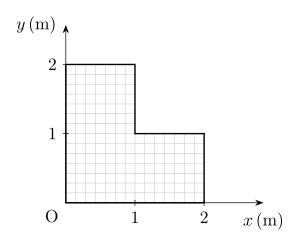
- AP EAPCET 2025Set eng-2025-05-23-AN1 markMCQQ.The coordinates of the centre of mass of a uniform L shaped plate of mass 3 kg shown in the figure is [FIGURE] (an L-shaped plate on the x-y plane (metres): the outline runs from the origin (0,0) up to (0,2), across to (1,2), down to (1,1), across to (2,1), down to (2,0), and back to (0,0) — i.e. a 2x2 square with the 1x1 square at the bottom-right corner removed) (A) (65 m,65 m) (B) (23 m,23 m) (C) (21 m,21 m) (D) (56 m,56 m)
›Reveal solutionSolution
Tests centre of mass of a composite uniform lamina by decomposing it into simple rectangles. Answer: (5/6 m,5/6 m).
Concept and Intuition
For a uniform (constant surface density) lamina made of an irregular shape, the standard trick is to break it into simple pieces whose individual centroids and areas are easy to write down, then combine them as a weighted average — weighting by area (since uniform density means mass is proportional to area).
Step-by-Step Solution
- From the figure, the L-shape is bounded by the path (0,0)→(0,2)→(1,2)→(1,1)→(2,1)→(2,0)→(0,0). This decomposes into:
- Rectangle 1: x∈[0,1], y∈[0,2] — a 1 m×2 m block, area A1=2 m2, centroid at (0.5,1).
- Rectangle 2: x∈[1,2], y∈[0,1] — a 1 m×1 m block, area A2=1 m2, centroid at (1.5,0.5).
- Total area =A1+A2=3 m2, matching the total mass of 3 kg (so surface density =1 kg/m2, and each rectangle's mass equals its area in kg): m1=2 kg, m2=1 kg.
- Centre of mass: …
- From the figure, the L-shape is bounded by the path (0,0)→(0,2)→(1,2)→(1,1)→(2,1)→(2,0)→(0,0). This decomposes into:
- AP EAPCET 2025Set eng-2025-05-26-FN1 markMCQQ.A body of mass 2 kg is moving towards north with a velocity of 20 ms−1 and another body of mass 3 kg is moving towards east with a velocity of 10 ms−1. The magnitude of the velocity of the centre of mass of the system of the two bodies is (A) 20 ms−1 (B) 10 ms−1 (C) 15 ms−1 (D) 25 ms−1
›Reveal solutionSolution
The centre of mass moves with velocity equal to total momentum over total mass; since the two momenta are perpendicular they add as a 3-4-5 vector triangle, giving 10 ms−1 — option (B).
Concept and Intuition
The velocity of the centre of mass of a system is defined by vcm=∑mi∑mivi — it is exactly the total (vector) momentum of the system divided by the total mass. Because the two bodies move along perpendicular directions (north and east), their momenta must be combined as vectors, not scalars — this is the crux of the problem.
Step-by-Step Solution
- Momentum of body 1 (north): p1=m1v1=2×20=40 kgms−1 (north).
- Momentum of body 2 (east): p2=m2v2=3×10=30 kgms−1 (east). …
🎓Unlock everything free for 14 days
- ✓Full step-by-step solutions
- ✓Concept-first explanations
- ✓Methods, shortcuts & mistakes
- ✓PYQ mapping + timed mock tests
Full access for 14 days. No credit card required.