Q.Show that the coefficient of area expansion, (ΔA/A)/ΔT, of a rectangular sheet of the solid is twice its linear expansivity, αl.
🔒You're viewing a preview — the full solution, concept, methods & PYQ mapping are locked.
🔒 Start your 14-day free trial to unlock the full solution →Concept understanding — Thermal Expansion Coefficient
Thermal Expansion Coefficient: From Intuition to Precision
The Intuition: What Happens When Things Get Hot?
Think about a metal railway track on a summer day. The track is laid in sections with small gaps between them. On a hot afternoon, those gaps get smaller — sometimes the track even buckles. Why? Because the metal expands when heated.
Or consider a mercury thermometer. The liquid mercury sits in a bulb at the bottom. When your body warms the bulb, the mercury expands and rises up the narrow tube. The hotter you are, the higher it climbs.
This is thermal expansion: most materials get bigger when heated and smaller when cooled. The atoms inside vibrate more vigorously as temperature rises, pushing their neighbours slightly farther apart. The entire object grows in every direction.
But different materials expand by different amounts. A steel rod and an aluminium rod of the same length, heated by the same amount, will not end up the same length. Aluminium expands more. So we need a number that tells us how much a given material expands per degree of temperature change. That number is the thermal expansion coefficient.
The Precise Statement: Defining the Coefficient
There are actually three coefficients, depending on whether we care about length, area, or volume. For a first meeting, we focus on the most common one: the linear thermal expansion coefficient, denoted by the Greek letter α (alpha).
α=L01⋅ΔTΔL
Where:
- L0 is the original length of the object (at some starting temperature)
- ΔL is the change in length (final length minus original length)
- ΔT is the change in temperature (final temperature minus initial temperature)
What this formula says in plain English: The coefficient α is the fractional change in length per degree of temperature change. If α=2.5×10⁻⁵per∘C, it means that for every 1∘C rise in temperature, the material expands by 0.0025% of its original length.
How to Use It: The Working Formula
From the definition, we can rearrange to get the practical formula:
ΔL=αL0ΔT
So the final length L after a temperature change is:
L=L0+ΔL=L0(1+αΔT)
For small temperature changes (say, less than 100∘C), this linear approximation is excellent. For very large changes, the coefficient itself may change slightly with temperature, but at the introductory level we treat α as constant.
A Concrete Example
A steel bridge girder is 50.00m long at 20∘C. The linear expansion coefficient of steel is α=1.2×10⁻⁵/∘C. How much longer is it on a 40∘C day?
Step 1: Identify the quantities.
- L0=50.00m
- ΔT=40−20=20∘C
- α=1.2×10⁻⁵/∘C
Step 2: Apply the formula.
ΔL=αL0ΔT=(1.2×10⁻⁵)(50.00)(20)
Step 3: Calculate.
ΔL=1.2×10−5×1000=0.012m=1.2cm
So the girder expands by 1.2cm. That is why bridges have expansion joints — without them, the structure would buckle.
Two Important Cousins: Area and Volume Expansion
For a thin sheet (like a metal plate), we care about area expansion. The area expansion coefficient is approximately 2α. For a solid object, the volume expansion coefficient is approximately 3α. These come from the same idea: if every linear dimension grows by a factor (1+αΔT), then area grows by (1+αΔT)2≈1+2αΔT, and volume by (1+αΔT)3≈1+3αΔT.
These approximations (2α and 3α) are valid only when αΔT is small compared to 1. For most solids and modest temperature changes, this is true. For gases, the expansion is much larger and a different treatment is needed.
What the Coefficient Tells Us About Materials
| Material | α (per ∘C) | Behaviour |
|----------|--------------------------------|-----------| …
The key idea is that area expansion arises from linear expansion in two perpendicular directions.
Consider a rectangle of sides l and b, with initial area A=lb. When heated by ΔT, each side expands linearly:
l′=l(1+αlΔT),b′=b(1+αlΔT)
The new area is:
A′=l′b′=lb(1+αlΔT)2=A(1+2αlΔT+αl2ΔT2)
For small ΔT, the αl2ΔT2 term is negligible. So: …
For a rectangular sheet, area expansion comes from both length and width expanding independently. Since each linear dimension expands by a factor (1+αlΔT), the area expands by (1+αlΔT)2≈1+2αlΔT, so the area expansion coefficient αA=2αl.
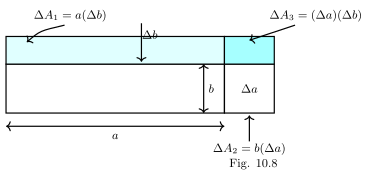
The key insight is that area expansion isn't a separate phenomenon — it's just linear expansion happening in two perpendicular directions at once. When a solid is heated uniformly, every linear dimension expands according to the same coefficient αl. For a rectangle, that means both its length and its width increase, and the new area is simply the product of the two expanded dimensions.
Let’s walk through this carefully.
- Start with the definition of linear expansivity. The linear expansion coefficient αl tells you the fractional change in length per degree temperature change:
αl=L1dTdL
For a finite temperature change ΔT, if αl is constant (which it is, to a very good approximation for small ΔT), the new length is:
L′=L(1+αlΔT)
This is the fundamental relation we’ll use.
- Now consider a rectangular sheet. Let the original length be a and original breadth be b. The original area is:
A=ab
- After heating by ΔT, both dimensions expand. The new length and breadth become:
a′=a(1+αlΔT)
b′=b(1+αlΔT)
So the new area is:
A′=a′b′=ab(1+αlΔT)2
- Expand the square and simplify.
A′=A(1+2αlΔT+αl2(ΔT)2)
For typical solids, αl is of the order 10−5K−1, so αl2(ΔT)2 is utterly negligible compared to 2αlΔT for any reasonable ΔT (say, up to a few hundred degrees). We drop that term:
A′≈A(1+2αlΔT)
- Read off the area expansion coefficient. The change in area is: …
A faster route uses differentials directly instead of expanding (1+αlΔT)2 and dropping a second-order term by hand. Since A=lb, differentiate: dA=bdl+ldb. Each side obeys dl=αlldT and db=αlbdT, so dA=2αl(lb)dT=2αlAdT, giving A1dTdA=2αl immediately — calculus automatically discards the higher-order piece that had to be argued away by hand before. This shortcut generalizes on sight: for a volume V=lbh, the s …
Showing the 12 most recent of 30 on this concept.
- AP EAPCET 2026Set eng-2026-05-12-FN1 markMCQQ.How much should the temperature of a metal ring of diameter 100 cm be raised in order to fit it on a wooden disc of diameter 100.6 cm [coefficient of linear expansion of metal =12×10−6 ∘C−1] (A) 300°C (B) 400°C (C) 500°C (D) 600°C
›Reveal solutionSolution
A ring's diameter (and circumference) both expand according to the same linear-expansion law as a straight rod — set the required diameter change equal to αL0ΔT and solve for ΔT. Answer: (C) 500°C.
Concept and Intuition
For small temperature changes, any linear dimension of a solid — length, diameter, or circumference of a ring — expands according to ΔL=αL0ΔT, where α is the coefficient of linear expansion. A metal ring's diameter behaves exactly like a rod of the same original length for this purpose (all linear dimensions scale by the same factor (1+αΔT)). To fit the ring over the larger wooden disc, its diameter must expand from 100 cm to at least 100.6 cm.
Step-by-Step Solution
- Required change in diameter: ΔL=100.6−100=0.6 cm, with original diameter L0=100 cm.
- Linear expansion equation:
ΔL=αL0ΔT⇒ΔT=αL0ΔL.
- Substitute values (α=12×10−6 ∘C−1): …
- AP EAPCET 2026Set eng-2026-05-14-AN1 markMCQQ.Two rods made of metals A and B, each of length 20cm expand by 0.075cm and 0.045cm respectively, when heated from 0°C to 100°C. A composite rod of same length is made with a portion of metal A and remaining with B expands by 0.060cm for same rise of temperature. Then the portion of composite rod made of A has initial length (A) 8 cm (B) 10 cm (C) 15 cm (D) 18 cm
›Reveal solutionSolution
Each metal has its own linear expansion coefficient found from its solo expansion data; in a composite rod the two pieces expand independently and additively. Solving the linear equation for the split gives 10 cm of metal A.
Concept and Intuition
When a rod made of two different metals joined end-to-end (not bonded to constrain each other, just placed in series to make one longer rod) is heated, each segment expands according to its own coefficient of linear expansion α, applied to its own original length. The total expansion of the composite rod is simply the sum of the two segments' expansions — there's no more physics than superposition here.
Step-by-Step Solution
- From the solo-rod data (length L0=20 cm each, ΔT=100∘C):
αA=L0ΔTΔLA=20×1000.075=3.75×10⁻⁵ /∘C
αB=L0ΔTΔLB=20×1000.045=2.25×10⁻⁵ /∘C
- Let the composite rod (total length 20 cm) have length x of metal A and (20−x) of metal B. Each piece expands independently:
ΔLcomposite=xαAΔT+(20−x)αBΔT=0.060 cm
- Substitute ΔT=100: …
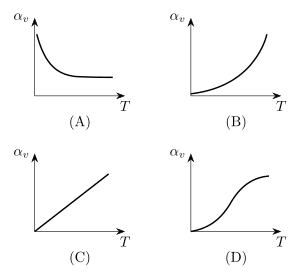
- AP EAPCET 2026Set eng-2026-05-13-AN1 markMCQQ.Which of the following graphs shows the variation of volume expansion coefficient of copper with temperature? (A) [FIGURE: graph of αv vs T — a curve starting high and decreasing, concave up, approaching a low value] (B) [FIGURE: graph of αv vs T — a curve starting near zero and increasing, concave up (rising steeply)] (C) [FIGURE: graph of αv vs T — a straight line through the origin, increasing linearly] (D) [FIGURE: graph of αv vs T — an S-shaped (sigmoid) curve rising from the origin and flattening out]
›Reveal solutionSolution
This tests knowledge of how the thermal (volume) expansion coefficient of a solid metal actually varies with absolute temperature — it is not linear, not a simple decaying curve, and not an unbounded exponential rise; it saturates, giving an S-shaped curve.
Concept and Intuition
Thermal expansion in a solid arises from the anharmonicity of interatomic bonds — as atoms vibrate more energetically, the average interatomic spacing increases. The volumetric expansion coefficient αv=V1(∂T∂V)P is, via the Grüneisen relation, proportional to the lattice specific heat capacity CV(T):
αv(T)=KVγGCV(T),
where γG (Grüneisen parameter), bulk modulus K and volume V vary slowly with temperature compared to CV(T).
The specific heat of a solid follows the well-known Debye behaviour: it is essentially zero at T→0K (vibrational modes are frozen out quantum-mechanically), rises rapidly through an intermediate temperature range, and then saturates to the classical Dulong–Petit value at high temperature (all vibrational modes fully excited classically). Since αv tracks CV(T), it shows exactly the same qualitative shape: starts near zero, rises, and flattens — an S-shaped (sigmoid) curve.
Step-by-Step Solution
- Recognise that αv(T) for a solid metal is not an independent, freely-chosen function — it is tied to the lattice heat capacity through the Grüneisen relation.
- Recall the Debye/Einstein model result for CV(T): near 0 K it goes as T3 (Debye's law), so it starts at (near) zero and curves upward slowly at first.
- At intermediate temperatures CV(T) rises quickly. …
- AP EAPCET 2026Set eng-2026-05-15-FN1 markMCQQ.If the temperature of a steel solid sphere of mass 4 kg and radius 5 cm is increased by 100C, then the increase in the moment of inertia of the sphere about its diameter is (Coefficient of linear expansion of steel = 1.2×10⁻⁵ K−1) (A) 3.6 g cm2 (B) 4.8 g cm2 (C) 2.4 g cm2 (D) 9.6 g cm2
›Reveal solutionSolution
Heating a solid sphere expands its radius; since I∝R2, a fractional change dR/R in radius produces twice that fractional change in I. Plugging in numbers gives ΔI=9.6 gcm2.
Concept and Intuition
The moment of inertia of a solid sphere about its diameter is I=52MR2. Thermal expansion changes only the geometric size R (mass is conserved), so differentiating: dI=54MRdR, which can be written as IdI=R2dR. Since linear expansion gives RdR=αΔT, we get the handy result IdI=2αΔT — the same trick used for area/volume expansion coefficients (2α for area, 3α for volume; here it's the "area-like" R2 dependence).
Step-by-Step Solution
- Convert to cgs for convenience: M=4000 g, R=5 cm.
- I=52MR2=52×4000×25=40000 g·cm². …
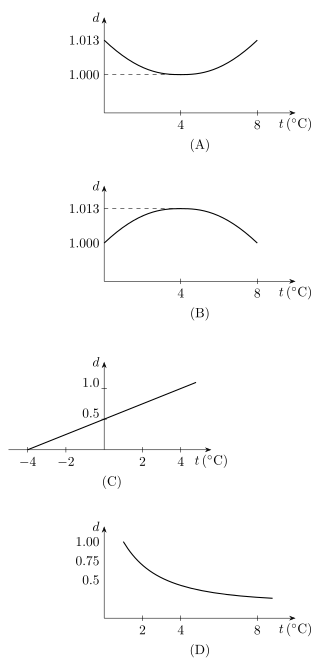
- AP EAPCET 2026Set eng-2026-05-18-FN1 markMCQQ.Which of the following graphs is correctly drawn between temperature (t) and the density(d) of water? (A) [FIGURE] (a graph of density d on the y-axis vs temperature t°C on the x-axis: the curve starts at d = 1.013 at t = 0, decreases to a minimum of d = 1.000 at t = 4, then increases again as t rises toward 8) (B) [FIGURE] (a graph of density d on the y-axis vs temperature t°C on the x-axis: the curve starts at d = 1.000 at t = 0, rises to a maximum of d = 1.013 at t = 4, then decreases as t rises toward 8) (C) [FIGURE] (a straight-line graph of density d on the y-axis vs temperature t°C on the x-axis: the line rises linearly, crossing zero density near t = -4, passing through about d = 0.5 near t = -2 and d = 1.0 near t = 4) (D) [FIGURE] (a graph of density d on the y-axis vs temperature t°C on the x-axis: the curve starts near d = 1.00 at low t and decreases steeply, asymptotically approaching about d = 0.2 as t increases toward 8)
›Reveal solutionSolution
This tests the well-known anomalous behaviour of water's density with temperature, which peaks at 4°C. Answer: option (B), the hump-shaped curve with maximum at t=4°C.
Concept and Intuition
Most liquids simply expand (density decreases) as temperature rises. Water is anomalous between 0°C and 4°C: as it warms from 0°C, hydrogen-bonded ice-like clusters break down and the water molecules pack more efficiently, so density increases up to 4°C. Above 4°C, normal thermal expansion takes over and density decreases as usual. This means density is at its maximum at 4°C, lower on both sides.
Step-by-Step Solution
- Identify the physical fact: water's density-temperature graph has a maximum at t=4°C (this is why lakes freeze from the top — 4°C water sinks to the bottom).
- This means the graph must rise from t=0 to t=4, then fall from t=4 onward — a hump (∩)-shaped curve, not a U-shape, not monotonic, and not a straight line.
- Option (A) shows a U-shape (minimum at 4°C) — this is the opposite of the real physical behaviour, so it's wrong.
- Option (B) shows exactly the hump shape (rises to a peak at t=4, then falls) — matches the real anomalous expansion of water. …
- AP EAPCET 2023Set eng-2023-05-17-AN1 markMCQQ.A steel tape of 300 cm length is graduated at 27 °C. The length of a steel rod measured using the tape is found to be 110 cm at 50 °C. The actual length of steel rod at 50 °C is (αsteel=1.2×10⁻⁵ K−1) (A) 110.03 cm (B) 110.10 cm (C) 110.07 cm (D) 110.62 cm
›Reveal solutionSolution
A tape calibrated at 27°C but used at a hotter 50°C has physically expanded, so its markings under-read the true length; correcting for that expansion gives 110.03 cm.
Concept and Intuition
A measuring tape is manufactured with its scale markings correct at a specific reference temperature (here 27°C). If used at a higher temperature, the metal expands, so the distance between successive markings (say, between the '0' and '1 cm' marks) becomes physically longer than 1 true cm. This means when the tape reads a certain length, the object it's measuring is actually slightly longer than that reading, because each 'cm' on the expanded tape now corresponds to more than a true cm.
Step-by-Step Solution
- Temperature rise from calibration: ΔT=50−27=23°C.
- Expansion factor of the tape's own markings: (1+αΔT)=1+(1.2×10⁻⁵)(23)=1+2.76×10−4=1.000276.
- Since the tape's markings have stretched, the object's true length is the tape's reading multiplied by this same expansion factor: Ltrue=Lmeasured×(1+αΔT)=110×1.000276. …
- AP EAPCET 2022Set ap-2022-07-11-FN1 markMCQQ.If we consider a rectangular sheet of the solid, the coefficient of areal expansion is (A) Half of its coefficient of linear expansion (B) Thrice of its coefficient of linear expansion (C) Twice of its coefficient of linear expansion (D) Square root of its coefficient of linear expansion
›Reveal solutionSolution
For an isotropic solid, if the linear expansion coefficient is α, the areal expansion coefficient β=2α and the volumetric expansion coefficient γ=3α.
Concept and Intuition
A rectangular sheet expands in both its length and breadth on heating; since area is a product of two linear dimensions, each of which independently grows by a factor (1+αΔT), the area grows (to first order) by twice that fractional change.
Step-by-Step Solution
- Let sides be l1,l2 initially, so A=l1l2.
- Each dimension expands: l1′=l1(1+αΔT), l2′=l2(1+αΔT).
- New area: A′=l1l2(1+αΔT)2≈l1l2(1+2αΔT) (neglecting the tiny α2 term). …
- AP EAPCET 2022Set ap-2022-07-12-AN1 markMCQQ.A steel rod of length 5 m and radius 2 cm kept at room temperature is heated to 10 °C above the room temperature. The % change in the volume is (Coefficient of linear expansion of steel =10×10−6 °C−1) (A) 0.03 (B) 0.01 (C) 0.9 (D) 1.2
›Reveal solutionSolution
For small temperature changes, the volumetric expansion coefficient is three times the linear expansion coefficient; multiplying by ΔT gives the fractional (and hence percentage) volume change.
Concept and Intuition
For an isotropic solid, if the coefficient of linear expansion is α, the coefficient of volume expansion is γ=3α (since V∝L3 and differentiating gives a factor of 3). Note that the length (5 m) and radius (2 cm) of the rod are irrelevant here — only α and ΔT matter for percentage volume change.
Step-by-Step Solution
- γ=3α=3×10×10−6=30×10−6 ∘C−1. …
- AP EAPCET 2022Set ap-2022-07-12-FN1 markMCQQ.A steel rod of length 5 m and radius 2 cm kept at room temperature is heated to 10°C above the room temperature. Then the change in the cross-sectional area of the rod. (coefficient of linear expansion of steel = 10×10−6 °C−1) (A) 0.01 % (B) 0.02 % (C) 0.03 % (D) 0.09 %
›Reveal solutionSolution
Since area scales as the square of a linear dimension, its thermal-expansion coefficient is exactly twice the linear coefficient. Answer: 0.02%.
Concept and Intuition
When every linear dimension of an object expands by a fractional amount αΔT, an area (which scales as length²) expands by approximately twice that fraction, since A=πr2 and a small relative change in r doubles when squared: (1+αΔT)2≈1+2αΔT.
Step-by-Step Solution
- The rod's cross-section is a circle of radius r, so A=πr2.
- With temperature rise ΔT, radius becomes r′=r(1+αΔT).
- New area: A′=πr′2=πr2(1+αΔT)2≈A(1+2αΔT) for small αΔT.
- So AΔA=2αΔT=2(10×10−6)(10)=2×10⁻⁴. …
- AP EAPCET 2022Set eng-2022-07-04-AN1 markMCQQ.A metal tape is calibrated at 25∘C. On a cold day when the temperature is −15∘C, the percentage error in the measurement of length is (Coefficient of linear expansion of metal =1×10⁻⁵∘C−1) (A) 0.04 % (B) 0.05 % (C) 0.1 % (D) 0.08 %
›Reveal solutionSolution
The tape's length changes by αΔT=1×10−5×40=4×10⁻⁴, i.e. a 0.04% error, because it is used at a temperature different from its calibration temperature.
Concept and Intuition
A metal tape marked at one temperature contracts or expands when used at another temperature, per ΔL=L0αΔT. The tape's markings no longer correspond to true lengths, giving a systematic percentage error equal to αΔT in magnitude.
Step-by-Step Solution
- ΔT=(−15)−25=−40∘C.
- Fractional error =∣αΔT∣=1×10−5×40=4×10⁻⁴. …
- AP EAPCET 2022Set eng-2022-07-05-FN1 markMCQQ.An iron sphere having diameter D and mass M is immersed in hot water so that the temperature of the sphere increases by δT. If α is the coefficient of linear expansion of the iron then the change in the surface area of the sphere is (A) πD2.α.δT(α.δT−4) (B) πD2.α.δT(α.δT+4) (C) πD2.α.δT(α.δT−2) (D) πD2.α.δT(α.δT+2)
›Reveal solutionSolution
This tests superficial (areal) thermal expansion, derived exactly (not using the small-expansion approximation) from linear expansion of the diameter.
Concept and Intuition
When a sphere's diameter expands linearly by a factor (1+αδT), its surface area (which scales as the square of a linear dimension) expands by the square of that factor. Expanding this square exactly (not dropping the α2δT2 term) gives the precise change in area.
Step-by-Step Solution
- Original surface area: A=πD2.
- New diameter after heating: D′=D(1+αδT).
- New surface area: A′=πD′2=πD2(1+αδT)2=πD2(1+2αδT+α2δT2).
- Change in area: ΔA=A′−A=πD2(2αδT+α2δT2).
- Factor out αδT: ΔA=πD2⋅αδT(αδT+2).
Common Mistakes …
- AP EAPCET 2022Set eng-2022-07-07-FN1 markMCQQ.The coefficient of volume expansion of a material is 5×10⁻⁴ ∘C−1. The fractional change in its density for a 40 ∘C rise in temperature is nearly (A) 0.01 (B) 0.02 (C) 0.03 (D) 0.04
›Reveal solutionSolution
This tests the relation between volume expansion and density change; the density decreases fractionally by 0.02 (2%) for this temperature rise.
Concept and Intuition
Mass is conserved as a substance is heated, but its volume expands, so density must fall. Since ρ=m/V, and V increases by a fractional amount ΔV/V=γΔT (definition of the volume expansion coefficient), a first-order (small-change) argument gives
ρ′=V(1+γΔT)m≈ρ(1−γΔT)
so the fractional decrease in density is approximately γΔT, valid when γΔT≪1.
Step-by-Step Solution
- Given γ=5×10⁻⁴ ∘C−1 and ΔT=40 ∘C.
- Fractional volume change: VΔV=γΔT=5×10−4×40=0.02.
- To first order, fractional density change has the same magnitude (opposite sign): …
🎓Unlock everything free for 14 days
- ✓Full step-by-step solutions
- ✓Concept-first explanations
- ✓Methods, shortcuts & mistakes
- ✓PYQ mapping + timed mock tests
Full access for 14 days. No credit card required.