Q.A metre-long tube open at one end, with a movable piston at the other end, shows resonance with a fixed frequency source (a tuning fork of frequency 340 Hz) when the tube length is 25.5 cm or 79.3 cm. Estimate the speed of sound in air at the temperature of the experiment. The edge effects may be neglected.
🔒You're viewing a preview — the full solution, concept, methods & PYQ mapping are locked.
🔒 Start your 14-day free trial to unlock the full solution →Concept understanding — Acoustic Resonance Harmonics
Acoustic Resonance Harmonics
Imagine pushing a child on a swing. If you push at random moments, the swing jerks but never goes high. But if you push exactly when the swing is coming back toward you — matching its natural rhythm — each small push adds to the motion, and soon the swing soars. That is resonance: a small, well-timed force builds up a large response.
Acoustic resonance is the same idea, but with sound. A guitar string, an air column in a pipe, or a wine glass each has certain natural frequencies at which it vibrates easily. When a sound wave (or a periodic push) arrives at one of those frequencies, the object absorbs energy efficiently and its vibration amplitude grows large. That build-up is acoustic resonance.
Harmonics: The Family of Natural Frequencies
An object does not have just one natural frequency — it has a whole ladder of them, called harmonics. The lowest one is the fundamental (first harmonic); the rest are related to it in a way that depends on the boundary conditions of the vibrating system. This is the point most notes skip, and it is exactly what CBSE Class 11 tests.
The statement "harmonic frequencies are whole-number multiples of the fundamental" is only true for systems that are symmetric at both ends (both fixed, or both free). It is not true for every vibrating system — a stretched drum membrane, for instance, has overtones that are not simple whole-number multiples of its fundamental, which is exactly why a drum's note sounds less "musical" than a string's.
Case 1 — Both ends fixed (a stretched string) or both ends open (an open organ pipe)
Here every harmonic is present:
fn=nf1,n=1,2,3,4,…
For a string fixed at both ends, the fundamental f1 is one loop; f2=2f1 is two loops, f3=3f1 is three loops, and so on. A pipe open at both ends behaves the same way for the air column inside it.
Case 2 — One end closed, one end open (a closed organ pipe)
The closed end must be a displacement node and the open end an antinode. That boundary condition rules out the even harmonics — only the odd multiples of the fundamental survive:
fn=nf1,n=1,3,5,7,…
This is why a closed pipe of a given length sounds an octave lower (and tonally different) than an open pipe of the same length — it is missing every even harmonic.
The Precise Statement
Acoustic resonance harmonics occur when a driving sound wave's frequency matches one of the natural frequencies of a vibrating system, causing that system to vibrate with maximum amplitude at that natural frequency. Which harmonics exist — all integers, or only odd integers — depends entirely on the boundary conditions at the two ends of the system.
Why This Matters
- A guitar string vibrates at its fundamental and several of its harmonics simultaneously; the relative strength of each harmonic gives the instrument its characteristic timbre. …
Concept: Acoustic Resonance Harmonics (Closed Pipe)
For a tube closed at one end (piston side) and open at the other, resonance occurs at lengths
Ln=(2n−1)4λ, where n=1,2,3,…
Step 1 – Identify the harmonic numbers
Given L1=25.5 cm and L2=79.3 cm.
These correspond to successive odd harmonics:
L1=4λ and L2=43λ (since 79.3≈3×25.5).
Step 2 – Find wavelength
Difference between successive resonance lengths:
L2−L1=43λ−4λ=2λ …
The problem uses resonance in a tube closed at one end (piston) and open at the other. The two given lengths correspond to successive resonance modes. The speed of sound is found from the difference in lengths: v=2f(L2−L1)=2×340×(0.793−0.255)≈366 m/s.
A tube with one end closed and the other open supports only odd harmonics of the fundamental. The closed end is a displacement node (pressure antinode), and the open end is a displacement antinode (pressure node). For a given frequency, resonance occurs when the tube length equals an odd multiple of a quarter-wavelength:
L=(2n−1)4λ,n=1,2,3,…
Here the piston acts as the closed end, and the open end is fixed. The tuning fork provides a fixed frequency f=340 Hz. As the piston is moved, resonance is observed at two different lengths: L1=25.5 cm and L2=79.3 cm. These must be successive resonance lengths for the same frequency — meaning they correspond to consecutive odd multiples of λ/4.
- Identify the mode numbers. Let L1 correspond to n=k and L2 to n=k+1 (since they are successive). Then:
L1=(2k−1)4λ,L2=(2(k+1)−1)4λ=(2k+1)4λ
- Subtract to eliminate k. The difference between the two lengths is:
L2−L1=[(2k+1)−(2k−1)]4λ=2⋅4λ=2λ
So the wavelength is twice the difference in lengths:
λ=2(L2−L1)
- Plug in the numbers. Convert cm to m: L1=0.255 m, L2=0.793 m. Then:
λ=2×(0.793−0.255)=2×0.538=1.076 m
- Use the wave equation. Speed of sound v=fλ: v=340×1.076≈365.84 m/s …
Step 1: A tube closed at one end (the piston) and open at the other resonates when its length equals an odd multiple of λ/4: Ln=(2n−1)λ/4.
Step 2: Two successive resonance lengths always differ by exactly λ/2 — this holds regardless of the (unknown) end correction, since the constant offset cancels in the subtraction: λ=2(L2−L1).
Step 3: Compute λ=2×(79.3−25.5) cm=2×53.8=107.6 cm=1.076 m. …
Showing the 12 most recent of 13 on this concept.
- AP EAPCET 2025Set eng-2025-05-23-FN1 markMCQQ.In a closed organ pipe, the number of nodes formed in fifth and ninth harmonics are respectively (A) 5, 9 (B) 3, 5 (C) 5, 7 (D) 2, 4
›Reveal solutionSolution
Only odd harmonics exist in a closed organ pipe; counting nodes along the standing wave pattern for the 5th and 9th harmonics gives 3 and 5 respectively. Answer: 3, 5.
Concept and Intuition
A closed organ pipe has a node at the closed end (air cannot move there) and an antinode at the open end (air moves freely). Only odd harmonics (n=1,3,5,7,9,…) can form standing waves satisfying these boundary conditions, with pipe length L=nλ/4. Visualizing the standing wave pattern for each harmonic, nodes and antinodes alternate starting from a node at the closed end.
Step-by-Step Solution
- For the nth harmonic (n odd) in a closed pipe, the wave pattern has nodes at positions x=0,λ/2,λ,… and antinodes at x=λ/4,3λ/4,… up to length L=nλ/4.
- Counting: nodes occur at every half-wavelength interval starting from the closed end; the total count of nodes for harmonic n is 2n+1. …
- AP EAPCET 2025Set ap-2025-05-20-AN1 markMCQQ.A closed pipe and an open pipe of same length produce 4 beats per second when they are set into vibrations simultaneously. If the lengths of both the pipes were halved, then the number of beats produced per second is (Assume same mode of vibrations in both cases) (A) 8 (B) 4 (C) 1 (D) 2
›Reveal solutionSolution
The beat frequency between a closed pipe and an open pipe of the same length equals the closed pipe's own fundamental frequency; halving the length doubles every frequency, so the beats double from 4 to 8 per second.
Concept and Intuition
For a pipe of length L carrying sound of speed v:
- Closed pipe (one end closed) fundamental: fc=4Lv
- Open pipe (both ends open) fundamental: fo=2Lv=2fc
So for pipes of equal length, the open pipe's fundamental is always exactly twice the closed pipe's fundamental. All frequencies scale as 1/L, so halving L doubles every fundamental frequency (and hence any beat frequency built from them).
Step-by-Step Solution
- With length L: fo−fc=2fc−fc=fc=4Lv. This equals the given beat frequency, so 4Lv=4 Hz.
- With length halved to L/2: new closed-pipe fundamental fc′=4(L/2)v=2Lv=2fc=8 Hz. New open-pipe fundamental fo′=2(L/2)v=Lv=4fc=16 Hz.
- New beat frequency =fo′−fc′=16−8=8 Hz. …
- AP EAPCET 2025Set ap-2025-05-20-FN1 markMCQQ.If the third harmonic of a closed pipe is in resonance with fourth harmonic of an open pipe, then the ratio of the lengths of the closed and open pipes is (A) 8 : 3 (B) 3 : 8 (C) 3 : 4 (D) 4 : 3
›Reveal solutionSolution
Equating the third-harmonic frequency of a closed pipe with the fourth-harmonic frequency of an open pipe gives a length ratio Lclosed:Lopen=3:8.
Concept and Intuition
A closed (one end closed) pipe supports only odd harmonics, with the n-th harmonic (n=1,3,5,…) at frequency fn=4Lnv. An open (both ends open) pipe supports all harmonics, with the n-th harmonic at fn=2Lnv. Setting the given harmonic frequencies equal (resonance condition) lets us directly compare the two pipe lengths.
Step-by-Step Solution
- Closed pipe, third harmonic (n=3, valid since closed pipes only have odd harmonics):
fc=4Lc3v
- Open pipe, fourth harmonic (n=4):
fo=2Lo4v=Lo2v
- Resonance condition: fc=fo
4Lc3v=Lo2v⟹3Lo=8Lc⟹LoLc=83
- So Lc:Lo=3:8.
Common Mistakes …
- AP EAPCET 2024Set ap-2024-05-17-FN1 markMCQQ.A metal rod of 50 cm length is clamped at its midpoint and is set to vibrations. The density of that metal is 2×10² kgm−3. Young's modulus of that metal is 8×10⁸ Nm−2. Fundamental frequency of the vibration is. (A) 2500 Hz (B) 2 kHz (C) 2.75 kHz (D) 200 Hz
›Reveal solutionSolution
A rod clamped at its middle vibrates with a node at the centre and antinodes at both ends; its fundamental frequency is f=v/(2L) with v=Y/ρ. Answer: (B) 2 kHz.
Concept and Intuition
Longitudinal standing waves in a rod are governed by the same wave equation as sound, with speed v=Y/ρ (Y= Young's modulus, ρ= density). Clamping the rod at its midpoint forces a node (zero displacement) there, while the two free ends must be antinodes (maximum displacement) — this is exactly analogous to a rod free at both ends but forced through the middle. The distance from the centre to each free end is a quarter wavelength (λ/4) in the fundamental mode, so the whole rod length L corresponds to λ/2 ... equivalently the full length matches half of a full standing wave pattern that repeats over 2L — giving the standard textbook result f=v/(2L) for this configuration.
Step-by-Step Solution
- Compute the longitudinal wave speed in the rod: v=ρY=2×1028×108=4×106=2000 m/s. …
- AP EAPCET 2024Set eng-2024-05-20-AN1 markMCQQ.A pipe with 30 cm Length is open at both ends. Which harmonic mode of the pipe resonates a 1.65 kHz source? (Velocity of sound in air =330 ms−1) (A) 2 (B) 3 (C) 3.5 (D) 2.5
›Reveal solutionSolution
The fundamental frequency of the 30 cm open pipe is 550 Hz; 1650 Hz=3×550 Hz is exactly its third harmonic.
Concept and Intuition
A pipe open at both ends supports standing waves with antinodes at both open ends, allowing all harmonics (unlike a pipe closed at one end, which allows only odd harmonics). The resonant frequencies are integer multiples of the fundamental 2Lv.
Step-by-Step Solution
- Fundamental frequency: f1=2Lv=2×0.30330=0.6330=550 Hz.
- General harmonic: fn=nf1=550n Hz.
- Set equal to the source: 550n=1650⟹n=3. …
- AP EAPCET 2024Set eng-2024-05-22-AN1 markMCQQ.The fundamental frequency of an open pipe is 100 Hz. If the bottom end of the pipe is closed and 31rd of the pipe is filled with water, then the fundamental frequency of the pipe is (A) 200 Hz (B) 100 Hz (C) 75 Hz (D) 150 Hz
›Reveal solutionSolution
Filling part of an open pipe with water turns it into a shorter closed pipe; recompute the fundamental frequency for the new closed-pipe length.
Concept and Intuition
An open pipe of length L has both ends free to vibrate (antinodes at both ends), giving a fundamental f=v/2L. Once the bottom is sealed and water fills the lower third, the water surface behaves as a rigid, closed boundary (a node), while the top remains open (an antinode). The air column relevant to the vibration is now only the top two-thirds of the pipe, and it behaves exactly like a closed pipe of that shorter length, whose fundamental is f=v/4L′ (one quarter wavelength fits in the tube).
Step-by-Step Solution
- Original open pipe: f0=2Lv=100 Hz⇒Lv=200.
- After filling: water occupies the bottom 31 of length L; the remaining air column length is L′=32L, closed at the water surface and open at the top. …
- AP EAPCET 2024Set eng-2024-05-22-FN1 markMCQQ.The vibrations of four air columns are shown below. The ratio of frequencies is [FIGURE] (four sub-diagrams labelled (a)-(d), each of length L, showing standing-wave loop patterns of vibrating air columns with different numbers of loops/nodes) (A) 1:2:3:4 (B) 1:3:2:4 (C) 1:4:3:2 (D) 1:4:2:3
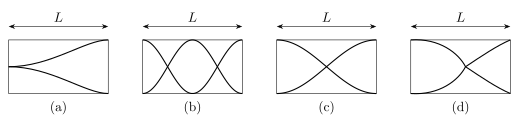
›Reveal solutionSolution
Each drawn air-column pattern corresponds to a specific closed-open or open-open pipe harmonic; reading off nodes/antinodes gives frequencies in the ratio 1:4:2:3.
Concept and Intuition
Standing waves in an air column must have a displacement NODE at any closed end and a displacement ANTINODE at any open end. The distance between successive nodes (or antinodes) is λ/2, and a full 'loop' pattern from node-to-node or antinode-to-antinode always spans λ/2. Reading the boundary conditions and the number of internal nodes/antinodes off a drawn vibration pattern directly tells us how many quarter- or half-wavelengths fit in the fixed length L, and hence the frequency (since f=v/λ).
Step-by-Step Solution
- (a): starts as a single point at the left edge (a node — closed end) and flares out to touch both top and bottom at the right edge (an antinode — open end), with no other nodes in between. This is exactly ONE quarter-wavelength: L=λa/4⇒λa=4L, so fa=v/4L.
- (b): touches both left and right edges fully (antinodes at both ends, open–open pipe) and has two internal crossing points (nodes) at L/4 and 3L/4, i.e. antinodes at 0,L/2,L — three antinodes, two loops. This is the open-open pipe's 2nd harmonic: L=λb⇒fb=v/L=4(4Lv)=4fa.
- (c): touches both edges (antinodes at both ends — open-open) with a SINGLE crossing (node) exactly at the centre — this is the open-open pipe's fundamental (one full loop, half wavelength across L): L=λc/2⇒fc=v/2L=2fa. …
- AP EAPCET 2024Set eng-2024-05-23-FN1 markMCQQ.The frequency of fifth harmonic of a closed pipe is equal to the frequency of third harmonic of an open pipe. If the length of the open pipe is 72 cm, then the length of the closed pipe is (A) 60 cm (B) 45 cm (C) 30 cm (D) 75 cm
›Reveal solutionSolution
Equating the closed pipe's 5th-harmonic frequency to the open pipe's 3rd-harmonic frequency and solving for the closed pipe's length gives 60 cm.
Concept and Intuition
A closed pipe supports only odd harmonics with frequency fn=nv/4L (n=1,3,5,…), while an open pipe supports all harmonics with fn=nv/2L. Setting the two given harmonic frequencies equal (same speed of sound v in both) lets us solve directly for the unknown length.
Step-by-Step Solution
- Closed pipe, 5th harmonic: f=4Lc5v.
- Open pipe, 3rd harmonic: f=2Lo3v, with Lo=72 cm.
- Equate: 4Lc5v=2×723v=1443v.
- Cross-multiply: 5×144=4Lc×3⇒720=12Lc⇒Lc=60 cm. …
- AP EAPCET 2022Set ap-2022-07-11-AN1 markMCQQ.A pipe of length 80 cm is open at both the ends. A second pipe, closed at one end, has the same fundamental frequency as the open pipe. The length of the second pipe is (A) 80 cm (B) 160 cm (C) 40 cm (D) 120 cm
›Reveal solutionSolution
Matching the fundamental frequencies of an open pipe and a closed pipe shows the closed pipe must be exactly half as long.
Concept and Intuition
An open-open pipe of length L supports a fundamental with wavelength 2L, so fopen=v/2L. A pipe closed at one end supports a fundamental with wavelength 4L′ (a quarter-wave resonance), so fclosed=v/4L′. Setting the two frequencies equal (same fundamental) directly compares L and L′.
Step-by-Step Solution
- fopen=2(80)v=160v.
- fclosed=4L′v. …
- AP EAPCET 2022Set ap-2022-07-12-FN1 markMCQQ.A music system playing a loud music is kept on a table. If a glass of water is kept on the same table, the glass vibrates and generates ripples in the water. This is due to a property known as (A) Reflection of the sound (B) Refraction of the sound (C) Reverberation of the sound (D) Resonance of the sound
›Reveal solutionSolution
A glass on a table vibrating and rippling water when loud music plays nearby is a textbook case of resonance — the sound wave's frequency matching a natural vibration mode of the glass. Answer: Resonance.
Concept and Intuition
Every object has natural frequencies at which it vibrates most easily. When an external periodic driving force (here, sound pressure waves from the speaker, transmitted through the table) has a frequency at or near one of these natural frequencies, the object absorbs energy efficiently and its vibration amplitude grows dramatically. This amplitude build-up under a matching driving frequency is called resonance, and it's why the glass visibly shakes and ripples the water even though it isn't touched.
Step-by-Step Solution
- The sound from the music system is a mechanical (pressure) wave that also propagates through the table into the glass.
- Reflection would just mean the sound wave bounces off a surface — it doesn't explain amplitude buildup in the glass itself.
- Refraction concerns bending of sound crossing between media — irrelevant here.
- Reverberation is about persistence of sound in a room due to multiple reflections — not about a glass shaking. …
- AP EAPCET 2022Set eng-2022-07-08-FN1 markMCQQ.An open air pipe of length 80 cm has the second harmonic frequency equal to the fundamental frequency of a closed organ air pipe. The length of the closed pipe is (A) 20 cm (B) 40 cm (C) 60 cm (D) 10 cm
›Reveal solutionSolution
Matches an open pipe's second harmonic to a closed pipe's fundamental; solving gives the closed pipe length as 20 cm.
Concept and Intuition
An open (both ends open) pipe supports all harmonics, fn=2Lnv, while a closed (one end closed) pipe supports only odd harmonics of its fundamental, fn=4L(2n−1)v, with fundamental f1′=4L′v. Matching a harmonic of one pipe to a harmonic of the other lets us solve for an unknown length, with the speed of sound v cancelling out.
Step-by-Step Solution
- Open pipe, length L=80cm=0.8m: second harmonic f2=2L2v=Lv=0.8v.
- Closed pipe, unknown length L′: fundamental f1′=4L′v. …
- AP EAPCET 2021Set eng-2021-08-23-FN1 markMCQQ.A string is divided into three segments, so that the segment possesses fundamental frequencies in the ratio 1:2:3. Then, the length of the segments are in the ratio ________ (A) 6:3:2 (B) 4:3:2 (C) 4:2:1 (D) 3:2:1
›Reveal solutionSolution
Fundamental frequency is inversely proportional to segment length (same string, same tension), so frequencies 1:2:3 correspond to lengths 6:3:2.
Concept and Intuition
A vibrating string segment fixed at both ends has fundamental frequency f=2Lv, where v=T/μ is the wave speed determined by the tension T and linear mass density μ. Since all three segments come from the SAME string (same tension throughout, same material/density), v is identical for all three — so frequency depends only on length, and f∝1/L.
Step-by-Step Solution
- f∝L1 for fixed v, so L∝f1.
- Given f1:f2:f3=1:2:3, the lengths satisfy L1:L2:L3=11:21:31. …
🎓Unlock everything free for 14 days
- ✓Full step-by-step solutions
- ✓Concept-first explanations
- ✓Methods, shortcuts & mistakes
- ✓PYQ mapping + timed mock tests
Full access for 14 days. No credit card required.