Q.The amino acid attaches to the tRNA at its:
🔒You're viewing a preview — the full solution, concept, methods & PYQ mapping are locked.
🔒 Start your 14-day free trial to unlock the full solution →Concept understanding — Template Strand Transcription
Template Strand Transcription: A First Look
Imagine you have a master recipe book written in a language only the head chef can read. To share a recipe with the kitchen staff, you don't hand them the original book — you make a working copy on a separate sheet, using the original as your guide. That original page you read from is the template. The copy you produce is the transcript.
In a cell, the master recipe book is DNA. It holds all the instructions for making proteins, which do almost everything in your body. But DNA never leaves the nucleus — it's too precious and too large. So the cell makes a temporary, portable copy of a specific instruction. That copy is called messenger RNA (mRNA).
The process of making this mRNA copy is transcription. And the strand of DNA that is actually read to make the copy is called the template strand.
The Precise Meaning
DNA is a double helix — two strands twisted together. During transcription, the cell unzips a small section of this helix. Only one of the two strands serves as the blueprint. That strand is the template strand. The other strand, called the coding strand (or non-template strand), is not read — it just sits there, matching the sequence of the mRNA that gets made (with one chemical difference: DNA uses T, RNA uses U).
So the template strand is the actual DNA sequence that RNA polymerase (the enzyme that does the copying) reads and uses to build a complementary mRNA molecule.
Think of the template strand as the negative of a photograph. The mRNA is the print made from that negative. The coding strand is like a second print that happens to look almost identical to the final photo — but it wasn't used to make it.
Why It Matters
- Accuracy: The cell must read the correct strand. If it read the wrong one, the mRNA would be nonsense and the protein would be wrong or non-functional.
- Direction: RNA polymerase reads the template strand in the 3' to 5' direction, and builds mRNA in the 5' to 3' direction. This is a fixed rule — like reading a sentence left to right.
- Gene regulation: Which strand is the template for a given gene is fixed. But different genes on the same DNA molecule may use different strands as their template. So a single stretch of DNA can contain genes pointing in opposite directions.
A Simple Example
Suppose a short stretch of DNA has these two strands:
- Strand A:
ATGCGT - Strand B:
TACGCA
If Strand A is the template, the mRNA made will be complementary to it: UACGCA (remember, U replaces T in RNA).
If Strand B is the template, the mRNA will be complementary to B: AUGCGU.
The two mRNAs are completely different. So the cell must know, for each gene, which strand is the template. That information is encoded in the DNA sequence itself — in the promoter region that tells RNA polymerase where to start and which way to go.
The template strand is not the same as the coding strand. The mRNA sequence is identical to the coding strand (with U instead of T), but it is complementary to the template strand. This is a common confusion — the mRNA looks like the coding strand, but it was built from the template strand.
What NCERT Says …
The tRNA molecule has a characteristic cloverleaf secondary structure that folds into an L-shaped three-dimensional form. At one end of this L-shape lies the anticodon loop, which recognizes and pairs with the complementary codon on mRNA during translation. At the opposite end sits the acceptor arm, formed by the 5' and 3' ends of the tRNA molecule coming together.
The amino acid attachment site is always located at the 3'-end of the tRNA, specifically at the CCA sequence that terminates every mature tRNA molecule. The enzyme aminoacyl-tRNA synthetase catalyzes the formation of an ester bond between the carboxyl group of the amino acid and the 3'-OH group of the terminal adenosine nucleotide. This creates an aminoacyl-tRNA, also called a charged tRNA, ready to deliver its amino acid to the ribosome. …
The amino acid attaches to the tRNA molecule at its 3'-end, where a specific CCA sequence provides the attachment site.
Transfer RNA molecules are the adaptor molecules that bridge the language of nucleic acids and proteins during translation. To understand where an amino acid binds, we need to look at the structure of tRNA itself.
A tRNA molecule folds into a characteristic cloverleaf structure in two dimensions, which further twists into an L-shaped three-dimensional form. This structure has several key regions: the acceptor arm at one end, the anticodon loop at the opposite end, and additional loops (the D loop or DHU loop, and the TψC loop) in between. Each region serves a distinct purpose in the translation machinery.
The acceptor arm is formed by the 5'-end and 3'-end of the tRNA strand coming together and base-pairing. Crucially, the 3'-end always terminates in a CCA sequence—these three nucleotides (cytosine-cytosine-adenine) are universal across all tRNAs. The amino acid attaches specifically to the adenine nucleotide at this 3'-end through an ester bond between the carboxyl group of the amino acid and the 3'-OH group of the ribose sugar.
The enzyme aminoacyl-tRNA synthetase catalyzes this attachment reaction, and each synthetase is specific to one amino acid and its corresponding tRNA molecules. This ensures the correct pairing. …
Anchor the answer to a single universal landmark rather than the whole cloverleaf structure: every mature tRNA molecule, regardless of which amino acid it carries, ends in the same terminal sequence, …CCA-3'. It is the free 3'-OH of this terminal adenosine that forms the ester bond to the amino acid. Because this CCA motif is universal and always sits at the 3'- …
- AP EAPCET 2026Set ap-2026-05-19-AN1 markMCQQ.Match the following Column-I: A - Sigma factor; B - Rho factor; C - Capping; D - Tailing Column-II: I - Termination of transcription; II - Initiation of transcription; III - Addition of adenylates to 3' end of hn-RNA; IV - Addition of methyl guanosine triphosphate to 5' end of hn-RNA (A) A-II, B-I, C-IV, D-III (B) A-II, B-I, C-III, D-IV (C) A-III, B-I, C-II, D-IV (D) A-IV, B-III, C-II, D-I
›Reveal solutionSolution
Sigma factor = initiation, Rho factor = termination, capping = 5' methyl-G cap, tailing = 3' poly-A tail. Answer: (A) A-II, B-I, C-IV, D-III.
Concept and Intuition
Bacterial transcription and eukaryotic hnRNA processing each have well-defined molecular "tags" for their respective steps. In bacteria, RNA polymerase's core enzyme needs an accessory sigma (σ) subunit to recognise the promoter sequence and correctly begin (initiate) transcription; once transcription is underway, some genes are terminated with the help of a separate rho (ρ) protein that recognises specific termination signals (rho-dependent termination), as opposed to intrinsic (rho-independent) termination via hairpin structures. Separately, eukaryotic primary transcripts (hnRNA) are processed at both ends before becoming mature mRNA: a 5' cap (7-methylguanosine triphosphate) is added for ribosome recognition and mRNA stability, and a 3' poly-A tail (chain of adenylate residues) is added for stability and export.
Step-by-Step Solution
- A. Sigma factor → helps initiate transcription by recognising the promoter ⇒ II (Initiation of transcription). …
- AP EAPCET 2026Set ap-2026-05-20-AN1 markMCQQ.What would be the nitrogen base sequences in the m-RNA formed by the given DNA segment. 31 ATGCAGCATGACCGA 51 51 TACGTCGTACTGGCT 31 (A) 31 UACGUCGUACUGGCU 51 (B) 51 AUGCAGCAUGACCGA 31 (C) 51 UACGUCGUACUGGCU 31 (D) 31 AUGCAGCAUGACCGA 51
›Reveal solutionSolution
This tests transcription mechanics: identifying the template strand and correctly
building an antiparallel, complementary mRNA (U replacing T) from it — the answer
is 5′ UACGUCGUACUGGCU 3′, option (C).
Concept and Intuition
DNA is double stranded and antiparallel. During transcription, RNA polymerase binds
one strand — the template (antisense) strand — and reads it 3′→5′,
synthesising the new mRNA 5′→3′ by adding bases complementary to the template.
Because the mRNA is synthesised complementary and antiparallel to the template, it
ends up with the same sequence and same polarity as the other (coding/sense) strand, except that U replaces T. So the fastest, safest way to get the mRNA is:
find the coding strand (the one not used as template) and simply swap T for U —
you do not need to complement it again.
Step-by-Step Solution
- Write the two strands as given: Strand 1: 3′-ATGCAGCATGACCGA-5′ Strand 2: 5′-TACGTCGTACTGGCT-3′
- Verify they are a genuine complementary antiparallel pair by checking each position lines up as A–T or G–C — they do, confirming this is one real double helix segment.
- Take Strand 1 (written 3′→5′) as the template strand — this is the strand RNA polymerase reads in the 3′→5′ direction.
- The mRNA is synthesised complementary and antiparallel to Strand 1, i.e. it must run 5′→3′ and pair A–U, T–A, G–C, C–G against Strand 1's bases. Doing this base by base reproduces exactly Strand 2's sequence, read 5′→3′, with U for T.
- Strand 2 5′→3′ is TACGTCGTACTGGCT; converting T→U gives 5′-UACGUCGUACUGGCU-3′ — this matches option (C). …
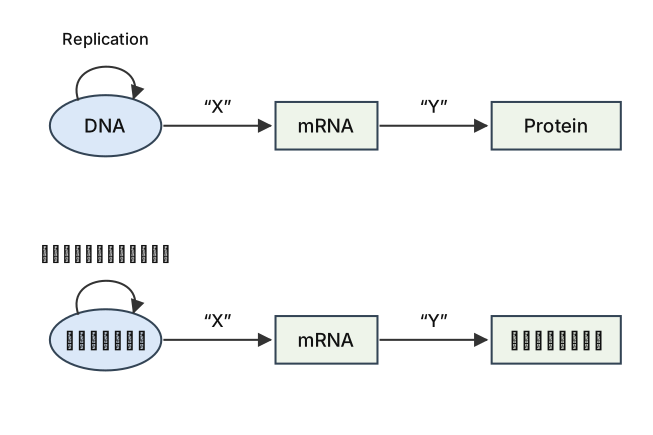
- AP EAPCET 2024Set ap-2024-05-16-FN1 markMCQQ.Diagram represents central dogma of molecular biology. Choose the correct labelling of "X" and "Y". [FIGURE] (a schematic showing DNA with a curved arrow labelled "Replication" looping back onto itself; DNA leads via an arrow labelled "X" to mRNA; mRNA leads via an arrow labelled "Y" to Protein) (A) Translation, Transcription (B) Translocation, Transcription (C) Transcription, Replication (D) Transcription, Translation
›Reveal solutionSolution
The central dogma describes the flow of genetic information: DNA → RNA → Protein. Here, X is Transcription (DNA to mRNA) and Y is Translation (mRNA to Protein), so the correct option is (D).
The central dogma of molecular biology, first articulated by Francis Crick, is the fundamental framework for how genetic information flows in a cell. It states that information is stored in DNA, then passed to an intermediate messenger (mRNA) through a process called transcription, and finally that messenger is used to build a protein through translation. The diagram shows exactly this flow: DNA → mRNA → Protein. The curved arrow labeled "Replication" looping back to DNA is a separate process (copying DNA for cell division), not part of the X→Y path.
Let’s walk through the reasoning step by step:
-
Identify the flow in the diagram
The diagram shows three main molecules: DNA, mRNA, and Protein. The arrow from DNA to mRNA is labeled “X”, and the arrow from mRNA to Protein is labeled “Y”. The curved arrow from DNA back to itself is already labeled “Replication” — that’s the process of making a copy of DNA.
-
Recall the two key processes in the central dogma
- Transcription: The synthesis of mRNA from a DNA template. This happens in the nucleus (in eukaryotes) and uses RNA polymerase.
- Translation: The synthesis of a protein from an mRNA template. This happens on ribosomes, using tRNA and amino acids.
-
Match the processes to the arrows
- The arrow from DNA to mRNA (X) must be Transcription, because that’s how genetic information is copied into a messenger RNA.
- The arrow from mRNA to Protein (Y) must be Translation, because that’s how the mRNA sequence is decoded into a polypeptide chain.
-
Eliminate incorrect options
- (A) Translation, Transcription — reverses the order; wrong. …
-
- AP EAPCET 2022Set ap-2022-07-11-FN1 markMCQQ.Basing on the below representation of Central Dogma – Genetic information flows from Replication: DNA --[1]--> [2] --[3]--> [4] (A) 1. Translation 2. t-RNA 3. Transcription 4. RNA (B) 1. Transcription 2. r-RNA 3. RNA 4. Translation (C) 1. Transcription 2. m-RNA 3. Translation 4. Protein (D) 1. Primer 2. hn-RNA 3. Transcription 4. Aminoacid
›Reveal solutionSolution
This tests the basic Central Dogma sequence; the answer fills the blanks as Transcription → mRNA → Translation → Protein.
Concept and Intuition
The Central Dogma of molecular biology describes the normal, one-directional flow of genetic information: the DNA sequence is first copied into a messenger RNA molecule (transcription), and that mRNA is then read by ribosomes to synthesise a polypeptide/protein (translation). This is the universal information pathway in gene expression.
Step-by-Step Solution
- Step [1], DNA to [2]: DNA is copied into RNA via the process of Transcription.
- [2] itself must be messenger RNA (m-RNA), since it is this RNA that carries the coding information for a protein.
- Step [3], [2] to [4]: m-RNA is decoded by ribosomes to build a polypeptide, via the process of Translation.
- [4] is the final product: Protein.
- So the sequence is DNA --(Transcription)--> m-RNA --(Translation)--> Protein, exactly matching option (C). …
- AP EAPCET 2021Set ap-2021-10-05-FN1 markMCQQ.Number of adenylate residues added at 3′ end of hnRNA ________ (A) 200−300 (B) 300−400 (C) 400−500 (D) 100−200
›Reveal solutionSolution
This tests a factual detail of hnRNA post-transcriptional processing — 3' end polyadenylation — and the answer is 200–300 adenylate residues.
Concept and Intuition
Eukaryotic mRNA is not translation-ready right after transcription; the primary transcript (hnRNA) is processed. Three key steps occur: capping at the 5' end (addition of unusual nucleotide, GTP), splicing (removal of introns, exon joining), and tailing at the 3' end (addition of adenylate residues — the poly-A tail). The poly-A tail protects the mRNA from degradation and assists in nuclear export and translation efficiency.
Step-by-Step Solution
- hnRNA undergoes three main processing events: 5' capping, splicing, and 3' polyadenylation.
- Polyadenylation adds a stretch of adenylate (adenine nucleotide) residues at the free 3'-OH end of the transcript. …
🎓Unlock everything free for 14 days
- ✓Full step-by-step solutions
- ✓Concept-first explanations
- ✓Methods, shortcuts & mistakes
- ✓PYQ mapping + timed mock tests
Full access for 14 days. No credit card required.