Q.In the medium where E. coli was growing, lactose was added, which induced the lac operon. Then, why does lac operon shut down some time after addition of lactose in the medium?
🔒You're viewing a preview — the full solution, concept, methods & PYQ mapping are locked.
🔒 Start your 14-day free trial to unlock the full solution →Concept understanding — Lac Operon Catabolite Repression
Imagine you are a factory manager. You have two raw materials: a high-grade fuel that your machines run on perfectly, and a low-grade backup fuel that works but is harder to use. As long as the good fuel is available, you would never waste time and energy switching to the backup. But if the good fuel runs out, you immediately switch to the backup to keep production going.
That is exactly what catabolite repression does inside a bacterium like E. coli. It is the cell's way of saying: "Use the best fuel first; don't bother with the second-best until you absolutely have to."
The Two Fuels: Glucose and Lactose
E. coli bacteria love glucose. It is their favourite energy source — easy to break down, gives quick energy. Lactose (milk sugar) is harder to digest; the cell needs to build special enzymes (like β-galactosidase) to break it down. These enzymes are coded by the lac operon.
The cell has a simple rule: If glucose is present, do not waste energy making lactose-digesting enzymes. That is catabolite repression. It is a global regulatory mechanism that ensures glucose is used first, even when lactose is also available.
Catabolite repression is sometimes called the glucose effect. It is not unique to the lac operon — it affects many operons that break down alternative sugars. But the lac operon is the classic textbook example.
How It Works: The Molecular Switch
The key player is a molecule called cAMP (cyclic AMP). Its level inside the cell is inversely related to glucose concentration:
- When glucose is high: cAMP levels are low.
- When glucose is low: cAMP levels rise.
cAMP binds to a protein called CAP (Catabolite Activator Protein). The cAMP–CAP complex then binds to a specific site near the lac operon's promoter. This binding dramatically increases the rate of transcription — it is like pressing the accelerator pedal.
So here is the logic:
- Glucose present (high): Low cAMP → CAP cannot bind → lac operon is barely transcribed, even if lactose is around. The cell ignores lactose.
- Glucose absent (low): High cAMP → CAP binds → lac operon is fully activated. Now, if lactose is also present, the operon switches on fully and the cell digests lactose.
Catabolite repression is a positive control mechanism. The CAP–cAMP complex activates transcription. This is different from the lac repressor, which blocks transcription when lactose is absent. The lac operon is controlled by two switches: a negative one (repressor) and a positive one (CAP–cAMP). Both must be in the "on" position for maximum expression.
Why It Matters (Exam Perspective)
The NCERT textbook (Class 12 Biology, Chapter 6) presents catabolite repression as a fine-tuning mechanism. It explains that even when the lac repressor is removed (by lactose binding), transcription is still low unless glucose is absent. The CAP–cAMP complex is the "second key" that unlocks full expression.
Key points to remember for exams: …
The lac operon shuts down after some time because lactose in the medium gets used up. Once the available lactose is consumed, the inducer (allolactose) is no longer formed. Without allolactose, the lac repressor becomes active again and binds to the operator, blocking transcription.
- Lactose is converted to allolactose, which inactivates the repressor.
- As lactose depletes, allolactose levels fall.
- The repressor rebinds the operator, stopping transcription. …
The lac operon shuts down after lactose is added because lactose gets used up, and the inducer (allolactose) disappears, allowing the repressor to bind again and stop transcription.
The lac operon is a classic example of an inducible gene system in E. coli. When the bacterium is placed in a medium containing only glucose, the operon remains off because glucose represses it via catabolite repression. But when lactose is added and glucose is absent, the operon is induced — the repressor is inactivated by allolactose (an isomer of lactose), and transcription proceeds. This allows the cell to produce the enzymes needed to break down lactose.
However, the induction is not permanent. The operon shuts down some time after lactose addition because the very process it enables — lactose utilisation — removes the inducer. As the bacterial population grows and consumes the available lactose, the concentration of lactose in the medium falls. When lactose levels drop, the amount of allolactose inside the cell also declines. Without allolactose to bind and inactivate the repressor, the repressor protein becomes active again. It then binds to the operator region of the lac operon, physically blocking RNA polymerase from transcribing the structural genes.
This is a beautiful example of negative feedback: the product of the induced pathway (lactose breakdown) eventually removes the signal that turned the pathway on. …
Trace it as a negative-feedback loop diagram rather than a sequential story: lactose (input) -> allolactose (inducer) -> inactivated repressor -> transcription -> lactose consumed (output feeds back to reduce the input). Once you see that the operon's own product (enzymes that consume lactose) removes the very signal tha …
- AP EAPCET 2026Set ap-2026-05-19-AN1 markMCQQ.Gene 'y' in the Lac operon synthesizes the following protein/enzyme. (A) Transacetylase (B) Permease (C) β-galactosidase (D) Repressor
›Reveal solutionSolution
In the lac operon's z-y-a gene cluster, gene y (lacY) encodes permease, the membrane transporter that brings lactose into the cell. Answer: (B) Permease.
Concept and Intuition
The lac operon (Jacob and Monod's model of inducible gene regulation) has a single promoter-operator controlling three structural genes transcribed as one polycistronic mRNA: lacZ (β-galactosidase, hydrolyses lactose into glucose + galactose and also converts some lactose to allolactose, the real inducer), lacY (permease, transports lactose across the cell membrane into the cytoplasm), and lacA (transacetylase, whose exact metabolic role is less central but is transcribed along with z and y). The repressor protein, coded by the separate lacI gene (with its own independent promoter), binds the operator to block transcription in the absence of lactose.
Step-by-Step Solution
- Identify the gene naming convention: lacZ, lacY, lacA correspond to β-galactosidase, permease, and transacetylase respectively.
- Gene 'y' = lacY → codes for permease. …
- AP EAPCET 2026Set ap-2026-05-20-AN1 markMCQQ.During the expression of Lac operon, the repressor protein binds to (A) Promoter (B) Operator (C) Inducer (D) Terminator
›Reveal solutionSolution
This tests the basic mechanism of negative regulation in the lac operon: the
repressor's binding site is the operator, not the promoter, inducer, or terminator.
Concept and Intuition
The lac operon is a classic example of negative inducible regulation. The lacI
gene constitutively produces a repressor protein. In the absence of lactose (the
inducer), this repressor binds the operator — a DNA sequence that overlaps/lies
next to the promoter — and this bound repressor sterically blocks RNA polymerase
from moving from the promoter into the structural genes, so transcription is
switched off. When lactose (via allolactose) is present, it binds the repressor,
changes its shape, and the repressor can no longer bind the operator, so RNA
polymerase transcribes lacZ, lacY, lacA freely.
Step-by-Step Solution
- Identify the four choices as operon elements: Promoter (where RNA polymerase binds), Operator (the repressor's binding site), Inducer (lactose/allolactose, which binds the repressor, not DNA), Terminator (where transcription ends).
- Recall the definition of the operator: a DNA sequence whose occupation by the repressor blocks transcription initiation.
- The repressor protein's job, by definition, is to bind the operator — this is the textbook mechanism of lac operon repression. …
- AP EAPCET 2024Set ap-2024-05-16-AN1 markMCQQ.Assertion (A): Lac mRNA is synthesized in the presence of inducer Reason (R): The activity of repressor protein is suppressed by inducer (A) A and R are correct. R is the correct explanation of A (B) A and R are correct. R is not the correct explanation of A (C) A is correct but R is incorrect (D) A is incorrect but R is correct
›Reveal solutionSolution
Inducer binding inactivates the lac repressor, which is exactly why lac mRNA is only made when an inducer is present; R correctly explains A.
Concept and Intuition
The lac operon is the classic model of inducible gene regulation in bacteria. In the absence of an inducer, the repressor protein (encoded by the i gene) binds tightly to the operator region, physically blocking RNA polymerase from transcribing the structural genes (z, y, a), so lac mRNA is not made. When an inducer (allolactose, a derivative of lactose, or synthetic analogs like IPTG) is present, it binds to the repressor, causing a conformational change that reduces the repressor's affinity for the operator. The repressor then falls off the operator, RNA polymerase gains access, and transcription of the lac structural genes (hence lac mRNA synthesis) proceeds.
Step-by-Step Solution
- Assertion: lac mRNA is synthesized in the presence of inducer - true, this is the defining feature of an inducible operon.
- Reason: inducer suppresses repressor activity - true, this is the actual molecular mechanism (inducer binds repressor, changing its conformation). …
- AP EAPCET 2024Set ap-2024-05-16-AN1 markMCQQ.In Lac Operon Z, Y, a and i indicates the following codes (A) β galactosidase, permease, transacetylase, repressor (B) Inducer, promoter, operator, repressor (C) trp, ara, his, val (D) Promoter, operator, repressor, inducer
›Reveal solutionSolution
The lac operon's z, y, and a genes encode beta-galactosidase, permease, and transacetylase respectively, while the i gene encodes the repressor protein.
Concept and Intuition
The lac operon of E. coli is organised as a cluster of structural genes under the control of a single promoter/operator, plus a separate regulatory gene. The z gene encodes beta-galactosidase, the enzyme that cleaves lactose into glucose and galactose (and also catalyses the conversion of lactose into the actual inducer, allolactose). The y gene encodes permease, a membrane transport protein that actively pumps lactose into the bacterial cell. The a gene encodes transacetylase, whose exact physiological role is less central but is thought to detoxify non-metabolisable thiogalactosides. The i gene, positioned upstream, is the regulatory gene that codes for the lac repressor protein, which binds the operator to control transcription of z, y, and a.
Step-by-Step Solution
- Identify z gene product: beta-galactosidase (lactose-hydrolysing enzyme).
- Identify y gene product: permease (lactose transporter).
- Identify a gene product: transacetylase.
- Identify i gene product: repressor protein (regulatory, controls the operon). …
- AP EAPCET 2023Set ap-2023-05-23-AN1 markMCQQ.Lac Operon concept is introduced by these bio chemist and geneticist (A) Mendel & Butler (B) Monad & Jacob (C) Jacob & Monad (D) Jacob & Sutton
›Reveal solutionSolution
This tests who proposed the lac operon model and matches the given order ("biochemist and geneticist") to the correct names: Monod (biochemist) and Jacob (geneticist).
Concept and Intuition
The operon concept — a cluster of structural genes under the control of a common promoter/operator, switched on or off as a unit — was proposed in 1961 by François Jacob and Jacques Monod, based on their work on the lac operon of E. coli. Monod was primarily a biochemist who had studied bacterial growth kinetics and enzyme induction (diauxic growth, allostery), while Jacob was a geneticist who worked on bacterial conjugation and gene transfer with Élie Wollman. Together they explained how lac genes (lacZ, lacY, lacA) are coordinately regulated by a repressor protein and an operator sequence.
Step-by-Step Solution
- Identify the two scientists credited with the lac operon concept: Jacob and Monod.
- Assign roles: Monod = biochemist (enzyme/metabolic studies); Jacob = geneticist (gene transfer/genetic mapping studies). …
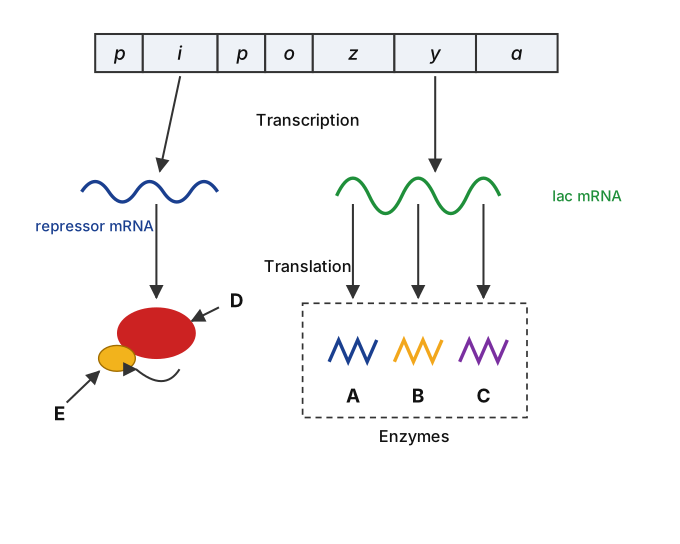
- AP EAPCET 2021Set ap-2021-09-06-FN1 markMCQQ.Given the diagram of the lac operon showing an operon of inducible enzymes. Identify components and enzymes (A, B, C, D and E)? [FIGURE] (a labelled diagram of the lac operon: the gene map p-i-p-o-z-y-a with transcription/translation arrows; repressor mRNA is translated into a protein labelled D; lac mRNA is translated into three enzymes labelled A, B, C; a small inducer molecule labelled E is shown interacting with protein D) (A) A – β. Galactosidase, B – Permease, C – Transacetylase, D – Repressor protein, E – Inducer (lactose) (B) A – β. Galactosidase, B – Permease, C – Transacetylase, D – Inducer (lactose), E – Repressor protein (C) A – β. Galactosidase, B – Transacetylase, C – Permease, D – Repressor protein, E – Inducer (lactose) (D) A – Permease, B – Transacetylase, C – β. Galactosidase, D – Repressor protein, E – Inducer (lactose)
›Reveal solutionSolution
A lac-operon gene map: a horizontal row of boxed segments labelled p, i, p, o, z, y, a (le The lac operon diagram shows the classic gene arrangement (p-i-p-o-z-y-a) and the corresponding products: the repressor protein (D) binds the inducer lactose (E), and the three structural genes encode β‑galactosidase (A), permease (B), and transacetylase (C) in that order.
The key to this question is knowing the standard lac operon map and the function of each gene product. The operon is an inducible system: the repressor protein (made from the i gene) normally blocks transcription at the operator (o). When the inducer (lactose) binds the repressor, the repressor releases from the operator, allowing transcription of the z, y, and a genes. The diagram labels the repressor as D and the inducer as E, and the three enzymes from the polycistronic mRNA as A, B, and C in the order they are transcribed.
-
Identify the repressor and inducer (D and E).
The diagram shows a red oval (D) with a small yellow/orange oval (E) attached. This represents the repressor protein (D) bound to the inducer molecule (E). In the lac operon, the repressor is encoded by the i gene, and the inducer is lactose (or allolactose). So D = repressor protein, E = inducer (lactose).
-
Identify the three enzymes (A, B, C) from the lac mRNA.
The lac mRNA is transcribed from the z, y, and a genes in that order (left to right on the gene map). The three enzymes produced are:
- z gene → β‑galactosidase (cleaves lactose into glucose and galactose)
- y gene → permease (transports lactose into the cell)
- a gene → transacetylase (a less critical enzyme that acetylates lactose derivatives) …
-
🎓Unlock everything free for 14 days
- ✓Full step-by-step solutions
- ✓Concept-first explanations
- ✓Methods, shortcuts & mistakes
- ✓PYQ mapping + timed mock tests
Full access for 14 days. No credit card required.