Q.Why don't you observe some flowers of the following plants (or any others available to you): Cucumber, Mango, Peepal, Coriander, Papaya, Onion, Lobia, Cotton, Tobacco, Rose, Lemon, Eucalyptus, Banana? Try to find out which animals visit them and whether they could be pollinators. You'll have to patiently observe the flowers over a few days and at different times of the day. You could also try to see whether there is any correlation in the characteristics of a flower to the animal that visits it. Carefully observe if any of the visitors come in contact with the anthers and the stigma, as only such visitors can bring about pollination. Many insects may consume pollen or the nectar without bringing about pollination — such floral visitors are referred to as pollen/nectar robbers.
Concept understanding — Male And Female Gametophyte
Let’s start with something you already know. Think of a plant like a mango tree. It produces flowers, and those flowers eventually turn into mangoes. How does that happen? The flower is the plant’s reproductive organ, and inside it, two tiny but crucial structures are made: the male gametophyte and the female gametophyte. These are not the “male” and “female” parts of the flower themselves (like the stamen and pistil) — they are the microscopic, single-generation cells that actually carry the genetic material to form the next plant.
The everyday intuition
Imagine you are baking a cake. The male gametophyte is like the packet of dry yeast — it’s small, mobile, and needs to be added to the mixture. The female gametophyte is like the bowl of flour, eggs, and sugar — it’s larger, stationary, and provides the environment where the yeast works. Without the yeast reaching the bowl, no cake rises. Without the bowl, the yeast has nothing to act on. In a flower, the male gametophyte (pollen grain) must travel to the female gametophyte (embryo sac) for fertilisation to happen.
The precise meaning
In NCERT biology, the male gametophyte is the pollen grain. It develops inside the anther (the top part of the stamen). A mature pollen grain contains two cells: a tube cell and a generative cell. The tube cell will grow a long tube down the style of the pistil, and the generative cell will divide to form two sperm cells. So the male gametophyte is not the whole stamen — it’s the tiny, single-celled (or two-celled) structure that carries the male genetic material.
The female gametophyte is the embryo sac. It develops inside the ovule, which is located in the ovary of the pistil. The embryo sac is a seven-celled, eight-nucleate structure (though you don’t need to memorise numbers for a prose subject — just know it’s a small, organised sac). It contains the egg cell (the female gamete) and other cells that help in fertilisation and nourishment. The female gametophyte is not the whole pistil — it’s the microscopic sac inside the ovule.
The male gametophyte (pollen grain) is haploid — it has only one set of chromosomes. The female gametophyte (embryo sac) is also haploid. When they fuse during fertilisation, they form a diploid zygote, which grows into the seed. This is why both are called “gametophytes” — they produce gametes (sperm and egg).
Why it matters
Without the male and female gametophytes, no seed would form, and no fruit would develop. In flowering plants, the male gametophyte is the pollen that bees carry, wind blows, or humans collect for pollination. The female gametophyte is the hidden, protected structure inside the ovary. Their meeting is the moment of fertilisation — the start of a new plant’s life.
For a commerce or humanities student, the key takeaway is this: gametophytes are the tiny, single-generation carriers of genetic material in plants. They are not the visible flower parts — they are the microscopic “packages” that ensure reproduction. In NCERT, this concept is the foundation for understanding pollination, fertilisation, and seed formation. It’s a simple but powerful idea: life passes from one generation to the next through these miniature, specialised cells.
Students revising this topic often search for "Male And Female Gametophyte NEET questions", "Male And Female Gametophyte important questions", or "Male And Female Gametophyte class 12 biology". This concept is directly part of the Sexual Reproduction in Flowering Plants chapter in the NCERT/CBSE Class 12 Biology syllabus, and it is also an important topic for NEET and state medical/CET entrance exams, making it worth mastering for both board and competitive-exam preparation.
This is a real, hands-on NCERT observation activity — there is no single fixed answer, since it depends on what you actually observe. But the biology it's testing is well established: each of the listed flowers is associated with characteristic pollinator(s) predictable from its floral traits (colour, scent, shape, nectar, timing) — e.g. brightly coloured, scented, nectar-rich flowers (Rose, Lemon, Cotton) attract bees/butterflies; Banana and Eucalyptus flowers are visited by bats/birds or bees; wind-pollinated types (grasses, and self-pollinating ones like Peepal figs, which are pollinated by a specific fig wasp) show few or no true pollinators among casual visitors — a real visitor only counts as a pollinator if it actually contacts BOTH the anthers and the stigma.
Answer depends on real observation, but the correct principle is: a floral visitor only counts as a pollinator if it makes contact with both the anthers and the stigma — otherwise it may just be a pollen/nectar robber.
This NCERT activity asks you to observe real flowers and identify their pollinators — the answer comes from your own observation, guided by the principle that a true pollinator contacts both anthers and stigma.
This is a genuine field-observation exercise, not a question with one fixed numeric or factual answer — the book is asking you to go outside and watch real flowers. That said, the biology it is teaching is concrete and can be explained:
What to look for: watch each flower over several days, at different times (some open/attract visitors only at dawn, dusk, or night), and record every animal that lands on it.
How to tell a real pollinator from a robber: the key test the book itself states is contact — does the visiting animal actually touch both the anthers (picking up pollen) and the stigma (depositing pollen) during its visit? An insect that only drinks nectar from the side, or chews the petals, without brushing against the reproductive parts, is a pollen/nectar robber, not a pollinator, even though it visits the flower.
What you're likely to find, by flower type (grounded in known pollination biology for these species, useful to check your own observations against): brightly-coloured, scented, nectar-producing flowers such as Rose, Lemon, Cotton and Tobacco typically attract bees, butterflies, or moths; large, strongly-scented flowers like Banana and some Eucalyptus attract bats, birds, or large bees; small, often less showy flowers like Onion and Coriander (both in umbellifer/allium-type clusters) rely heavily on smaller insects such as flies and bees; Peepal is a special case — like all figs, it is pollinated almost exclusively by one specific, co-evolved fig wasp species, so a casual observer is unlikely to see other true pollinators visiting it; wind-adapted flowers may show almost no animal visitors doing any pollinating work at all.
There is no single fixed answer — record what you actually observe — but a visitor only counts as a genuine pollinator if it contacts both the anthers and the stigma; otherwise it is a pollen/nectar robber, per the activity's own stated test.
Showing the 12 most recent of 13 on this concept.
- AP EAPCET 2026Set ap-2026-05-20-FN1 markMCQQ.Choose the correct statements among the following A) As the anthers of Hibiscus is single lobed it will have four microsporangia B) Pollengrain has two layers wall madeup of sporopollenin C) By maturation and dehydration. Microspores develops into pollengrain D) Epidermis, endothecium and middle layer will help in dehiscence of anthers (A) A, B (B) C, A (C) B, D (D) C, D
›Reveal solutionSolution
Microspores mature into pollen grains, and the outer three anther-wall layers (epidermis, endothecium, middle layers) assist dehiscence — both true; the Hibiscus microsporangia count and the "two-layer sporopollenin" claim are both false.
Concept and Intuition
A typical bilobed anther has two microsporangia per lobe (four total), but some plants (Malvaceae, Cucurbitaceae) have monothecous, single-lobed anthers with only two microsporangia total. The pollen grain wall is genuinely two-layered, but the tough, resistant outer exine alone is built of sporopollenin; the inner intine is ordinary cellulose/pectin. Inside the sporangium, microspores mature and dehydrate to become functional pollen grains, while the anther wall's outer three layers (epidermis, endothecium, middle layers) protect the developing pollen and later help the anther split open, leaving the innermost tapetum to nourish the developing microspores instead.
Step-by-Step Solution
- Statement A: FALSE — a single-lobed (monothecous) anther, as in Hibiscus, has only two microsporangia, not four.
- Statement B: FALSE — only the exine is made of sporopollenin; the intine is cellulose/pectin, so "two layers ... made up of sporopollenin" over-generalises.
- Statement C: TRUE — microspores mature and dehydrate within the sporangium to become pollen grains.
- Statement D: TRUE — epidermis, endothecium, and middle layers together perform protection and help the anther dehisce; the tapetum (innermost layer) instead nourishes the pollen.
- Correct pair: C, D.
Common Mistakes
- Assuming all anthers are bilobed with exactly four microsporangia — monothecous exceptions exist.
- Attributing sporopollenin to both pollen wall layers instead of only the exine.
✓Final answerThe correct option is (D) — C, D.
ANSWER: D
- AP EAPCET 2025Set ap-2025-05-19-AN1 markMCQQ.In the flowering plants, a mature female gametophyte is derived from the megaspore mother cell by (A) One Mitotic division and three Meiotic divisions (B) One Meiotic and one Mitotic division (C) One Meiotic and three Mitotic divisions (D) Three Meiotic and one Mitotic division
›Reveal solutionSolution
The megaspore mother cell forms the embryo sac via one meiotic division (producing megaspores) followed by three mitotic divisions of the functional megaspore — option (C).
Concept and Intuition
Megasporogenesis (meiosis) reduces the chromosome number and produces megaspores; megagametogenesis (mitosis) then builds the multicellular embryo sac from the surviving megaspore.
Step-by-Step Solution
- The diploid megaspore mother cell (MMC) undergoes meiosis (one meiotic division, i.e., meiosis I + II) to produce four haploid megaspores.
- In most flowering plants only one megaspore remains functional; the other three degenerate.
- The functional megaspore undergoes three successive mitotic divisions, producing 8 nuclei arranged in the typical monosporic (Polygonum type) embryo sac.
- Cellularisation gives the 7-celled, 8-nucleate mature female gametophyte (egg apparatus, central cell, antipodals).
- Hence the process = one meiotic + three mitotic divisions.
Common Mistakes
- Miscounting the mitotic divisions needed to go from 1 megaspore nucleus to 8 nuclei (it is exactly three doublings: 1→2→4→8).
✓Final answerThe correct option is (C) — One Meiotic and three Mitotic divisions.
ANSWER: C
- AP EAPCET 2025Set ap-2025-05-20-AN1 markMCQQ.Choose the correct statements among the following I. Exine exhibits an array of patterns and designs. II. Tapetum layers of microsporangium will be useful for the dehiscence. III. The intine wall of pollengrain is made up cellulose and pectin. IV. By wall formation 8 celled embryosac is developed. (A) I and II (B) I and III (C) II and III (D) III and IV
›Reveal solutionSolution
The exine's ornamentation (I) and the intine's cellulose-pectin composition (III) are
both true; the tapetum nourishes the pollen (not dehiscence, II false), and the
8-nucleate embryo sac arises by free nuclear division, not by wall formation (IV
false).
Concept and Intuition
A mature pollen grain has a two-layered wall:
- The outer wall, the exine, is made of sporopollenin (one of the most resistant organic materials known) and shows an enormous diversity of surface sculpturing/ patterns, useful even for identifying pollen species (palynology).
- The inner wall, the intine, is a thin, continuous layer made of cellulose and pectin.
Inside the anther, the innermost wall layer of the microsporangium is the tapetum,
whose main role is to nourish the developing pollen grains (it is a nutritive tissue,
and also supplies materials like sporopollenin precursors for exine formation) — it is
not responsible for anther dehiscence. Anther dehiscence (splitting open to release
pollen) is instead driven by the drying/shrinkage of the fibrous endothecium layer.
The mature embryo sac (female gametophyte) develops from the functional megaspore
through three rounds of free nuclear (mitotic) division without immediate cell-wall
formation, producing an 8-nucleate stage; cell walls are then organised around most of
these nuclei afterward, giving the typical 7-celled, 8-nucleate embryo sac (the two
polar nuclei share the large central cell). So it is not accurate to say the 8-nucleate
stage itself arises "by wall formation" — wall formation is a later, separate step.
Step-by-Step Solution
- Statement I: exine shows varied patterns/designs — true, a well-documented palynological fact.
- Statement II: tapetum is "useful for dehiscence" — false; tapetum nourishes the pollen, dehiscence is due to the endothecium.
- Statement III: intine is made of cellulose and pectin — true, standard structural fact.
- Statement IV: "by wall formation 8 celled embryo sac is developed" — false; the 8-nucleate stage is produced by free nuclear (mitotic) divisions, with wall formation occurring afterward (and the mature embryo sac is 7-celled, not 8-celled, due to the binucleate central cell).
- Correct statements: I and III — option (B).
Common Mistakes
- Attributing anther dehiscence to the tapetum instead of the endothecium.
- Saying the embryo sac is "8-celled" — it is 8-nucleate but only 7-celled, since the central cell contains two polar nuclei without an intervening wall.
✓Final answerThe correct option is (B) — I and III.
ANSWER: B
- AP EAPCET 2024Set ap-2024-05-16-AN1 markMCQQ.Choose the correct statements related to plant reproduction I. In Cladophora male and female gametes are morphologically similar II. Male and female gametes of Pteris are heterogametes III. Fungi are usually homothallic and unisexual IV. Monoecious plants are bisexual (A) I, II, IV (B) I, II, III (C) II, III, IV (D) I, III, IV
›Reveal solutionSolution
Statements I, II, and IV correctly describe gamete morphology and plant sexuality; Statement III is internally contradictory and false.
Concept and Intuition
Sexual reproduction terminology hinges on whether the two gametes look alike (isogamy) or different (heterogamy/oogamy), and whether an organism carries both sexes on one individual (monoecious/homothallic = bisexual) or needs two separate individuals/strains (dioecious/heterothallic = unisexual). Getting these labels internally consistent is the crux of this question.
Step-by-Step Solution
- I. Cladophora (a green alga) reproduces via motile gametes that are morphologically similar to each other (isogamy) — TRUE.
- II. Pteris (a fern) is oogamous: it produces a large, non-motile egg and small, motile, coiled multiflagellate sperm — these gametes are clearly dissimilar, i.e. heterogametes — TRUE.
- III. 'Fungi are usually homothallic and unisexual' is self-contradictory: homothallic specifically means bisexual/self-fertile (a single mycelium carries both mating types), which is the opposite of unisexual (heterothallic, requiring two different strains). A fungus is one or the other, not both at once as a blanket statement — FALSE.
- IV. Monoecious plants bear both male and female reproductive structures on the same individual (even if individual flowers are unisexual), which is exactly what is meant by calling the plant 'bisexual' at the whole-plant level (e.g. maize, cucurbits) — TRUE.
- So the correct statements are I, II, and IV.
Common Mistakes
- Reading 'homothallic' and 'unisexual' as compatible terms rather than recognising they describe opposite mating systems.
- Confusing 'unisexual/bisexual FLOWER' with 'unisexual/bisexual PLANT' — monoecious plants can bear unisexual flowers while the plant itself is considered bisexual.
✓Final answerThe correct option is (A) — I, II, IV.
ANSWER: A
- AP EAPCET 2024Set ap-2024-05-16-FN1 markMCQQ.In Angiosperms arrange the events of pre fertilization/post fertilization in a sequence. (A) Sporogenesis → Spores/Gametogenesis → Gametes (B) Gametes → Syngamy/Embryo → Endosperm (C) Gametogenesis → Gametes transfer/Zygote → Embryo (D) Spores → Gametes/Zygote → Embryo
›Reveal solutionSolution
The true event order in angiosperm reproduction is: gametes are made (gametogenesis) → gametes are transferred and fuse to form the zygote (this fusion IS fertilization, the pre/post-fertilization boundary) → the zygote develops into the embryo. This matches option (C).
Concept and Intuition
Sexual reproduction in flowering plants unfolds as a strict sequence of events, conventionally divided into pre-fertilization and post-fertilization events, with fertilization (syngamy) itself as the pivot:
- Pre-fertilization events: development of male and female gametophytes (microsporogenesis/megasporogenesis producing spores, followed by gametogenesis producing the actual gametes), and then transfer of gametes — pollination brings pollen to the stigma, and the pollen tube subsequently delivers the male gametes to the embryo sac.
- The fertilization event: syngamy, the fusion of a male gamete with the egg cell, produces the diploid zygote. (A second fusion, triple fusion, produces the primary endosperm nucleus, but the question's answer choices are built around the zygote→embryo axis.)
- Post-fertilization events: the zygote undergoes embryogeny to become the embryo, while the ovule develops into the seed and the ovary into the fruit.
So, tracing this through in the correct order: gametes must first be made (gametogenesis), then they must be brought together (transfer) so that fertilization (syngamy) can occur and produce the zygote, and only after that does the zygote grow into the embryo. This is precisely the sequence gametogenesis → gamete transfer/zygote (fertilization) → embryo.
Step-by-Step Solution
- Identify the true biological order of milestones: gametes exist → gametes meet and fuse (fertilization) → the resulting zygote develops.
- Gametogenesis is the process that produces the gametes — this must come first among the listed stages.
- Gamete transfer (pollination + pollen tube growth) is a pre-fertilization event that culminates in syngamy, producing the zygote — this is the second stage, and it is exactly the fertilization boundary between pre- and post-fertilization events.
- Embryo formation (embryogeny) happens only after the zygote exists — this is the final, purely post-fertilization stage.
- Matching this order (gametogenesis → gamete transfer/zygote → embryo) to the options gives option (C).
Common Mistakes
- Treating "sporogenesis → spores/gametogenesis → gametes" (option A) as the full answer — this only covers gametophyte development (a pre-fertilization sub-sequence) and stops before fertilization or embryo formation, so it doesn't represent the full pre-to-post-fertilization arc the question asks for.
- Mixing up the order of syngamy (gamete fusion → zygote) with embryo/endosperm formation, or thinking gametes and zygote formation happen before gametogenesis.
✓Final answerThe correct option is (C) — Gametogenesis → Gametes transfer/Zygote → Embryo.
ANSWER: C
- AP EAPCET 2023Set ap-2023-05-23-AN1 markMCQQ.Name the cells of mature pollen grain when you observe under microscope with the following characters respectively. A) Bigger cell with abundant food reserve and large irregular shaped nucleus. B) Small, dense cytoplasm with nucleus. (A) Generative cell, Gametes (B) Vegetative cell, Gametes (C) Vegetative cell, Generative cell (D) Generative cell, Vegatative cell
›Reveal solutionSolution
This tests knowledge of the two-celled structure of a mature pollen grain — the vegetative cell and the generative cell — distinguished by their size, cytoplasm density, and nuclear shape.
Concept and Intuition
A mature (2-celled) pollen grain contains a bigger vegetative cell with abundant food reserves and an irregularly shaped nucleus, and a smaller generative cell, which is spindle-shaped with dense cytoplasm and a prominent nucleus, floating in the cytoplasm of the vegetative cell. The generative cell later divides mitotically (either in the pollen grain or the pollen tube) to produce the two non-motile male gametes.
Step-by-Step Solution
- Description A — "bigger cell with abundant food reserve and large irregular shaped nucleus" — matches the vegetative (tube) cell.
- Description B — "small, dense cytoplasm with nucleus" — matches the generative cell.
- Note that "gametes" themselves are the products of generative cell division, not what is directly observed as one of the two cells inside a freshly matured pollen grain — so options naming "Gametes" as one of the two observed cells are incorrect.
- Hence, A = Vegetative cell, B = Generative cell.
Common Mistakes
- Calling the male gametes themselves one of the two "cells" seen under the microscope in a freshly mature (2-celled) pollen grain — gametes only form after generative cell division, typically in the pollen tube.
- Swapping which cell is bigger — the vegetative cell, not the generative cell, is the larger one with abundant reserves.
✓Final answerThe correct option is (C) — Vegetative cell, Generative cell.
ANSWER: C
- AP EAPCET 2023Set ap-2023-05-23-FN1 markMCQQ.If chromosome number in meiocyte of rice is 24, then the chromosome number in the pollen grains is (A) 24 (B) 48 (C) 36 (D) 12
›Reveal solutionSolution
A basic ploidy question: the meiocyte (microspore mother cell/PMC) is diploid, and pollen grains produced by its meiotic division are haploid.
Concept and Intuition
The "meiocyte" here is the pollen mother cell (PMC), a diploid (2n) sporogenous cell inside the anther. It undergoes meiosis to produce four haploid microspores, each of which develops into a pollen grain. Meiosis halves the chromosome number.
Step-by-Step Solution
- Meiocyte chromosome number = 2n = 24.
- Meiosis (reduction division) halves this: n = 24/2 = 12.
- Pollen grains are the haploid gametophytic products, so each pollen grain has n = 12 chromosomes.
Common Mistakes
- Thinking the pollen grain retains the meiocyte's chromosome number (24) — meiosis specifically halves it.
✓Final answerThe correct option is (D) — 12.
ANSWER: D
- AP EAPCET 2022Set ap-2022-07-12-AN1 markMCQQ.Number of cells in the Angiosperm pollen grains at the time of release (A) 2 cells (B) 3 cells (C) 1 cell (D) 4 cells
›Reveal solutionSolution
This tests the general rule for angiosperm pollen grain cell number at the time of release from the anther — most species shed pollen at the 2-celled stage.
Concept and Intuition
A microspore (pollen grain) undergoes mitosis to form a larger vegetative (tube) cell and a smaller generative cell — this is the 2-celled stage. In most angiosperm species, pollen is released from the anther at this 2-celled stage, with the generative cell only dividing into two male gametes later, after germination, inside the pollen tube as it grows through the style. In a minority of species (roughly 30%, e.g., grasses), the generative cell divides before the pollen is shed, so the grain is released already at the 3-celled stage.
Step-by-Step Solution
- Microspore mother cell undergoes meiosis to form microspores (pollen grains), each initially uninucleate.
- Each microspore undergoes an asymmetric mitotic division forming a vegetative cell and a generative cell — the pollen grain is now 2-celled.
- As the general/default rule taught for angiosperms at this level, pollen is shed from the anther at this 2-celled stage.
- The generative cell divides into two male gametes later (either before shedding in some species, or more commonly after germination inside the pollen tube).
Common Mistakes
- Assuming pollen is always released at the 3-celled stage — this is true only for a minority of species; the standard/default taught answer for "at the time of release" is 2 cells.
✓Final answerThe correct option is (A) — 2 cells.
ANSWER: A
- AP EAPCET 2022Set ap-2022-07-12-FN1 markMCQQ.Pollen grains are well preserved as fossils of (A) Lignin (B) Pectin (C) Chitin (D) Sporopollenin
›Reveal solutionSolution
Sporopollenin's extreme chemical resistance allows pollen grains to survive as well-preserved fossils.
Concept and Intuition
The pollen grain wall has two layers: the inner intine (made of cellulose and pectin, easily degradable) and the outer exine (made of sporopollenin). Sporopollenin can withstand nearly all biological and chemical degradation processes, which is exactly why the exine survives in sediments for extremely long periods, allowing palynologists to study fossil pollen.
Step-by-Step Solution
- Identify the wall layer responsible for pollen preservation: the exine.
- Recall the exine's chemical composition: sporopollenin.
- Recognize sporopollenin's key property: resistance to high temperatures, strong acids/alkalis, and enzymatic degradation — none of the natural biological or chemical agents can degrade it easily.
- This resistance is precisely why pollen grains fossilise so well and can be studied even after geological time spans.
Common Mistakes
- Confusing sporopollenin (exine) with cellulose/pectin (intine, which is NOT resistant and does not fossilise well).
✓Final answerThe correct option is (D) — Sporopollenin.
ANSWER: D
- AP EAPCET 2021Set ap-2021-09-03-FN1 markMCQQ.Match the following? Column - I:(a) Epidermis(b) Endothecium(c) Tapetam(d) Sporogenous tissue. Column - II:(i) Multi nucleated(ii) Homogenous(iii) One celled thick(iv) Fibrous thickness. Column - III: (p) Protection (q) Formation of Micropores (r) dehiscence of anther (s) Nourishment (A) (a – i – q), (b – iii – r), (c – iv – q), (d – i – s) (B) (a – iii – p), (b – iv – r), (c – i – s), (d – ii – q) (C) (a – i – s), (b – ii – r), (c – iii – q), (d – iv – p) (D) (a – iv – r), (b – i – s), (c – ii – q), (d – iii – p)
›Reveal solutionSolution
Each anther-wall layer has a distinct structure and job: epidermis protects, endothecium's fibrous thickenings aid dehiscence, tapetum (multinucleate) nourishes pollen, and sporogenous tissue (homogeneous) forms the microspores. Answer: (B).
Concept and Intuition
The anther wall, from outside to inside, consists of the epidermis, endothecium, middle layers, and tapetum, surrounding a central mass of sporogenous tissue. Each layer is structurally specialised for a specific job: the epidermis is a thin protective covering; the endothecium develops radial fibrous (band-like) thickenings of cellulose that create tension helping the anther split open (dehisce) at maturity; the tapetum, the innermost nutritive layer, has cells that often become multinucleate (through nuclear division without cytokinesis) as they supply nutrients to the developing pollen grains; and the sporogenous tissue is a compact, uniform (homogeneous) mass of cells in the centre of each microsporangium that undergoes meiosis to produce the haploid microspores (pollen).
Step-by-Step Solution
- (a) Epidermis: structurally it is a single layer, i.e., "one celled thick" (iii); functionally it provides protection (p). → a–iii–p.
- (b) Endothecium: characterised by "fibrous thickness"/wall thickenings (iv); functionally these thickenings cause the dehiscence of anther (r). → b–iv–r.
- (c) Tapetum: cells become "multi nucleated" (i); functionally it provides nourishment to the pollen (s). → c–i–s.
- (d) Sporogenous tissue: described as "homogenous" (ii) tissue; functionally, through meiosis, it is responsible for formation of microspores (q). → d–ii–q.
- Assembling: (a–iii–p), (b–iv–r), (c–i–s), (d–ii–q), matching option (B).
Common Mistakes
- Assigning the fibrous thickenings to the epidermis instead of the endothecium.
- Mixing up tapetum's nourishing role with the sporogenous tissue's role of actually forming the microspores.
✓Final answerThe correct option is (B) — (a – iii – p), (b – iv – r), (c – i – s), (d – ii – q).
ANSWER: B
- AP EAPCET 2021Set ap-2021-09-06-FN1 markMCQQ.The diagram represents the lifecycle of angiosperm. Choose the correct combination of labelling? [FIGURE] (a labelled diagram showing the life cycle of an angiosperm, with boxes A, B, C, D, E marking structures/stages from pollen-grain formation through fertilization to embryo development) (A)(a) - Anther,(b) - Stigma,(c) - Egg, D - Male gametophyte, E - Ovule (B)(a) - Ovule,(b) - Stigma,(c) - Male gametophyte, D - Anther, E - Egg (C)(a) - Male gametophyte,(b) - Stigma,(c) - Anther, D - Egg, E - Ovule (D)(a) - Stigma,(b) - Anther,(c) - Male gametophyte, D - Egg, E - Ovule
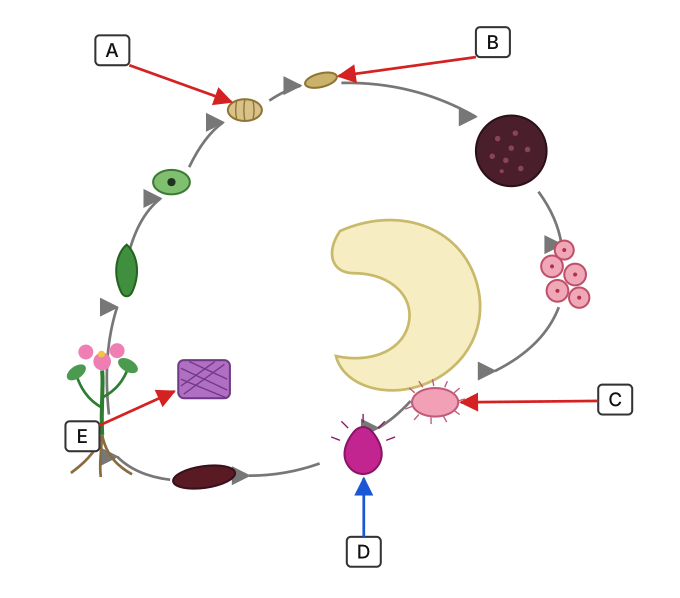
›Reveal solutionSolution
A circular life-cycle diagram of a flowering plant, with a flowering plant (green stem, pi The key is to trace the angiosperm life cycle clockwise from the mature plant: the male gametophyte (pollen grain) is produced in the anther, lands on the stigma, then the pollen tube delivers sperm to the egg inside the ovule; the correct match is (D).
The diagram shows a circular life cycle of a flowering plant. To label it correctly, you must follow the sequence of events from the mature sporophyte (the plant) through meiosis, gametophyte formation, fertilization, and back to the new sporophyte. The labels A, B, C, D, E correspond to specific structures or stages along this loop. Let’s walk through the cycle step by step.
-
Start at the mature flowering plant (lower-left).
The plant is the diploid sporophyte. It produces two types of reproductive structures: the anther (part of the stamen, male) and the ovule (inside the ovary, female). In the diagram, the first structure after the plant is a green flask/teardrop shape — this is the ovule (containing the megaspore mother cell). But note: the labels A–E are placed at specific points further along the loop.
-
Follow the clockwise arrows.
- The first labelled structure is A (top-left, a ribbed oval). This is a pollen grain — the male gametophyte. It is produced inside the anther. So A = Male gametophyte (pollen grain).
- Next, B (top-right, an elongated grain) is the stigma — the receptive tip of the pistil where the pollen grain lands. So B = Stigma.
- Continuing right, the large dark speckled mass is the pollen tube growing through the style, but the next label is C (mid-right, a pink oval with a wavy fringe). This is the egg cell inside the embryo sac. So C = Egg.
- Below that, D (magenta bulb with radiating lines) is the anther — the structure that produces pollen. So D = Anther.
- Finally, E (left-middle, purple cross-hatched block) is the ovule (after fertilization, it becomes the seed). So E = Ovule.
-
Check the answer options.
Only option (D) matches:
- A = Male gametophyte
- B = Stigma
- C = Egg
- D = Anther
- E = Ovule
Watch outA common mistake is to confuse the anther (male structure that produces pollen) with the pollen grain itself. The anther is part of the sporophyte; the pollen grain is the male gametophyte. In the diagram, the anther appears later (D) because the cycle shows the result of meiosis (pollen) first, then the structures involved in pollination and fertilization.
TipThink of the life cycle as a clockwise story: pollen (male gametophyte) → lands on stigma → sends sperm to egg → anther (where pollen came from) → ovule (where egg develops) → back to plant. Option (D) is the only one that tells this story correctly.
✓Final answerThe correct option is (D).
ANSWER: D
-
- AP EAPCET 2021Set ap-2021-10-05-FN1 markMCQQ.Approximate diameter of pollen grain is ________ (A) 50−75 micrometer (B) 75−100 micrometer (C) 25−50 micrometer (D) 25−35 micrometer
›Reveal solutionSolution
The typical diameter range of a pollen grain is 25–50 micrometers.
Concept and Intuition
Pollen grains, though microscopic, have a fairly standard size range across most flowering plants, generally described in textbooks as approximately 25 to 50 micrometers in diameter (with some species showing larger or smaller exceptions, but this is the typically quoted 'general' range).
Step-by-Step Solution
- Recall the standard textbook description of pollen grain size: 'generally spherical, measuring about 25–50 μm in diameter.'
- Match this to the given options, selecting the 25–50 micrometer range.
Common Mistakes
- Confusing this range with the larger or smaller ranges offered as distractors (50–75, 75–100, 25–35 μm), which don't match the commonly cited textbook figure.
✓Final answerThe correct option is (C) — 25−50 micrometer.
ANSWER: C
🎓Unlock everything free for 14 days
- ✓Full step-by-step solutions
- ✓Concept-first explanations
- ✓Methods, shortcuts & mistakes
- ✓PYQ mapping + timed mock tests
Full access for 14 days. No credit card required.