Q.Arrange the following sets of compounds in order of their increasing boiling points:
🔒You're viewing a preview — the full solution, concept, methods & PYQ mapping are locked.
🔒 Start your 14-day free trial to unlock the full solution →Concept understanding — Boiling Point Trends
Boiling Point Trends (Organic Compounds)
A substance's boiling point is set by how much energy is needed to overcome the attractive forces HOLDING its molecules together in the liquid — the stronger those intermolecular forces, the higher the boiling point.
The Forces, Weakest to Strongest
- Van der Waals (London dispersion) forces — present in every molecule, and they grow stronger as the molecule gets bigger (more electrons, larger surface area of contact between neighbouring molecules) and more polarisable.
- Dipole–dipole forces — present in polar molecules, add an extra attraction on top of dispersion forces.
- Hydrogen bonding — present when H is bonded directly to N, O, or F; much stronger than ordinary dipole–dipole attraction, and it raises the boiling point sharply compared to a similarly-sized molecule without it.
Trend 1: Down a Series of Halogens (Same Alkyl Group)
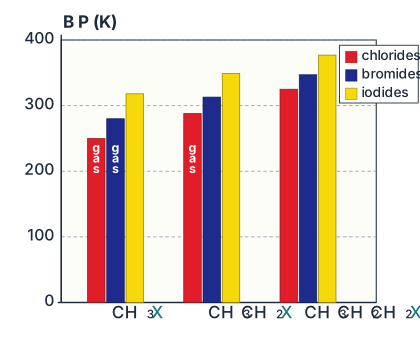
For a fixed R group, boiling point rises as the halogen gets heavier: R−I>R−Br>R−Cl>R−F. This looks surprising at first, since electronegativity (and so bond polarity/dipole moment) actually DECREASES down the group — but boiling point here is dominated by the growing size and polarisability of the halogen atom (stronger dispersion forces), which outweighs the shrinking dipole contribution.
The measured values for the methyl, ethyl and propyl halides show this rise clearly:
Trend 2: Chain Length and Branching
- Longer chains (more carbons) have more surface area for van der Waals contact between neighbouring molecules, so boiling point rises with chain length within a homologous series.
- Branching LOWERS boiling point compared to a straight-chain isomer of the same molecular formula — a more compact, spherical shape has less surface-to-surface contact with neighbouring molecules, weakening the dispersion forces. (E.g. neopentane boils well below n-pentane.)
Trend 3: Hydrogen Bonding Beats Molecular Mass …
Why this formula?
Boiling Point Trends: Why They Happen
Boiling point is the temperature at which a liquid's vapor pressure equals the external atmospheric pressure. To understand why boiling points follow certain trends, we must first understand what determines vapor pressure.
The Core Idea: Intermolecular Forces
A liquid boils when its molecules have enough kinetic energy to overcome the intermolecular forces (IMFs) holding them together in the liquid phase. Stronger IMFs → harder to escape → lower vapor pressure at a given temperature → higher boiling point.
There is no single "formula" for boiling point, but the relationship is captured by the Clausius–Clapeyron equation, which links vapor pressure (P) to temperature (T) and the enthalpy of vaporization (ΔHvap):
lnP=−RΔHvap⋅T1+C
Where:
- P = vapor pressure
- ΔHvap = enthalpy of vaporization (energy needed to vaporize 1 mole)
- R = gas constant
- T = absolute temperature (Kelvin)
- C = constant (depends on substance)
Why this formula makes sense
- ΔHvap is large when IMFs are strong — more energy is needed to separate molecules.
- At boiling point, P=Patm (usually 1 atm). So a substance with larger ΔHvap needs a higher T to reach that pressure.
Thus, boiling point ∝ strength of intermolecular forces.
The Four Key Trends (with Reasoning)
1. Trend across a period (e.g., Period 2: CH₄ → NH₃ → H₂O → HF)
| Molecule | IMFs present | Boiling point (°C) |
|---|---|---|
| CH₄ | London dispersion only | -161 |
| NH₃ | Dispersion + H-bonding | -33 |
| H₂O | Dispersion + H-bonding (2 per molecule) | 100 |
| HF | Dispersion + H-bonding | 19 |
Why?
- CH₄ is nonpolar — only weak London dispersion forces.
- NH₃, H₂O, HF have hydrogen bonding (strongest IMF).
- H₂O forms two H-bonds per molecule (donor + acceptor), while NH₃ forms one and HF forms one — hence H₂O has the highest boiling point.
Key insight: Hydrogen bonding dominates over molecular mass in small molecules.
2. Trend down a group (e.g., Halogens: F₂ → Cl₂ → Br₂ → I₂)
| Molecule | Molar mass (g/mol) | Boiling point (°C) |
|---|---|---|
| F₂ | 38 | -188 |
| Cl₂ | 71 | -34 |
| Br₂ | 160 | 59 |
| I₂ | 254 | 184 |
Why?
- All are nonpolar — only London dispersion forces.
- Dispersion force strength increases with number of electrons (larger molar mass → more polarizable electron cloud → stronger temporary dipoles).
- So boiling point increases down the group.
Key insight: For nonpolar molecules, molar mass (electron count) is the primary factor.
3. Branching in alkanes (e.g., C₅H₁₂ isomers)
| Isomer | Boiling point (°C) |
|---|---|
| n-pentane (straight chain) | 36 |
| 2-methylbutane (branched) | 28 |
| 2,2-dimethylpropane (highly branched) | 10 |
Why?
- All have same molecular formula — same molar mass. …
Concept: Boiling Point Trends — Boiling point depends on molecular mass (more mass → higher BP) and intermolecular forces (hydrogen bonding > dipole-dipole > van der Waals). Alcohols have strong H-bonding; ethers and aldehydes have weaker dipole-dipole; alkanes have only van der Waals.
(a) All are alcohols. BP increases with chain length (more surface area for van der Waals) and decreases with branching (less surface area). Order from smallest to largest chain: methanol (C1), ethanol (C2), propan-1-ol (C3), butan-2-ol (C4, branched), butan-1-ol (C4, straight), pentan-1-ol (C5). …
Boiling points of organic compounds depend on intermolecular forces — hydrogen bonding dominates for alcohols, while van der Waals forces and dipole-dipole interactions matter for other functional groups. For (a), the order is methanol < ethanol < propan-1-ol < butan-2-ol < butan-1-ol < pentan-1-ol. For (b), the order is n-butane < ethoxyethane < pentanal < pentan-1-ol.
Why boiling point trends matter
Boiling point is a measure of how much energy you need to overcome the intermolecular forces holding molecules together in the liquid. The stronger these forces, the higher the boiling point. For organic compounds, three types of forces are at play:
- Hydrogen bonding — the strongest, occurs when H is bonded to N, O, or F.
- Dipole-dipole interactions — moderate, occur in polar molecules without O–H or N–H bonds.
- London dispersion forces — weakest, but increase with molecular size and surface area.
Alcohols have an –OH group, so they can form hydrogen bonds — this gives them significantly higher boiling points than hydrocarbons or ethers of similar size. Within a homologous series, boiling point rises with chain length because dispersion forces increase. Branching lowers boiling point because it reduces surface area for dispersion forces.
Let’s apply this to each set.
(a) Alcohols: methanol, ethanol, propan-1-ol, butan-1-ol, butan-2-ol, pentan-1-ol
All are alcohols, so hydrogen bonding is present in every case. The key factors are:
-
Chain length — more carbon atoms → larger electron cloud → stronger dispersion forces → higher boiling point. So, for straight-chain primary alcohols: methanol (C1) < ethanol (C2) < propan-1-ol (C3) < butan-1-ol (C4) < pentan-1-ol (C5).
-
Branching — butan-2-ol is a secondary alcohol with a branched chain. Branching reduces the surface area, weakening dispersion forces. So butan-2-ol boils lower than butan-1-ol, even though both have 4 carbons.
Don’t assume all alcohols of the same carbon count have the same boiling point. Branching matters — a secondary alcohol like butan-2-ol has a lower boiling point than its straight-chain isomer butan-1-ol.
- Position of –OH — for small alcohols, the –OH group dominates, but once you have 4+ carbons, the chain effect becomes significant. Butan-2-ol still boils higher than propan-1-ol because it has one more carbon.
Let’s check actual boiling points (in °C) to confirm:
| Compound | Boiling point (°C) |
|---|---|
| Methanol | 65 |
| Ethanol | 78 |
| Propan-1-ol | 97 |
| Butan-2-ol | 99 |
| Butan-1-ol | 117 |
| Pentan-1-ol | 138 |
So the increasing order is:
Methanol < Ethanol < Propan-1-ol < Butan-2-ol < Butan-1-ol < Pentan-1-ol
--- …
Method: Intermolecular Force Analysis (Hydrogen Bonding & van der Waals Forces)
This method compares boiling points by identifying the dominant intermolecular forces in each molecule and then considering molecular size/shape.
Steps for (a): Alcohols (Pentan-1-ol, butan-1-ol, butan-2-ol, ethanol, propan-1-ol, methanol)
Step 1: Identify the functional group
All are alcohols (−OH group). Alcohols form strong hydrogen bonds between molecules — this raises boiling points significantly compared to similar-sized non-alcohols.
Step 2: Rank by molecular size (carbon chain length)
Larger molecules have more electrons → stronger London dispersion forces → higher boiling point.
Chain length order (longest to shortest):
- Pentan-1-ol (5 carbons)
- Butan-1-ol & Butan-2-ol (4 carbons)
- Propan-1-ol (3 carbons)
- Ethanol (2 carbons)
- Methanol (1 carbon)
Step 3: Compare isomers (same chain length)
For butan-1-ol vs butan-2-ol:
- Butan-1-ol (primary alcohol, straight chain) has a linear shape → molecules pack closely → stronger dispersion forces → higher boiling point.
- Butan-2-ol (secondary alcohol, branched) has a more spherical shape → weaker packing → lower boiling point.
Step 4: Arrange in increasing order
Smallest → largest:
Methanol < Ethanol < Propan-1-ol < Butan-2-ol < Butan-1-ol < Pentan-1-ol
Steps for (b): Different functional groups (Pentan-1-ol, n-butane, pentanal, ethoxyethane)
Step 1: Identify dominant intermolecular forces
| Compound | Functional group | Dominant force |
|---|---|---|
| Pentan-1-ol | −OH (alcohol) | Hydrogen bonding (strongest) |
| Pentanal | −CHO (aldehyde) | Dipole-dipole (moderate) |
Here are the most common mistakes students make when ranking boiling points, along with the correct reasoning to avoid them.
Mistake 1: Ignoring the Dominant Intermolecular Force
The Error: Students often compare only molecular mass or only the presence of a functional group without checking which force actually controls the boiling point.
- Example from (a): Assuming all alcohols have similar boiling points because they all have hydrogen bonding.
- Example from (b): Assuming pentanal (an aldehyde) always has a higher boiling point than ethoxyethane (an ether) because it has a carbonyl group.
Why it’s wrong: Boiling point is determined by the total strength of intermolecular forces. The hierarchy is:
- Hydrogen bonding (strongest — present in alcohols, carboxylic acids, amines).
- Dipole-dipole interactions (moderate — present in aldehydes, ketones, ethers, esters).
- London dispersion forces (weakest — present in all molecules, but become significant with large size).
How to avoid: Always list the primary force for each compound first. For alcohols, hydrogen bonding dominates. For non-alcohols, compare dipole-dipole vs. dispersion forces.
Mistake 2: Forgetting that Branching Lowers Boiling Point
The Error: Students rank butan-2-ol (branched) higher than butan-1-ol (straight-chain) because they have the same molecular formula.
Why it’s wrong: Branching reduces the surface area of the molecule. Less surface area means weaker London dispersion forces between molecules. Even though both have hydrogen bonding, the straight-chain isomer packs more closely and has stronger dispersion forces.
Correct Order (for part a): Methanol < Ethanol < Propan-1-ol < Butan-2-ol < Butan-1-ol < Pentan-1-ol
How to avoid: When comparing isomers (same formula, different structure), the more branched isomer always has the lower boiling point. Draw the structures to see the shape.
Mistake 3: Confusing Boiling Point with Solubility or Melting Point
The Error: Students think that because ethanol is miscible with water (good solubility), it must have a very high boiling point.
Why it’s wrong: Solubility depends on compatibility with a solvent (water). Boiling point depends on the energy needed to separate molecules from each other. A small alcohol like methanol has strong hydrogen bonding, but its molecules are so small that the total force holding them together is less than for a larger alcohol like pentan-1-ol.
How to avoid: Remember the size effect: For a homologous series (e.g., alcohols), boiling point increases with chain length because dispersion forces add up, even though hydrogen bonding is similar per molecule.
Mistake 4: Misidentifying the Functional Group in Part (b)
The Error: Students treat pentanal as an alcohol or think ethoxyethane (diethyl ether) has hydrogen bonding.
Why it’s wrong:
- Pentanal (CHX3CHX2CHX2CHX2CHO) is an aldehyde. It has a polar C=O bond, so it has dipole-dipole interactions, but no O–H bond, so no hydrogen bonding between its own molecules.
- Ethoxyethane (CHX3CHX2−O−CHX2CHX3) is an ether. It has a polar C–O bond, so it has dipole-dipole interactions, but again no O–H bond, so no hydrogen bonding between its own molecules. …
Showing the 12 most recent of 14 on this concept.
- AP EAPCET 2026Set eng-2026-05-13-AN1 markMCQQ.Match the following List – I (Compound) / List – II (b.p / K) A. n−C4H9OH / I. 310.5 B. (C2H5)2NH / II. 350.8 C. n−C4H9NH2 / III. 390.3 D. C2H5N(CH3)2 / IV. 329.3 The correct answer is (A) A-IV, B-II, C-I, D-III (B) A-III, B-IV, C-I, D-II (C) A-III, B-IV, C-II, D-I (D) A-II, B-III, C-IV, D-I
›Reveal solutionSolution
This tests the classic boiling-point trend among an alcohol, a 1° amine, a 2° amine, and a 3° amine of comparable molecular weight, driven by hydrogen-bonding capacity. The match is A-III, B-IV, C-II, D-I.
Concept and Intuition
For molecules of similar size, boiling point tracks how strongly molecules can hydrogen-bond to each other:
- Alcohols (O–H) hydrogen-bond most strongly (O is more electronegative than N, and the O–H bond is highly polarized), so they have the highest boiling points among comparably-sized compounds.
- Primary amines have two N–H bonds per molecule available for intermolecular hydrogen bonding — next highest.
- Secondary amines have only one N–H bond — weaker hydrogen bonding, lower boiling point than primary amines.
- Tertiary amines have no N–H bond at all (nitrogen's lone pair can still accept a hydrogen bond from something else, but the molecule itself cannot donate one), so they rely mainly on weaker dipole–dipole and dispersion forces — lowest boiling point of the four.
Step-by-Step Solution
- A. n-C4H9OH (n-butanol): a primary alcohol — strongest H-bonding → highest boiling point among the four, 390.3 K → list item III. A-III.
- C. n-C4H9NH2 (n-butylamine): a primary amine, two N–H bonds → next highest, 350.8 K → list item II. C-II.
- B. (C2H5)2NH (diethylamine): a secondary amine, one N–H bond → lower still, 329.3 K → list item IV. B-IV. …
- AP EAPCET 2026Set ap-2026-05-19-FN1 markMCQQ.Among the hydrides of group 15 elements, the hydride with highest boiling point is A and the hydride with lowest boiling point is B. What are A and B respectively? (A) BiH3, NH3 (B) BiH3, PH3 (C) NH3, PH3 (D) NH3, SbH3
›Reveal solutionSolution
Boiling points of group 15 hydrides dip after ammonia (loss of H-bonding) then rise with increasing molar mass; highest is BiH3, lowest is PH3.
Concept and Intuition
NH3 has strong intermolecular hydrogen bonding (N is small and highly electronegative), giving it an unusually high boiling point for its size. Once H-bonding is lost going to PH3, boiling point drops sharply because only weak van der Waals (London dispersion) forces operate. As you continue down the group (AsH3→SbH3→BiH3), molecular size and mass increase steadily, so van der Waals forces strengthen again and boiling point rises — eventually exceeding even NH3.
Step-by-Step Solution
- Approximate boiling points: NH3≈−33°C, PH3≈−87.7°C, AsH3≈−55°C, SbH3≈−17°C, BiH3≈+17°C.
- Lowest of these is PH3 (the H-bonding of NH3 is gone, and molecular mass is still small). …
- AP EAPCET 2025Set eng-2025-05-22-FN1 markMCQQ.The correct order of boiling points of the compounds given below is A) Methoxy ethane B) Propan-1-ol C) Propanal D) Propanone (A) C > B > A > D (B) B > D > C > A (C) B > C > D > A (D) C > A > B > D
›Reveal solutionSolution
Tests ranking boiling points by intermolecular forces: H-bonding alcohol > dipolar ketone > dipolar aldehyde > weakly-polar ether.
Concept and Intuition
For molecules of similar molar mass, boiling point is set by the strength of intermolecular forces. An –OH group enables strong hydrogen bonding (raising b.p. sharply above similarly-sized non-alcohols). A C=O group gives a fairly strong permanent dipole (ketones/aldehydes), but weaker than H-bonding. An ether has a weaker net dipole (bond dipoles partly oppose) and no H-bond donor, so it boils at the lowest temperature of the four functional classes here.
Step-by-Step Solution
- B) Propan-1-ol, CH3CH2CH2OH: extensive intermolecular H-bonding via −OH gives it the highest boiling point of the four.
- D) Propanone (acetone), CH3COCH3: a symmetric ketone with a strong dipole from C=O but no H-bond donor — boils next highest.
- C) Propanal, CH3CH2CHO: also has a polar C=O, but the aldehyde's dipole/packing gives it a slightly lower boiling point than the ketone of the same carbon count. …
- AP EAPCET 2025Set eng-2025-05-24-FN1 markMCQQ.Observe the following substances. Ethanol, acetic acid, ethylamine, trimethylamine, salicylic acid, ethanal. In the above list, the number of substances with H-bonding is (A) 4 (B) 3 (C) 5 (D) 2
›Reveal solutionSolution
Tests recognizing which functional groups (O–H, N–H) enable hydrogen bonding; 4 of the 6 substances qualify.
Concept and Intuition
Hydrogen bonding needs a hydrogen atom covalently bonded to a small, highly electronegative atom — O, N, or F — so that the H carries a strong partial positive charge able to interact with a lone pair on a neighbouring electronegative atom. A carbonyl oxygen (as in an aldehyde) or a nitrogen with no attached H (as in a fully substituted tertiary amine) cannot act as an H-bond donor themselves.
Step-by-Step Solution
- Ethanol (C2H5OH): has an O–H group → capable of H-bonding.
- Acetic acid (CH3COOH): has a carboxylic O–H group → capable of H-bonding.
- Ethylamine (C2H5NH2): a primary amine with N–H bonds → capable of H-bonding.
- Trimethylamine (N(CH3)3): a tertiary amine — nitrogen has no attached H, so it cannot donate a hydrogen bond → excluded.
- Salicylic acid: has both a carboxylic O–H and a phenolic O–H → capable of H-bonding. …
- AP EAPCET 2023Set ap-2023-05-22-AN1 markMCQQ.What is the correct boiling point order of the following haloalkanes? i) 2-chloro 2-methylpropane ii) 1-Cholobutane iii) 2-Chlorobutane (A) i > ii > iii (B) ii > iii > i (C) i < ii < iii (D) i > iii > ii
›Reveal solutionSolution
Among isomeric C₄H₉Cl haloalkanes, the straight-chain isomer boils highest and the most branched (tertiary) isomer boils lowest, giving the order ii > iii > i.
Concept and Intuition
For a set of structural isomers with the same molecular formula, boiling point is governed mainly by the strength of intermolecular van der Waals (London dispersion) forces, which depend on the surface area available for molecules to contact each other. A straight (unbranched) chain packs closely and has more surface contact, giving stronger dispersion forces and a higher boiling point. Branching makes the molecule more compact/spherical, reducing surface area and intermolecular contact, and hence lowering the boiling point.
Step-by-Step Solution
- Identify the three isomers, all of formula C4H9Cl: (i) 2-chloro-2-methylpropane (tert-butyl chloride) — most branched, chlorine on a tertiary carbon; (ii) 1-chlorobutane — straight (unbranched) chain, chlorine on a primary carbon; (iii) 2-chlorobutane — chlorine on a secondary carbon, slightly branched.
- Rank by branching (least to most): (ii) unbranched < (iii) one branch point < (i) most branched (quaternary-like carbon skeleton around the C–Cl carbon). …
- AP EAPCET 2023Set ap-2023-05-22-AN1 markMCQQ.Para-nitro phenol has higher boiling point than ortho-nitrophenol. This is due to (A) The presence of intermolecular hydrogen bonding between Para-nitro phenol molecules (B) The presence of intramolecular hydrogen bonding in Para-nitro phenol molecules (C) The presence of intermolecular hydrogen bonding between ortho-nitro phenol molecules (D) The absence of intramolecular hydrogen bonding between ortho-nitro phenol molecules
›Reveal solutionSolution
Para-nitrophenol boils higher than ortho because ortho forms intramolecular H-bonding (chelation) while para is forced into intermolecular H-bonding, which needs more energy to break.
Concept and Intuition
Boiling point depends on the strength of the forces holding molecules together in the liquid. Ortho-nitrophenol's −OH and −NO2 are adjacent, so they hydrogen-bond to each other within the same molecule (a six-membered ring "chelate"). This uses up the −OH's hydrogen-bonding capacity internally, so ortho-nitrophenol molecules interact with each other only weakly (via van der Waals forces) — it boils low and is even steam-volatile. In para-nitrophenol the groups are on opposite ends of the ring and cannot reach each other, so the −OH of one molecule instead hydrogen-bonds to the −NO2/−OH of a neighbouring molecule — building an extended, harder-to-break intermolecular network, hence a higher boiling point.
Step-by-Step Solution
- Identify the substitution pattern: ortho places −OH and −NO2 next to each other; para places them across the ring.
- Ortho: intramolecular H-bond forms a stable ring — no need for the molecule to H-bond with neighbours. …
- AP EAPCET 2023Set eng-2023-05-15-FN1 markMCQQ.Arrange the following in increasing order of their boiling points N-Ethylethanamine - I Butanamine - II N,N-dimethylethanamine - III (A) III > II > I (B) III > I > II (C) II > III > I (D) II > I > III
›Reveal solutionSolution
Boiling point of amines of the same formula falls as 1° > 2° > 3°, because more N–H bonds mean stronger intermolecular hydrogen bonding.
Concept and Intuition
All three compounds share the molecular formula C4H11N, so molecular weight/dispersion forces are essentially comparable; the boiling-point differences are governed by hydrogen bonding capacity. A primary amine (−NH2) has two N–H bonds and can form the most extensive intermolecular hydrogen-bond network, giving it the highest boiling point among the three classes for a given carbon count. A secondary amine (−NH−) has only one N–H bond, so it hydrogen-bonds less extensively (lower bp than the primary isomer). A tertiary amine has no N–H bond at all, so it cannot hydrogen-bond with itself, relying only on weaker dipole–dipole and dispersion forces, giving it the lowest boiling point.
Step-by-Step Solution
- Classify each compound: Butanamine (II) = CH3CH2CH2CH2NH2, a primary amine (2 N–H bonds).
- N-Ethylethanamine (I) = diethylamine, (C2H5)2NH, a secondary amine (1 N–H bond).
- N,N-Dimethylethanamine (III) = CH3CH2N(CH3)2, a tertiary amine (0 N–H bonds). …
- AP EAPCET 2023Set eng-2023-05-18-AN1 markMCQQ.The correct order of boiling points of following molecules is(i) n – Hexane(ii) 2-methylpentane(iii) 2,3 – dimethylbutane (A) i > ii > iii (B) iii > ii > i (C) iii > i > ii (D) i > iii > ii
›Reveal solutionSolution
Boiling point falls as branching increases among isomeric alkanes, so n-hexane > 2-methylpentane > 2,3-dimethylbutane.
Concept and Intuition
All three compounds are isomers of hexane (C6H14), so they have identical molecular formula and hence similar total van der Waals attraction potential — but the shape of the molecule matters. A straight, extended chain (n-hexane) has more surface-to-surface contact with neighbouring molecules, maximizing van der Waals (London dispersion) forces. Branching makes the molecule more compact and spherical, reducing effective surface contact and hence the strength of intermolecular attractions, which lowers the boiling point.
Step-by-Step Solution
- n-Hexane: a straight, unbranched 6-carbon chain — largest surface area for intermolecular contact — highest boiling point among the three.
- 2-Methylpentane: one methyl branch — somewhat more compact than n-hexane — intermediate boiling point.
- 2,3-Dimethylbutane: two methyl branches, the most compact/spherical of the three — smallest surface area for contact — lowest boiling point. …
- AP EAPCET 2023Set eng-2023-05-18-AN1 markMCQQ.At 298 K, if the vapour pressure of pure liquids toluene, benzene, chloroform and dichloromethane are 60, 160, 200 and 415 torr respectively. Then which liquid is having high boiling point? (A) Toluene (B) Benzene (C) Chloroform (D) Dichloromethane
›Reveal solutionSolution
Boiling point and vapour pressure (at fixed T) are inversely related; toluene's lowest vapour pressure (60 torr) means it has the highest boiling point.
Concept and Intuition
Vapour pressure measures how readily a liquid's molecules escape into the gas phase at a given temperature — it is a direct measure of volatility. Boiling point is the temperature at which vapour pressure equals atmospheric pressure. A liquid that already has a low vapour pressure at a reference temperature needs to be heated more to reach atmospheric pressure, so lower vapour pressure at a fixed T corresponds to a higher boiling point.
Step-by-Step Solution
- List the vapour pressures at 298 K: toluene 60 torr, benzene 160 torr, chloroform 200 torr, dichloromethane 415 torr.
- Rank from lowest to highest vapour pressure: toluene < benzene < chloroform < dichloromethane. …
- AP EAPCET 2023Set eng-2023-05-18-AN1 markMCQQ.Arrange the hydrides NH3, HF, H2O, HCl in the increasing order of their boiling points (A) HF<NH3<HCl<H2O (B) H2O<HF<HCl<NH3 (C) NH3<HCl<H2O<HF (D) HCl<NH3<HF<H2O
›Reveal solutionSolution
Boiling points of these hydrides are governed mainly by hydrogen bonding strength/extent, giving the increasing order HCl<NH3<HF<H2O.
Concept and Intuition
Among simple hydrides, boiling point is strongly influenced by hydrogen bonding, which occurs when H is bonded to a small, highly electronegative atom (N, O, F). HCl's Cl is not electronegative/small enough to hydrogen bond significantly, so it relies only on weaker dipole-dipole/dispersion forces and has the lowest boiling point among these four. Among the hydrogen-bonded species, H2O forms an extensive 3-D hydrogen-bonded network (2 lone pairs and 2 H atoms per molecule, ideal for a 3-D network) giving it the highest boiling point, while HF and NH3 form more limited (chain-like or less networked) hydrogen bonding.
Step-by-Step Solution
- HCl: negligible hydrogen bonding (Cl is not electronegative/small enough) — lowest boiling point among the four (≈−85∘C).
- NH3: hydrogen bonds via N, but only one lone pair per molecule to hydrogen bond with ⇒ boiling point ≈−33∘C.
- HF: strong hydrogen bonding via a highly electronegative F, but limited to one H and three lone pairs (only one bond forms per molecule in the chain) ⇒ boiling point ≈19.5∘C. …
- AP EAPCET 2022Set ap-2022-07-11-AN1 markMCQQ.Which among the following will have the highest boiling point ? (A) Butan-2-ol (CH3CH(OH)CH2CH3) (B) Butan-2-one (CH3COCH2CH3) (C) n-Butane (CH3CH2CH2CH3) (D) Ethyl propyl ether (CH3CH2−O−CH2CH2CH3)
›Reveal solutionSolution
Among an alcohol, a ketone, an alkane, and an ether of comparable size, the alcohol has the highest boiling point because only it can hydrogen-bond between its own molecules.
Concept and Intuition
Boiling point depends on the strength of intermolecular forces that must be overcome to vaporise the liquid. Alcohols (-OH group) can form hydrogen bonds with each other, a strong, directional intermolecular force. Ketones and ethers only have permanent dipole-dipole interactions (no O-H or N-H to hydrogen-bond with each other), which are weaker than hydrogen bonding. Alkanes have only weak, non-polar van der Waals (London dispersion) forces, the weakest of all.
Step-by-Step Solution
- Butan-2-ol: contains -OH, capable of strong intermolecular hydrogen bonding ⇒ highest boiling point among these four.
- Butan-2-one: a ketone, polar C=O but no H-bond donor ⇒ moderate boiling point (dipole-dipole), lower than the alcohol.
- Ethyl propyl ether: polar C-O-C but no H-bond donor either ⇒ boiling point similar to or slightly below the ketone. …
- AP EAPCET 2022Set eng-2022-07-05-FN1 markMCQQ.Arrange the following in decreasing order of their boiling points(a) CH3CH2CH2CH2OH (butan-1-ol)(b) CH3CH2CH2CH2NH2 (butan-1-amine, a primary amine)(c) a tertiary amine, (CH2CH3) chain with an N bearing two other alkyl branches (drawn as a small N with two branches, i.e. a trialkylamine)(d) a secondary amine with an N-H, drawn as two ethyl-type chains joined through an N-H (a secondary amine) (A) a > b > d > c (B) a > c > d > b (C) b > c > d > a (D) c > a > b > d
›Reveal solutionSolution
Boiling point here tracks hydrogen-bonding ability: the alcohol (strongest H-bonding) is highest, then primary amine (two N–H), then secondary amine (one N–H), then tertiary amine (no N–H, weakest): a > b > d > c.
Concept and Intuition
For molecules of comparable molecular weight, boiling point is governed largely by the strength and extent of intermolecular hydrogen bonding. Oxygen is more electronegative than nitrogen, so O–H···O hydrogen bonds are stronger than N–H···N hydrogen bonds — alcohols therefore boil higher than amines of similar size. Among amines themselves, hydrogen bonding requires an N–H bond to donate; a primary amine has two N–H bonds (most extensive hydrogen-bonded network), a secondary amine has only one N–H bond (less association), and a tertiary amine has none (cannot hydrogen-bond to itself at all, only weaker dipole-dipole/van der Waals forces), giving it the lowest boiling point of the three.
Step-by-Step Solution
- Butan-1-ol (a): −OH group, strongest hydrogen bonding of the four compounds → highest boiling point.
- Butan-1-amine (b), a primary amine: two N–H bonds, extensive intermolecular hydrogen bonding → next highest. …
🎓Unlock everything free for 14 days
- ✓Full step-by-step solutions
- ✓Concept-first explanations
- ✓Methods, shortcuts & mistakes
- ✓PYQ mapping + timed mock tests
Full access for 14 days. No credit card required.