Q.An aromatic organic compound 'A' with molecular formula C8H8O gives positive DNP and iodoform tests. It neither reduces Tollens' reagent nor does it decolourise bromine water. Write the structure of 'A'.
🔒You're viewing a preview — the full solution, concept, methods & PYQ mapping are locked.
🔒 Start your 14-day free trial to unlock the full solution →Concept understanding — Haloform (Iodoform) Reaction
Haloform (Iodoform) Reaction
The haloform reaction is a characteristic reaction of methyl ketones (compounds containing the CH3-CO- group) and of ethanal and ethanol (which carry the CH3-CH(OH)- unit). When such a compound is treated with a halogen (X2) in the presence of a base (NaOH), the three hydrogens of the methyl group are successively replaced by halogen, and the resulting trihalomethyl carbonyl compound is then cleaved by hydroxide.
The overall result is that the CH3-CO- fragment is lost as a haloform (CHX3), while the rest of the molecule is converted into a carboxylate ion (and, on acidification, a carboxylic acid). For example, with iodine and NaOH a methyl ketone R-CO-CH3 gives R-COO−Na+ and a yellow precipitate of iodoform, CHI3:
R-CO-CH3+3I2+4NaOH→R-COONa+CHI3↓+3NaI+3H2O …
Positive DNP means a carbonyl; positive iodoform means a CH3-CO- group; no Tollens' reduction rules out an aldehyde and no bromine-water decolourisation rules out C=C — so the only C8H8O fit …
C8H8O with positive DNP + iodoform but negative Tollens' and no alkene is acetophenone, C6H5COCH3.
Concept. This is a functional-group identification of the kind CBSE Class-12 aldehydes-ketones-and-carboxylic-acids questions ask.
Why (clue by clue).
- Positive 2,4-DNP (Brady's) test ⇒ a carbonyl (>C=O) is present.
- Positive iodoform test ⇒ a CH3-C(=O)- (methyl ketone) group is present.
- Does not reduce Tollens' reagent ⇒ it is a ketone, not an aldehyde. …
- AP EAPCET 2024Set eng-2024-05-22-FN1 markMCQQ.An organic compound (X) has an empirical formula C4H8O. This gives a pale yellow precipitate with iodine in NaOH solution. What is X? (A) CH3CH2CH2CHO (B) CH2=CHCH(OH)CH3 (C) CH3−C(=CH2)−O−CH3 (D) CH3CH2OCH=CH2
›Reveal solutionSolution
The iodoform (haloform) test needs a CH3CO− or CH3CH(OH)− group;
of the four C4H8O isomers, only the secondary alcohol CH2=CHCH(OH)CH3
qualifies.
Concept and Intuition
The iodoform reaction (I2 + NaOH) converts a methyl ketone (or acetaldehyde) or a secondary
alcohol of the type CH3−CH(OH)−R into the corresponding carboxylate plus
iodoform, CHI3, seen as a characteristic pale yellow precipitate. The key structural
requirement is a methyl group directly on the carbonyl carbon, or on the carbinol carbon of a
secondary alcohol (which is first oxidised in situ by the hypoiodite formed from I2/NaOH).
Step-by-Step Solution
- All four given structures are isomers of C4H8O, so molecular formula alone cannot distinguish them — the test is structural.
- (A) CH3CH2CH2CHO (butanal): the carbonyl carbon is attached to a propyl group, not a methyl group — no iodoform reaction.
- (B) CH2=CHCH(OH)CH3: the carbinol carbon carries a methyl group directly (CH3−CH(OH)−) — this is oxidised in situ to a methyl ketone and gives a positive iodoform test.
- (C) and (D) are enol ethers (no free carbonyl or CH3CH(OH) group present, and …
- AP EAPCET 2022Set eng-2022-07-07-FN1 markMCQQ.Identify P and Q respectively of the following reaction: a cyclohexene ring bearing an acetyl (−C(=O)CH3) group on the alkene carbon (1-acetylcyclohexene), reacted with NaOI (sodium hypoiodite) →P+Q (A) a cyclohexene ring bearing a −CH(OH)CH3 group on the alkene carbon, and NaI (B) sodium cyclohexanecarboxylate (a saturated cyclohexane ring bearing −COO−Na+ directly on the ring), and CH3I (C) a saturated cyclohexane ring bearing −CH2COO−Na+ (an extra CH2 spacer between the ring and the carboxylate), and CHI3 (D) sodium cyclohex-1-ene-1-carboxylate (a cyclohexene ring, double bond retained, bearing −COO−Na+ directly on the alkene carbon), and CHI3
›Reveal solutionSolution
NaOI is a haloform reagent — it converts the methyl-ketone side chain into a carboxylate plus iodoform, leaving the ring's C=C completely untouched, so P is sodium cyclohex-1-ene-1-carboxylate and Q is CHI3.
Concept and Intuition
The haloform reaction is diagnostic for methyl ketones (CH3CO− groups, or alcohols that can be oxidised to them): triiodomethylation of the methyl group followed by cleavage under basic conditions gives iodoform (CHI3, a characteristic yellow solid) and the carboxylate salt of the rest of the molecule. Because the reaction is entirely localised on the terminal methyl carbon of the ketone, any other functional groups elsewhere in the molecule — here, the ring's C=C double bond — are left completely unaffected.
Step-by-Step Solution
- Starting material: cyclohexene ring bearing −C(=O)CH3 on the alkene (sp²) carbon — i.e. 1-acetylcyclohexene.
- NaOI (from I2+NaOH) progressively iodinates the acidic α-hydrogens of the methyl group, ultimately forming R−CO−CI3.
- Hydroxide attacks the carbonyl carbon, and CI3− (which becomes CHI3 on protonation, i.e. iodoform) leaves as the carbanion, cleaving the C–C bond between the carbonyl carbon and the trihalomethyl carbon. …
- AP EAPCET 2021Set ap-2021-09-03-FN1 markMCQQ.During the process of preparation of CHCl3, which among the following statements are true?(i) Bleaching powder on reaction with H2O gives Cl2.(ii) Cl2 reacts with ethanol and produces acetic acid.(iii) Chloral is formed from the reaction of excess Cl2 with acetaldehyde.(iv) Ca(OH)2 cannot hydrolyze chloral to give CHCl3. (A)(i) &(ii) only (B)(ii) &(iii) only (C)(iii) &(iv) only (D)(i) &(iii) only
›Reveal solutionSolution
Tracing the classic bleaching-powder route to chloroform: Cl2 generation (true), oxidation product is acetaldehyde not acetic acid (statement ii false), chloral forms from excess Cl2 (true), and Ca(OH)2 DOES hydrolyze chloral to chloroform (so statement iv, which denies this, is false). Answer: (D).
Concept and Intuition
The industrial/lab route to chloroform (CHCl3) from ethanol via bleaching powder proceeds through a sequence: generate chlorine in situ, use it to oxidize the alcohol to an aldehyde, then further chlorinate that aldehyde, and finally hydrolyze the chlorinated aldehyde with base to release the chloroform. Getting the identity of each intermediate right (acetaldehyde, not acetic acid) and knowing that the final hydrolysis step genuinely happens (not a step that fails) is the crux of this question.
Step-by-Step Solution
- Statement (i): Bleaching powder, CaOCl2, reacts with water: CaOCl2+H2O→Ca(OH)2+Cl2. This is textbook-standard and TRUE.
- Statement (ii): The Cl2 generated oxidizes ethanol: CH3CH2OH+Cl2→CH3CHO+2HCl — the product is acetaldehyde, not acetic acid. So statement (ii) is FALSE.
- Statement (iii): Excess chlorine then chlorinates the acetaldehyde at the methyl group: CH3CHO+3Cl2→CCl3CHO (chloral) +3HCl. This is TRUE. …
- AP EAPCET 2021Set eng-2021-08-24-AN1 markMCQQ.Which compounds among the following give positive iodoform test? [FIGURE] (six labelled structures:(i) 1-(3,4-dimethoxyphenyl)ethan-1-ol — a benzene ring bearing two OCH3 groups (labelled H3CO) on adjacent-region carbons and a CH(OH)CH3 substituent;(ii) an alkene of form Ph−CH=C(CH3)−CH(OH)−CH3 — a phenyl ring attached via a double bond to a carbon bearing a CH3, which connects to a CH(OH)CH3 group;(iii) an isomeric alkene, Ph−CH(OH)−C(CH3)=CH−CH3, with the OH adjacent to the phenyl ring and CH3 groups on the alkene carbons;(iv) 2-methylcyclopentan-1-one — a five-membered ring bearing a ketone C=O and an adjacent CH3;(v) 1-cyclohexylethan-1-one (acetylcyclohexane) — a cyclohexane ring bearing a C(=O)CH3 group;(vi) 3-cyclohexyl-1-phenylpropan-1-ol — a cyclohexane ring joined by a CH2 chain to a CH(OH) carbon bearing a phenyl group) (A) (i),(iii) &(vi) only (B) (iii),(iv) &(v) only (C) (i),(ii) &(v) only (D) (ii),(iv) &(vi) only 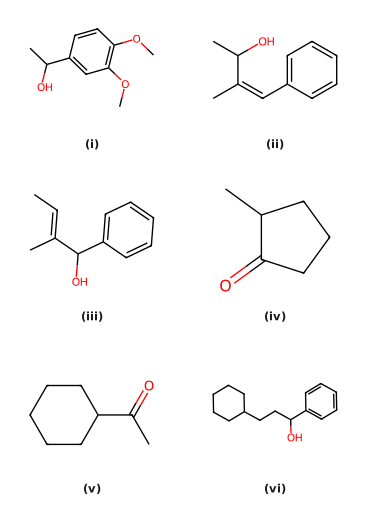
›Reveal solutionSolution
The iodoform test is positive for a CH₃CO- (methyl ketone) group, or a CH₃CH(OH)- (methyl-bearing secondary alcohol) group that oxidises to one. Checking all six structures, only (i), (ii), and (v) carry this pattern — option (C).
The iodoform test detects a methyl ketone (CH₃CO-) directly, or a secondary alcohol of the form CH₃CH(OH)-, which iodine/base first oxidises to a methyl ketone before cleaving it to give yellow CHI₃. The key requirement: the methyl group must sit directly on the carbon bearing the OH (or the carbonyl) — not on a neighbouring carbon.
-
(i) 1-(3,4-dimethoxyphenyl)ethan-1-ol, Ar-CH(OH)-CH₃. The carbinol carbon carries a methyl group directly → CH₃CH(OH)- pattern. Ring substituents (methoxy groups) don't interfere with the test. Positive.
-
(ii) Ph-CH=C(CH₃)-CH(OH)-CH₃. The terminal carbon is -CH(OH)-CH₃ — a methyl directly on the carbinol carbon, regardless of what's further down the chain. Positive.
-
(iii) Ph-CH(OH)-C(CH₃)=CH-CH�3. The carbinol carbon (attached to Ph) is bonded to Ph, OH, H, and the alkene carbon — no methyl group directly on it (the methyl sits on the next carbon, part of the double bond). Negative.
-
(iv) 2-methylcyclopentan-1-one. The carbonyl carbon (C1) is flanked by two ring carbons, not a methyl group; the methyl substituent is on the adjacent C2 (the α-carbon), not on the carbonyl carbon itself — so there is no CH₃CO- unit. Negative. …
-
🎓Unlock everything free for 14 days
- ✓Full step-by-step solutions
- ✓Concept-first explanations
- ✓Methods, shortcuts & mistakes
- ✓PYQ mapping + timed mock tests
Full access for 14 days. No credit card required.