Q.Which alkyl halide from the following pairs would you expect to react more rapidly by an SN2 mechanism? Explain your answer.
Concept understanding — Ambident Nucleophile Reactivity
Ambident Nucleophile Reactivity
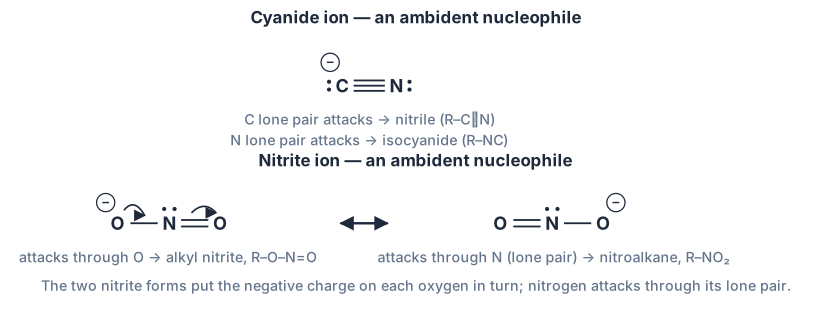
Most nucleophiles attack through a single, obvious atom — a single lone pair, a single reactive site. An ambident nucleophile is unusual: it has TWO different atoms that each carry enough electron density to act as the attacking site, so it can bond to an electrophile through either one, giving two structurally different products from the same reagent.
Why This Happens: Resonance Delocalisation
An ambident nucleophile's negative charge (or lone pair) is delocalised by resonance across more than one atom, so more than one atom is genuinely nucleophilic.
Cyanide ion, CN−: −C≡N:↔:C=N−. Both the carbon and the nitrogen carry real electron density and can attack an electrophile.
- Attack through carbon gives an alkyl cyanide (nitrile), R−C≡N.
- Attack through nitrogen gives an alkyl isocyanide (isonitrile), R−N≡C.
Nitrite ion, NO2−: the negative charge is shared between nitrogen and the oxygens.
- Attack through oxygen gives an alkyl nitrite, R−O−N=O.
- Attack through nitrogen gives a nitroalkane, R−NO2.
What Decides Which End Attacks: The Counter-Ion Matters
For cyanide specifically, the identity of the metal counter-ion changes which end of CN− ends up bonded to the electrophile — this is the classic KCN-vs-AgCN contrast:
- KCN is genuinely ionic: it dissociates fully to give a FREE CN− ion. The carbon end is intrinsically the more nucleophilic site (more polarisable, and it forms the stronger C–C bond with the alkyl carbon), so KCN reacts through carbon, giving the nitrile as the major product.
- AgCN is covalent, with silver bonded to the CARBON of the cyanide group (Ag−C≡N). With the carbon end already occupied by silver, it is the NITROGEN lone pair that is left free to attack the alkyl halide — so AgCN gives the isocyanide as the major product.
A common mistake is to assume silver coordinates to nitrogen (since nitrogen is "more electronegative" or "harder"). It is the opposite: silver bonds to carbon, and it is precisely THAT occupation of the carbon end that forces attack to happen through nitrogen instead.
Whenever a reagent is described as an "ambident nucleophile," first identify the two possible attack sites and draw the resonance structures that put charge on each — then ask what about THIS specific reagent (ionic vs covalent form, hard/soft character of the electrophile, solvent) decides which site actually reacts.
Ambident nucleophile reactivity, as seen with cyanide and nitrite ions, is discussed in the NCERT/CBSE Class 12 Chemistry chapter on Haloalkanes and Haloarenes, and ‘ambident nucleophile cyanide vs isocyanide’ is a commonly searched important-question topic for board exams and JEE Main organic chemistry. Predicting which atom attacks in each case is a reasoning-based question type that also appears in NEET organic chemistry sections.
Why this formula?
Ambident Nucleophile Reactivity: Why the Rules Hold
Ambident nucleophiles are nucleophiles that have two (or more) different atoms capable of donating a lone pair to form a bond with an electrophile. Classic examples include:
- Cyanide ion (CNX−): can attack via carbon or nitrogen
- Nitrite ion (NOX2X−): can attack via oxygen or nitrogen
- Enolate ions: can attack via carbon or oxygen
The key question: Why does one atom react preferentially over the other?
The Core Principle: Hard-Soft Acid-Base (HSAB) Theory
The reactivity of ambident nucleophiles is governed by HSAB theory, which states:
Hard acids prefer hard bases; soft acids prefer soft bases.
Why this holds — the reasoning:
- Hard species are small, highly charged, and non-polarizable. Their interactions are dominated by ionic (electrostatic) forces.
- Soft species are large, polarizable, and have diffuse electron clouds. Their interactions are dominated by covalent (orbital overlap) forces.
For an ambident nucleophile, the two attacking atoms differ in hardness/softness:
| Ambident Nucleophile | Harder Atom | Softer Atom |
|---|---|---|
| CNX− | N (hard) | C (soft) |
| NOX2X− | O (hard) | N (soft) |
| Enolate (CHX2=CH−OX−) | O (hard) | C (soft) |
The Key Formula(e) and Their Derivation
1. Charge Density Rule (for hard-hard interactions)
For a hard electrophile (e.g., HX+, CHX3X+, AlClX3):
The nucleophile attacks via the atom with higher charge density (more negative charge).
Why?
Hard-hard interactions are electrostatic. The force between charges is:
F=r2k⋅q1⋅q2
- q1, q2 = charges on the species
- r = distance between them
A hard electrophile has a localized positive charge. The nucleophile's atom with greater negative charge density (more concentrated charge) exerts a stronger electrostatic attraction. This atom is typically the more electronegative one (e.g., O in enolate, N in cyanide).
Example:
Enolate with CHX3I (hard electrophile) → O-alkylation (harder O attacks)
2. Polarizability Rule (for soft-soft interactions)
For a soft electrophile (e.g., CHX3CHX2I, HgX2+, BrX2):
The nucleophile attacks via the atom with higher polarizability (softer atom).
Why?
Soft-soft interactions are covalent and depend on orbital overlap. The softer atom has:
- Larger, more diffuse orbitals (e.g., 3p vs 2p)
- Lower electronegativity
- Greater polarizability — its electron cloud can distort easily to form a bond
The energy of orbital overlap is approximated by:
ΔE∝energy gap(overlap integral)2
A softer atom has a higher-energy HOMO (closer to the electrophile's LUMO), giving a smaller energy gap and stronger interaction.
Example:
Enolate with CHX3CHX2I (soft electrophile) → C-alkylation (softer C attacks)
The "Why" Behind the Pattern: A Unified Picture
| Electrophile Type | Preferred Attack | Reason |
|---|---|---|
| Hard (small, high charge) | Harder atom (more electronegative) | Electrostatic attraction dominates |
| Soft (large, polarizable) | Softer atom (less electronegative) | Covalent orbital overlap dominates |
The critical insight:
The ambident nucleophile does not have a fixed reactivity — it adapts to the electrophile. This is not a contradiction; it's a consequence of two different bonding mechanisms competing.
Exam-Relevant Summary
| Ambident Nucleophile | Hard Electrophile → Product | Soft Electrophile → Product |
|---|---|---|
| CNX− | R−NC (isocyanide) via N | R−CN (nitrile) via C |
| NOX2X− | R−ONO (nitrite) via O | R−NOX2 (nitro) via N |
| Enolate | R−O (O-alkylation) | R−C (C-alkylation) |
Key takeaway:
The formula is not arbitrary — it follows directly from HSAB theory and the nature of the bonding interaction (electrostatic vs. covalent). Always identify the electrophile's hardness/softness first, then predict the attacking atom.
Concept: Steric Hindrance in SN2 Reactions
The SN2 mechanism involves a backside attack by the nucleophile. The reaction rate is highly sensitive to steric crowding around the electrophilic carbon — more substituents on that carbon slow the reaction dramatically.
Reasoning for each pair:
(i) CH3CH2CH2CH2Br (1° alkyl halide) vs. CH3CH2CH(Br)CH3 (2° alkyl halide).
The primary halide has less steric hindrance at the carbon bearing the leaving group, so it reacts faster.
(ii) CH3CH2CH(Br)CH3 (2°) vs. (CH3)3CBr (3°).
The tertiary halide is extremely hindered; SN2 is essentially impossible here. The secondary halide is much faster.
(iii) Both are 1 degree bromides, but the branching differs. Numbering from the Br-bearing carbon (C1) outward:
CH3CH(CH3)CH2CH2Br: C2 is a plain CH2 (no branch); the methyl branch sits on C3, the gamma-carbon (two carbons away from the reacting centre).
CH3CH2CH(CH3)CH2Br: the methyl branch sits on C2, the beta-carbon -- directly adjacent to the reacting carbon, right in the path of the incoming nucleophile's backside attack.
A beta-branch hinders SN2 far more than a gamma-branch (which is farther from the reaction site), so the compound with the branch on gamma is less hindered and reacts faster.
(i) CH3CH2CH2CH2Br reacts faster;
(ii) CH3CH2CH(Br)CH3 reacts faster;
(iii) CH3CH(CH3)CH2CH2Br reacts faster (its branch is on the farther gamma-carbon, not the crowding beta-carbon).
The SN2 reaction rate depends on steric hindrance around the electrophilic carbon. Less hindered alkyl halides react faster. For (i) 1-bromobutane > 2-bromobutane;
(ii) 2-bromobutane > tert-butyl bromide;
(iii) CH3CH(CH3)CH2CH2Br reacts faster — its methyl branch sits on the farther gamma-carbon, while the other isomer has a beta-branch that crowds the backside attack.
The Core Concept: Why Steric Hindrance Rules SN2
The SN2 mechanism is a one-step, concerted process. The nucleophile attacks the carbon bearing the leaving group from the back side, while the leaving group departs from the front. This means the nucleophile must physically approach the carbon atom.
If that carbon is crowded with bulky groups (like methyl or ethyl substituents), the nucleophile struggles to get close enough to form the transition state. The transition state itself is even more crowded — five groups are partially bonded to the carbon. So the rate of an SN2 reaction is exquisitely sensitive to steric hindrance at the reaction centre.
The order of reactivity for alkyl halides is:
Methyl>Primary>Secondary>Tertiary
Tertiary halides are so hindered that SN2 is essentially impossible — they react by SN1 instead.
Now let's apply this principle to each pair.
(i) CH3CH2CH2CH2Br vs CH3CH2CH(Br)CH3
Step 1: Identify the carbon bearing the bromine.
- In CH3CH2CH2CH2Br, the Br is on a primary carbon (attached to only one other carbon).
- In CH3CH2CH(Br)CH3, the Br is on a secondary carbon (attached to two other carbons).
Step 2: Compare steric hindrance.
The primary carbon has only one alkyl substituent (the rest are hydrogens). The secondary carbon has two alkyl groups — one ethyl and one methyl — which block the back-side approach more severely.
Step 3: Conclusion.
The primary halide will react much faster in SN2.
A common mistake is to think that the longer carbon chain in the primary halide makes it more hindered. But the chain is away from the reaction centre — only the groups directly attached to the electrophilic carbon matter.
Answer for (i): CH3CH2CH2CH2Br (1-bromobutane) reacts faster.
(ii) CH3CH2CH(Br)CH3 vs (CH3)3CBr
Step 1: Classify each halide.
- CH3CH2CH(Br)CH3 is secondary (the Br carbon is attached to two carbons).
- (CH3)3CBr is tertiary (the Br carbon is attached to three carbons).
Step 2: Visualise the steric environment.
The secondary carbon has one ethyl and one methyl group. The tertiary carbon has three methyl groups — a much more crowded "umbrella" around the back side. In fact, the tert-butyl group is so bulky that the nucleophile cannot approach without severe steric clash.
Step 3: Conclusion.
The secondary halide will react faster by SN2; the tertiary halide essentially never uses SN2.
Tertiary halides do undergo substitution, but via SN1 (carbocation mechanism), not SN2. If the question specifically asks for SN2, tertiary halides are always the slowest.
Answer for (ii): CH3CH2CH(Br)CH3 (2-bromobutane) reacts faster.
(iii) CH3CH(CH3)CH2CH2Br vs CH3CH2CH(CH3)CH2Br
Step 1: Number each chain from the Br-bearing carbon (C1) outward.
- First compound, CH3CH(CH3)CH2CH2Br: C1 = CH2Br, C2 = CH2, C3 = CH(CH3), C4 = CH3. The methyl branch sits on C3 — two carbons away from the reacting C1.
- Second compound, CH3CH2CH(CH3)CH2Br: C1 = CH2Br, C2 = CH(CH3), C3 = CH2, C4 = CH3. The methyl branch sits on C2 — directly adjacent (β) to the reacting C1.
Step 2: Compare steric hindrance at the reaction centre.
Both are primary bromides, but the branch's DISTANCE from C1 differs between the two. The second compound's branch on the immediately adjacent β-carbon crowds the backside approach path much more than the first compound's branch, which sits one carbon further away on the γ-carbon and has far less steric effect on attack at C1.
Step 3: Conclusion.
The first compound, CH3CH(CH3)CH2CH2Br, reacts faster by SN2 — its branch is further from the reaction centre and interferes less with the nucleophile's backside approach.
A branch on the carbon DIRECTLY adjacent to the leaving group (the β-carbon) still slows SN2 down, even though the reacting carbon itself remains primary — steric hindrance from a nearby branch is not limited to branches on the reacting carbon itself.
Answer for (iii): CH3CH(CH3)CH2CH2Br reacts faster (its branch is one carbon further from the reaction centre).
- CH3CH2CH2CH2Br reacts faster;
- CH3CH2CH(Br)CH3 reacts faster;
- CH3CH(CH3)CH2CH2Br reacts faster (its methyl branch sits on the farther gamma-carbon, while the other compound's branch sits on the immediately adjacent beta-carbon, which crowds the backside attack much more).
Method: Steric Hindrance Analysis for SN2 Reactivity
Concept: SN2 reactions proceed through a single transition state where the nucleophile attacks from the back side of the carbon–leaving group bond. The rate depends critically on steric accessibility — more substituents on the electrophilic carbon slow the reaction.
Steps
- Identify the electrophilic carbon (the carbon bonded to the leaving group, Br).
- Count the number of alkyl groups attached to that carbon:
- Methyl (0 alkyl groups) → fastest
- Primary (1 alkyl group) → fast
- Secondary (2 alkyl groups) → slow
- Tertiary (3 alkyl groups) → extremely slow (often negligible)
- Compare within each pair — the alkyl halide with fewer substituents on the reacting carbon reacts faster.
(i) CH3CH2CH2CH2Br vs CH3CH2CH(Br)CH3
- First compound: CH3CH2CH2CH2Br — Br is on a primary carbon (1 alkyl group).
- Second compound: CH3CH2CH(Br)CH3 — Br is on a secondary carbon (2 alkyl groups).
Result: The primary alkyl halide (CH3CH2CH2CH2Br) reacts more rapidly.
(ii) CH3CH2CH(Br)CH3 vs (CH3)3CBr
- First compound: CH3CH2CH(Br)CH3 — secondary carbon.
- Second compound: (CH3)3CBr — tertiary carbon (3 alkyl groups).
Result: The secondary alkyl halide (CH3CH2CH(Br)CH3) reacts more rapidly. Tertiary halides are practically unreactive via SN2.
(iii) CH3CH(CH3)CH2CH2Br vs CH3CH2CH(CH3)CH2Br
- First compound: CH3CH(CH3)CH2CH2Br — Br is on a primary carbon (the terminal CH2Br group).
- Second compound: CH3CH2CH(CH3)CH2Br — Br is also on a primary carbon (the CH2Br group).
Both are primary, so we must look deeper: steric hindrance from the β-carbon (the carbon directly next to the reacting carbon) vs the γ-carbon (one carbon further out).
- In the first compound, numbering out from Br: C2 (the β-carbon) is a plain CH2 with no branch; the methyl branch is on C3, the γ-carbon — two carbons from the reaction site.
- In the second compound, the methyl branch sits on C2, the β-carbon — directly adjacent to the carbon bearing Br, right in the path of the nucleophile's backside approach.
Result: A β-branch crowds the backside attack far more than a γ-branch. The first compound (CH3CH(CH3)CH2CH2Br, branch on the farther γ-carbon) is less hindered and reacts more rapidly; the second compound (branch on the closer β-carbon) is slower.
Final Answer Summary
| Pair | Faster Reactant | Reason |
|---|---|---|
| (i) | CH3CH2CH2CH2Br | Primary vs secondary carbon |
| (ii) | CH3CH2CH(Br)CH3 | Secondary vs tertiary carbon |
| (iii) | CH3CH(CH3)CH2CH2Br | Branch is on the farther γ-carbon, not the crowding β-carbon |
Common Mistakes Students Make on SN2 Reactivity Comparisons
Mistake 1: Confusing Substrate Structure with Leaving Group Ability
The error: Students often think "more branched = faster" because they confuse SN2 with SN1 or carbocation stability.
Example from (i):
CH3CH2CH2CH2Br (1° alkyl halide) vs CH3CH2CH(Br)CH3 (2° alkyl halide)
Why it's wrong: SN2 is steric hindrance controlled, not carbocation stability controlled.
- 1° halides have less steric hindrance → faster SN2
- 2° halides have more bulky groups around the carbon → slower SN2
Correct answer for (i):
CH3CH2CH2CH2Br reacts more rapidly because it is a primary alkyl halide with less steric hindrance.
How to avoid:
- Draw the backside attack arrow.
- Count the number of alkyl groups attached to the reacting carbon.
- Rule: SN2 rate: 1° > 2° > 3° (methyl > 1° > 2° > 3°)
Mistake 2: Ignoring the "Methyl vs Primary" Distinction
The error: Students treat methyl and primary halides as equally fast.
Example: Comparing CH3Br (methyl) with CH3CH2Br (primary)
Why it's wrong: Methyl halides have no alkyl groups on the reacting carbon — the backside is completely open. Primary halides have one alkyl group, which creates some steric hindrance.
Correct order:
Methyl > 1° > 2° > 3°
How to avoid:
- Memorise the steric hindrance series
- For exam: "Methyl is fastest, then primary, then secondary, then tertiary (which is essentially unreactive by SN2)"
Mistake 3: Forgetting That Tertiary Halides Are Essentially Unreactive in SN2
The error: Students try to compare tertiary halides as if they could react by SN2.
Example from (ii):
CH3CH2CH(Br)CH3 (2°) vs (CH3)3CBr (3°)
Why it's wrong:
- 3° halides have three bulky alkyl groups blocking the backside
- SN2 requires a direct backside attack — impossible with 3° carbon
- 3° halides react by SN1 or E1, not SN2
Correct answer for (ii):
CH3CH2CH(Br)CH3 reacts more rapidly (in fact, (CH3)3CBr is essentially unreactive by SN2)
How to avoid:
- Rule: If the carbon is tertiary, SN2 is not possible — write "negligible SN2 reactivity"
- For exam: "3° halides do not undergo SN2 reactions"
Mistake 4: Not Distinguishing β-Branching from γ-Branching
The error: Students see that both compounds in (iii) are primary halides with a methyl branch "somewhere on the chain" and assume the branching position doesn't matter, concluding the two react at similar rates.
Example from (iii):
CH3CH(CH3)CH2CH2Br vs CH3CH2CH(CH3)CH2Br
Why it's wrong:
- Both ARE primary (Br is on a CH2 group), but where the branch sits relative to that reacting carbon matters a lot.
- In CH3CH(CH3)CH2CH2Br, the branch is on the γ-carbon (two carbons from Br) — far enough from the backside-attack path to barely matter.
- In CH3CH2CH(CH3)CH2Br, the branch is on the β-carbon (directly adjacent to the Br-bearing carbon) — right in the way of the incoming nucleophile.
Correct answer for (iii):
CH3CH(CH3)CH2CH2Br (branch on γ) reacts faster than CH3CH2CH(CH3)CH2Br (branch on β) — a β-branch is measurably more rate-slowing for SN2 than a γ-branch.
How to avoid:
- Always circle the carbon attached to the leaving group (α), then its immediate neighbour (β), then the next one out (γ).
- A branch ON the β-carbon crowds the backside attack directly; a branch on the γ-carbon is one bond farther away and hinders much less — don't dismiss the difference as negligible.
Mistake 5: Confusing "Ambident Nucleophile" with "Substrate Reactivity"
The error: Students mix up the concept of ambident nucleophiles (like CN⁻, NO₂⁻) with the alkyl halide reactivity question.
Why it's wrong:
- This question is about alkyl halide structure affecting SN2 rate
- Ambident nucleophiles are about nucleophile structure (two possible attacking atoms)
- They are separate topics
How to avoid:
- Read the question carefully: "Which alkyl halide...?"
- If the question mentions ambident nucleophiles, it will explicitly say so
- For this question, focus only on steric hindrance of the alkyl halide
Quick Summary Table for SN2 Reactivity
| Alkyl Halide Type | SN2 Rate | Reason |
|---|---|---|
| Methyl (CH3X) | Fastest | No steric hindrance |
| Primary (1°) | Fast | One alkyl group |
| Secondary (2°) | Slow | Two alkyl groups |
| Tertiary (3°) | Essentially zero | Three alkyl groups block backside |
Final tip for exams:
- Draw the backside attack arrow
- Count alkyl groups on the reacting carbon
- More alkyl groups = slower SN2
- Never compare 3° halides by SN2 — they don't react that way
- AP EAPCET 2026Set eng-2026-05-12-AN1 markMCQQ.What are A and B in the following reaction sequence? C4H9BrASN2C4H9NO2 (major Product) SnHClB (A) AgNO2 ; CH3CH2CH2CH2NH2 (n-butylamine) (B) AgNO2 ; (CH3)3C−NH2 (tert-butylamine) (C) KNO2 ; CH3CH2CH(NH2)CH3 (sec-butylamine) (D) KNO2 ; (CH3)2CHCH2NH2 (isobutylamine)
›Reveal solutionSolution
AgNO2 (covalent silver nitrite) gives the nitroalkane as major product via N-attack in a clean SN2 (no skeletal rearrangement); Sn/HCl then reduces the nitro group to give n-butylamine.
Concept and Intuition
Nitrite, NO2−, is an ambident nucleophile — it can bond to an electrophile through either its nitrogen or one of its oxygens, giving two different constitutional products from the same formal reagent. The identity of the counter-cation changes which end reacts: with the more ionic alkali-metal nitrites (Na/KNO2), the reaction tends toward O-attack, giving alkyl nitrites (esters, R–O–N=O); with the more covalent silver salt AgNO2, the reaction instead proceeds through nitrogen, giving the nitroalkane R–NO2 as the major product — mirroring the well-known KCN (C-attack, nitrile) vs AgCN (N-attack, isocyanide) contrast for cyanide.
Step-by-Step Solution
- The question states the major product's formula as C4H9NO2, i.e. a nitroalkane (R–NO2), not an alkyl nitrite ester — this identifies the reagent needed as AgNO2, which favours N-attack.
- The arrow is explicitly labelled SN2: a clean, single-step backside-attack substitution with inversion at the reacting carbon and, crucially, no carbocation intermediate — so no skeletal rearrangement is possible.
- Taking C4H9Br in its default (straight-chain) reading as n-butyl bromide, SN2 attack by AgNO2 gives 1-nitrobutane, CH3CH2CH2CH2NO2, with the carbon skeleton unchanged.
- Sn/HCl is a standard reducing system for a nitro group to a primary amine (via nitroso and hydroxylamino intermediates, net six-electron reduction): R−NO2Sn/HClR−NH2 — this step does not touch the carbon skeleton at all.
- So B = n-butylamine, CH3CH2CH2CH2NH2.
Common Mistakes
- Picking KNO2 because it "sounds textbook standard" — for this ambident nucleophile, it is specifically the silver salt that gives the nitro compound as major product, the opposite pattern to what many students first guess.
- Choosing a rearranged product like tert-butylamine — that would require a carbocation intermediate (SN1-type), which the explicitly labelled SN2 mechanism rules out.
✓Final answerThe correct option is (A) — A = AgNO2, B = n-butylamine (CH3CH2CH2CH2NH2).
ANSWER: A
- AP EAPCET 2026Set eng-2026-05-13-FN1 markMCQQ.In which of the following set/s, reactant and reagent are correctly matched to get ethyl isonitrile as major product? I. CH3CH2Cl — AgCN II. CH3CHO — NH2OH, (CH3CO)2O III. CH3CH2NH2 — CHCl3/OH−, Δ The correct answer is (A) I , III (B) II , III (C) I only (D) II only
›Reveal solutionSolution
This tests which reagent pairs genuinely give an isonitrile (isocyanide) as the major product. AgCN + alkyl halide (N-attack) and the carbylamine reaction (1° amine + CHCl₃/KOH) both do; the oxime-dehydration route gives a nitrile instead. Answer: I, III.
Concept and Intuition
Isonitriles (R−NC) and nitriles (R−CN) are structural isomers formed from the ambident cyanide ion CN−, which can attack an electrophile through either its carbon end or its nitrogen end. With KCN (essentially ionic), the more nucleophilic and less electronegative carbon end attacks preferentially, giving the nitrile as major product. With AgCN, the compound is largely covalent — silver is bonded to the carbon of CN− (soft–soft Ag–C interaction), which ties up the carbon and leaves the lone pair on nitrogen free to act as the nucleophile. So AgCN + R–X gives the isocyanide as the major product. Separately, the carbylamine reaction — a 1° amine treated with chloroform and alcoholic KOH — is a completely different, classical route to isocyanides: KOH generates the electrophilic carbene :CCl2 from CHCl3, which is attacked by the amine nitrogen's lone pair, and after loss of HCl twice, gives R−NC directly. This reaction is in fact used as a qualitative test for primary amines (the isocyanide has a distinctive foul smell).
Step-by-Step Solution
- Statement I: CH3CH2Cl + AgCN. Because AgCN is covalent (Ag–C≡N), the nitrogen lone pair performs the SN2 attack on the alkyl halide's carbon, displacing Cl−, giving CH3CH2−N≡C (ethyl isocyanide) as the major product. Correctly matched.
- Statement II: CH3CHO + NH2OH gives the oxime CH3−CH=N−OH (a condensation, loss of H2O). Treating the oxime with (CH3CO)2O (a dehydrating agent) eliminates a second water molecule across the C=N–OH system to give the nitrile CH3−C≡N — not the isonitrile. Incorrectly matched for the stated target.
- Statement III: CH3CH2NH2 + CHCl3/OH−,Δ is exactly the carbylamine reaction, giving CH3CH2−NC (ethyl isocyanide) directly. Correctly matched.
- So only I and III correctly produce ethyl isonitrile as the major product.
Common Mistakes
- Confusing KCN (gives nitrile, C-attack) with AgCN (gives isonitrile, N-attack) — students often assume any cyanide salt gives the same product.
- Thinking the oxime pathway (II) also gives an isonitrile just because nitrogen is involved — it actually dehydrates straight to the nitrile, skipping the isocyanide altogether.
✓Final answerThe correct option is (A) — I, III.
ANSWER: A
- AP EAPCET 2026Set eng-2026-05-18-FN1 markMCQQ.Identify the product Y in the following reaction sequence (catalyst; major product) C2H4i) HBrii) AgCNXH2/CatalystY (major product) (A) n-propyl amine (B) Isopropyl amine (C) Ethyl amine (D) Ethyl methyl amine
›Reveal solutionSolution
This tests the AgCN-vs-KCN distinction (isocyanide formation) and the reduction of isocyanides to secondary N-methylamines; the product Y is ethyl methyl amine.
Concept and Intuition
Cyanide salts react with alkyl halides at either the carbon end (giving a nitrile, R-CN) or the nitrogen end (giving an isocyanide/carbylamine, R-NC), and which end attacks depends on the counter-cation. KCN is largely ionic, so the more nucleophilic carbon end of CN− attacks, giving the nitrile. AgCN is more covalent (Ag–C bond character ties up the carbon), forcing the alkyl halide to be attacked through nitrogen, giving the isocyanide. Isocyanides, R−N≡C, are then reduced by H2/catalyst by sequential addition across both the π bonds of the N≡C triple bond, ending in a secondary amine R−NH−CH3 (the terminal carbon becomes a methyl group bonded to N).
Step-by-Step Solution
- C2H4+HBr→CH3CH2Br (simple electrophilic addition of HBr to ethylene; both carbons are equivalent so there's no regiochemistry issue).
- CH3CH2Br+AgCN→CH3CH2−NC (ethyl isocyanide) — this is X. AgCN's covalent Ag–C bond makes the nitrogen end of cyanide the nucleophile, giving the isocyanide rather than the nitrile that KCN would give.
- CH3CH2−NCH2/catalystCH3CH2−NH−CH3 — catalytic hydrogenation reduces the isocyanide's N≡C triple bond fully, converting the terminal carbon (originally the isocyanide carbon) into a CH3 group attached to nitrogen, and giving a secondary amine.
- The product Y is CH3CH2−NH−CH3, i.e. N-ethyl-N-methylamine / ethyl methyl amine, matching option (D).
Common Mistakes
- Using KCN's reaction outcome (nitrile, then reduced to a primary amine with an extra CH2, n-propylamine) instead of recognising that AgCN specifically gives the isocyanide pathway — this is the classic trap (confusing with option A, n-propyl amine).
- Forgetting that reducing an isocyanide gives a secondary amine (with an N-methyl group), not a primary amine.
✓Final answerThe correct option is (D) — Ethyl methyl amine.
ANSWER: D
- AP EAPCET 2026Set ap-2026-05-19-FN1 markMCQQ.Consider the following reaction C2H5Cl+KCN⟶X (major product) X can also be obtained from which of the following reactions? I. C2H5NH2KOH / CHCl3, Δ II. C2H5CONH2Py, Δ III. C2H5CHO(i) NH2OH (ii) (CH3CO)2O Correct answer is (only = only) (A) I, II only (B) II, III only (C) I, III only (D) I, II, III
›Reveal solutionSolution
Ethyl chloride + KCN gives the nitrile C2H5CN; checking each alternative route shows the carbylamine reaction (I) instead gives the isomeric isocyanide, while amide dehydration (II) and aldoxime dehydration (III) both genuinely give the same nitrile.
Concept and Intuition
Cyanide is an ambident nucleophile: with alkyl halides in KCN it attacks through carbon to give a nitrile (R−CN), while the carbylamine (isocyanide) test attacks through nitrogen to give an isocyanide (R−NC) — these are structural isomers, not the same compound. Nitriles can also be made by dehydrating a primary amide (losing water from −CONH2) or by dehydrating an aldoxime (itself made from an aldehyde + hydroxylamine), both of which retain the original carbon count of the starting compound.
Step-by-Step Solution
- C2H5Cl+KCN→C2H5−CN (X = propanenitrile) via C-attack (SN2).
- Route I: C2H5NH2CHCl3/KOH,ΔC2H5NC — this is the carbylamine reaction, producing the isocyanide R−NC, NOT the nitrile R−CN. So I does not give X.
- Route II: C2H5CONH2 on dehydration loses H2O to directly give C2H5CN — same compound as X.
- Route III: C2H5CHONH2OHC2H5CH=NOH (aldoxime) (CH3CO)2O,−H2OC2H5CN — again the same nitrile as X.
- So only II and III genuinely reproduce X; I gives an isomeric but different compound.
Common Mistakes
- Treating the carbylamine product (R−NC) as 'the same as' the nitrile (R−CN) just because they share a molecular formula — they are different functional groups (isocyanide vs nitrile) with different chemistry and different smells/toxicity/reactivity.
✓Final answerThe correct option is (B) — II, III only.
ANSWER: B
- AP EAPCET 2024Set eng-2024-05-18-FN1 markMCQQ.An alkyl halide C3H7Cl, on reaction with a reagent X gave the major product Y (C4H7N). Y on hydrolysis released gas, which turns red litmus to blue. What are X and Y? (A) KCN/C2H5OH, CH3CH2CH2−NC (propyl isocyanide) (B) KCN/C2H5OH, CH3CH2CH2−CN (butanenitrile) (C) AgCN/C2H5OH, CH3CH2CH2−CN (butanenitrile) (D) AgCN/C2H5OH, CH3CH2CH2−NC (propyl isocyanide)
›Reveal solutionSolution
KCN/ethanol attacks alkyl halides mainly through carbon, giving the nitrile as major product; nitrile hydrolysis releases NH3 (turns red litmus blue) — X, Y = KCN/C2H5OH, propyl cyanide, option (B).
Concept and Intuition
Cyanide ion, CN−, is an ambident nucleophile — it can attack through either its carbon or its nitrogen atom, giving two different products from the same alkyl halide:
- R−X+CN−→R−CN (alkyl cyanide/nitrile) — attack through carbon.
- R−X+CN−→R−NC (alkyl isocyanide/carbylamine) — attack through nitrogen.
Which product dominates depends on the counter-ion/solvent:
- KCN (or NaCN) in a polar solvent like ethanol is largely ionic, so the more nucleophilic carbon end of CN− attacks preferentially — nitrile is the major product.
- AgCN is much more covalent (Ag–C bond character), which leaves the nitrogen lone pair more available/nucleophilic — isocyanide is the major product with AgCN.
The two products differ sharply in what their hydrolysis gives:
- Nitrile hydrolysis: R−CN+2H2OH+/OH−RCOOH+NH3 — releases ammonia gas, a colourless pungent gas that turns red litmus blue (basic gas) — matching the clue in the question.
- Isocyanide hydrolysis: R−NC+2H2O→RNH2+HCOOH — releases an amine and formic acid, not free ammonia gas in the same simple sense.
Step-by-Step Solution
- C3H7Cl (n-propyl chloride) + CN− replaces Cl with CN, giving a 4-carbon, 1-nitrogen product C4H7N — consistent with either CH3CH2CH2−CN (nitrile) or CH3CH2CH2−NC (isocyanide); both share the molecular formula C4H7N.
- The clue "Y on hydrolysis released gas which turns red litmus blue" identifies free ammonia, which is released specifically from nitrile hydrolysis.
- So Y must be the nitrile, CH3CH2CH2−CN (butanenitrile/butyronitrile), meaning the reaction favoured carbon-attack.
- Carbon-attack (giving the nitrile as major product) happens with KCN in ethanol (more ionic cyanide source), not with AgCN.
- So X = KCN/C2H5OH, Y = CH3CH2CH2−CN — option (B).
Common Mistakes
- Mixing up which cyanide source (KCN vs AgCN) favours which product — remembering "Ag is more covalent → N attacks" is the key trigger.
- Forgetting that isocyanide hydrolysis does not directly release ammonia gas, so it wouldn't fit the litmus clue.
✓Final answerThe correct option is (B) — X = KCN/C2H5OH, Y = CH3CH2CH2−CN (butanenitrile).
ANSWER: B
- AP EAPCET 2022Set eng-2022-07-05-AN1 markMCQQ.Assertion (A): I-Bromopentane reacts with AgCN to give pentylisocyanide Reason (R): AgCN is mainly ionic in nature (A) A is true R is true and R is correct explanation of A (B) A is true, R is true but R is not correct explanation of A (C) A is true, R is false (D) A is false, R is true
›Reveal solutionSolution
The assertion (isocyanide forms with AgCN) is correct, but the stated reason (that AgCN is ionic) is factually wrong — AgCN is predominantly covalent, and that's the real reason for the isocyanide-selective outcome.
Concept and Intuition
Cyanide is an ambident nucleophile — it can attack an electrophile through either its carbon or its nitrogen lone pair. With ionic KCN/NaCN, the free CN− ion attacks predominantly through carbon (since a C-C bond is more stable than a C-N bond), giving alkyl cyanides (nitriles) as the major product. With AgCN, however, the Ag-C bond is largely covalent, tying up the carbon and leaving the nitrogen lone pair free to act as the nucleophile, giving isocyanides (isonitriles) as the major product.
Step-by-Step Solution
- Evaluate the Assertion: 1-bromopentane reacting with AgCN indeed gives pentyl isocyanide (C5H11−NC) as the major product — this matches known behaviour of AgCN in nucleophilic substitutions, so A is TRUE.
- Evaluate the Reason: the reason claims "AgCN is mainly ionic in nature" — this is factually incorrect. AgCN is predominantly covalent (Ag-CN bond has significant covalent character), which is precisely why the reaction proceeds via nitrogen attack (isocyanide) rather than carbon attack (nitrile). So R is FALSE.
- Since A is true and R is false, the correct combination is option (C).
Common Mistakes
- Assuming the assertion and reason must both be evaluated as "linked," without independently checking the factual correctness of R — R directly contradicts the established explanation (AgCN being covalent, not ionic).
- Confusing the roles: it's KCN/NaCN that are ionic (giving nitriles via C-attack); AgCN's covalent character causes the opposite (N-attack, isocyanide) outcome.
✓Final answerThe correct option is (C) — A is true, R is false.
ANSWER: C
- AP EAPCET 2022Set eng-2022-07-07-AN1 markMCQQ.Hydrolysis of the minor product formed from the reaction of 1-Bromo propane and ethanolic KCN given (A) CH3CH2CH2−NH2 (a straight three-carbon chain ending in −NH2, n-propylamine) (B) CH3CH(NH2)CH3 (a branched three-carbon chain with −NH2 on the middle carbon, isopropylamine) (C) CH3CH2CH2−COOH (a straight three-carbon chain ending in −COOH, butanoic acid) (D) CH3CH(COOH)CH3 (a branched three-carbon chain with −COOH on the middle carbon, isobutyric acid)
›Reveal solutionSolution
The minor product of alkyl halide + ethanolic KCN is the isocyanide (attack via the N end of the ambident CN−); hydrolysing an isocyanide is the classic carbylamine reaction, giving a primary amine and formic acid.
Concept and Intuition
CN− is an ambident nucleophile — it can attack through carbon (giving a nitrile, R−CN) or through nitrogen (giving an isocyanide/isonitrile, R−NC). With the more ionic, aqueous/ethanolic KCN, C-attack (nitrile) dominates as the major product, but some N-attack (isocyanide) also occurs as a minor product. Isocyanides are hydrolysed (acid-catalyzed) to a primary amine plus formic acid — this reaction is in fact used as a diagnostic (carbylamine test) and as a method to convert an alkyl halide into a primary amine with one carbon degradation avoided (unlike nitrile hydrolysis/reduction, which keeps the extra carbon).
Step-by-Step Solution
- 1-Bromopropane + ethanolic KCN → major product: CH3CH2CH2−CN (butanenitrile precursor, C-attack); minor product: CH3CH2CH2−NC (propyl isocyanide, N-attack).
- Hydrolysis of the isocyanide (minor product): CH3CH2CH2−NC+2H2OH+CH3CH2CH2−NH2+HCOOH.
- So the product of hydrolysing the minor product is n-propylamine, CH3CH2CH2−NH2.
Common Mistakes
- Hydrolysing the major product (nitrile) instead, which would give propanoic acid/butanoic acid derivatives, not an amine directly.
- Forgetting that isocyanide hydrolysis loses the extra carbon as formic acid, giving an amine with the SAME number of carbons as the original alkyl halide (not one more, as nitrile hydrolysis would).
✓Final answerThe correct option is (A) — CH3CH2CH2−NH2.
ANSWER: A
🎓Unlock everything free for 14 days
- ✓Full step-by-step solutions
- ✓Concept-first explanations
- ✓Methods, shortcuts & mistakes
- ✓PYQ mapping + timed mock tests
Full access for 14 days. No credit card required.