Q.200 cm3 of an aqueous solution of a protein contains 1.26 g of the protein. The osmotic pressure of such a solution at 300 K is found to be 2.57×10⁻³ bar. Calculate the molar mass of the protein.
🔒You're viewing a preview — the full solution, concept, methods & PYQ mapping are locked.
🔒 Start your 14-day free trial to unlock the full solution →Concept understanding — Osmotic Pressure Molar Mass
Osmotic Pressure and Molar Mass: From Intuition to Formula
Imagine you have a glass of pure water, and you carefully place a tea bag into it. After a while, the water turns brown. The tea molecules have moved from the bag into the water. That's simple diffusion. But now imagine a different setup: you have a U-shaped tube with a special membrane at the bottom that only lets water molecules pass through — not larger molecules like sugar. On one side you put pure water, on the other side you put a sugar solution. What happens?
Water will spontaneously move from the pure water side into the sugar solution side, pushing the liquid level higher on the sugar side. That rising column of liquid is a direct physical effect — it's osmotic pressure trying to equalise concentrations. The taller the column gets, the more hydrostatic pressure it exerts back. Eventually, that back-pressure exactly balances the "pull" of the sugar, and the system stops.
That balancing pressure — the pressure you would need to apply to the solution side to prevent the water from moving — is the osmotic pressure (Π).
The Intuition Behind Molar Mass from Osmotic Pressure
Here's the key insight: the osmotic pressure depends only on the number of solute particles in a given volume of solution, not on what those particles are. A big protein molecule and a tiny sugar molecule, if present in the same number per litre, produce the same osmotic pressure.
This is incredibly useful. If you dissolve an unknown substance (say, a polymer or a protein) in water and measure the osmotic pressure, you can work backwards to find how many moles of it are present. And if you know the mass you dissolved, you can calculate the molar mass:
Molar mass=number of molesmass of solute (g)
So osmotic pressure becomes a direct window into the molecular weight of substances that are too large or too fragile to vaporise (like proteins, polymers, or enzymes).
The Precise Statement
For dilute solutions, osmotic pressure follows a law that looks exactly like the ideal gas law:
ΠV=nRT
where:
- Π = osmotic pressure (in atm or Pa)
- V = volume of solution (in L or m³)
- n = number of moles of solute
- R = ideal gas constant (0.0821 L·atm·mol⁻¹·K⁻¹ or 8.314 J·mol⁻¹·K⁻¹)
- T = absolute temperature (in K)
This is the van't Hoff equation for osmotic pressure. It tells you that osmotic pressure is directly proportional to the molar concentration of the solute:
Π=VnRT=cRT
where c is the molar concentration (mol/L).
From Osmotic Pressure to Molar Mass
If you dissolve a known mass w (in grams) of an unknown substance in a volume V of solvent, and measure the osmotic pressure Π at temperature T, you can find the molar mass M as follows:
- From ΠV=nRT, we get n=RTΠV
- But n=Mw (mass divided by molar mass)
- Equating: Mw=RTΠV
- Rearranging:
M=ΠVwRT
This is the working formula. Every quantity on the right is measurable in the lab.
Why This Method is Special
Osmotic pressure measurements are extraordinarily sensitive. For a substance with a very large molar mass (say, 100,000 g/mol), the freezing point depression or boiling point elevation would be too tiny to measure accurately. But osmotic pressure can still give a measurable reading because it's a colligative property that depends only on particle count, and the effect is large even at low concentrations.
Osmotic pressure is the most sensitive colligative property for determining molar masses of macromolecules. It can detect concentrations as low as 10−4 M, which is 100–1000 times more sensitive than freezing point depression.
A Worked Example
Problem: 0.50 g of a protein is dissolved in enough water to make 100 mL of solution at 25°C. The osmotic pressure is measured as 0.012 atm. Find the molar mass of the protein.
Solution:
Given: …
Why this formula?
Great — let’s build a clear, concept-first understanding of Osmotic Pressure and its link to Molar Mass.
1. What is Osmotic Pressure?
Osmotic pressure (Π) is the minimum pressure that must be applied to a solution to prevent the net flow of solvent into it through a semipermeable membrane.
Think of it as the “push” needed to stop the solvent from diluting the solution.
2. The Key Formula
The central equation is:
Π=iCRT
Where:
- Π = osmotic pressure (atm or Pa)
- i = van’t Hoff factor (number of particles per formula unit)
- C = molar concentration (mol/L or mol/m³)
- R = universal gas constant
- T = absolute temperature (K)
For non-electrolytes (like glucose, urea), i=1, so:
Π=CRT
3. Why does this formula hold? — The Reasoning
Step 1: Analogy to Ideal Gas Law
The van’t Hoff equation for osmotic pressure is structurally identical to the ideal gas law:
PV=nRT⇒P=VnRT=CRT
Why? Because solute particles in a dilute solution behave like gas molecules — they are far apart, move randomly, and exert a “pressure” on the membrane.
- In a gas: particles hit the container walls → pressure.
- In a solution: solute particles cannot cross the membrane, but they collide with it → osmotic pressure.
So, the formula Π=CRT is not a coincidence — it’s a direct analogy.
Step 2: The van’t Hoff Factor i
For electrolytes (e.g., NaCl), one formula unit dissociates into multiple ions:
- NaCl → Na⁺ + Cl⁻ → i=2
- CaCl₂ → Ca²⁺ + 2Cl⁻ → i=3
Each ion acts as an independent particle, so the effective concentration increases by factor i:
Π=iCRT
Step 3: Linking to Molar Mass
We usually know mass of solute (w) and volume of solution (V). Molar concentration is:
C=Vn=Vw/M
where M = molar mass (g/mol).
Substitute into the osmotic pressure equation:
Π=i⋅MVw⋅RT
Rearrange to solve for molar mass:
M=ΠViwRT
This is the key formula used in experiments to find molar mass from osmotic pressure.
4. Why is this method special? …
The key idea is using Osmotic Pressure to determine Molar Mass. Osmotic pressure is a colligative property, particularly useful for finding the molar masses of macromolecules like proteins, as it yields large, easily measurable values even for dilute solutions.
The osmotic pressure (Π) of a dilute solution is given by the van't Hoff equation:
Π=VnRT=MVwRT
Here, w is the mass of the solute, M is its molar mass, V is the volume of the solution in Litres, R is the gas constant, and T is the temperature in Kelvin.
- Rearrange the formula to solve for the molar mass (M): M=ΠVwRT
- Convert the given volume from cm3 to Litres: V=200 cm3=0.200 L
- Substitute the given values. Use R=0.083 L bar K−1 mol−1 — the value NCERT's own Solution uses, consistent with the pressure unit (bar): …
Osmotic pressure is a colligative property used to determine the molar mass of macromolecules like proteins. Applying the van't Hoff equation with the book's R=0.083 L bar K−1mol−1 gives the molar mass of the protein as 61,022 g mol−1 (≈ 6.10×10⁴ g mol−1).
Proteins are large molecules, often referred to as macromolecules. Determining their molar mass is crucial for understanding their structure and function. Traditional colligative properties like elevation in boiling point or depression in freezing point are often not suitable for macromolecules for a few key reasons:
- Small Magnitude: For a given mass concentration, the molar concentration (and thus the colligative effect) is very small due to the large molar mass. This makes the changes in boiling or freezing points difficult to measure accurately.
- Temperature Sensitivity: Proteins are often sensitive to temperature changes and can denature (lose their natural structure and function) at high or low temperatures, making boiling or freezing point measurements impractical.
Osmotic pressure, however, offers a distinct advantage. Even for very dilute solutions of macromolecules, the osmotic pressure can be significant and accurately measurable at physiological temperatures. This makes it the preferred method for determining the molar masses of polymers and proteins.
The relationship between osmotic pressure and molar concentration for dilute solutions is given by the van't Hoff equation, which is analogous to the ideal gas equation:
Π=CRT
Where:
Π is the osmotic pressure
C is the molar concentration (molarity) of the solute
R is the gas constant
T is the temperature in Kelvin
Let's break down the calculation step-by-step.
-
Identify the given information and the target:
- Volume of solution (V) = 200 cm3
- Mass of protein (w) = 1.26 g
- Temperature (T) = 300 K
- Osmotic pressure (Π) = 2.57×10⁻³ bar
- We need to calculate the molar mass of the protein (M).
-
Ensure consistent units:
Since the pressure is given in bar and we will convert volume to litres, we use the gas constant R=0.083 L bar mol−1 K−1 — the value NCERT's own Solution uses throughout this chapter.
- Convert volume from cm3 to Litres: V=200 cm3=200×10−3 L=0.200 L
- All other units are already consistent with the chosen R value.
-
Relate molar concentration to molar mass:
The molar concentration (C) is defined as the number of moles of solute (n) per unit volume of solution (V):
C=Vn
The number of moles (n) can also be expressed as the mass of the solute (w) divided by its molar mass (M):
n=Mw
Substituting this into the expression for C:
C=Vw/M=MVw
-
Substitute the expression for C into the van't Hoff equation:
Π=(MVw)RT
-
Rearrange the equation to solve for molar mass (M):
M=ΠVwRT …
Method: Osmotic Pressure Method for Molar Mass Determination
This method uses the van't Hoff equation for osmotic pressure, which relates the colligative property to the molar concentration of the solute.
Key Formula
π=i⋅C⋅R⋅T
For a non-electrolyte (like a protein), i=1, so:
π=Vn⋅R⋅T=M⋅Vw⋅R⋅T
Where:
- π = osmotic pressure (in bar)
- w = mass of solute (in g)
- M = molar mass (in g/mol)
- V = volume of solution (in L)
- R = gas constant (0.083 L·bar·mol−1·K−1 — the value NCERT uses in this chapter)
- T = temperature (in K)
Step-by-Step Solution
Step 1: Convert volume to litres
V=200cm3=0.200L
Step 2: Rearrange the formula to solve for M
M=π⋅Vw⋅R⋅T
Step 3: Substitute the given values
- w=1.26g
- R=0.083L⋅bar⋅mol−1⋅K−1
- T=300K
- π=2.57×10⁻³bar
- V=0.200L
M=2.57×10−3×0.2001.26×0.083×300
Step 4: Calculate numerator
1.26×0.083×300=31.374
Step 5: Calculate denominator
2.57×10−3×0.200=5.14×10⁻⁴
Step 6: Final calculation
M=5.14×10−431.374≈6.10×10⁴g/mol …
Here are the common mistakes students make on this exact problem, along with how to avoid each one.
Mistake 1: Forgetting to convert volume to litres
The osmotic pressure formula π=iCRT uses concentration C in mol/L. Volume must be in litres, not cm³.
- Wrong: 200cm3 used as 200L or 200mL without conversion.
- Correct: 200cm3=0.200L.
How to avoid: Always write the conversion step:
V=200cm3×1000cm31L=0.200L.
Mistake 2: Using the wrong value of R
The gas constant R must match the units of pressure and volume.
- Given: π=2.57×10⁻³bar, T=300K.
- Wrong: Using R=0.0821L atm mol−1K−1 without converting bar to atm.
- Correct: Use a bar-based R. NCERT's Solution uses R=0.083L bar mol−1K−1 — using the fuller 0.08314 instead shifts the third significant figure of the answer (≈ 6.11×10⁴ vs ≈ 6.10×10⁴), so quote the book's value in exams.
How to avoid:
Check the pressure unit in the question. If it's in bar, use the bar-based R (0.083, as in the textbook).
If it's in atm, use R=0.0821L atm mol−1K−1 and convert pressure first.
Mistake 3: Forgetting the van't Hoff factor i for a non-electrolyte
Proteins in water are non-electrolytes — they do not dissociate.
- Wrong: Assuming i=2 or i=(number of ions).
- Correct: For a protein, i=1.
How to avoid:
Identify the solute type. If it's a non-electrolyte (like protein, sugar, urea), set i=1. Only use i>1 for salts that dissociate.
Mistake 4: Mixing up the formula for molar mass
The correct rearrangement of π=MVwRT (with i=1) is:
M=πVwRT
- Wrong: Writing M=RTVwπ or inverting the fraction.
- Correct: M=2.57×10−3bar×0.200L1.26g×0.083L bar mol−1K−1×300K
How to avoid:
Write the formula step by step:
π=VnRT=MVwRT
Then solve for M: …
Showing the 12 most recent of 21 on this concept.
- AP EAPCET 2026Set eng-2026-05-14-AN1 markMCQQ.At 300 K, a decimolar solution of potassium ferrocyanide is 50% dissociated. The osmotic pressure (in atm) of the solution is (R=0.082 L atm K−1mol−1) (A) 6.83 (B) 3.87 (C) 7.38 (D) 7.83
›Reveal solutionSolution
Potassium ferrocyanide gives 5 ions on complete dissociation; with α=0.5, i=3, giving π=iCRT=7.38 atm.
Concept and Intuition
Osmotic pressure of an electrolyte solution is corrected by the van't Hoff factor i, which accounts for the extra particles produced on dissociation: π=iCRT, where i=1+(n−1)α, n being the number of ions per formula unit and α the degree of dissociation.
K4[Fe(CN)6]⇌4K++[Fe(CN)6]4− gives n=5 ions in total.
Step-by-Step Solution
- n=5 (4 K⁺ + 1 ferrocyanide ion), α=0.5.
- i=1+(5−1)(0.5)=1+2=3.
- C=0.1 M (decimolar), T=300 K, R=0.082 L atm K⁻¹ mol⁻¹.
- π=iCRT=3×0.1×0.082×300. …
- AP EAPCET 2026Set eng-2026-05-15-FN1 markMCQQ.At 27°C, x g of C6H12O6 (molar mass = 180 g mol−1) and y g of a non-volatile, non-electrolyte (molar mass = 92 g mol−1) were present separately in 1.0 L solutions. The osmotic pressure of two solutions is equal. What is x/y? (A) 45/23 (B) 23/45 (C) 32/54 (D) 54/32
›Reveal solutionSolution
Equal osmotic pressure at the same temperature means equal molar concentration; since both solutions occupy the same 1.0 L volume, this reduces to equal moles of solute. The answer is 45/23.
Concept and Intuition
Osmotic pressure of a dilute solution is given by van't Hoff's equation π=CRT, analogous to the ideal gas law, where C is the molar concentration of solute particles. For two non-electrolyte solutes (no dissociation, so van't Hoff factor i=1) at the same temperature, equal osmotic pressures directly imply equal molar concentrations C.
Step-by-Step Solution
- For glucose: C1=1.0x/180=180x mol/L (moles divided by 1.0 L).
- For the other solute: C2=1.0y/92=92y mol/L. …
- AP EAPCET 2025Set eng-2025-05-21-AN1 markMCQQ.A centi molar solution of acetic acid is 50% dissociated at 27°C. The osmotic pressure of the solution (in atm) is (R=0.083 LatmK−1mol−1) (A) 0.37 (B) 3.7 (C) 0.037 (D) 0.73
›Reveal solutionSolution
Applying the van't Hoff factor for a partially dissociated weak electrolyte to the osmotic-pressure formula gives π ≈ 0.37 atm. Answer: (A).
Concept and Intuition
Acetic acid is a weak electrolyte: CH3COOH⇌CH3COO−+H+, dissociating into 2 particles per molecule. Because dissociation is only partial (here 50%), the effective number of particles in solution is more than 1 but less than 2 per formula unit — captured by the van't Hoff factor i=1+α(n−1), which then scales the ideal (undissociated) osmotic pressure formula.
Step-by-Step Solution
- "Centi molar" means C=0.01 mol/L.
- Acetic acid dissociates into n=2 particles (the acetate ion and the proton).
- Degree of dissociation α=0.5 (50%).
- Van't Hoff factor: i=1+α(n−1)=1+0.5(2−1)=1+0.5=1.5.
- Osmotic pressure with the van't Hoff correction: π=iCRT.
- T=27°C=300 K, R=0.083 L atm K⁻¹ mol⁻¹. …
- AP EAPCET 2025Set ap-2025-05-19-AN1 markMCQQ.A 1% (w/v) aqueous solution of a certain solute is isotonic with a 3% (w/v) solution of glucose (molar mass 180 g mol−1). The molar mass of solute (in g mol−1) is (A) 120 (B) 60 (C) 360 (D) 80
›Reveal solutionSolution
Isotonic solutions share the same molar concentration; equating the glucose and solute molarities from their w/v percentages gives molar mass =60 g/mol.
Concept and Intuition
Two solutions are isotonic when they generate the same osmotic pressure at the same temperature, which (for non-electrolytes, same van't Hoff factor) means they have the same molar concentration (π=CRT, and RT is identical for both solutions at the same T).
Step-by-Step Solution
- Glucose solution: 3% w/v means 3 g of glucose per 100 mL, i.e. 30 g per litre. Molar concentration =18030=61 mol/L≈0.1667 M.
- Solute solution: 1% w/v means 1 g per 100 mL, i.e. 10 g per litre. Molar concentration =M10 mol/L, where M is the unknown molar mass. …
- AP EAPCET 2024Set ap-2024-05-16-FN1 markMCQQ.At 27 °C, x g of CaCl2 was dissolved in 2.5 L of water. The osmotic pressure of resultant solution is 0.82 atm. What is x in g? (i=2.5; R=0.082 Latmmol−1K−1) (A) 37 (B) 1.85 (C) 3.7 (D) 18.5
›Reveal solutionSolution
Using the van't Hoff osmotic-pressure equation with the given i, solve for moles of CaCl2, then convert to mass using its molar mass (111 g/mol) → x = 3.7 g.
Concept and Intuition
For an electrolyte solution, the observed osmotic pressure is boosted by the van't Hoff factor i, which accounts for dissociation into multiple particles: π=iCRT=iVnRT.
Step-by-Step Solution
- T=27∘C=300 K.
- Rearranging: n=iRTπV.
- Substitute: n=2.5×0.082×3000.82×2.5.
- The 2.5 (volume) cancels: n=0.082×3000.82=24.60.82=0.03333 mol. …
- AP EAPCET 2024Set eng-2024-05-20-FN1 markMCQQ.[FIGURE] (an osmosis apparatus: a vessel divided by a semi-permeable membrane, SPM, into part-II (with a piston, left) and part-I (with a piston, right) containing sea water) The osmotic pressure of sea water is 1.05 atm. Four experiments were carried as shown in table. In which of the following experiments, pure water can be obtained in part-II of vessel? Table: Expt. No. | Pressure applied in part-I of Vessel | Pressure applied in part-II of Vessel I | 10 atm | - II | - | 10 atm III | 15 atm | - IV | - | 15 atm (A) I, III only (B) II, IV only (C) I, II, III, IV (D) IV only
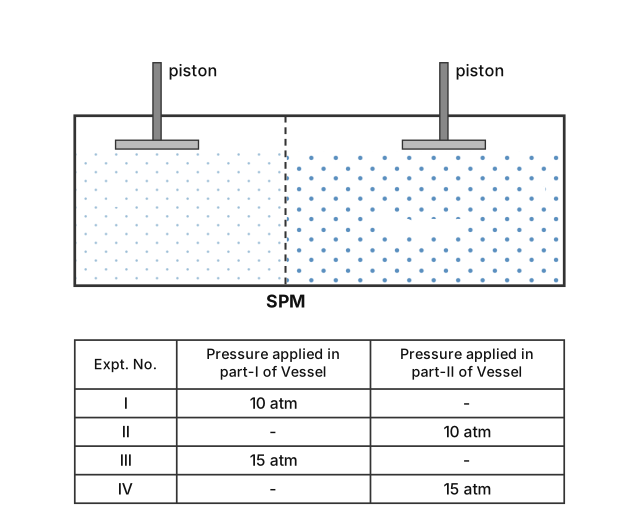
›Reveal solutionSolution
Reverse osmosis requires pressure greater than the solution's osmotic pressure applied on the solution (sea-water) side; only Experiments I and III do this — answer (A).
Concept and Intuition
In normal osmosis, pure solvent moves through a semi-permeable membrane INTO the solution side (to dilute it), driven by the difference in chemical potential. Reverse osmosis flips this: if you apply mechanical pressure exceeding the solution's osmotic pressure directly on the solution side, you force pure solvent to move OUT of the solution and into the pure-solvent side — this is exactly how sea water is desalinated. Applying pressure on the pure water side instead does not achieve this; it would, if anything, drive water from the pure side toward the solution side (enhancing normal osmosis or having no useful effect for extracting pure water into part-II).
Step-by-Step Solution
- Sea water (with π=1.05 atm) sits in part-I; part-II is the side where we want to collect pure water.
- To achieve reverse osmosis (pure water pushed from part-I into part-II across the SPM), the applied pressure must be on part-I (the solution side) and must exceed π=1.05 atm.
- Expt I: 10 atm on part-I — exceeds 1.05 atm and is on the correct (solution) side. ✓ Works. …
- AP EAPCET 2024Set eng-2024-05-21-AN1 markMCQQ.Given below are two statements. Statement I: Liquids A & B form a non-ideal solution with negative deviation. The interactions between A and B are weaker than A-A & B-B interactions. Statement II: In reverse osmosis, the applied pressure must be higher than the osmotic pressure of solution. The correct answer is (A) Both Statement-I and Statement-II are correct (B) Both Statement-I and Statement-II are not correct (C) Statement-I is correct but Statement-II is not correct (D) Statement-I is not correct but Statement-II is correct
›Reveal solutionSolution
Negative deviation needs STRONGER unlike-molecule interactions (Statement I has this backwards), while the reverse osmosis condition (applied pressure > osmotic pressure) is correctly stated in Statement II.
Concept and Intuition
Raoult's law deviations are governed by the relative strength of A–B interactions compared to A–A and B–B interactions. If A–B attractions are stronger (e.g., due to hydrogen bonding, like acetone-chloroform), molecules are held back more than in the ideal case, lowering the escaping tendency and vapour pressure — this is negative deviation. Positive deviation happens when A–B interactions are weaker than the pure-component interactions. For reverse osmosis, in normal osmosis solvent flows from pure solvent into solution across a semipermeable membrane; to reverse this flow (purify the solution, e.g. desalination), you must apply external pressure exceeding the osmotic pressure of the solution.
Step-by-Step Solution
- Evaluate Statement I: it claims A–B interactions are WEAKER than A–A/B–B interactions cause negative deviation. This is the reverse of the truth — weaker A–B interactions actually cause POSITIVE deviation (molecules escape more easily than in the ideal case). So Statement I is incorrect. …
- AP EAPCET 2024Set eng-2024-05-22-AN1 markMCQQ.At 300 K, 6 g of urea was dissolved in 500 mL of water. What is the osmotic pressure (in atm) of resultant solution? (R=0.082 LatmK−1mol−1) (C = 12; N = 14; O = 16; H = 1) (A) 0.492 (B) 2.46 (C) 4.92 (D) 49.2
›Reveal solutionSolution
Osmotic pressure is computed from π=CRT using urea's molar mass (60 g/mol); the answer is 4.92 atm, option (C).
Concept and Intuition
Osmotic pressure is a colligative property — it depends only on the number of solute particles per unit volume of solution, not on their identity. For a non-electrolyte like urea (which does not dissociate), van't Hoff's equation for dilute solutions mirrors the ideal gas law:
πV=nRT⇒π=CRT
where C=n/V is the molar concentration.
Step-by-Step Solution
- Molar mass of urea, CO(NH2)2: C(12)+O(16)+2×N(14)+4×H(1)=12+16+28+4=60 g/mol.
- Moles of urea =606=0.1 mol.
- Volume of solution =500 mL=0.5 L. …
- AP EAPCET 2023Set ap-2023-05-22-AN1 markMCQQ.Which of the following aqueous solution has highest osmotic pressure? (A) 5.85%(VW)NaCl (B) 3.42%(VW)Al2(SO4)3 (C) 6%(VW)Urea (D) 18%(VW)Glucose
›Reveal solutionSolution
Converting each percentage to molarity and multiplying by the van't Hoff factor shows NaCl's solution has the highest effective particle concentration, hence the highest osmotic pressure.
Concept and Intuition
Osmotic pressure is a colligative property: π=iCRT, where i is the van't Hoff factor (number of particles the solute dissociates into) and C is the molar concentration. For electrolytes, you must multiply the molarity by i to get the effective particle concentration that actually determines π.
Step-by-Step Solution
- NaCl: 5.85% (w/v) means 5.85 g per 100 mL =58.5 g/L. Molar mass of NaCl =58.5 g/mol, so C=1 M. NaCl dissociates into 2 ions (Na++Cl−), so i=2. Effective concentration =1×2=2 M.
- Al2(SO4)3: 3.42% (w/v)=34.2 g/L. Molar mass =2(27)+3(96)=342 g/mol, so C=0.1 M. It dissociates into 2Al3++3SO42−=5 ions, so i=5. Effective concentration =0.1×5=0.5 M.
- Urea: 6% (w/v)=60 g/L. Molar mass =60 g/mol, so C=1 M. Urea is a non-electrolyte, i=1. Effective concentration =1 M. …
- AP EAPCET 2023Set ap-2023-05-23-FN1 markMCQQ.34.2% (VW) sucrose (C12H22O11) solution is isotonic with 18% (VW) of unknown solution X. Formula of X is (A) C6H10O4 (B) C6H12O2 (C) C6H12O6 (D) C5H12O5
›Reveal solutionSolution
Isotonic solutions must have equal molar concentrations; matching the given w/V percentages to molarities pins the unknown's molar mass at 180 g/mol, i.e. glucose.
Concept and Intuition
Osmotic pressure (and hence isotonicity) depends on the molar concentration of solute particles, not on mass concentration. Two solutions are isotonic (produce the same osmotic pressure at the same temperature) exactly when they have the same molarity (assuming both are non-electrolytes, van't Hoff factor = 1).
Step-by-Step Solution
- Sucrose solution: 34.2% w/V means 34.2 g of sucrose per 100 mL, i.e. 342 g/L.
- Sucrose's molar mass, C12H22O11, is 12(12)+22(1)+11(16)=144+22+176=342 g/mol.
- Molarity of sucrose solution =342 g/mol342 g/L=1 mol/L.
- For X at 18% w/V =180 g/L to be isotonic (same molarity, 1 mol/L), its molar mass must be 1 mol/L180 g/L=180 g/mol. …
- AP EAPCET 2023Set eng-2023-05-16-FN1 markMCQQ.What is the osmotic pressure (in atm) of 0.02M aqueous glucose solution at 300 K? (R=0.082 L atm mol−1K−1) (A) 0.4921 (B) 0.492 (C) 0.988 (D) 0.9881
›Reveal solutionSolution
Osmotic pressure follows the van't Hoff equation π=CRT — a direct plug-in gives 0.492 atm.
Concept and Intuition
For a dilute non-electrolyte solution, osmotic pressure behaves like an ideal-gas-like law: π=CRT, where C is molar concentration. Glucose is a non-electrolyte (van't Hoff factor i=1), so no correction is needed.
Step-by-Step Solution
- π=CRT=0.02×0.082×300.
- 0.02×0.082=0.00164.
- 0.00164×300=0.492 atm.
Common Mistakes …
- AP EAPCET 2023Set eng-2023-05-17-AN1 markMCQQ.If the osmotic pressure of cane sugar solution is 2.46 atm at 27 °C, then what is the concentration (in mol L−1) of the solution (R=0.0821 L atm mol−1 K−1) (A) 0.1 (B) 0.2 (C) 0.01 (D) 0.02
›Reveal solutionSolution
This tests the van't Hoff osmotic pressure equation for a non-electrolyte solution. Answer: C ≈ 0.1 mol/L.
Concept and Intuition
Osmotic pressure of a dilute non-electrolyte solution follows the van't Hoff equation π=CRT, analogous to the ideal gas law, where C is molar concentration.
Step-by-Step Solution
- Convert temperature: 27°C=300 K.
- Apply π=CRT⇒C=RTπ=0.0821×3002.46.
- Compute denominator: 0.0821×300=24.63.
- C=2.46/24.63≈0.0999≈0.1 mol/L. …
🎓Unlock everything free for 14 days
- ✓Full step-by-step solutions
- ✓Concept-first explanations
- ✓Methods, shortcuts & mistakes
- ✓PYQ mapping + timed mock tests
Full access for 14 days. No credit card required.