Q.45 g of ethylene glycol (C2H6O2) is mixed with 600 g of water. Calculate
Concept understanding — Boiling Point Elevation
Boiling Point Elevation — From Intuition to Precision
Imagine you're cooking pasta. You add salt to the water, and the water takes longer to boil. That's not your imagination — it's a real physical effect. The salt has raised the boiling point of the water. Pure water boils at 100°C at sea level, but salt water needs a slightly higher temperature to boil. That's boiling point elevation in action.
Why does this happen?
To understand why, you need to think about what boiling actually is. Boiling occurs when the vapour pressure of the liquid equals the surrounding atmospheric pressure. Vapour pressure is the pressure exerted by molecules escaping from the liquid surface into the gas phase.
When you dissolve a non-volatile solute (like salt, which doesn't evaporate) in a solvent (like water), something interesting happens at the surface. Some of the surface molecules are now solute particles — they don't escape into the vapour. This means fewer solvent molecules can leave the liquid per second. The result? The vapour pressure of the solution is lower than that of the pure solvent at the same temperature.
Now, to make this reduced vapour pressure equal to the atmospheric pressure (so the liquid can boil), you need to raise the temperature. That extra heat gives the remaining solvent molecules enough energy to overcome the solute's interference and produce the required vapour pressure.
The solute itself doesn't boil away — it stays behind. That's why we call it a non-volatile solute. If the solute were volatile (like alcohol), the story changes.
The precise statement
Boiling point elevation is the increase in the boiling point of a solvent when a non-volatile solute is dissolved in it. The boiling point of the solution is always higher than that of the pure solvent.
The elevation ΔTb is given by:
ΔTb=Tb(solution)−Tb(pure solvent)
And it depends only on the number of solute particles, not on their chemical identity (for dilute solutions). This is a colligative property — a property that depends on the concentration of particles, not their nature.
ΔTb=Kb⋅m
Where:
- ΔTb = boiling point elevation (in °C or K)
- Kb = ebullioscopic constant of the solvent (a fixed value for each solvent)
- m = molality of the solution (moles of solute per kg of solvent)
What is Kb?
The ebullioscopic constant Kb is a property of the pure solvent. It tells you how much the boiling point rises per unit molal concentration. For water, Kb=0.512°C kg mol−1. So a 1 molal aqueous solution (1 mole of solute per kg of water) boils at 100.512°C.
For quick calculations: ΔTb∝m. Double the molality, double the elevation. But this works only for dilute solutions — at high concentrations, interactions between solute particles break the linearity.
What about electrolytes?
If the solute dissociates into ions (like NaCl → Na⁺ + Cl⁻), the number of particles increases. One mole of NaCl gives two moles of particles in solution. So the effective concentration is higher. We account for this using the van't Hoff factor i:
ΔTb=i⋅Kb⋅m
For NaCl, i≈2 (in dilute solutions). For sugar (which doesn't dissociate), i=1.
Never forget the van't Hoff factor for ionic solutes. A common mistake is to treat NaCl as one particle — it's two. That doubles the elevation.
A quick example
You dissolve 58.5 g of NaCl (molar mass = 58.5 g/mol) in 500 g of water. What is the boiling point of the solution? (Kb for water = 0.512 °C kg mol⁻¹)
- Moles of NaCl = 58.5/58.5=1.0 mol
- Molality m=1.0 mol/0.500 kg=2.0 mol/kg
- For NaCl, i=2, so effective molality = 2×2.0=4.0 mol/kg
- ΔTb=0.512×4.0=2.048°C
- Boiling point = 100+2.048=102.048°C
The boiling point elevation depends on the number of particles in solution, not their mass or identity. That's why 1 mole of NaCl raises the boiling point twice as much as 1 mole of sugar.
Why does this matter in exams?
Boiling point elevation is a standard topic in physical chemistry (Class 12 CBSE, JEE, NEET). You'll be asked to:
- Calculate ΔTb given mass of solute, solvent, and Kb
- Compare boiling points of different solutions
- Determine molar mass of an unknown solute using ΔTb
- Apply the van't Hoff factor for electrolytes
The key is to remember: more particles → higher boiling point. Everything else follows from that single idea.
Searches like "boiling point elevation formula chemistry" and "colligative properties class 12 numericals" point directly to the Solutions chapter of the NCERT/CBSE Class 12 Chemistry curriculum. The van't Hoff factor correction for electrolytes in particular is a very common JEE Main and NEET question.
Why this formula?
Boiling Point Elevation: Why the Formula Holds
Let's build this from first principles — understanding the why before the what.
What Happens at the Boiling Point?
At the boiling point, a liquid's vapor pressure equals the external atmospheric pressure. For a pure solvent, this happens at a fixed temperature (e.g., 100°C for water at 1 atm).
When you add a non-volatile solute (like salt or sugar), the solute particles occupy space at the liquid surface, reducing the number of solvent molecules that can escape into vapor. This lowers the vapor pressure of the solution compared to the pure solvent.
The Key Consequence
Since vapor pressure is now lower, the solution must be heated to a higher temperature to make its vapor pressure reach atmospheric pressure again. That's the boiling point elevation.
The Formula and Its Derivation
The boiling point elevation ΔTb is given by:
ΔTb=Kb⋅m
where:
- ΔTb=Tb(solution)−Tb(pure solvent)
- Kb = ebullioscopic constant (depends only on the solvent)
- m = molality of the solution (moles of solute per kg of solvent)
Why Molality and Not Molarity?
Molality is temperature-independent — it doesn't change when the solution is heated. Molarity (moles per liter) changes because volume expands with temperature. Since we're measuring a temperature change, we need a concentration unit that stays fixed.
The Reasoning Behind Kb
The constant Kb comes from thermodynamics. For a dilute solution, the vapor pressure lowering follows Raoult's Law:
Psolution=xsolvent⋅Psolvent0
where xsolvent is the mole fraction of solvent and Psolvent0 is the pure solvent's vapor pressure.
Using the Clausius-Clapeyron equation (which relates vapor pressure to temperature) and Raoult's Law, one can derive:
Kb=1000⋅ΔHvapRTb2
where:
- R = gas constant (8.314 J/mol·K)
- Tb = boiling point of pure solvent (in Kelvin)
- ΔHvap = molar enthalpy of vaporization (J/mol)
- The factor 1000 converts grams to kg (since molality uses kg of solvent)
What This Tells Us
- Kb is a property of the solvent alone — it doesn't depend on the solute.
- Solvents with higher boiling points or lower heats of vaporization have larger Kb values (greater elevation per molal concentration).
Why the Formula is Linear (for Dilute Solutions)
For dilute solutions, the mole fraction of solvent is approximately:
xsolvent≈1−nsolventnsolute
The vapor pressure lowering is proportional to the solute mole fraction. Since molality m∝nsolventnsolute for dilute solutions, the boiling point elevation becomes directly proportional to m.
This linearity breaks down at high concentrations — then we need more complex models.
Exam-Relevant Summary
| Concept | Key Point |
|---|---|
| Cause | Non-volatile solute lowers vapor pressure |
| Effect | Higher temperature needed to boil |
| Formula | ΔTb=Kb⋅m |
| Kb depends on | Solvent only (Tb, ΔHvap) |
| Concentration unit | Molality (temperature-independent) |
| Valid for | Dilute solutions (linear approximation) |
Remember: The formula is not magic — it's a direct consequence of vapor pressure lowering combined with the thermodynamics of phase equilibrium.
Concept: Freezing Point Depression
When a non-volatile solute dissolves in a solvent, the freezing point of the solution drops below that of the pure solvent. The depression is given by ΔTf=Kf⋅m, where Kf is the cryoscopic constant and m is molality.
Step 1. Find the molar mass of ethylene glycol: M=2(12)+6(1)+2(16)=62 g/mol.
Step 2. Calculate moles of solute: n=6245=0.7258 mol.
Step 3. Calculate molality: m=0.60.7258=1.2097≈1.2 mol/kg. NCERT rounds the molality to 1.2 mol kg−1 before the final multiplication, and we follow the book.
Step 4. Apply the formula with Kf=1.86 K kg/mol for water:
ΔTf=1.86×1.2=2.2 K
Step 5. The freezing point of the solution is 273.15 K−2.2 K=270.95 K.
- The freezing point depression is 2.2 K.
- The freezing point of the solution is 270.95 K.
Dissolving a non-volatile solute lowers the freezing point of a solvent by ΔTf=Kf⋅m. For 45 g ethylene glycol in 600 g water, the depression is 2.2 K, so the solution freezes at 270.95 K — exactly the values in NCERT's own Solution.
When you dissolve a non-volatile solute like ethylene glycol in water, the solute particles disrupt the orderly arrangement water molecules need to form ice. This interference means the solution must be cooled below the normal freezing point before it can freeze. The extent of this freezing point depression depends on how many solute particles are present per kilogram of solvent—the molality—and a solvent-specific constant Kf that captures how "sensitive" the solvent is to dissolved particles.
The relationship is beautifully simple:
ΔTf=Kf⋅m
where ΔTf is the freezing point depression (always positive), Kf is the cryoscopic constant (for water, Kf=1.86K kg mol−1), and m is the molality in mol/kg.
Step-by-step solution
1. Find the molar mass of ethylene glycol
Ethylene glycol is C2H6O2. Adding up atomic masses:
M=2(12)+6(1)+2(16)=24+6+32=62g/mol
2. Calculate moles of ethylene glycol
We have 45 g of solute:
n=62g/mol45g=0.7258mol
3. Convert mass of water to kilograms
The solvent mass is 600 g:
mass of water=600g=0.600kg
4. Calculate molality
Molality is moles of solute per kilogram of solvent:
m=0.600kg0.7258mol=1.2097mol/kg≈1.2mol/kg
NCERT's Solution rounds the molality to 1.2mol kg−1 at this point and carries that rounded value forward; we do the same so our final answers match the book's.
5. Apply the freezing point depression formula
Using Kf=1.86K kg mol−1 for water:
ΔTf=1.86K kg mol−1×1.2mol kg−1=2.2K
If you keep the unrounded molality (1.2097 mol kg⁻¹) all the way through, you get ΔTf=2.25 K — the small difference is purely a rounding choice. NCERT rounds the molality first, and its printed answers (2.2 K and 270.95 K) are the ones to quote.
Students often confuse ΔTf (the change in freezing point, always positive) with the new freezing point itself (which is below the pure solvent's freezing point). Keep them distinct.
6. Determine the new freezing point
Pure water freezes at 273.15 K. The solution freezes at:
Tf(solution)=273.15K−2.2K=270.95K
- The freezing point depression is ΔTf=2.2K.
- The freezing point of the solution is 270.95K.
Method: Freezing Point Depression (Cryoscopy)
This is a colligative property problem — the solute particles (ethylene glycol) lower the freezing point based only on how many particles are present, not their identity.
Step 1 — Identify the formula
The freezing point depression is given by:
ΔTf=i⋅Kf⋅m
Where:
- ΔTf = freezing point depression (in K)
- i = van't Hoff factor (for non-electrolytes like ethylene glycol, i=1)
- Kf = cryoscopic constant of the solvent (for water, Kf=1.86K kg mol−1)
- m = molality of the solution (mol solute per kg solvent)
Step 2 — Calculate moles of solute
Molar mass of ethylene glycol (C2H6O2):
2(12)+6(1)+2(16)=24+6+32=62g mol−1
Moles of solute:
moles=62g mol−145g=0.7258mol
Step 3 — Calculate molality
Mass of solvent (water) = 600 g = 0.600 kg
m=0.600kg0.7258mol=1.2097mol kg−1≈1.2mol kg−1
NCERT rounds the molality to 1.2mol kg−1 before the next step — do the same so your answer matches the book's.
Step 4 — Calculate freezing point depression
ΔTf=(1)×(1.86K kg mol−1)×(1.2mol kg−1)=2.2K
(Carrying the unrounded 1.2097 instead gives 2.25 K — a rounding choice only; quote the book's 2.2 K.)
Step 5 — Calculate the freezing point of the solution
Pure water freezes at 273.15K. The solution freezes lower by ΔTf:
Freezing point=273.15K−2.2K
270.95K
Final Answer
| Quantity | Value |
|---|---|
| (a) Freezing point depression | ΔTf=2.2K |
| (b) Freezing point of solution | 270.95K |
Key concept check: Ethylene glycol is a non-electrolyte (i=1), so each molecule contributes one particle. If it were an electrolyte (like NaCl, i=2), the depression would double for the same molality.
Here are the most common mistakes students make when solving freezing point depression problems, using this question as the example.
1. Using the wrong formula (Freezing vs. Boiling)
Mistake:
Students often confuse the formulas for freezing point depression and boiling point elevation. They might use Kb when they need Kf, or forget the sign convention.
Correct approach:
- Freezing point depression:
ΔTf=i⋅Kf⋅m
- Boiling point elevation:
ΔTb=i⋅Kb⋅m
For water:
- Kf=1.86K kg mol−1
- Kb=0.52K kg mol−1
How to avoid:
Write the correct formula before plugging in numbers. Circle whether the problem asks for freezing or boiling.
2. Forgetting the van't Hoff factor (i)
Mistake:
Assuming i=1 for all solutes. Ethylene glycol is a non-electrolyte, so i=1 is correct here — but students often forget to check.
Correct approach:
- Non-electrolyte (sugar, glycol, urea): i=1
- Electrolyte (NaCl, CaCl2): i = number of ions produced
How to avoid:
Always ask: Does this solute dissociate in water? If yes, find i from the dissociation equation.
3. Incorrect molality calculation
Mistake:
Using mass of solvent in grams instead of kilograms, or using mass of solution instead of solvent.
Correct calculation for this example:
- Molar mass of ethylene glycol (C2H6O2):
2(12)+6(1)+2(16)=62g/mol
- Moles of solute:
6245≈0.726mol
- Mass of solvent (water) = 600 g = 0.600 kg
- Molality:
m=0.6000.726≈1.21≈1.2mol/kg
How to avoid:
Convert solvent mass to kg before dividing. Write units at every step.
4. Sign error in final freezing point
Mistake:
Adding ΔTf to the pure solvent's freezing point instead of subtracting.
Correct:
Freezing point of pure water = 273.15K
Depression means the solution freezes lower:
Tf=273.15K−ΔTf
How to avoid:
Remember: Depression = decrease. The new freezing point is always lower than the pure solvent's freezing point.
5. Rounding differently from the intended answer
Mistake:
Mixing rounding conventions mid-way and then wondering why the answer differs from the textbook's.
What happens here:
NCERT rounds the molality to 1.2mol kg−1 before multiplying, giving ΔTf=1.86×1.2=2.2K. If you instead carry the unrounded 1.2097 all the way, you get 2.25 K. Both computations are honest arithmetic — but the book's printed answer is 2.2 K, so state where you rounded.
How to avoid:
Keep 3–4 significant figures in intermediate steps, state clearly when you round, and match the expected answer's precision at the end.
6. Forgetting to state the final answer clearly
Mistake:
Writing only ΔTf when the question asks for both (a) depression and (b) freezing point.
Correct final answer for this problem:
- (a) Freezing point depression:
ΔTf=1×1.86×1.2=2.2K
- (b) Freezing point of solution:
Tf=273.15−2.2=270.95K
How to avoid:
Read the question twice. Label each part of your answer clearly.
Quick checklist to avoid all these mistakes
| Step | What to check |
|---|---|
| 1 | Which colligative property? (Freezing or boiling?) |
| 2 | Is the solute an electrolyte? → Find i |
| 3 | Solvent mass in kg |
| 4 | Molality = moles solute / kg solvent |
| 5 | Use correct Kf or Kb |
| 6 | Sign: freezing = subtract, boiling = add |
| 7 | State where you round; match the book's precision |
Showing the 12 most recent of 21 on this concept.
- AP EAPCET 2026Set eng-2026-05-12-AN1 markMCQQ.The value of Kf (in Kkgmol−1) of a solvent (X) is four times the value of its Kb. 2g of a non-volatile, non-electrolytic solute A is dissolved in 200 g of solvent X. The ΔTb of resultant solution is YK. 4g of A is dissolved in 200 g of X and the ΔTf of resultant solution is ZK. What is the ratio of Y and Z? (Molar mass of A = 100 gmol−1) (A) 1 : 2 (B) 1 : 4 (C) 1 : 8 (D) 1 : 16
›Reveal solutionSolution
Using ΔT=K× molality for both cases and Kf=4Kb, the ratio Y:Z works out to 1:8.
Concept and Intuition
Both elevation of boiling point and depression of freezing point are colligative properties proportional to molality: ΔTb=Kbm and ΔTf=Kfm. Since the same solute A (molar mass 100) is used in the same mass of the same solvent X in both cases, only the mass of solute taken and the relevant constant (Kb vs Kf) differ between the two scenarios.
Step-by-Step Solution
- Case 1 (ΔTb=Y): moles of A =1002=0.02 mol; mass of solvent =0.2 kg. Molality m1=0.20.02=0.1 mol/kg.
Y=Kb×0.1
- Case 2 (ΔTf=Z): moles of A =1004=0.04 mol; mass of solvent =0.2 kg. Molality m2=0.20.04=0.2 mol/kg.
Z=Kf×0.2
- Given Kf=4Kb: Z=4Kb×0.2=0.8Kb
- Ratio: ZY=0.8Kb0.1Kb=81
- So Y:Z=1:8.
Common Mistakes
- Forgetting to convert 200 g to 0.2 kg when computing molality.
- Mixing up which constant (Kb or Kf) applies to which measured quantity (Y uses Kb, Z uses Kf).
✓Final answerThe correct option is (C) — 1 : 8.
ANSWER: C
- AP EAPCET 2026Set eng-2026-05-13-FN1 markMCQQ.An aqueous solution of a non-volatile and non-electrolytic solute boils at 100.5°C. What will be the freezing point of the same solution? (Given Kb=0.512 K kg mol−1 and Kf=1.86 K kg mol−1) (A) −2.816 °C (B) −1.816 °C (C) −0.908 °C (D) −3.632 °C
›Reveal solutionSolution
This tests linking boiling-point elevation to freezing-point depression via a common molality; the freezing point works out to −1.816°C.
Concept and Intuition
For a dilute solution of a non-volatile, non-electrolyte solute, both the elevation in boiling point and the depression in freezing point are colligative properties proportional to the same molality of the solute: ΔTb=Kbm and ΔTf=Kfm. Given one property, we can back out the molality and then predict the other.
Step-by-Step Solution
- Elevation in boiling point: ΔTb=100.5°C−100°C=0.5 K.
- Find molality from ΔTb=Kbm: m=KbΔTb=0.5120.5≈0.9766 molkg−1.
- Find depression in freezing point: ΔTf=Kfm=1.86×0.9766≈1.8164 K.
- Freezing point of the solution =0°C−ΔTf=0−1.816=−1.816°C.
Common Mistakes
- Forgetting the solvent is water (normal freezing point 0°C, normal boiling point 100°C) and mis-setting the reference points.
- Directly equating ΔTb and ΔTf instead of computing molality first and then scaling by Kf.
✓Final answerThe correct option is (B) — −1.816 °C.
ANSWER: B
- AP EAPCET 2026Set eng-2026-05-15-AN1 markMCQQ.The boiling point of 1M aqueous solution of KCl (85% dissociation) having density 1.04 gmL−1 is (Given: Kb(H2O)=0.52 Kkgmol−1, molar mass of KCl=74.5 gmol−1) (A) 100.096°C (B) 100.996°C (C) 100.896°C (D) 100.796°C
›Reveal solutionSolution
This tests boiling-point elevation with a dissociating electrolyte, requiring first converting molarity to molality via the given density. The boiling point comes out to 100.996 °C.
Concept and Intuition
Boiling point elevation depends on molality (not molarity), and for an electrolyte that partially dissociates, the van't Hoff factor i accounts for the actual number of particles in solution.
Step-by-Step Solution
- Take 1 litre (1000 mL) of the 1M KCl solution as the basis. Moles of KCl =1 mol.
- Mass of the whole solution =density×volume=1.04 g/mL×1000 mL=1040 g.
- Mass of solute (KCl) =1 mol×74.5 g/mol=74.5 g.
- Mass of solvent (water) =1040−74.5=965.5 g=0.9655 kg.
- Molality m=kg solventmoles solute=0.96551≈1.0357 molkg−1.
- KCl dissociates as KCl→K++Cl−, so n=2 ions per formula unit. With degree of dissociation α=0.85: van't Hoff factor i=1+α(n−1)=1+0.85(2−1)=1.85.
- Boiling point elevation: ΔTb=iKbm=1.85×0.52×1.0357. Compute: 1.85×0.52=0.962; 0.962×1.0357≈0.9964 K.
- Boiling point =100°C+0.996°C=100.996°C.
Common Mistakes
- Using molarity directly as molality (ignoring the density-based conversion).
- Forgetting to subtract solute mass from solution mass when finding solvent mass.
- Using i=n instead of i=1+α(n−1) for partial dissociation.
✓Final answerThe correct option is (B) — 100.996°C.
ANSWER: B
- AP EAPCET 2026Set eng-2026-05-18-FN1 markMCQQ.At 300 K, x moles of CaCl2 (i=2.5 ; molar mass =111 g mol−1) is dissolved in 2.5 L of water. The osmotic pressure of resultant solution is 0.75 atm. What is ΔTb of solution? (density of water =1 g mL−1 ; Kb=0.52 K kg mol−1 ; R=0.08 L atm mol−1K−1) (A) 0.016 K (B) 0.032 K (C) 0.048 K (D) 0.064 K
›Reveal solutionSolution
Using the osmotic-pressure data to find the molar concentration, then the molality, and finally applying ΔTb=iKbm gives ΔTb≈0.016 K.
Concept and Intuition
Both osmotic pressure and boiling-point elevation are colligative properties that depend on the effective number of particles in solution (captured by the van't Hoff factor i). We first use the osmotic pressure relation π=iCRT to back out the molar concentration C of CaCl2, convert that to molality using the mass of water given, and then apply the boiling-point elevation formula.
Step-by-Step Solution
- From π=iCRT: C=iRTπ=2.5×0.08×3000.75=600.75=0.0125 mol L−1.
- Moles of CaCl2, x=C×V=0.0125×2.5 L=0.03125 mol.
- Mass of water (solvent) =2.5 L×1000 g/L (density=1 g/mL)=2500 g=2.5 kg.
- Molality, m=kg of solventx=2.50.03125=0.0125 mol kg−1.
- ΔTb=iKbm=2.5×0.52×0.0125=0.01625 K≈0.016 K.
Common Mistakes
- Using the volume of the solution as though it were the mass of solvent without checking the density conversion.
- Forgetting to include the van't Hoff factor i in the boiling-point elevation formula after already having used it once for the osmotic-pressure step.
✓Final answerThe correct option is (A) — 0.016 K.
ANSWER: A
- AP EAPCET 2025Set eng-2025-05-23-FN1 markMCQQ.A solution of urea in water has a boiling point of 100.18 °C. What is the freezing point of the same solution, if Kf and Kb of water are 1.86 and 0.52 K kg mol−1, respectively ? (Boiling point of water = 100 °C) (A) −0.34 ∘C (B) −0.22 ∘C (C) −0.64 ∘C (D) −0.32 ∘C
›Reveal solutionSolution
This links two colligative properties (boiling point elevation and freezing point depression) through the common molality of the solution.
Concept and Intuition
Both boiling-point elevation and freezing-point depression are colligative properties proportional to the same molality of solute particles: ΔTb=Kbm and ΔTf=Kfm. Given one, we can find the molality and then use it to get the other.
Step-by-Step Solution
- Boiling point elevation: ΔTb=100.18−100=0.18∘C.
- Molality from ΔTb=Kbm: m=KbΔTb=0.520.18=0.3462 mol/kg.
- Freezing point depression: ΔTf=Kfm=1.86×0.3462=0.6439∘C≈0.64∘C.
- Freezing point of the solution =0∘C−0.64∘C=−0.64∘C.
Common Mistakes
- Using Kf or Kb interchangeably without recomputing molality first.
- Forgetting the sign convention: freezing point is depressed (goes negative), boiling point is elevated (goes above 100 °C).
✓Final answerThe correct option is (C) — −0.64 ∘C.
ANSWER: C
- AP EAPCET 2024Set ap-2024-05-16-FN1 markMCQQ.The molal depression constant of water (Kf) is 1.86 Kkgmol−1. What is the approximate ΔfusH (in kJmol−1) of water if it freezes at 273 K? (A) 3 (B) 6 (C) 9 (D) 12
›Reveal solutionSolution
The cryoscopic-constant formula relates Kf to the solvent's molar mass, freezing point, and molar enthalpy of fusion; solving gives ΔfusH≈6 kJ/mol for water.
Concept and Intuition
The molal depression constant Kf of a solvent is fundamentally derived from its freezing point and its enthalpy of fusion (the energy needed to melt the solid), via the thermodynamic relation:
Kf=1000ΔfusHRTf2M
where M is the solvent's molar mass (g/mol), Tf its freezing point (K), and ΔfusH its molar enthalpy of fusion (J/mol).
Step-by-Step Solution
- Rearranging for ΔfusH: ΔfusH=1000KfRTf2M.
- Substitute R=8.314 Jmol−1K−1, Tf=273 K, M=18 g/mol, Kf=1.86 Kkgmol−1.
- Tf2=74529.
- Numerator: 8.314×74529×18≈1.115×10⁷.
- ΔfusH=1000×1.861.115×107=18601.115×107≈5996 J/mol≈6 kJ/mol.
Common Mistakes
- Forgetting the factor of 1000 (needed since Kf is per kg of solvent while M is in grams).
- Using the wrong molar mass (18 g/mol for water, not 18 kg).
✓Final answerThe correct option is (B) — 6.
ANSWER: B
- AP EAPCET 2024Set eng-2024-05-20-AN1 markMCQQ.A non-volatile solute is dissolved in water. The ΔTb of resultant solution is 0.052 K. What is the freezing point of the solution (in K)? (Kb of water = 0.52 K kg mol−1; Kf of water = 1.86 K kg mol−1; Freezing point of water = 273 K) (A) 272.628 (B) 273.186 (C) 273.000 (D) 272.814
›Reveal solutionSolution
From the boiling-point elevation, the molality is found (0.1 mol/kg), and then the SAME molality is used with Kf to get the freezing-point depression, giving a freezing point of 272.814 K.
Concept and Intuition
Both boiling-point elevation and freezing-point depression are colligative properties governed by the same solution molality — ΔTb = Kb·m and ΔTf = Kf·m. Since molality doesn't change, we can find it from one property and use it to compute the other.
Step-by-Step Solution
- ΔTb = Kb·m → m = ΔTb/Kb = 0.052 / 0.52 = 0.1 mol/kg.
- ΔTf = Kf·m = 1.86 × 0.1 = 0.186 K.
- Freezing point of solution = freezing point of pure water − ΔTf = 273 − 0.186 = 272.814 K.
Common Mistakes
- Adding ΔTf instead of subtracting it — freezing point is DEPRESSED (lowered), not raised.
- Confusing Kb and Kf while computing molality, or reusing ΔTb's numeric value directly as ΔTf.
✓Final answerThe correct option is (D) — the freezing point of the solution is 272.814 K.
ANSWER: D
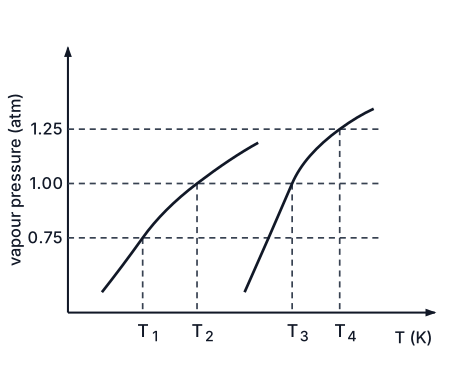
- AP EAPCET 2024Set eng-2024-05-21-AN1 markMCQQ.The following graph is obtained for vapour pressure (in atm) (on y-axis) and T (in K) (on x-axis) for aqueous urea solution and water. What is the boiling point (in K) of urea solution? (Atmospheric pressure = 1 atm) [FIGURE] (two vapour-pressure-vs-temperature curves rising left to right; three horizontal dashed lines at y = 0.75, 1.00 and 1.25 atm intersect the two curves; the resulting four intersection points are projected onto the x-axis at four temperatures labeled, in increasing order, T1,T2,T3,T4) (A) T1 (B) T2 (C) T3 (D) T4
›Reveal solutionSolution
The solution's boiling point is where its vapour-pressure curve meets P=1 atm, which is T3 on the graph (higher than pure water's T2, consistent with boiling point elevation).
Concept and Intuition
A liquid boils at the temperature where its vapour pressure equals the surrounding atmospheric pressure. Dissolving a non-volatile solute (urea) lowers the solution's vapour pressure at any given temperature (Raoult's law), which means the solution's vapour-pressure curve sits to the right of pure water's curve — it needs a HIGHER temperature to reach the same vapour pressure. This is exactly boiling point elevation, ΔTb>0.
Step-by-Step Solution
- Atmospheric pressure is given as 1 atm, so the boiling point of any liquid on this graph is where its curve crosses the horizontal y=1.00 line.
- The problem states the left curve (pure water, lower vapour pressure needed at lower temperature) crosses y=1.00 at T2.
- The right curve (urea solution, shifted to higher temperature for the same vapour pressure due to boiling point elevation) crosses y=1.00 at T3.
- Since we need the boiling point of the UREA SOLUTION specifically, the answer is T3, not T2 (that's water's boiling point) or T1/T4 (which correspond to the y=0.75 and y=1.25 lines, not atmospheric pressure).
Common Mistakes
- Picking T2, mistaking it for the solution's boiling point when it's actually pure water's boiling point.
- Picking T4, which is where the solution curve crosses y=1.25 atm, not the relevant y=1.00 (atmospheric) line.
✓Final answerThe correct option is (C) — T3.
ANSWER: C
- AP EAPCET 2023Set eng-2023-05-16-FN1 markMCQQ.The elevation in the boiling point of aqueous urea solution is 0.104 K. What is its ΔTf (in K) value? (for Water Kb=0.52 K kg mol−1, Kf=1.86 K kg mol−1) (A) 0.0186 (B) 0.186 (C) 0.372 (D) 0.0372
›Reveal solutionSolution
The same molality drives both boiling-point elevation and freezing-point depression; find m from ΔTb, then use it with Kf to get ΔTf.
Concept and Intuition
Both colligative properties depend on the same solution molality m: ΔTb=Kbm and ΔTf=Kfm. Since urea is a non-electrolyte (no dissociation), the molality computed from one property applies directly to the other.
Step-by-Step Solution
- m=KbΔTb=0.520.104=0.2 mol/kg.
- ΔTf=Kf×m=1.86×0.2=0.372 K.
Common Mistakes
- Swapping Kb and Kf values.
- Trying to convert molality to molarity unnecessarily — not needed since both Kb/Kf relations use molality directly.
✓Final answerThe correct option is (C) — 0.372.
ANSWER: C
- AP EAPCET 2023Set eng-2023-05-18-FN1 markMCQQ.What is the boiling point of solution of 0.1m KCl? Kb of water is 0.52 K kg mol−1. (α=100%) (water boil at 373 K) (A) 100.104 K (B) 373.104 K (C) 273.104 K (D) 373.052 K
›Reveal solutionSolution
Since KCl fully dissociates into 2 ions per formula unit (van't Hoff factor i=2), the boiling point elevation is ΔTb=iKbm=0.104 K, giving a boiling point of 373.104 K.
Concept and Intuition
Boiling point elevation is a colligative property that depends on the total number of solute particles in solution, not just the number of formula units dissolved. For an electrolyte like KCl that dissociates completely into K+ and Cl− (α=100%), each mole of KCl produces 2 moles of particles, so the van't Hoff factor i=2 must be included in the elevation formula.
Step-by-Step Solution
- Formula: ΔTb=iKbm.
- Since KCl dissociates completely (α=100%) into 2 ions (K+ + Cl−), i=1+α(n−1)=1+1×(2−1)=2.
- Substitute: ΔTb=2×0.52×0.1=0.104 K.
- New boiling point =Tb∘(water)+ΔTb=373 K+0.104 K=373.104 K.
Common Mistakes
- Forgetting the van't Hoff factor i=2 for a strong 1:1 electrolyte and computing ΔTb as if KCl were a non-electrolyte (which would give only 0.052 K rise).
- Adding the elevation to the wrong reference temperature (e.g., 273 K instead of 373 K for water's normal boiling point).
✓Final answerThe correct option is (B) — 373.104 K.
ANSWER: B
- AP EAPCET 2023Set eng-2023-05-19-FN1 markMCQQ.What is the depression of freezing point, when mole fraction of non-electrolyte solute in aqueous solution is 0.01? (Kf of H2O=1.86 K kg mol−1) (A) 1.246 K (B) 1.380 K (C) 1.528 K (D) 1.043 K
›Reveal solutionSolution
Converting the given mole fraction of solute to molality and applying ΔTf=Kfm gives a freezing-point depression of about 1.043 K.
Concept and Intuition
Freezing point depression depends on molality, not mole fraction directly, so we must first convert. For a solution with total 1 mole (basis), if x2=0.01 is the solute's mole fraction, then n2=0.01 and n1=0.99 (moles of water). Molality is moles of solute per kg of solvent.
Step-by-Step Solution
- Take a basis of 1 total mole: n2=0.01 mol solute, n1=0.99 mol water.
- Mass of water (solvent): 0.99 mol×18 g/mol=17.82 g =0.01782 kg.
- Molality m=mass of solvent in kgn2=0.017820.01≈0.5612 mol/kg.
- ΔTf=Kf×m=1.86×0.5612≈1.044 K, matching the closest option, 1.043 K.
Common Mistakes
- Treating mole fraction as if it were molality directly (skipping the conversion via water's molar mass).
- Using the total moles (solute+solvent) rather than just solvent moles when computing the solvent mass.
✓Final answerThe correct option is (D) — 1.043 K.
ANSWER: D
- AP EAPCET 2022Set eng-2022-07-04-FN1 markMCQQ.At T (K) x g of a non-volatile solid (molar mass 78 g mol−1) when added to 0.5 kg water, lowered its freezing point by 1.0∘C. What is x (in g)? (Kf of water at T(K) = 1.86 K Kg mol−1) (A) 10.48 (B) 20.96 (C) 41.92 (D) 5.24
›Reveal solutionSolution
Freezing-point depression gives the molality directly; converting molality to mass via the given molar mass gives x≈20.96g.
Concept and Intuition
Freezing-point depression is a colligative property: ΔTf=Kf×m, where m is the molality of the solute (moles of solute per kg of solvent) and Kf is the cryoscopic constant of the solvent. Since the solute is non-volatile and (implicitly) a non-electrolyte (no van't Hoff factor mentioned), we use this formula directly.
Step-by-Step Solution
- Given: ΔTf=1.0∘C, Kf=1.86 Kkgmol−1, mass of water =0.5 kg, molar mass of solute M=78 gmol−1.
- Find molality: m=KfΔTf=1.861.0=0.5376 molkg−1.
- Molality is moles of solute per kg solvent, so moles of solute n=m×(mass of water in kg)=0.5376×0.5=0.2688 mol.
- Convert moles to mass using molar mass: x=n×M=0.2688×78=20.96 g.
- This matches option (B).
Common Mistakes
- Forgetting to multiply by the mass of water (0.5 kg, not 1 kg) when converting molality to moles -- this is the most common arithmetic slip here (it would give double the correct value, i.e. 41.92 g, one of the decoy options).
✓Final answerThe correct option is (B) — 20.96.
ANSWER: B
🎓Unlock everything free for 14 days
- ✓Full step-by-step solutions
- ✓Concept-first explanations
- ✓Methods, shortcuts & mistakes
- ✓PYQ mapping + timed mock tests
Full access for 14 days. No credit card required.